
On this page
- Key Takeaways
- What Operational Mechanisms Drive Cost Reductions in Philippine Shared Services?
- How Does Scalability and Flexibility Eliminate Fixed Corporate Overhead?
- Why Is Process Standardization Critical to Capturing Full Offshore Savings?
- What Does Streamlining Shared Services Look Like in Practice?
- How Does PITON-Global Help Enterprises Maximize Savings and Eliminate Sourcing Risk?
- Frequently Asked Questions
BPO services in the Philippines reduce shared services operating costs by 60%–70% through labor arbitrage, structural process standardization, human-in-the-loop AI integration, and capital expenditure avoidance. By shifting multi-region Finance and Accounting, Human Resources, and IT functions to specialized Philippine centers of excellence, enterprise buyers lower cost per transaction while improving compliance, processing speed, and service levels.
Key Takeaways
- Structural labor arbitrage: Capture a 60%–70% reduction in fully loaded operational spend without sacrificing talent quality or technical execution.
- CapEx to OpEx transformation: Eliminate multi-million-dollar internal investments in physical real estate, server infrastructure, enterprise software licenses, and ongoing system maintenance.
- Process standardization, AI integration, and friction reduction: Accelerate unit transaction throughput by combining standardized workflows with agentic AI “Pilot and Wingman” architectures, while strict ISO 27001, SOC 2 Type II, and PCI DSS adherence lowers dispute overhead, late-payment penalties, and compliance fines.
- Turnover-adjusted savings: Mitigate hidden attrition costs by tapping into a mature talent market with significantly higher retention rates than onshore shared service hubs.
What Operational Mechanisms Drive Cost Reductions in Philippine Shared Services?
Sustained cost reduction stems from three mechanisms beyond wage arbitrage: fully loaded cost conversion, which consolidates payroll taxes, benefits, real estate, hardware, and management layers into an all-inclusive $10–$16 hourly seat rate; the Pilot and Wingman AI architecture, which lifts per-FTE processing capacity 40%–60%; and operational footprint consolidation into a single 24/7 hub that eliminates redundant regional management and software.
While direct wage arbitrage provides immediate top-line savings, sustained cost reduction stems from structural operational efficiencies. Philippine BPO providers operate specialized shared services centers that achieve economies of scale impossible for single internal corporate departments to replicate.
Fully Loaded Cost Conversion
Onshore shared service centers incur significant hidden overhead—payroll taxes, medical benefits, commercial real estate, desktop hardware, and local management layers—on top of base salary. Philippine BPO solutions consolidate all of these expenses into an all-inclusive hourly seat rate, typically $10–$16 per hour for specialized back-office roles. The comparison below shows how a $75,000 onshore salary becomes a $110,000 fully loaded cost, against a $28,000 all-inclusive Philippine rate.

Figure 1. Fully loaded cost of an onshore internal FTE ($75,000 base plus benefits, hardware, and overhead) versus a Philippine BPO FTE at an all-inclusive $28,000 (illustrative).
The “Pilot and Wingman” AI Architecture
Modern shared services operations in Manila employ autonomous AI agents—Wingmen—to execute repetitive data retrieval, verification, and system handshakes, while human specialists—Pilots—supervise complex exceptions and approvals. This increases per-FTE processing capacity by 40% to 60%, drastically reducing the headcount required to manage growing transaction volumes.
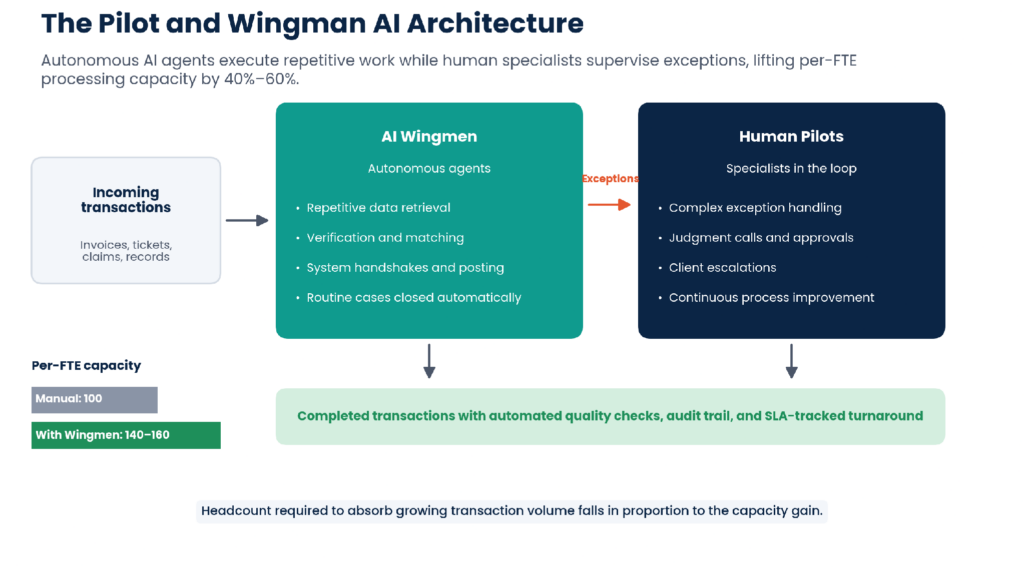
Figure 2. The Pilot and Wingman architecture: AI agents handle repetitive retrieval, verification, and system handshakes while human specialists supervise exceptions, lifting per-FTE capacity 40%–60%.
Operational Footprint Consolidation
Centralizing multi-region back-office functions—global Accounts Payable or IT L2 support, for example—into a single 24/7 delivery hub eliminates redundant regional management teams and disparate software deployments. The table below quantifies the net effect by vertical.
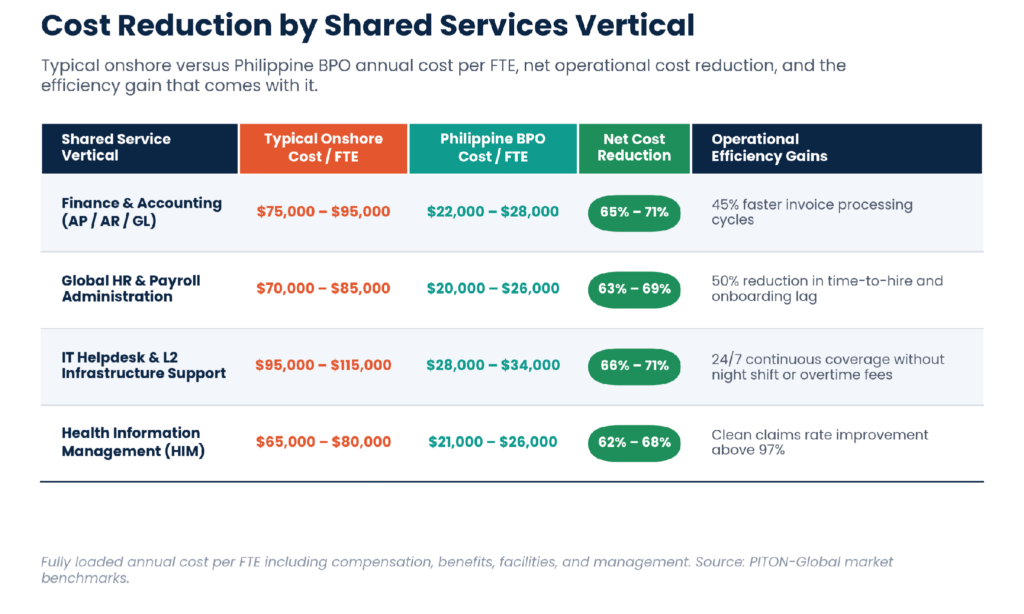
Figure 3. Typical onshore versus Philippine BPO annual cost per FTE, net operational cost reduction, and efficiency gains by shared services vertical.
How Does Scalability and Flexibility Eliminate Fixed Corporate Overhead?
An internal shared services organization carries fixed capital investment that stays constant through volume dips. A Philippine BPO partner converts that CapEx into elastic OpEx: when demand surges for open enrollment or year-end audits, offshore teams scale rapidly without long-term leases or extra software licenses, and when volume contracts, flex-capacity clauses right-size headcount without severe onshore severance obligations.
Maintaining an internal shared services organization requires fixed capital investments that remain constant regardless of market volatility or transaction volume dips. Partnering with a Philippine BPO provider transforms fixed capital expenditure into elastic operational spend.
When demand surges—open enrollment periods for HR, year-end financial audits—offshore teams scale capacity rapidly without forcing the buyer to sign long-term lease commitments or purchase auxiliary software licenses. Conversely, during volume contraction, flex-capacity clauses allow organizations to right-size headcount without absorbing severe onshore severance obligations. The chart below shows the gap that opens between a fixed internal cost base and demand-matched BPO spend over a three-year cycle.
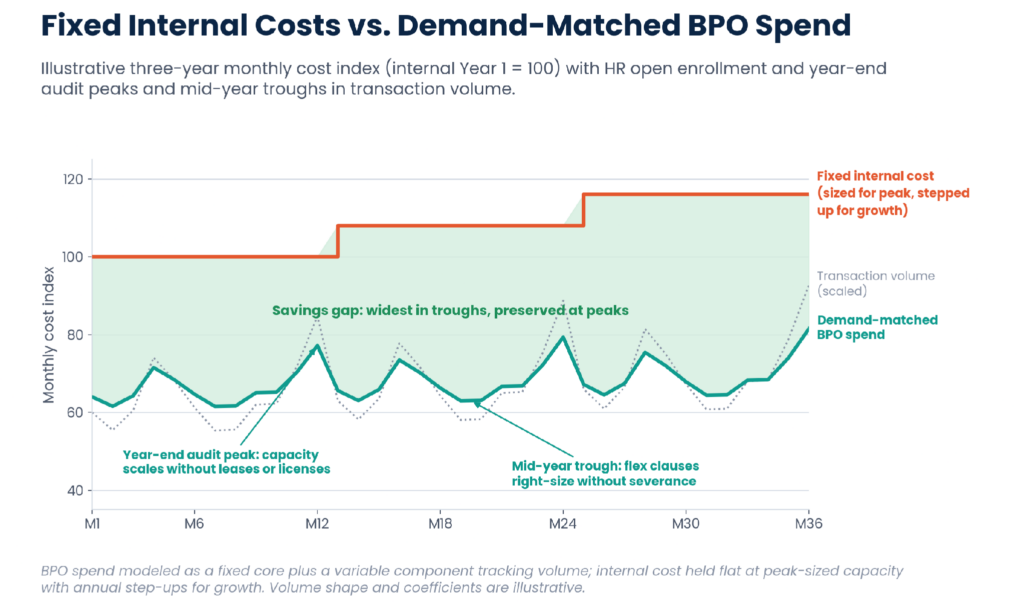
Figure 4. Fixed internal corporate costs versus flexible, demand-matched BPO operating costs over three years, with the gap widening during volume fluctuations (illustrative index).
True cost optimization in shared services isn’t achieved by simply buying cheaper labor—it is achieved by deploying a higher-performing operational architecture. When you combine the deep domain expertise of the Philippine workforce with standardized workflows and human-in-the-loop AI, you eliminate the friction, errors, and churn that inflate onshore operating budgets.
— John Maczynski, CEO, PITON-Global
Why Is Process Standardization Critical to Capturing Full Offshore Savings?
Offshoring an inefficient workflow yields an inefficient offshore operation, so Philippine providers begin engagements with a complete Process Definition Document audit that maps, streamlines, and standardizes workflows before execution. Standardized desktop workflows cut manual data entry errors by up to 80%, and contractual SLAs backed by financial penalties keep processing speed and turnaround times tightly regulated.
A common pitfall for enterprise buyers is migrating broken or unstandardized internal processes to an offshore team. To secure maximum cost reductions, Philippine service providers begin engagements with a complete Process Definition Document audit; by mapping, streamlining, and standardizing workflows prior to execution, they strip away non-value-added administrative steps. Two disciplines then lock the savings in.
Error Elimination
Standardized desktop workflows decrease manual data entry errors by up to 80%, directly cutting the costs associated with invoice disputes, compliance audits, and rework. Every avoided error is a transaction that does not have to be touched twice.
SLA Enforcement
Contractual Service Level Agreements—backed by financial penalties for non-conformance—ensure that transaction processing speed and turnaround times remain tightly regulated. The penalties are rarely invoked; their presence is what keeps the standardized workflow standardized.
What Does Streamlining Shared Services Look Like in Practice?
Streamlining shared services means standardized workflows plus automated quality checks. A mid-sized international logistics provider spending $180,000 a month on processing, with a 30-day receivables backlog and frequent data entry errors, deployed a 35-FTE Manila back-office team for freight auditing, AP, AR, and billing, cutting operating costs 64%, clearing the backlog within 60 days, and reducing billing errors below 0.5%.
Client Challenge
A mid-sized international logistics provider struggled with $180,000 in monthly processing costs, a 30-day backlog in accounts receivable, and frequent data entry errors caused by an understaffed onshore back-office team.
Vendor Selection
PITON-Global conducted an operational review and matched the logistics provider with a top-tier mid-sized Philippine BPO partner specializing in supply chain finance and accounting workflows.
Solution Implemented
A dedicated 35-FTE back-office team was established in Manila to handle freight auditing, accounts payable, accounts receivable, and customer billing using real-time desktop automation tools, following a Process Definition Document audit that standardized each workflow before go-live.
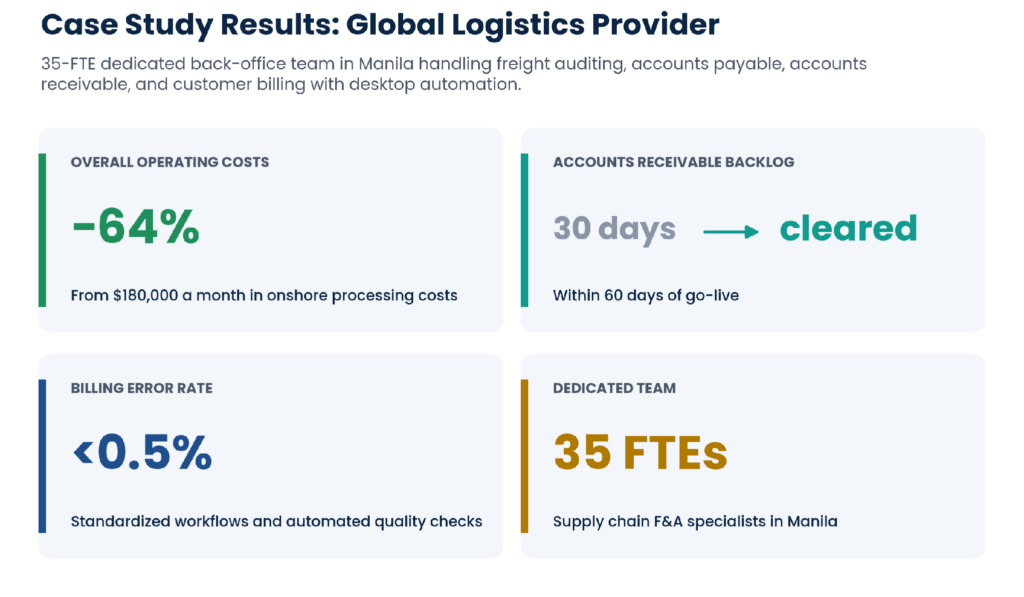
Figure 5. Quantifiable outcomes of the logistics provider’s back-office shared services migration.
Outcomes and Lessons
The enterprise achieved a 64% reduction in overall operating costs, cleared the 30-day accounts receivable backlog within 60 days, and reduced billing error rates to under 0.5%. The lesson: partnering with a specialized provider that implements standardized workflows and automated quality checks delivers immediate cash-flow recovery that far exceeds baseline labor savings.
How Does PITON-Global Help Enterprises Maximize Savings and Eliminate Sourcing Risk?
With more than 1,000 BPO companies in the Philippines, selecting the wrong partner means delayed migrations, poor service delivery, and cost overruns. PITON-Global is an independent BPO advisory and sourcing consultancy that provides vendor-neutral guidance through partner evaluation and selection, evaluating candidates from a network of more than 100 vetted partners on objective operational data, security compliance, and domain expertise.
Who Is PITON-Global?
PITON-Global is an independent, vendor-neutral BPO advisory and sourcing consultancy headquartered in Manila, led by senior industry operators with decades of hands-on experience and more than 65 combined years of global outsourcing governance. It guides enterprise buyers through partner evaluation and selection in a market of more than 1,000 providers.
How Does PITON-Global Differ from Traditional Outsourcing Brokers?
Traditional outsourcing brokers push preferred vendors and earn commissions on placement. PITON-Global provides vendor-neutral advisory led by senior operators, evaluates candidate providers on objective operational data, security compliance, and domain expertise, recommends on the buyer’s operational and financial interests rather than provider promotion, and stays engaged through SLA architecture and contract execution.
How Does PITON-Global’s Network of 100+ Vetted Philippine BPO Providers Benefit Organizations?
A network of more than 100 vetted Philippine BPO partners, assessed on operational data, certifications, and domain depth in finance, HR, IT, and health information management, lets buyers skip the open market. Because the standardization discipline and AI architecture described in this article are provider capabilities, the network is screened for them.
How Does PITON-Global’s Advisory-Led Vendor Matching Process Work?
PITON-Global’s vendor vetting framework runs in five steps: a requirement audit of functions, volumes, systems, and compliance obligations; candidate shortlisting from the vetted network; a competitive RFP with fully loaded cost benchmarking; SLA architecture covering accuracy, turnaround, and security; and contract execution with flex-capacity and transition terms.
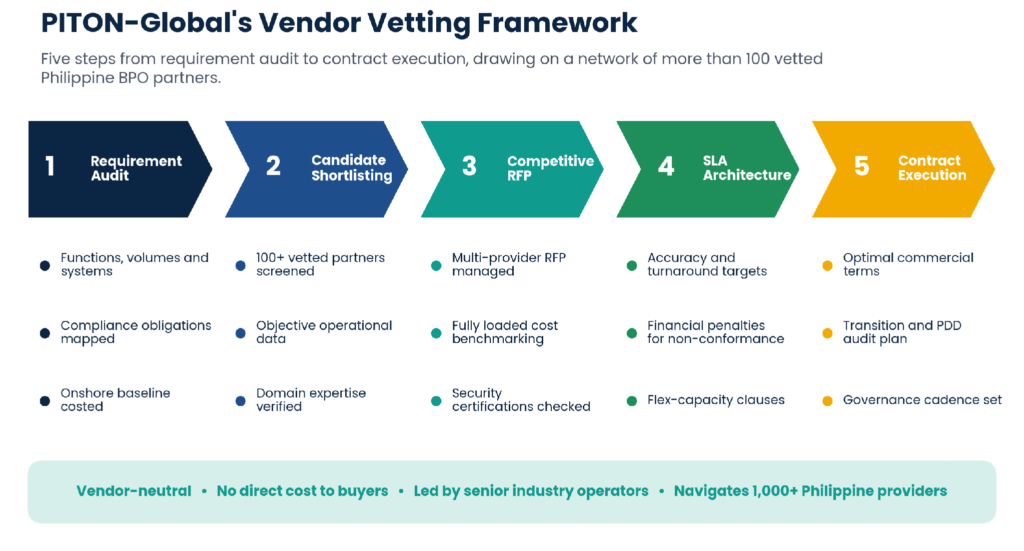
Figure 6. PITON-Global’s vendor vetting framework: requirement audit, candidate shortlisting, competitive RFP, SLA architecture, and contract execution.
Why Do Organizations Use PITON-Global?
Organizations use PITON-Global to secure optimal commercial terms, robust SLAs, and long-term cost reduction without corporate sourcing risk. Its advisory and vendor-matching services carry no direct cost to enterprise buyers, and the firm remains completely vendor-agnostic, advocating exclusively for the buyer’s operational and financial interests.
Frequently Asked Questions
What shared services functions yield the fastest cost reduction when outsourced to the Philippines?
Transactional Finance and Accounting, such as Accounts Payable and Accounts Receivable processing, and L1/L2 IT Helpdesk functions yield the fastest cost reductions. Standardized workflows in these areas allow rapid migration, typically achieving positive financial ROI within 60 to 90 days.
How do Philippine BPO providers protect sensitive corporate financial and HR data?
Leading Philippine providers maintain strict international security certifications, including SOC 1/2/3, ISO 27001, PCI DSS, and HIPAA compliance. Operations are conducted in secure, clean-desk environments with encrypted VPN tunnels, multi-factor authentication, and strict data loss prevention software.
Will outsourcing shared services to the Philippines compromise service quality?
No. Quality typically improves because offshore BPO teams treat back-office processing as their core competency rather than an administrative burden. Philippine providers operate under strict SLA benchmarks, continuous quality assurance monitoring, and specialized training programs.
What is the typical transition timeline for migrating shared services to a Philippine BPO?
A standard migration takes between 6 and 12 weeks, depending on program complexity and team size. This includes process mapping, system access integration, train-the-trainer sessions, shadow operations, and final sign-off.
How does PITON-Global charge for its vendor-neutral advisory services?
PITON-Global’s advisory and vendor-matching services are provided at no direct cost to enterprise buyers. The firm operates through standard industry advisory structures while remaining completely vendor-agnostic to advocate exclusively for the buyer’s operational and financial interests.