

Healthcare BPO companies in the Philippines mitigate rising labor costs through a three-tier architecture that integrates agentic AI with specialized clinical talent. By automating the bulk of routine interactions and shifting specialized workflows to lower-cost provincial hubs, providers neutralize domestic wage inflation while preserving a wide total-cost-of-ownership advantage over in-house US operations—a pattern visible in how offshore healthcare delivery teams are structured for US providers.
Key Takeaways
- Three-tier architecture: High-performing vendors use autonomous AI for routine inquiries, reserving specialized human-in-the-loop oversight for complex clinical workflows and compliance.
- Geographic labor arbitrage: Shifting voice and non-voice operations from Metro Manila to emerging provincial hubs cuts baseline salary expense materially.
- Outcome-based pricing: Top providers are moving from hourly billing to transaction- or value-based structures, aligning vendor revenue with clean-claim metrics and resolved cases.
- Stable total cost of ownership: Despite steady annual salary-budget increases, the total cost differential remains heavily in favor of Philippine deployment.
How Does the Three-Tier Delivery Model Neutralize Wage Pressures?
By abandoning linear headcount scaling. A technology-enabled framework routes work by complexity: autonomous AI handles the bulk of routine volume, AI-augmented specialists handle complex RCM, and licensed clinicians handle the small slice of high-risk work—so processing capacity scales without proportional headcount growth.
To absorb rising labor costs without eroding enterprise margins, top-tier providers have abandoned traditional linear headcount scaling and deployed a structured, technology-enabled operational framework. This architecture divides tasks by complexity, shifting repetitive processes to automated systems and reserving human capital for high-value execution, as the model below shows.
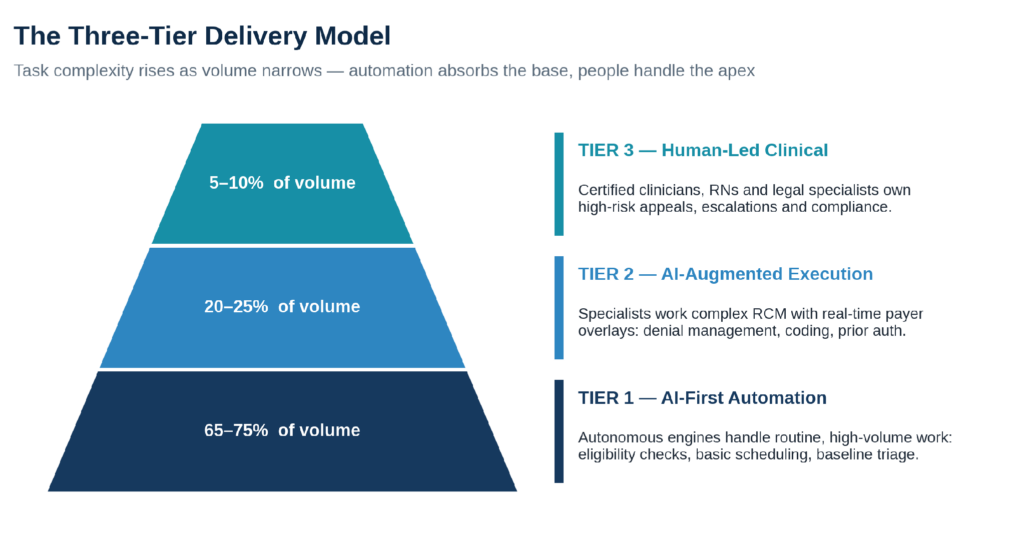
Figure 1 — The three-tier delivery model: AI-first automation at the base, AI-augmented execution in the middle, and human-led clinical work at the apex.
The Healthcare BPO Operational Hierarchy
- Tier 1 — AI-first automation (the majority of volume): Autonomous engines handle routine, high-volume transactional workloads: standard eligibility checks, basic appointment scheduling, and automated triage of baseline patient inquiries.
- Tier 2 — AI-augmented human execution (the complex middle): Specialists process complex RCM—denial management, complex coding, prior authorizations—using real-time data overlays that surface payer context and shorten transaction times.
- Tier 3 — human-led clinical and compliance (the high-risk apex): Certified clinicians, registered nurses, and legal specialists manage high-risk appeals, sensitive escalations, and regulatory compliance.
By handling the vast majority of transactional volume through automated workflows, providers scale processing capacity without a corresponding increase in headcount—largely insulating enterprise buyers from domestic salary adjustments.
What Strategic Cost Benchmarks and Geographic Differences Dictate Vendor Selection?
Operational expense varies sharply between Metro Manila and emerging provincial clusters. Provincial deployments in Davao, Iloilo, and Bacolod deliver meaningful savings—larger still for specialized technical roles—so placing workloads by geographic wage differential is a primary cost-management lever.
Operational expenses vary significantly between established economic zones in Metro Manila and emerging provincial talent clusters. Organizations can optimize cost structures by strategically placing workloads according to geographic wage differentials, as the benchmark below illustrates.
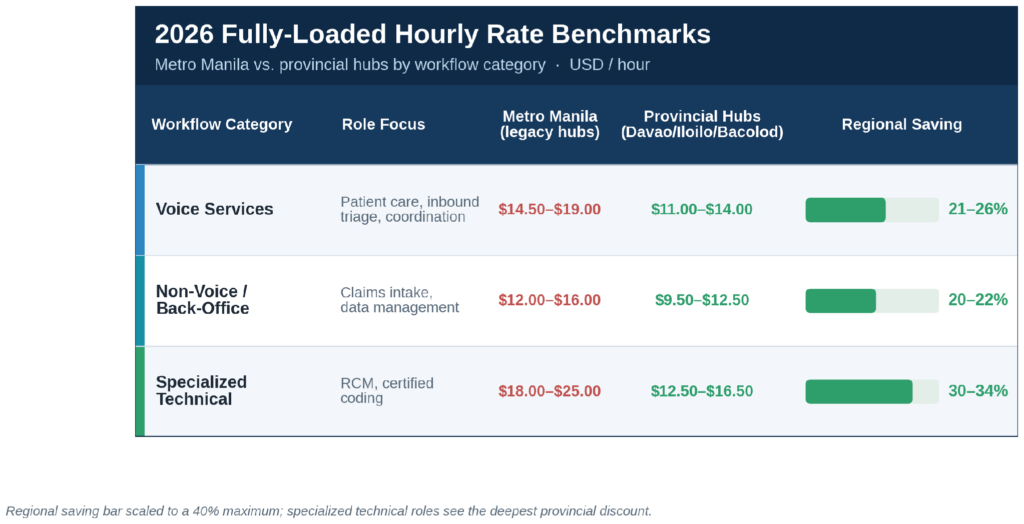
Figure 2 — 2026 fully-loaded hourly rate benchmarks, Metro Manila versus provincial hubs, by workflow category.
While Metro Manila retains the highest density of enterprise infrastructure, provincial deployments in cities like Davao, Iloilo, and Bacolod offer meaningful savings over metro rates. For complex programs requiring licensed nursing credentials or certified medical coders, decentralized talent recruitment serves as a primary tool to manage rising compensation demands.
What Are the Operational Risks and Trade-offs of Outcome-Based Contract Models?
Outcome-based pricing ties billing to validated production—a rate per clean claim or per resolved case—shifting wage-inflation risk to the vendor and giving buyers cost predictability. The trade-off is heavier tracking and quality control: poorly structured parameters can push vendors to prioritize volume over precision, raising denials or compliance risk.
To combat rising internal overhead, many progressive providers offer transactional or outcome-based pricing frameworks that shift financial risk away from fixed hourly inputs and tie billing to measurable production benchmarks.
The Financial Incentive
Buyers pay strictly for validated outcomes—a set rate per clean claim submitted or a flat fee per resolved case. The vendor uses internal technical optimization to drive down delivery costs, capturing the efficiency gains as margin while providing cost predictability to the client—the value-over-arbitrage logic also explored in our piece on value engineering beyond cost savings.
The Operational Trade-offs
While outcome-based pricing protects buyers from wage inflation, it introduces significant tracking and quality-control demands. If performance parameters are structured poorly, vendors may prioritize volume over precision—which in revenue cycle management can lead to missed documentation steps, higher denial rates, or data-compliance issues.
The mistake corporate buyers make is chasing the lowest hourly rate in an inflationary market. A cut-rate provider will compensate for rising wages by diluting their management layer and compromising data oversight. True cost mitigation is achieved by partnering with boutique operators who bundle technology infrastructure into an outcome-linked pricing agreement, protecting your margins while preserving clinical quality.
— John Maczynski, CEO, PITON-Global
What Does This Look Like in a Real Engagement?
A mid-sized US health system facing a steep rise in its administrative expense ratio deployed a 35-seat tier-2 hybrid team—automation for routine eligibility checks plus AI-assisted denial management. Within nine months it sharply cut administrative labor expense, lifted first-pass resolution substantially, and fully absorbed local wage increases through software efficiencies.
Client Challenge
A mid-sized US health system faced an unsustainable surge in its administrative expense ratio, driven by domestic staffing shortages and escalating specialized labor costs.
Vendor Selection Process
Using a data-driven advisory framework, the health system evaluated multiple Philippine-based boutique operators, filtering for verified data-compliance controls and specialized medical-coding capabilities.
Solution Implemented
The health system deployed a 35-seat dedicated team in a tier-two provincial hub using a hybrid operational model: autonomous automation for routine eligibility checks, alongside AI-assisted workflows for complex denial management. The outcomes are summarized below.
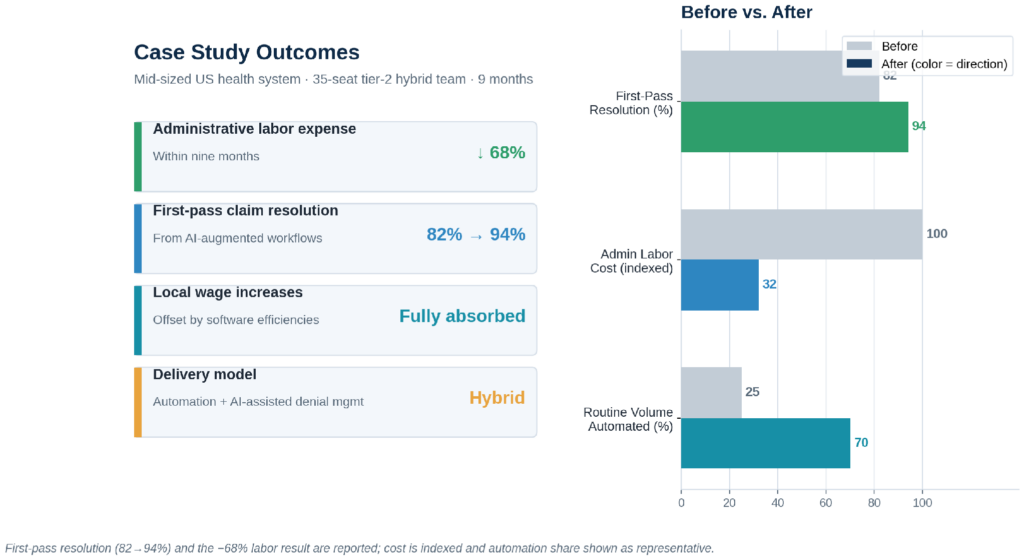
Figure 3 — Quantifiable business outcomes within nine months of deploying the hybrid tier-2 team.
Tying vendor accountability to performance metrics rather than simple headcount scale shields enterprise buyers from localized labor adjustments and improves end-to-end operational quality.
How Should Enterprise Buyers Evaluate Providers?
Buyers should audit a vendor’s operational health on four fronts: automation maturity (share of volume automated), geographic diversity (metro plus provincial mix), talent-retention strategy, and outcome-aligned pricing with verified compliance. The goal is a partner that scales through technology, not headcount.
When evaluating potential outsourcing partners, enterprise buyers must analyze the vendor’s internal operational health and account for the cost categories buyers most often overlook. The framework below captures the checks that confirm long-term cost stability.
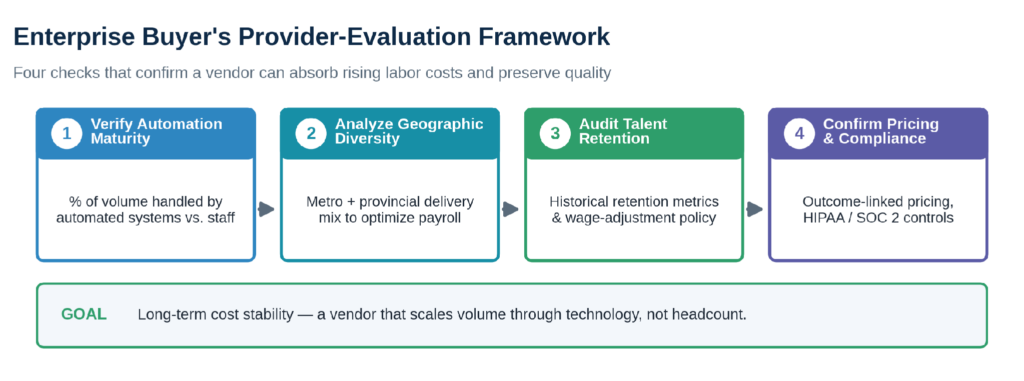
Figure 4 — A four-step provider-evaluation framework for confirming a vendor can absorb rising labor costs while preserving quality.
- Verify automation maturity: Request documentation of what percentage of transactional volume is handled by automated systems versus human staff.
- Analyze geographic diversity: Determine whether the vendor can distribute workflows across metropolitan and provincial delivery centers to optimize payroll structures.
- Audit talent-retention strategies: Review historical retention metrics and wage-adjustment policies to confirm the vendor can maintain team continuity amid local labor shifts; our guide to judging labor cost stability expands on these checks.
How Does PITON-Global Mitigate Operational Risk?
PITON-Global is an agile BPO advisory and outsourcing consultancy—not a transactional broker—that guides mid-market and enterprise organizations through the Philippine market. Its advisory-led matching connects buyers with specialized boutique providers from a network of 100+ vetted operators with the technology integration needed to absorb rising labor expense.
PITON-Global assists mid-market and enterprise organizations in navigating the complex Philippine outsourcing landscape. Unlike traditional brokers that rely on transactional volume, it operates as a long-term strategic guide, maintaining an extensive network of more than 100 heavily vetted call-center and back-office providers across the Philippines.
Organizations use PITON-Global’s advisory-led vendor-matching process to eliminate selection bias, mitigate operational risk, and accelerate implementation timelines. By analyzing an enterprise’s specific clinical, technical, and budgetary needs, PITON-Global connects buyers with highly specialized boutique providers that possess the infrastructure and technology integration necessary to absorb rising labor expenses.
Frequently Asked Questions
How do mid-tier Philippine BPO providers absorb local salary increases without raising client rates?
Providers offset rising compensation by deploying internal automation to streamline high-volume, repetitive processes. This lets them handle more transactional volume per human employee, increasing efficiency to protect client pricing structures.
What is the typical annual salary adjustment rate within the Philippine outsourcing market?
Recent industry benchmarks indicate modest, steady annual salary-budget increases across the sector—structurally predictable when contrasted with the sharper compensation spikes seen in domestic US markets.
Are data compliance and security protocols impacted when vendors move to provincial areas?
No. Leading provincial centers maintain identical data-security frameworks, redundant infrastructure, and compliance profiles to facilities in metropolitan capital regions.
What structural issues occur when choosing a provider based solely on lowest hourly cost?
Budget-focused operators often manage rising labor costs by reducing managerial oversight, limiting professional development, and employing fewer quality-assurance staff—frequently resulting in higher error rates, compliance gaps, and dropped communication volumes.
How are currency exchange fluctuations handled in modern offshore service agreements?
The majority of professional agreements are denominated in US dollars, offering budget predictability for international buyers, with underlying currency differences managed directly by the local provider.