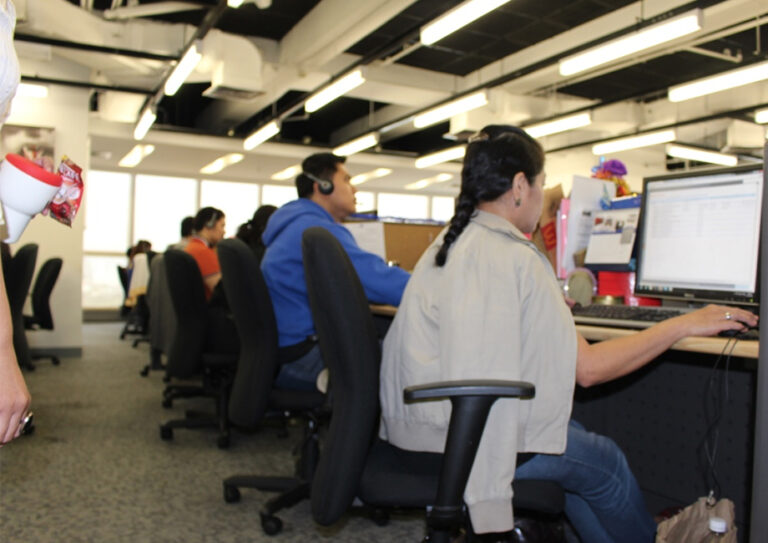

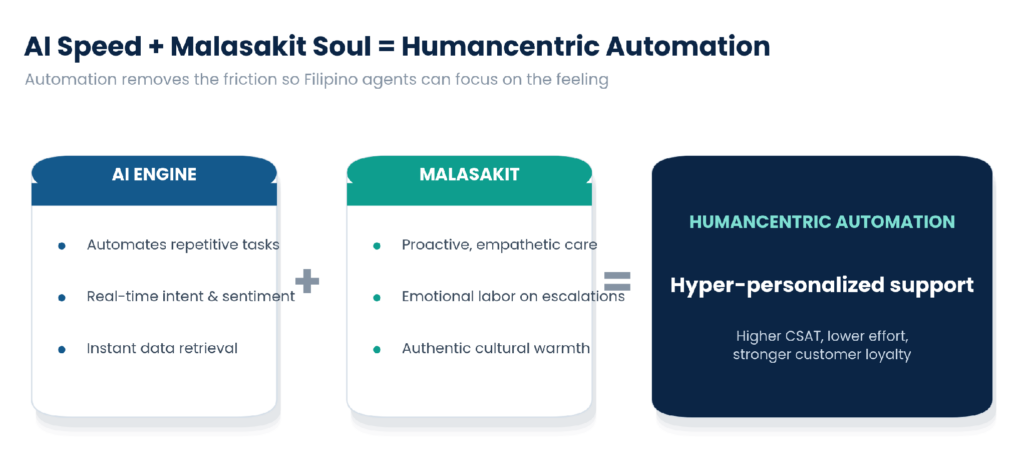
Philippine providers use machine learning to automate repetitive tasks while reserving Malasakit — the cultural trait of proactive, empathetic care — for complex, high-touch interactions, a working example of hybrid human-plus-AI support models. AI feeds agents real-time customer insight so they can deliver personalized, emotionally intelligent support. The technology handles the friction; the human handles the feeling.
Most global competitors deploy AI to cut headcount. The top Philippine providers do something different: they treat automation as a way to deepen human connection, not eliminate it. The model only works because the two halves are designed to reinforce each other — speed from the machine, soul from the agent. It is a deliberate design philosophy, not an accident of culture, and it is increasingly what separates a premium Philippine provider from a generic offshore bot farm. Where a pure-automation strategy optimizes for deflection, the humancentric model optimizes for how a customer feels at the end of the conversation — a far more durable advantage.
Why Is Malasakit the Ultimate Differentiator in AI-Driven CX?
Because it is what AI cannot replicate. Malasakit goes beyond standard service to a felt sense of ownership and instinctive empathy for the customer’s dilemma. When AI absorbs the mundane inquiries, agents are freed from transactional fatigue to pour unhurried emotional labor into the moments that actually build loyalty.
When routine tasks — tracking a package, resetting a password — are routed to conversational AI, Filipino agents are liberated from transactional fatigue and can dedicate genuine, unhurried attention to complex escalations. Rather than using automation to thin out the workforce, leading providers use it to concentrate human effort exactly where empathy changes the outcome. Malasakit is hard to script and harder to hand to software, which is exactly why it endures as automation spreads: the more the machine absorbs, the more the remaining human moments come to define the brand. For a stressed customer, the difference between a competent answer and a caring one is often the difference between churn and loyalty.
“AI gives us speed, but Malasakit gives us soul. We don’t use AI to replace the human touch; we use it to hyper-personalize it. By injecting real-time customer sentiment data directly into the agent desktop, our providers empower their teams to express authentic cultural empathy exactly when the customer needs it most.”
— John Maczynski, CEO of PITON-Global
How Does the Hybrid AI-Human Model Work Operationally?
Through “Humancentric Automation” — a continuous feedback loop. AI handles intake triage, surfaces resolution paths, and automates wrap-up; the agent adds contextual empathy at each step. Human nuance is then fed back to retrain the model, so the AI and the agent each make the other better over time.
Rather than operating in silos, AI tools and Filipino agents work in a continuous loop, drawing on the growing AI literacy of the local BPO workforce. The AI categorizes intent, gauges sentiment, and surfaces compliant resolution paths in seconds; the agent supplies the warmth, judgment, and proactive care that turn a correct answer into a reassuring one. Each phase pairs a machine task with a human one and a KPI that captures whether the handoff worked. In practice this means an interaction rarely feels handed between systems: because the agent inherits the AI’s full context, the customer experiences one continuous, informed conversation rather than a relay race between a bot and a person who asks them to start over.
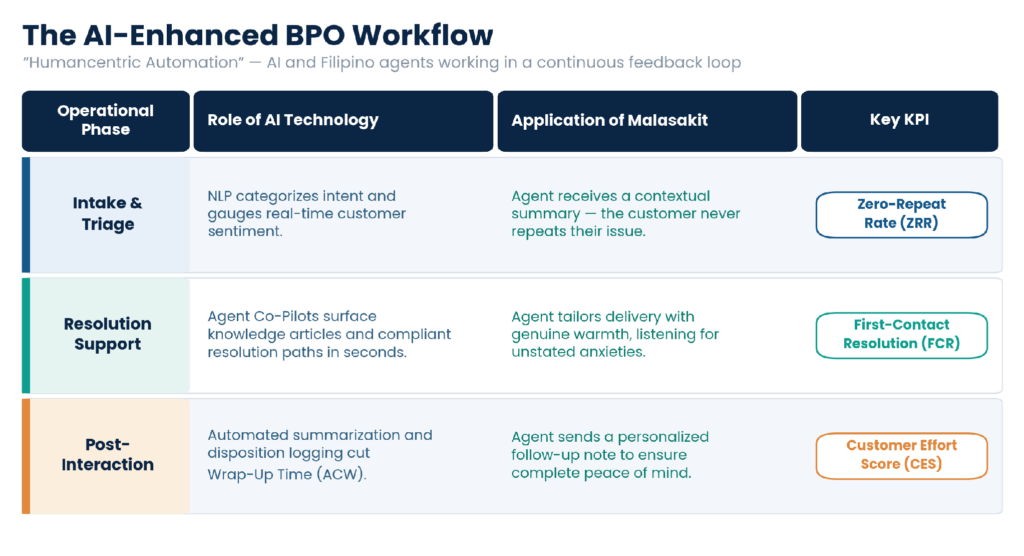
Each operational phase pairs an AI task with a Malasakit task — and a KPI that measures the handoff.
Crucially, the loop runs both ways, which is how human-in-the-loop oversight of AI-generated support works in practice. The agent’s read on tone and unstated anxiety becomes training signal that sharpens the model’s next intent and sentiment calls, so the system gets more human centric the longer it runs. Over months, that feedback turns a generic model into one tuned to a specific brand’s customers, their language, and their recurring anxieties.

What Metrics Prove the Value of Mixing Empathy With Automation?
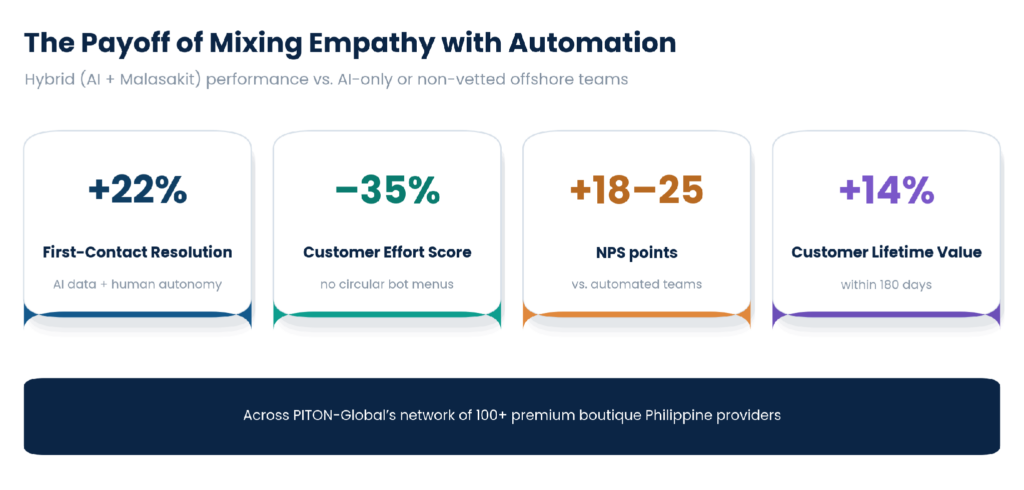
Buyers moving from AI-only bots to the Philippine hybrid model see First-Contact Resolution rise, Customer Effort Score fall, Net Promoter Score outperform automated teams, and Customer Lifetime Value lift within 180 days — driven by less automated frustration and lower churn.
The gains show up where it matters to a business: resolution, effort, advocacy, and retention. Customers stop navigating circular bot menus, agents resolve more on the first contact, and the reduction in automated frustration translates into measurably higher loyalty over the following six months. Taken together, the four measures describe a virtuous cycle: less friction lifts first-contact resolution and advocacy, stronger advocacy deepens loyalty, and that loyalty compounds quietly into lifetime value over the following two quarters.
How Did PITON-Global Engineer a Fintech CSAT Turnaround?
A US fintech’s aggressive “AI-first” self-service had alienated stressed customers and crushed retention. PITON-Global matched it to a premium mid-sized BPO, routing Tier-1 balance checks to an AI filter and all sensitive billing disputes to elite Filipino agents. Within 90 days, CSAT rose sharply while handle time and costs fell.
The client’s automated chatbots were failing exactly the customers who most needed care — stressed users trying to resolve sensitive billing discrepancies. PITON-Global audited the architecture and rebuilt the workflow around the right division of labor: an omni-channel AI filter resolved routine balance inquiries instantly, while every sensitive dispute went to a specialized team equipped with real-time translation and sentiment tools. The restructuring was surgical rather than wholesale — it changed who handled what, not simply how many people sat on the floor, which is also why generative AI is reshaping the seat-cost model in Manila.

The turnaround was fast and decisive. Within 90 days CSAT climbed sharply, handle time fell on the strength of better AI assistance, and the client cut costs substantially against its domestic overhead — proof that the answer to a failed AI-only strategy was not less automation, but automation in service of human empathy.