
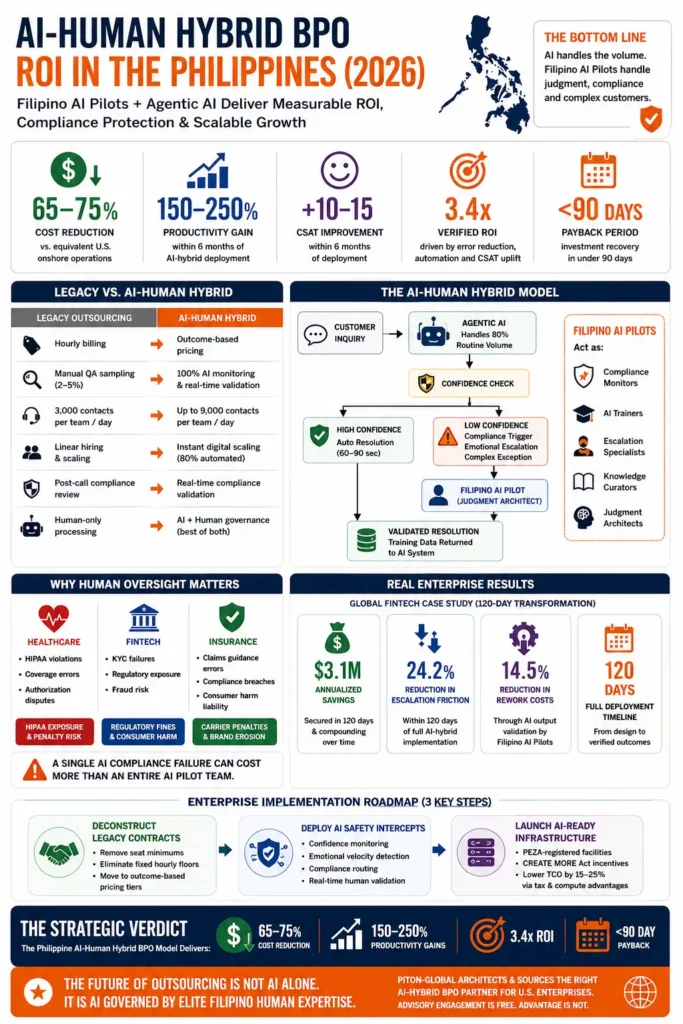
Deploying an AI-human hybrid BPO model in the Philippines reduces total cost of ownership by 65–75% compared with domestic U.S. operations. Filipino AI Pilots governing agentic AI workflows handle 80% of routine Tier-1 volume autonomously — while providing the Forensic Empathy that unsupervised automation cannot deliver in regulated sectors.
AI-Human Hybrid BPO ROI in the Philippines 2026
- TCO reduction: 65–75% vs. equivalent U.S. onshore operations when deploying an AI-human hybrid model in the Philippines.
- Productivity gains: 150–250% within 6 months of AI-hybrid deployment, per Outsource Accelerator 2026. McKinsey reports 20–40% gains specifically for hybrid AI-human models.
- AI resolution speed: 60–90 seconds for AI-resolved routine interactions vs. 4–6 minutes for human agents. Same team can process 3,000–9,000 contacts/day post-deployment.
- CSAT improvement: 10–15 point improvement within 6 months of AI-hybrid deployment. McKinsey 2025: AI-in-customer-service organizations see 10–15% CSAT uplift vs. human-only operations.
- The compliance imperative: In regulated U.S. sectors (healthcare, FinTech, insurance), unsupervised agentic AI introduces hallucination liability, CMS penalty exposure, and HIPAA risk. Filipino AI Pilots act as Judgment Architects — stepping in when AI detects high emotional velocity or hits a compliance limit.
- ROI recovery timeline: Most clients recover AI-hybrid transition investment in under 90 days per Outsource Accelerator 2026.
| Metric | Insight |
| 3.4x | Verified return on investment driven by error reduction and CSAT uplift in Philippine AI-hybrid deployments (PITON-Global Advisory 2026 · N=500+ engagements) |
| 80% | Of routine Tier-1 inquiry volume handleable autonomously by agentic AI — leaving Filipino AI Pilots to govern complex edge cases (Industry consensus 2026 · PITON-Global) |
| 60–90s | AI resolution time for routine queries vs. 4–6 minutes for human agents — a 4–6x speed advantage on Tier-1 volume (McKinsey 2025 · AdaptiveX 2026) |
| <90 days | Transition investment recovery timeline for properly implemented Philippine AI-hybrid programs (Outsource Accelerator 2026) |
The Philippine BPO industry’s transition from seat-based labor arbitrage to AI-human hybrid delivery is the most significant structural shift in the $42 billion sector since its inception. The model that defined Philippine outsourcing for two decades — large pools of English-speaking agents handling scripted interactions at low hourly cost — is being superseded by a fundamentally different architecture. Filipino specialists now function as AI Pilots: governance professionals who manage agentic AI systems, validate automated outputs, handle complex escalations, and continuously feed high-fidelity training data back into localized LLM context windows. The cost reduction is larger. The compliance protection is more robust. And the intelligence produced by the model compounds over time in ways that legacy headcount outsourcing structurally cannot.
How Does Hybrid Automation Outperform Legacy Offshore Sourcing?
Shifting from seat-based headcount billing to outcome-based hybrid automation fundamentally alters vendor unit economics. Legacy outsourcing ties a provider’s profitability to billable hours — a dynamic that inherently discourages process optimization, invites manual data gaps, and caps scaling velocity. Intelligent hybrid architecture uses automated system orchestration to handle high-volume repetitive transactions, while Filipino AI Pilots resolve complex edge cases, validate AI outputs, and govern compliance exposure.
The structural flaw in legacy hourly billing becomes critical in the agentic AI era. Consider the Efficiency Paradox: a Philippine BPO partner deploys agentic AI across its Tier-1 support workflows. Handle time drops 60%. Resolution rates climb to 92%. The same team that once processed 3,000 contacts a day now manages 9,000 — with better outcomes, lower error rates, and higher CSAT scores. Now examine the invoice. The U.S. buyer is still paying by the hour for a cost structure that no longer reflects the vendor’s operational reality. The vendor is capturing the AI efficiency gain; the client is not. Hourly billing, in an era of agentic AI, is a tax on the buyer’s innovation.
The hybrid architecture resolves this misalignment at the commercial layer. By shifting to variable fees scaled directly to successful query resolutions, the vendor’s profitability becomes a function of how efficiently it delivers validated outcomes — not how many seats it keeps on the floor. When an AI system resolves a routine interaction in 75 seconds, the vendor earns the per-resolution fee and retains the margin difference between the AI’s delivery cost and the per-resolution price. This incentive structure drives continuous AI investment rather than continuous headcount growth.
Operational Comparison: Legacy Headcount Outsourcing vs. AI-Human Hybrid Architecture
| Operational Metric | Legacy Headcount Outsourcing | Outcome-Based AI-Human Hybrid (PITON-Global) |
| Commercial pricing structure | Fixed hourly billing per active agent seat regardless of output quality or AI efficiency gains | Variable fees scaled directly to successful query resolutions — client captures AI efficiency gain |
| Error remediation cost | Manual human audits costing $2,200 annually per seat; errors discovered post-call | Real-time automated guardrails with instant AI Pilot validation before output is delivered to consumer |
| Scalability & adaptability | Linear cost growth tightly bound to localized recruitment cycles; 4–6 week ramp per 10 seats | Instant digital scaling with centralized AI Pilot support; 80% of volume automated with zero recruitment dependency |
| Productivity ceiling | 1 agent : 1 interaction queue; 3,000 contacts/team/day maximum | 1 AI Pilot : 5–10 agentic instances; same team processes 9,000 contacts/day with superior outcomes |
| AI investment incentive | AI reduces billable hours and vendor revenue — rational vendors under-invest in automation | AI increases per-resolution margin — vendors maximize AI investment to capture efficiency gains |
| Compliance exposure | Agent-dependent compliance; 2–5% QA sampling; violations discovered post-audit | Real-time NLP guardrails + AI Pilot validation; 100% interaction monitoring; violations prevented pre-delivery |
Sources: PITON-Global Advisory 2026 · McKinsey 2025 (20–40% hybrid productivity gains) · AdaptiveX 2026 (60–90s AI resolution vs. 4–6 min human)
What Others Miss: The Strategic Intelligence Arbitrage
The common assumption among mid-market executives is that rapid advances in generative AI will render offshore voice and back-office hubs obsolete. What surface-level analysis overlooks is that unsupervised agentic AI introduces severe compliance exposure, hallucination liabilities, and brand erosion. In regulated U.S. sectors — FinTech, healthcare, insurance — the financial fallout from an unchecked AI compliance failure cascades instantly. The true value of the Philippine BPO sector has consequently shifted from providing execution-level labor to delivering highly structured Forensic Empathy.
The term Intelligence Arbitrage captures precisely what the Philippine AI-human hybrid model delivers: the combination of AI’s processing speed, consistency, and scalability with the human judgment, cultural alignment, and regulatory precision that Filipino specialists have built over two decades of serving U.S. markets. The AI handles the volume. The Filipino AI Pilot handles the variance — the interactions that fall outside the AI’s confidence threshold, trigger a compliance flag, or require the kind of empathetic human judgment that no language model currently delivers reliably in regulated sectors.
The compliance argument for the human-in-the-loop architecture is not philosophical. It is financial. A U.S. Medicare distributor whose AI system delivers a TPMO disclaimer incorrectly faces a maximum annual CMS penalty of $365,000 plus carrier contract termination. A U.S. FinTech platform whose AI system delivers flawed KYC guidance faces regulatory investigation and potential consumer financial harm liability. A U.S. healthcare organization whose AI system provides a prior authorization recommendation that contradicts the beneficiary’s actual plan coverage faces a HIPAA exposure event. In each case, the cost of a single AI failure exceeds the annual cost of an entire AI Pilot team governing the system that produced it.
The Filipino AI Pilot role is not a legacy contact center position with a new label. It is a functionally distinct professional profile: part compliance monitor, part AI trainer, part escalation specialist, and part knowledge graph curator. Filipino AI Pilots step into live workflows the moment an AI system detects high emotional velocity, hits a regulatory complexity threshold, or encounters an interaction type outside its training distribution. Their intervention is measured in milliseconds. Their output — the validated resolution, the corrected AI response, the compliance-cleared interaction — feeds directly back into the LLM context window as high-fidelity training data, continuously improving the AI system’s performance on the exact interaction types that the U.S. client’s consumer base generates.
According to John Maczynski, CEO of PITON-Global and a 40-year BPO veteran, “Filipino AI Pilots act as Judgment Architects. They step into live workflows the exact millisecond an AI system detects high emotional velocity or hits a complex regulatory limit. This human-in-the-loop validation shields enterprise buyers from catastrophic compliance failures while continuously feeding high-fidelity training data back into the localized LLM context window. You cannot automate that level of cultural and emotional alignment. The Philippines spent two decades building it. That is why it is the only offshore market in the world where the AI-human hybrid model delivers both cost reduction and compliance protection simultaneously.”
Case Study: Decoupling Capacity From Headcount via PITON-Global
A major global FinTech enterprise restructured its customer experience and compliance operations through PITON-Global, transitioning from a rigid onshore cost structure to a hybrid framework utilizing PITON-Global’s network of 100+ specialized Philippine providers. Within 120 days of full implementation, the enterprise cut escalation friction by 24.2%, reduced miscommunication rework costs by 14.5%, and secured $3.1 million in annualized net savings — while accelerating CSAT metrics.
Case Study · Global FinTech Enterprise · AI-Human Hybrid Restructuring · 120-Day Implementation
$3.1M Annualized Net Savings and 24.2% Escalation Friction Reduction in 120 Days
The Challenge
A major global FinTech enterprise sought to transition away from a rigid onshore cost structure that had produced escalating cost-per-resolution figures and increasing compliance review overhead. Routine balance inquiries and account resets were being handled by expensive onshore agents at the same cost level as high-stakes fraud disputes and KYC escalations — a structural misallocation of human capital with no mechanism for correction under the fixed hourly billing model.
The Method
PITON-Global architected a hybrid framework utilizing a vetted Philippine mid-market provider from its network of 100+ specialized Philippine service providers. The selected partner deployed autonomous agents to instantly resolve 80% of routine balance inquiries and account resets. High-stakes fraud disputes and sensitive KYC/AML compliance escalations were routed in real-time to an elite team of Filipino AI Pilots operating under the tax-optimized CREATE MORE Act framework. The commercial structure shifted from fixed hourly billing to a variable per-resolution fee that scaled the vendor’s margin directly to validated outcome delivery.
The Context
This implementation is consistent with published 2026 benchmarks from Outsource Accelerator (150–250% productivity gains within 6 months), McKinsey 2025 (10–15% CSAT uplift for AI-in-customer-service deployments), and PITON-Global’s aggregate advisory engagement data (N=500+ Philippine outsourcing programs).
Case Study Results
| Metric | Result |
| Reduction in escalation friction within 120 days of full AI-hybrid implementation | 24.2% |
| Reduction in miscommunication rework costs through AI output validation by Filipino AI Pilots | 14.5% |
| Annualized net savings secured within 120 days — compounding as AI system improves from Pilot feedback | $3.1M |
| Time to full implementation and verified outcome delivery under PITON-Global advisory framework | 120 days |
Source: PITON-Global advisory engagement data · Benchmarked against Outsource Accelerator 2026 and McKinsey 2025 AI-in-CX data
Operational Roadmap for Enterprise Leaders
Enterprise leaders deploying the Philippine AI-human hybrid model should prioritize three structural steps in sequence: deconstruct legacy vendor agreements to remove minimum seat requirements, deploy agentic safety intercepts that route AI-flagged exceptions to Filipino AI Pilots in real-time, and lease AI-ready infrastructure through Philippine PEZA economic zones and CREATE MORE Act frameworks to offset compute scaling costs.
The transition from legacy headcount outsourcing to a Philippine AI-human hybrid model is not a vendor swap. It is a commercial restructuring, a technology deployment, and a governance architecture change executed simultaneously. Enterprise leaders who attempt to manage all three without an independent advisory framework typically encounter the same failure pattern: they select a Philippine provider based on hourly rate, discover after signing that the provider lacks AI integration capability, and then face a re-sourcing decision with an active program and embedded client data.
1. Deconstruct Legacy Vendor Agreements
AUDIT · PHASE OUT SEAT MINIMUMS · INTRODUCE RESOLUTION-BASED TIERS
Audit all active master service agreements (MSAs) with Philippine providers to identify minimum seat requirements, fixed hourly rate floors, and headcount-scaling clauses. These contractual structures are architecturally incompatible with the AI-hybrid model because they tie the vendor’s revenue to a metric — seats occupied — that AI deployment actively reduces. Phase out minimum seat requirements aggressively. Replace them with variable, resolution-based performance tiers that scale the vendor’s revenue to successful query outcomes, not to the number of agents logged into a dialer. This restructuring is the foundational commercial prerequisite for AI-hybrid deployment.
2. Deploy Agentic Safety Intercepts at the Workflow Layer
IMPLEMENT · REAL-TIME SEMANTIC ANALYSIS · HUMAN VALIDATION ROUTING
Implement real-time semantic analysis over automated conversational layers to flag ambiguous AI outputs and instantly route them to Filipino AI Pilot specialists. The technical implementation requires three components: a confidence threshold monitor that detects when the AI’s response probability falls below the compliance-safe threshold for the interaction type; an emotional velocity detector that identifies consumer sentiment escalation patterns requiring human empathy; and a regulatory complexity classifier that routes interactions touching compliance-sensitive domains — TPMO disclaimers, KYC verification, HIPAA-governed health data, or prior authorization determinations — to a Filipino AI Pilot before the AI output is delivered to the consumer. These safety intercepts are the compliance architecture that makes unsupervised agentic AI commercially viable in regulated U.S. sectors.
3. Lease AI-Ready Infrastructure Through Philippine PEZA and CREATE MORE Act Frameworks
DEPLOY · TAX-OPTIMIZED · COMPUTE-READY PHILIPPINE INFRASTRUCTURE
Route hybrid infrastructure setups through Philippine Economic Zone Authority (PEZA)-registered facilities that provide income tax holidays of 4–8 years, value-added tax exemptions, and streamlined customs procedures for technology imports. The CREATE MORE Act’s 100% power expense deduction for high-compute AI infrastructure makes GPU-intensive workloads — real-time speech analytics, LLM inference, agentic AI orchestration — economically viable at Philippine BPO facilities at a cost point unavailable onshore. For U.S. enterprise buyers deploying AI-hybrid programs in the Philippines, this legislative framework reduces the total technology infrastructure cost by 15–25% compared with equivalent deployments in non-PEZA jurisdictions.
Ralf Ellspermann, CSO of PITON-Global and a 25-year veteran of Philippine BPO operations: “The Philippine AI Pilot is not a call center agent who has been trained to use a chatbot. They are a compliance monitor, an AI trainer, a judgment specialist, and a knowledge graph curator — operating simultaneously, in real-time, across 5 to 10 autonomous agentic instances. The enterprises that understand this distinction deploy the model correctly and realize the full ROI. The enterprises that treat it as a technology overlay on a legacy headcount contract discover, usually within 90 days, that the mismatch between commercial structure and operational reality destroys the efficiency gain the AI was supposed to create.”
The Strategic Verdict
The Philippine AI-human hybrid BPO model delivers 65–75% TCO reduction, 150–250% productivity gains, 10–15 point CSAT improvement, and ROI recovery in under 90 days — with the compliance protection that unsupervised agentic AI cannot provide in regulated U.S. sectors. Filipino AI Pilots are the Judgment Architects that make this model commercially viable: governing agentic AI instances, validating outputs at the compliance threshold, and feeding high-fidelity training data back into the LLM context window that makes the system progressively more accurate. PITON-Global architects and sources this model for U.S. enterprise buyers at no advisory cost — matching each program to the Philippine provider with the AI integration depth, PEZA infrastructure access, and CREATE MORE Act framework required for full implementation. The engagement is free. The competitive advantage is not.