TECHNICAL SUPPORT OUTSOURCING SERVICES PHILIPPINES

Technical support that resolves the system, not just the ticket.

Manila-based tier-1, tier-2 and tier-3 specialists who triage, reproduce and root-cause hardware, software, network and API incidents under SOC 2, ISO 27001 and PCI-DSS controls — measured by MTTR and first-contact resolution, not handle time.

Manila, Cebu & Clark delivery SOC 2 / ISO 27001 / PCI-DSS 24/7 follow-the-sun
SYSTEM RESOLUTION INDEX BLENDED
Mean time to resolution · blended
38 min
First-contact resolution
74%
resolved on first touch
Cost to serve
66%
vs onshore desk
MTTR Handle time flatters a vendor; MTTR exposes one. We shortlist desks that resolve, not just respond. Benchmark your MTTR
STACK & COMPLIANCE
Zendesk ServiceNow Jira Service Mgmt Salesforce Freshservice SOC 2 Type II ISO 27001 PCI-DSS ITIL 4
SAME RATE, DIFFERENT RESOLUTION

Two technical support vendors quote the same seat rate — how do we tell which one will actually resolve our tickets?

Ask what share of the invoice reaches engineers who touch your tickets — about 70% on vetted desks versus roughly 45% at legacy aggregators. Then ask for MTTR, reopen rate and escalation accuracy, not handle time. Vetted Manila desks run a 38-minute blended MTTR, 74% FCR, 4.1% reopen rate and 96% escalation accuracy.

THE SHORT VERSION

What technical support outsourcing services actually are.

THE SHORT VERSIONLAST UPDATED · JUNE 2026

Technical support outsourcing is the delegation of tiered system resolution — L1 triage, L2 troubleshooting and L3 engineering-grade escalation — to a specialized provider, to resolve hardware, software, network and API incidents within MTTR and first-contact-resolution targets.

What is it?Tiered L1 / L2 / L3 system resolution delivered from the Philippines — triage, troubleshooting and engineering-grade escalation as one operation.
Primary KPI38-min blended MTTR · 74% first-contact resolution · 4.1% ticket reopen rate · 96% escalation accuracy.
Who is this for?SaaS, fintech, healthcare and enterprise IT teams scaling support volume without scaling cost or losing resolution quality.
Why PITON-Global?Vendor-neutral sourcing of the top 1% of Manila desks — vetted on MTTR and escalation accuracy under SOC 2, ISO 27001 and PCI-DSS controls.
Evidence of successEngagement TS-057: a 60-seat desk cut MTTR from 92 to 38 minutes in two quarters · verified Q2 2026.
RESOLUTION SCOREBOARD

Resolution numbers most support vendors keep off the slide.

Here’s how PITON-Global-vetted Manila support teams actually perform — mean time to resolve, first-contact resolution, escalation accuracy — lined up beside the in-house and budget-offshore baseline. Hold a vendor to these and an SLA stops being wishful thinking — measured across 2025–26 vetted engagements (TS-057: MTTR 92→38 minutes in two quarters).

METRICPITON-GLOBAL-VETTEDBASELINEWHY IT MATTERS
Mean time to resolution (MTTR)38 min~92 minUptime & user productivity
First-contact resolution (FCR)74%~58%Fewer touches, lower cost
L1 resolution rate62%~45%Right-tiered, not over-escalated
Ticket reopen rate4.1%~11%Resolved, not just closed
Escalation-accuracy (correct tier)96%~78%No wasted engineering time
Technical CSAT4.6 / 54.0 / 5Trust in the fix
Cost to serve−66%onshore baseArbitrage without quality loss
Source: PITON-Global technical-support operating data, 2025–2026 engagements · baseline = onshore & generic-offshore tier-1/2 desk averages
COMPLIANCE MAP · COVERAGE BY TIER

How SOC 2, ISO 27001 and PCI-DSS apply at each tier.

Compliance is not a logo on a footer — it is a control that applies differently at L1, L2 and L3. This is the matrix an enterprise buyer searching for “PCI-DSS-compliant technical support” needs to see.

CERTIFICATIONL1 · TRIAGEL2 · TROUBLESHOOTL3 · ENGINEERING
SOC 2 Type IIAccess controls, least-privilege, session loggingChange-tracked diagnostics, evidence captureAudited code/DB access, segregation of duties
ISO 27001ISMS-governed runbooks, asset handlingIncident-management controls, risk treatmentSecure development & problem-record control
PCI-DSSNo cardholder data in L1 tickets, maskingScoped diagnostics, tokenized test dataCDE-aware fixes, change control & review
WHO WE SERVE

Four kinds of stack, resolved four different ways.

What the desk must be fluent in — the product, the firmware, the regulation, the reseller — is different in each, which is why the same page reads differently depending on what breaks.

01SaaS & enterprise software

Where the reopen rate is the churn signal. Product-fluent tiers behind customer success — stack traces, integrations, API-schema fluency.

02Connected hardware & IoT

The working device that doesn’t get boxed up. Firmware-fluent diagnostics, fault-data decision trees, verified-fault returns as the metric. TS-058 is this stack, measured.

03Fintech & regulated platforms

The P1 taxonomy’s home turf: payment-gateway severity, PCI-scoped diagnostics at every tier, the audit-ready chain of custody.

04MSPs & internal IT

Employee-facing service desks and white-label L2/L3 benches — the same tier discipline, pointed inward or resold.

THE TIER RESOLUTION MODEL

An incident lands — where does it resolve, and how fast?

Ninety percent of incidents never reach engineering — if the tiers are staffed and escalation criteria are real. Select a tier to see its scope, who acts, the MTTR, and the share of volume it resolves.

L1 · Triage & Restore62%
L2 · Troubleshoot & Reproduce28%
L3 · Engineering-Grade8%
Vendor / Product Escalation2%
Share of incident volume · blended 90-day
L1
Triage & Restore
MTTR AT THIS TIER
9 min
RESOLVED HERE
62%
WHO ACTS
Manila-based tier-1 specialists working a versioned runbook
SCOPE
Access and password resets, known-error fixes, configuration, basic connectivity, account and entitlement issues, and service restoration for anything with a documented resolution path.
Your last MSA promised an SLA. Did the vendor ever prove the MTTR before you signed?
WHY THE PHILIPPINES

What makes Manila the right floor for technical support.

Manila didn’t become the default home for support desks by being cheap. It pairs deep English fluency with a genuine service culture and an engineering bench that can actually fix the hard tickets — at a cost that funds a second tier instead of a thinner one.

Talent density
A workforce of English-fluent, IT-literate specialists fed by roughly 750,000 STEM and IT graduates a year — enough to staff true L2/L3 benches, not just script-readers.
Time-zone command
Manila runs genuine 24/7 follow-the-sun with live US overlap, so a P1 at 3am is worked by an awake, on-shift engineer — not a callback queue.
Neutral accent & service culture
A high-context, customer-first service culture and neutral accent that de-escalate a frustrated user and build trust in the fix — the soft skill behind the hard metric.
Compliance maturity
Two decades of regulated delivery: SOC 2, ISO 27001 and PCI-DSS-aligned facilities across Manila, Cebu and Clark with mature redundancy and BCP.
Cost to serve
60–70% lower fully-loaded cost than an onshore desk — arbitrage that funds a deeper tier model, not a thinner one.
Tenure & retention
Established BPO career paths keep senior L2/L3 specialists in seat, so institutional product knowledge compounds instead of churning.
RADICAL TRANSPARENCY

A fit when — and honestly not, when.

✓ A TIERED DESK IS THE RIGHT BUY WHEN YOU HAVE
Live software or hardware with real L2/L3 complexity — stack traces, logs, integrations.
A documented product, an API schema, and escalation paths worth defining.
An engineering team that wants its time back — and a backlog ready to receive RCAs.
MTTR, reopen rate, and escalation accuracy as the grading — not handle time.
→ USE A DIFFERENT MODEL WHEN YOU NEED
A 1,000-seat transactional floor stood up in 30 days — that’s a volume aggregator’s job, honestly.
Password resets and account creation as the primary workload — a runbook L1 desk alone is cheaper, and we’ll scope just that.
Support with no product access and no documentation — no desk on earth can resolve what it cannot see.
The lowest possible rate regardless of resolution — the scoreboard above shows what that buys.
THE FINE PRINT WE LEAD WITH The prerequisite we won’t waive: the tier model runs on your documentation, your environments, and your escalation criteria — defined in week one, versioned thereafter. The ceiling we hold: dedicated clusters are capped to protect coaching depth and QA calibration; growth adds governed teams, never a stretched one.
A shortlist that includes “no” is the only kind worth having.
INSIDE THE DESK

How system resolution is actually run.

Technical support is not a queue — it is an ITIL-aligned incident and problem-management operation. The discipline below is what separates a resolution desk from a response desk.

1
Runbook-driven L1
Tier-1 works from a maintained, versioned runbook for every known error class — restoring service fast and escalating cleanly the moment a case falls outside it.
2
Reproduce-before-escalate L2
Tier-2 reproduces the fault, captures logs and diagnostics, and packages an engineering-ready case — so L3 spends its time fixing, not re-investigating.
3
Root-cause & RCA at L3
Senior specialists own code-, database- and integration-level root cause, deliver a documented workaround, and author the RCA that closes the problem record.
4
Closed-loop knowledge
Every novel resolution is written back into the knowledge base, so L1 resolution rate climbs over time instead of plateauing.
5
100% QA on escalations
Every tier hand-off and every reopened ticket is quality-reviewed, holding escalation accuracy at 96% and protecting the engineering team’s time.
6
Auditable chain of custody
ITIL-aligned incident, problem and change records give every ticket a defensible trail — the evidence an enterprise audit or a sev-1 post-mortem requires.
FROM RESOLUTION TO PREVENTION · MEAN TIME TO PREVENTION

The desk that only closes tickets will close this one again next month.

Every recurring defect is a subscription your support budget pays without reading the invoice. The closed knowledge loop already lifts L1’s resolution rate wave over wave — the prevention pipeline points the same discipline at the source.

FRICTION → RCA → BACKLOG
The output isn’t a closed problem record; it’s a prevented ticket class.

L3’s root-cause work doesn’t end at the workaround. Recurring defect classes are packaged as structured, engineering-ready RCA reports — reproduction steps, logs, affected versions, occurrence counts — and synced into your Jira/backlog as ranked candidates for the next sprint.

THE OCCURRENCE LEDGER
Fixes prioritized by what they’re actually costing.

Every defect class carries its ticket count and cost-to-serve, so your product team prioritizes on evidence — the bug generating 400 tickets a quarter outranks the elegant edge case.

THE METRIC SHIFT
MTTR measures the desk; MTTP measures the system.

A desk graded only on MTTR has a quiet incentive to keep the recurring ticket recurring; a desk feeding your backlog is measured on making its own volume shrink.

THE THROUGH-LINEThe same loop runs twice on our desks — contact themes to your product team (the voice-of-customer loop), defect classes to your engineering backlog (this one). Support as an intelligence asset, in both theaters.
WHERE THE SUPPORT DOLLAR GOES

Two offshore desks can quote the same rate and buy you completely different teams.

The seat rate hides the allocation. Roughly half the saving versus onshore is straight arbitrage — the other half, and the part that decides whether tickets actually resolve, is where each dollar is allowed to go.

ALLOCATIONLEGACY AGGREGATORPITON-GLOBAL-VETTED DESK
Delivery & engineering talent — the people on your tickets ~45% ~70%
Account management & enterprise overhead ~35% ~15%
Margin ~20% ~15%

Same seat rate; opposite teams. The aggregator’s dollar buys you layers of client-services management and a thinner bench under them; the vetted desk strips the overhead and spends the difference on the L2/L3 depth the tier model requires. “Arbitrage that funds a deeper tier model, not a thinner one” isn’t a slogan — it’s an allocation decision, and it’s checkable: ask any vendor what share of your invoice reaches the people who touch your tickets.

Representative allocations; confirmed against actual staffing plans per engagement.
THE MATH OF RESOLUTION

Where the 7.0× return comes from when the system stays up.

From four streams a per-seat rate ignores: deflection and right-tiering, engineering time protected, downtime avoided, and labor arbitrage. The cheapest incident is the one resolved at L1, on first contact, that never reaches an engineer.

Right-Tiering & FCR Savings
$0.8M – $1.7M
Engineering Time Protected*
$1.0M – $2.1M
Downtime & Productivity Avoided
$0.7M – $1.6M
Labor Arbitrage
$1.8M – $2.2M
TOTAL ANNUAL NET BENEFIT60-SEAT TIERED DESK
$4.3M – $7.6M
7.0×
Documented return
* Engineering Time Protected is modeled exposure, not a booked figure — escalation delta × engineering loaded rate, validated against the client’s own sprint metrics.
PRICING TOPOGRAPHY · 2026 RATE CARD

Indicative 2026 rates — the resolution roles shown apart from the seat.

An L1 seat has a market rate; the engineer whose reproduction package saves L3 a day of re-investigation, and the author whose RCA closes the problem record for good, do not.

CORE ROLERATE (USD/HR)OPERATIONAL PROFILETIER
L1 triage specialist$12–$16Runbook-driven restore, clean escalation.L1
L1 senior / known-error owner$12–$16Runbook versioning, L1 rate ownership.L1
Reproduction engineer (L2)$12–$16Reproduces the fault, captures the evidence, packages the case L3 doesn’t have to re-investigate — the hinge of the whole tier model.NO GENERIC
EQUIVALENT
L2 troubleshooter$14–$18Diagnostics, workarounds, config-level fixes.L2
RCA / problem-record author (L3)$16–$20Code/DB/integration root cause, the documented workaround, and the backlog-ready RCA (the prevention pipeline).NO GENERIC
EQUIVALENT
L3 engineering specialist$14–$18Deep-stack resolution, vendor coordination.L3
QA / escalation auditor$10–$14100% review on hand-offs and reopens.QUALITY
Knowledge-base engineer$10–$14The closed loop’s librarian — every novel fix, written back.KB
Team lead / incident commander$14–$20P1 bridges, SLA governance, client reporting.LEADERSHIP

The two premium rows have no generic equivalent because a response desk staffs neither: escalations arrive at engineering raw, and root causes die in ticket comments. Rates confirmed per engagement against stack and incident mix.

Price my desk against the 38-minute standard
CLIENT STORY · ENGAGEMENT TS-058 · CONNECTED HARDWARE

How a connected-hardware maker cut returns by fixing faults on the first call.

Frustrated customers returned working devices because a script-bound frontline couldn’t diagnose past setup — and RMA costs were climbing faster than sales.

78%
first-contact
resolution
-43%
no-fault
returns
+22
NPS
points
THE CHALLENGE

A connected-hardware company shipped products that mostly worked — but a script-bound frontline couldn’t troubleshoot setup and connectivity issues, so customers gave up and returned working devices. No-fault-found returns were eating margin and dragging NPS down.

WHAT WE SOURCED

We sourced a technical support team trained on the actual hardware and firmware, with a diagnostic decision tree built from real fault data, log-reading skills, and a warm path to L3 engineering — measured on first-contact resolution and verified-fault returns, not handle time.

THE OUTCOME

First-contact resolution reached 78%, no-fault-found returns fell 43%, and NPS climbed 22 points as customers got their devices working instead of boxing them up. The RMA line stopped outpacing revenue.

“They actually fix the problem on the call. Our return rate dropped, our reviews turned around, and support went from a cost we dreaded to a reason people stay.”

— VP, Product Support · connected-hardware maker
THE RESOLUTION FILE · ENGAGEMENT TS-064 · L2 INSERTION ONLY

One tier, inserted — L2 only, between the client’s L1 and the client’s engineers.

CLIENT ENTITY

B2B SaaS platform, 25K tickets/month, L1 and engineering retained in-house. Identity withheld under NDA.

PRE-DEPLOYMENT BASELINE

L1 was adequate and engineering was excellent — the middle was missing. Anything past the runbook escalated straight to developers: un-reproduced, log-less, “user says it’s broken.” Engineers spent 35 hours/week re-investigating tickets before they could begin fixing them, and the sprint velocity paid for it. No support crisis; a missing tier, billed in engineering salaries.

THE INTERVENTION

An L2 insertion — nothing above or below it changed. A reproduce-before-escalate bench on the client’s Jira Service Management stack: every L1 escalation reproduced, logged, diagnosed to component, and either resolved at L2 or packaged engineering-ready with evidence attached. The client’s L1 kept triaging; the client’s engineers kept fixing — they just stopped investigating.

NINETY DAYS, MEASURED
METRICBEFOREAFTERDELTA
Escalations reaching engineering14% of tickets4%The middle tier, absorbing what it should
Engineering hours on re-investigation35 hrs/wk6 hrs/wkThe most expensive people in the building, returned to building
Reopen rate on L2-touched tickets12%4.1%Resolved, not relayed
STRATEGIC INSIGHT

The flagship proves the full tier model; TS-064 proves the entry point — the single tier most scale-ups skip and pay for daily. Nothing about L1 or engineering changed, so the attribution is clean: every protected hour traces to a ticket that arrived packaged instead of raw. A company doesn’t need to outsource its support to fix its escalation tax; it needs the tier that turns “user says it’s broken” into “here’s the reproduction, the logs, and the component.”

INCIDENT TAXONOMY · RESOLUTION INTENT

How do we classify incident complexity?

Severity drives the tier, the SLA and the escalation path. These are the working definitions — with examples from a fintech environment — that govern every ticket.

P1Critical severity
Production down or a security/payment incident affecting many users.
FINTECH EXAMPLE
Payment gateway returning errors at checkout across all merchants.
Response < 15 min · 24/7 bridge
P2High severity
Major function impaired with no full workaround; revenue or compliance exposure.
FINTECH EXAMPLE
MFA failing for a subset of users; logins degraded.
Response < 30 min
P3Moderate severity
Partial impact with a workaround; limited users or non-critical function.
FINTECH EXAMPLE
A reporting export intermittently times out.
Response < 2 hr
P4Low severity
Minor issue, question or request with no service impact.
FINTECH EXAMPLE
How-to question on API rate limits; cosmetic UI bug.
Response < 1 business day
Stop paying for tickets closed. Start paying for systems resolved.
Book a 45-Minute Call
FROM THE FOUNDERS

How we judge a support team — from the people who built ours.

“In four decades I have never seen a buyer regret choosing the desk with the lower MTTR. They regret the one with the lower rate.”

John Maczynski
CEO, PITON-Global · 40-Year Global BPO Veteran

“Handle time is a vanity metric. Ask for the reopen rate and the escalation accuracy — that is where the truth about a technical desk lives.”
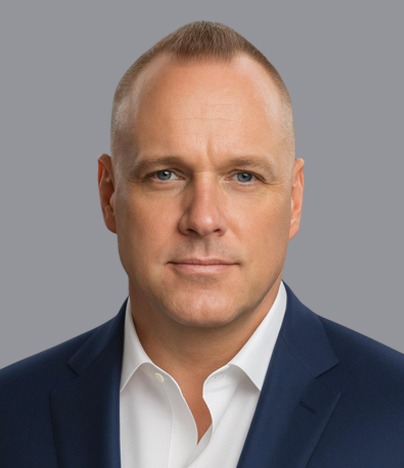
Ralf Ellspermann
CSO, PITON-Global · 25-Year Philippine BPO Veteran
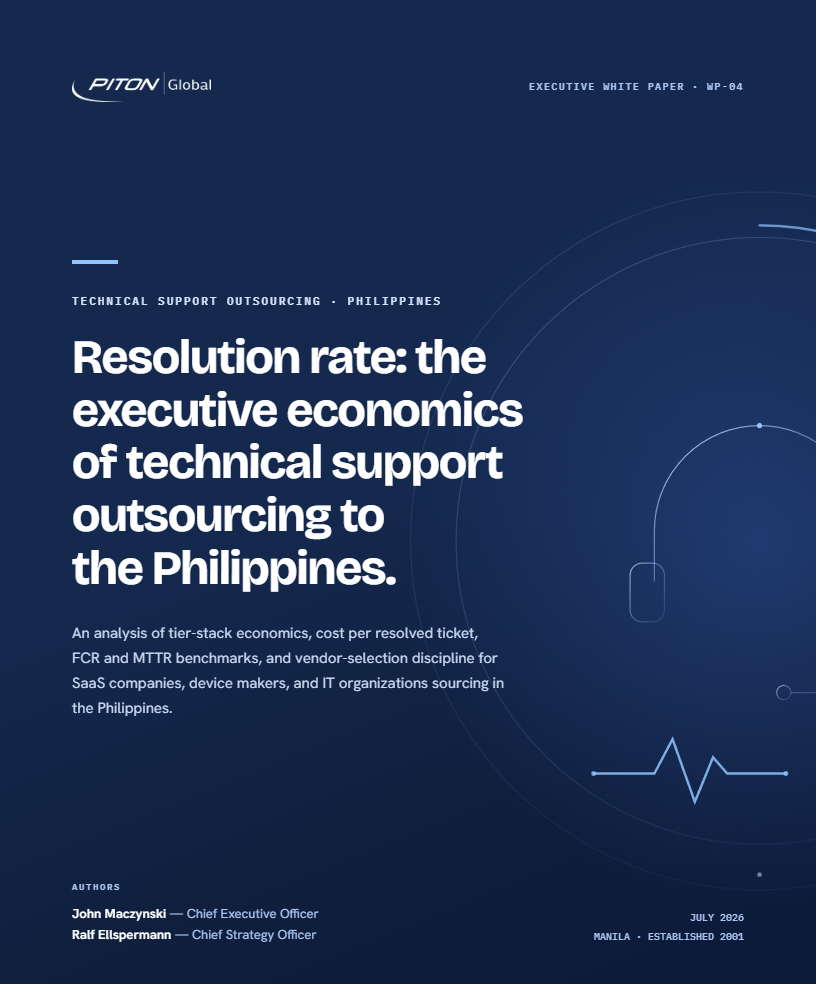
White paper cover — PITON-Global Executive White Paper WP-04
PDF · 13 PAGES
WHITE PAPER WP-04 · TECHNICAL SUPPORT OUTSOURCING · JULY 2026

Resolution Rate — Technical Support Outsourcing to the Philippines

An analysis of tier-stack economics, cost per resolved ticket, FCR and MTTR benchmarks, and vendor-selection discipline for SaaS companies, device makers, and IT organizations sourcing in the Philippines. Part of PITON-Global’s Executive White Paper Series, by John Maczynski and Ralf Ellspermann.

● 13 pages● 12-min read● Maczynski & Ellspermann
The tier stack: where support cost lives, and the only metric that prices it honestly
Support is retention: the churn arithmetic executives skip
Case study: a 55-seat SaaS support program, reconstructed
Download the report (PDF) Free · no gate · published July 2026
TECHNICAL SUPPORT · PHILIPPINES

Tell us the incident profile. We’ll name the desks that resolve it.

Share your stack, ticket mix and MTTR targets. We return a vendor-neutral shortlist of Philippine tier-2/3 desks that have proven the numbers on this page — at no cost to you.

Get Vendor-Neutral Advice
Vendor-neutral · no cost to you · 24-hour response guarantee, MTTR-verification pre-screen included · prepared and presented by John Maczynski, CEO
ANSWERED BY OUR PRINCIPALS

What support leaders ask before outsourcing tech support.

In-depth answers to the questions that decide a technical-support engagement — from the principals who run them.

Can you handle tier-2 and tier-3, not just tier-1?+
Yes. We staff technically-trained engineers for advanced troubleshooting, escalations and product-level issues. Tiered routing resolves most cases without escalation, and the harder ones reach genuinely capable engineers rather than bouncing back to your core team.— John Maczynski, CEO
Will agents actually know our product?+
Yes. Each program builds and maintains a knowledge base and trains to your stack, so answers are accurate and technical. Teams operate as an informed extension of yours, giving customers expert help rather than scripted responses.— Ralf Ellspermann, CSO
What does outsourcing tech support save us?+
Typically 60 to 70 percent on cost per contact versus in-house engineering support, with higher resolution. The deeper benefit is freeing your senior engineers from repetitive support so they focus on product, while customers still get fast, capable help.— John Maczynski, CEO
How do you keep first-contact resolution high?+
Through tiered routing, SME playbooks and calibrated QA, so most issues resolve at first contact and escalations reach the right engineer quickly. We report on resolution quality, not handle time, keeping the team aligned to fixing problems.— Ralf Ellspermann, CSO
Do you cover 24/7?+
Yes. Follow-the-sun teams keep technical support live around the clock across regions, so customers get help at any hour without you staffing overnight shifts in-house. Coverage and quality stay consistent across time zones.— John Maczynski, CEO
How do you protect customer and system data?+
All work runs in secured, access-controlled environments with no local storage and full audit trails. Access is scoped per role, every action is logged, and sensitive customer and system data never leaves the secured environment.— Ralf Ellspermann, CSO
Will you work in our tools?+
Yes. Engineers work natively in your ticketing, monitoring and remote-support tools, with full audit trails, rather than toggling between disconnected systems. That preserves context across every case and escalation.— John Maczynski, CEO
Will outsourcing hurt CSAT?+
Done right, it lifts CSAT. Faster, more capable fixes raise satisfaction, and we report on resolution quality rather than handle time, keeping the team aligned to genuinely solving problems rather than closing tickets quickly.— Ralf Ellspermann, CSO
How quickly can a support team be live?+
About eight weeks, through a gated stand-up. No customers are handled live until QA is signed off and a parallel run matches your bar. You see proven, product-fluent quality before any real volume flows.— John Maczynski, CEO
Are we locked into one platform?+
No. We are vendor-neutral across Zendesk, Freshdesk, Salesforce and your stack. We assess your tools, volume and goals, then match you to the right-fit partner at no cost, leaving the decision with you.— Ralf Ellspermann, CSO
Authorship, Review & Benchmark Verification
Authored by:
Ralf Ellspermann
Ralf Ellspermann
Chief Strategy Officer of PITON-Global
Two Decades Building and Advising Award-Winning Philippine BPO Operations

Ralf vets L1–L3 escalation discipline, ticket-deflection rates and knowledge-base hygiene across Philippine technical-support vendors.

View full bio  →
Verified by:
John Maczynski
John Maczynski
CEO of PITON-Global
Former Global EVP of the World’s Largest Contact Center · Four Decades of Outsourcing Experience

John validates the tiering economics and commercial terms behind each technical-support program on this page.

View full bio  →
Last Reviewed & VerifiedJune 4, 2026

Re-audited as SOC 2 Type II and ISO 27001 obligations evolve. Every benchmark on this page is held to PITON-Global’s internal vetting standard.

Inquire Now