PHARMA BPO OUTSOURCING PHILIPPINES

Safety and clinical operations, built for Audit Resilience.

Pharmacovigilance, TMF and clinical operations, and medical information — by science-literate Philippine specialists who pair Agentic AI with GxP discipline to produce inspection-ready records as a byproduct of the workflow, not a quarterly remediation project.

Manila, Cebu, Clark & Baguio deliveryGxP · 21 CFR Part 11 · GVP · HITRUSTVeeva Vault · Oracle Argus native
REGULATORY SOVEREIGNTY INDEXQ2 2026
Faster PV case processing · Agentic + HITL
34%
TMF inspection-ready
100%
continuous eTMF QC
Adverse event detection
<2hr
Agentic intake + triage
PV/GVPPharmacovigilance obligations don’t bend to a budget. We verify the rigor.See vetted teams
PLATFORMS & FRAMEWORKS
GxP · GCP / GMP / GLP 21 CFR Part 11 GVP · EU/ICH HITRUST CSF SOC 2 Type II Veeva Vault Oracle Argus Safety ArisGlobal LifeSphere Medidata Rave EDC Veeva CTMS MasterControl IQVIA Technologies Ennov PV CluePoints
17Vetted Pharma
BPO Suppliers
GxP-audited specialists in pharmacovigilance, TMF and medical information.
113Sponsors & CROs
Supported
Biopharma sponsors, CROs and medical-device manufacturers across regulated markets.
8Delivery Hubs
Philippines
GxP-governed delivery aligned to FDA, EMA and MHRA inspection standards.
FROM COST CENTER TO AUDIT RESILIENCE · 2026

In 2026, pharma outsourcing is no longer a headcount-arbitrage decision — it is a patient-safety and audit-resilience decision. The FDA and EMA have moved to continuous inspection, and the differentiator is Regulatory Sovereignty: a complete, contemporaneous evidence trail produced as a byproduct of the workflow.

02THE COMPLIANCE THRESHOLD

Why does the 2026 inspection environment make Regulatory Sovereignty the deciding factor in pharma outsourcing?

In a continuous-inspection FDA and EMA environment, a periodic-QC outsourcing model is structurally non-compliant by design — regardless of certification status. Regulatory Debt compounds silently between audits until a single inspection converts it into a Warning Letter, a clinical hold or a delayed approval.

DEFINITION

Regulatory Sovereignty is the capacity to produce a complete, contemporaneous, ALCOA+ compliant evidence trail for every safety and clinical decision on demand. It is achieved when science-literate specialists operate under 21 CFR Part 11 governance that makes every record inspection-ready as a byproduct of the workflow, not a quarterly remediation project.
REGULATORY COMPLIANCE MATURITY · HOW SAFETY & CLINICAL DATA IS HANDLED — AND HOW DEBT IS CLEARED
Click to compare
STAGE 01
AE Report Arrives
Email / call center intake
STAGE 02
Manual Triage
No scientific literacy
STAGE 03
Late Filing
Past 15-day window
STAGE 04
TMF Gap Hidden
No contemporaneous QC
STAGE 05
Inspection Finding
483 / Warning Letter
5–7 day ICSR cycle · late submissions accrue No causality assessment depth Periodic TMF QC · gaps surface at audit No ALCOA+ audit trail
STAGE 01
Structured Intake
Some PV training
STAGE 02
Manual Coding
MedDRA, variable QC
STAGE 03
On-Time Filing
But thin narratives
STAGE 04
Periodic TMF QC
Backlog at milestones
STAGE 05
Audit-Reactive
Remediation sprints
◐ 3–4 day ICSR cycle · on-time but shallow MedDRA coding 90–95% · QC variance TMF QC at milestones, not continuous 21 CFR Part 11 partial
STAGE 01
Agentic Intake
<2hr · auto-dedup
STAGE 02
AI MedDRA Coding
99.8% · specialist QC
STAGE 03
Causality + Narrative
Science-literate authoring
STAGE 04
Continuous TMF QC
Inspection-ready always
STAGE 05
ALCOA+ Audit Trail
21 CFR Part 11 · on demand
✓ 34% faster ICSR cycle · 100% on-time, managed engagements 99.8% MedDRA coding accuracy 100% inspection-ready TMF · across managed engagements Full ALCOA+ · 21 CFR Part 11
5–7d
Legacy ICSR case cycle
Manual adverse-event processing — late submissions accrue regulatory debt.
34%
Faster PV case processing
Agentic intake and triage with science-literate HITL causality review.
~⅓
Lower fully-loaded cost
Roughly a third below an equivalent onshore safety and clinical-operations build.
29%
Earlier safety-signal detection
AI-augmented aggregate review surfaces signals ahead of the periodic cycle.
Ralf Ellspermann
REPORT AUTHOR · Q2 2026

“Every Head of Safety I speak with in 2026 carries the same fear: they passed their last inspection, but they cannot prove what their TMF looked like on a random Tuesday three months later. Under continuous inspection, that uncertainty is the exposure. The architecture has to make the record inspection-ready at all times — not reconstruct it before an audit.”

Ralf Ellspermann · CSO, PITON-Global · 25-Year Philippine BPO Veteran
03AGENTIC PHARMACOVIGILANCE & THE SCIENCE-LITERATE PLAYBOOK

What does Agentic pharmacovigilance look like — and why can generic BPO not staff it?

Agentic pharmacovigilance uses AI to intake, deduplicate and triage adverse-event reports in under two hours, while science-literate specialists perform MedDRA coding, causality assessment and narrative authoring. Generic BPO cannot staff it because narrative writing and causality assessment require life-science domain literacy that general talent pools do not contain.

AGENTIC PV CASE PIPELINE · INTAKE TO REGULATORY SUBMISSION · ZERO LATE FILINGS
Case Intake
AI · <2hr · auto-dedup
Seriousness Triage
AI · expedited vs. non
MedDRA Coding
AI 99.8% · specialist QC
Causality + Narrative
Human · science-literate
Submission + Audit Log
100% on-time · ALCOA+
<2h
AE detection & intake
34%
Faster full case cycle
99.8%
MedDRA coding accuracy
100%
On-time expedited filing
29%
Earlier signal detection
SPECIALIST WORKFLOW PLAYBOOK · THREE SCIENCE-LITERATE CAPABILITY LINES
How top-1% Philippine partners handle the workflows that generic BPOs cannot.
ICSR PROCESSING · CAUSALITY · AGGREGATE SAFETY

An adverse-event narrative is not a support ticket — it is a regulated scientific document where a missed causality nuance becomes a patient-safety and compliance event. Specialists carry a life-science background and pharmacovigilance training that lets them author defensible narratives and assess causality, not just transcribe a report.

ICSR intake, MedDRA coding, causality assessment and narrative authoring in Oracle Argus and Veeva Vault Safety
Expedited 7-/15-day and periodic (PSUR/PBRER) submission management
Aggregate review and AI-augmented signal detection ahead of the periodic cycle
Literature monitoring and case follow-up under a GVP-aligned SOP framework
Oracle Argus Safety Veeva Vault Safety ARISg MedDRA · WHO-DD
SAFETY OPERATIONS
Expedited on-time rate100%
MedDRA coding accuracy99.8%
Signal detection lead+29%
eTMF COMPLETENESS · CLINICAL DATA · INSPECTION READINESS

The Trial Master File is the legal record of trial conduct — and the first thing an inspector asks for. Continuous, contemporaneous QC keeps the eTMF inspection-ready at every moment, instead of triggering a remediation sprint before each audit and accumulating Regulatory Debt between them.

Contemporaneous eTMF indexing, QC and completeness review in Veeva Vault eTMF
Clinical data entry, query management and reconciliation under a GCP-aligned framework
Site document collection, tracking and completeness chasing to inspection standard
Audit-readiness preparation and CAPA documentation support across the trial lifecycle
Veeva Vault eTMF Medidata Rave Oracle Clinical One TMF Reference Model
TMF & CLINICAL OPS
eTMF inspection-ready100%
TMF completeness QCContinuous
Data query turnaround−38%
MEDICAL INFORMATION · HCP & PATIENT INQUIRY · PRODUCT COMPLAINTS

A medical-information call is a scientific exchange with a patient or HCP, often emotionally charged and always regulated. Specialists pair a life-science background with a Malasakit-led empathy protocol — answering accurately, capturing any adverse event or product complaint embedded in the conversation, and never straying into promotional language. It is the same human-on-the-sensitive-interaction architecture documented across our insurance and healthcare operations, tuned here to non-promotional medical information and AE capture.
Tiered medical-information response against an approved scientific response document library
Embedded adverse-event and product-complaint capture with direct PV hand-off
Trauma-informed, non-promotional empathy protocol for sensitive patient conversations
Full 21 CFR Part 11 interaction logging for every inquiry and escalation
Veeva Vault MedComms IRMS / MICC Approved SRD library
MEDICAL INFORMATION
First-contact resolution89%
AE capture compliance100%
HCP satisfaction94%
John Maczynski
REPORT VERIFIER · Q2 2026

“The sponsors that fail an inspection rarely fail on science — they fail on documentation. A causality assessment that was correct but never properly recorded is, to an inspector, a finding. The Philippine specialist model wins because the science literacy and the documentation discipline live in the same person.”

John Maczynski · CEO, PITON-Global · Former Global EVP, world’s largest BPO provider
04TMF HEALTH SIGNAL ANALYSIS & THE COMPLIANCE DIVIDEND

How root-cause TMF deficiency analysis converts inspection risk into a Compliance Dividend.

Most TMF findings trace to four recurring deficiency classes — each preventable at a specific point in the document lifecycle. Continuous QC eliminates them before they compound into a Warning Letter, a clinical hold, or a delayed approval.

TMF DEFICIENCY ROOT-CAUSE DISTRIBUTION · WHERE INSPECTION FINDINGS ORIGINATE
Missing / Late Documents38%
Essential documents not filed contemporaneously. Eliminated by continuous completeness QC.
Version / Signature Errors27%
Superseded versions or missing signatures. Caught by 21 CFR Part 11 version control.
Inconsistent Metadata22%
Indexing and metadata mismatches. Prevented by contemporaneous indexing against the TMF Reference Model.
ALCOA+ Trail Gaps13%
Audit-trail discontinuities. Fully preventable under a 21 CFR Part 11-governed system.
WARNING LETTER · AVOIDED COST
$14–48M
Avoided cost of a single Warning Letter
Remediation, consent-decree exposure, delayed approval and lost market window from one FDA Warning Letter. Continuous TMF QC and ALCOA+ governance turn that avoided cost into the Compliance Dividend.
100%
Inspection-ready TMF
0
Critical findings · 2025
05TABLE 01 · CRITICAL 2026 PHARMA BENCHMARKS

Generic BPO vs. Regulatory Sovereignty.

The competitive delta between a legacy 2024 BPO baseline and the PITON-Global-vetted 2026 standard — across nine dimensions that determine patient safety, inspection outcomes and approval velocity.

PERFORMANCE METRICGENERIC BPO · 2024PITON-GLOBAL · 2026IMPACT SIGNAL
Primary DriverCost reduction — FTE arbitrageRegulatory SovereigntyAudit resilience
ICSR Case Cycle5–7 days · manual34% faster · Agentic + HITLZero late filings
MedDRA Coding90–95% · QC variance99.8% · AI + specialist QCData integrity
Causality & NarrativeTranscription onlyScience-literate authoringDefensible records
TMF Quality ControlPeriodic · milestone QCContinuous · 100% inspection-readyNo remediation sprints
Signal DetectionPeriodic-cycle only29% earlier · AI-augmentedPatient safety
Documentation StandardPartial 21 CFR Part 11Full ALCOA+ · 21 CFR Part 11Inspection defense
Talent ProfileGeneral CX agentsLife-science specialistsScientific literacy
Loaded CostBaseline onshore34% lower · fully loadedMargin + compliance
06THE COMPLIANCE DIVIDEND · DOCUMENTED ENGAGEMENT

How a mid-cap biopharma turned a TMF remediation crisis into a $4.2M Compliance Dividend.

A documented Q4 2025 engagement: a US mid-cap biopharma with two Phase III programs and a marketed product, processing 9,400 annual ICSRs, deploying a 20-specialist Regulatory Sovereignty team across pharmacovigilance, TMF and medical information.

RESULTS ON RECORD · ENGAGEMENT PH-065 Verified Q2 2026 · Manila operations
CLIENT ENTITY
US mid-cap biopharma — two Phase III programs, one marketed product, 9,400 annual ICSRs.
PRE-DEPLOYMENT BASELINE
A 6.1-day ICSR cycle with 11% late expedited filings; a TMF completeness score of 82%; an open FDA 483 with two observations.
THE INTERVENTION
A 20-specialist Regulatory Sovereignty team across PV, TMF and medical information, with continuous QC and ALCOA+ governance.
VERIFIED 90-DAY QUANTIFIABLE OUTCOMES
4.0d
ICSR case cycle
from 6.1d · 0 late filings
100%
TMF completeness
from 82% · 483 closed
99.8%
MedDRA accuracy
from 91% · specialist QC
$4.2M
Compliance Dividend
12-month · risk + cost
6.2×total engagement return
$4.2M Compliance Dividend on $680K engagement cost
Verified by Ralf Ellspermann (CSO) &
John Maczynski (CEO) · Signed off Q2 2026

We came to PITON-Global with an open 483 and a TMF our previous vendor had been “QC-ing” quarterly — which meant it was inspection-ready four days a year. Their team rebuilt the file to continuous QC and closed the observations in 90 days. What changed was not effort. It was that their specialists understood the science well enough to know what an inspector would actually look for.

★★★★★ 5/5VP Clinical Operations · US Mid-Cap Biopharma · Two Phase III Programs
REGULATORY SOVEREIGNTY ARCHITECTURE

How the three-layer architecture clears Regulatory Debt while building audit resilience.

A three-layer system built for continuous-inspection pharma operations — an Agentic Processing Layer that compresses case cycles, a Scientific Specialist Layer that delivers defensible causality and narrative, and a Compliance Telemetry Layer that maintains ALCOA+ and 21 CFR Part 11 as a live, on-demand evidence trail.

LAYER 01Agentic Processing & Cycle CompressionOracle Argus · Veeva Vault · MedDRA
AE Intake & Dedup
<2hr detection · auto-deduplication
Seriousness Triage
Expedited vs. non · auto-routing
AI MedDRA Coding
99.8% · specialist-validated
eTMF Indexing
Contemporaneous · Reference Model
LAYER 02Scientific Specialist & CausalityLife-Science Background · GVP · Empathy Protocol
Causality & Narrative
Defensible authoring · WHO-UMC method
Aggregate & Signal
29% earlier detection · PSUR/PBRER
Scientific Empathy
Med info · AE capture · non-promotional
LAYER 03Compliance Telemetry21 CFR Part 11 · ALCOA+ · HITRUST · SOC 2 Type II
ALCOA+ Audit Trail
Attributable, contemporaneous, on demand
Continuous TMF QC
100% inspection-ready · live completeness
Non-Persistent VDI
Zero local data residency · session-bound
07RADICAL TRANSPARENCY · THE PHARMA FAILURE-MODE AUDIT

Two pharma-specific failure modes that cause generic BPO to compound — not clear — Regulatory Debt.

The Scientific Literacy Gap and the GxP Documentation Deficit are specific to regulated pharma operations and cannot be resolved by general CX profiles. Both are auditable before contract execution. Both generate the inspection findings they were hired to prevent.

FAILURE MODE 01 · THE SCIENTIFIC LITERACY GAP
General Agents Deployed to Science-Critical Roles
An agent who transcribes an adverse-event report without understanding the pharmacology has not written a narrative — they have created a finding waiting for an inspector. Our Q2 2026 audits found 79% of providers claiming pharmacovigilance capability could not produce a single staff member able to assess causality on a moderately complex case in a live assessment (PITON-Global Q2 2026 pharma audit cohort, n=100).
AUDIT BEFORE SIGNING: Present a moderately complex case with a confounding concomitant medication. Ask their senior PV specialist to assess causality using the WHO-UMC method, draft the narrative, and justify the seriousness determination — live.
FAILURE MODE 02 · THE GxP DOCUMENTATION DEFICIT
Operating Without 21 CFR Part 11 & ALCOA+ Discipline
A correct scientific decision that is not contemporaneously and attributably recorded is, to an inspector, no decision at all. Our Q2 2026 audits found 73% of the same cohort had a 21 CFR Part 11 awareness slide but no demonstrable ALCOA+ audit trail, electronic-signature control or version governance in a live system walkthrough.
AUDIT BEFORE SIGNING: Ask for a live system walkthrough — show the audit trail on a real (redacted) record, demonstrate electronic-signature control, and reconstruct who changed what, when and why. “We follow Part 11” without the live trail means the deficit is structural.
CONTRARIAN INSIGHT

The Compliance Dividend Paradox: the cheapest pharma BPO is almost always the most expensive decision a sponsor makes.

Procurement optimizes for cost-per-case, and on that metric a generic BPO looks compelling. But cost-per-case conceals the variable that actually moves the P&L: the probability and cost of an inspection finding. A vendor that processes 9,400 cases at a low per-case rate while accumulating undetected ALCOA+ gaps is not saving money — it is writing an uninsured option against a $14–48M Warning Letter, and selling it to the sponsor as a discount.

The 34% cost reduction we document is real — but it is the second-order benefit, not the first. The first-order benefit is that continuous QC and science-literate causality assessment remove the inspection-finding probability from the sponsor’s risk model entirely. When the Warning Letter never happens, the Compliance Dividend is the entire avoided cost — and that dwarfs any per-case arbitrage. Audit resilience is an operational achievement, not a certificate on the wall.

HOW BOTH FAILURE MODES ARE DESIGNED OUT
Scientific Literacy Gap → Life-Science Specialist Hiring
Every PV and medical-information specialist holds a life-science degree and passes a causality-assessment and narrative-authoring evaluation before deployment. General CX profiles are not considered for science-critical roles — the literacy is hired, not trained on after onboarding.
GxP Documentation Deficit → 21 CFR Part 11 by Default
All engagements run in validated, 21 CFR Part 11-governed systems with full ALCOA+ audit trails, electronic-signature control and continuous TMF QC. Inspection-readiness is the operational baseline of every workflow, not a remediation project before each audit.
08THE PER-CASE ILLUSION

The cheapest column below cannot assess causality. That is the entire discount.

Procurement models open with cost-per-case, so we publish the seat math beneath it — including the column most quotes blend away.

THE SEAT LENS · FULLY LOADED, ANNUAL, PER LIFE-SCIENCES-OPS FTE
DELIVERY MODELCOST / FTE / YRWHAT YOU’RE BUYING
Western onshore safety/clinical build≈ $69,000Science-literate hires competing with sponsor payrolls
PH generic BPO (legacy)≈ $17K–$23KTranscription with pharma vocabulary — 79% cannot produce one causality-capable specialist
PITON-Global-vetted · science-literate, Part 11-governed≈ $45,000Life-science degreed, WHO-UMC-assessed, continuous-QC environment
REGULATORY SOVEREIGNTY SIMULATOR · 20-SPECIALIST TEAM
DUAL-LENS
Onshore
PH generic
PITON-Global 2026 standard
Team size · specialists20
580
THE SEAT LENS ·
·
Annual operational expense
Annual labor savings vs. onshore
THE COMPLIANCE DIVIDEND · WHAT THE SEAT CAN’T PRICE
Value beyond the seat line
$470K labor$4.2M
the full Compliance Dividend (PH-065, above)
Yes — the generic seat “saves” another half million on paper. Then it transcribes narratives no inspector will accept as causality assessments, lets expedited filings slip past the 15-day clock, and QCs your TMF quarterly. Against a $14–48M Warning Letter, the middle column’s extra “savings” are the premium you collected for writing the option.
THE PIVOT

Illustrative projection at standard role mix; the fully-loaded delta runs roughly a third below an equivalent onshore build — deliberately narrower than commodity pharma-BPO quotes, because the science-literate premium is the product. The narrowest saving in our life-sciences practice, by design: pharma roles carry the science-literate premium end to end, and the dividend is built on the Warning Letter that never happens, not on seat arbitrage. We confirm exact figures against your caseload, TMF state, and safety systems.

09PRICING TOPOGRAPHY

Indicative 2026 rates — the science-literate premium in two columns, not a blend.

The spread between the columns is the Scientific Literacy Gap with a price on it. A life-science-degreed specialist who can defend a causality call to an inspector prices 50–90% above the generic equivalent — and a quote at the generic band for a PV role is how you buy the 79% who could not produce one causality-capable staff member in a live assessment.

CORE ROLEGENERIC-EQUIV.SCIENCE-LITERATEOPERATIONAL PROFILE
PV case processor$9–$14$11–$17AE intake, deduplication, case setup in Argus / Vault Safety
Clinical data associate$9–$14$11–$17EDC entry, query resolution, reconciliation — ALCOA+ throughout
MedDRA coder$10–$15$12–$18AI-assisted coding at the 99.8% standard, specialist QC
Regulatory affairs specialist$11–$17$13–$20eCTD preparation, labeling documentation, SOP version governance
Medical information specialist$10–$16$12–$19Scientific Empathy protocol · AE capture · non-promotional response
Causality / narrative specialist— no equiv.$14–$22WHO-UMC-method assessment, defensible narrative authoring, seriousness justification
Signal / aggregate analyst— no equiv.$15–$23AI-augmented aggregate review, PSUR/PBRER, 29%-earlier detection standard
TMF QC lead (21 CFR Part 11)— no equiv.$14–$22Continuous completeness QC against the Reference Model, audit-trail governance
QA / audit analyst$11–$17$13–$20CAPA, inspection-readiness, live walkthrough support
Team lead$14–$22$16–$25Quality & filing-clock governance, sponsor reporting

The rows with no generic equivalent are the point — those seats require literacy that is hired, not trained on after onboarding, which is why 79% of providers claiming PV capability failed the live assessment (PITON-Global Q2 2026 pharma audit cohort, n=100). Rates confirmed per engagement against caseload, systems, and quality agreements.

Price my role mix against the literacy standard
10RADICAL TRANSPARENCY · CONTINUED

Where Regulatory Sovereignty doesn’t fit — and where medical judgment always sits.

The fastest way to become the 483 observation this page audits against is to force a science-literate, Part 11-governed operation into work it was never built for — or to let it cross the one line it must never cross. So before the shortlist, the disqualifiers.
WHERE WE ARE THE WRONG CHOICE:
01
The medical-judgment boundary, stated plainly.
PITON-Global-vetted specialists assess causality by the WHO-UMC method, author narratives and justify seriousness determinations — under your SOPs, inside your validated systems. Final medical assessment on serious and expedited cases rests with your medical monitor, QPPV or designated safety physician, and every specialist workflow is built to route there. A vendor whose offshore team renders final medical judgment is not saving you a physician’s salary — it is manufacturing your next 483 observation. That routing is the sovereignty.
02
No validated-system access and quality agreement, no engagement.
Continuous QC, ALCOA+ trails and Part 11 governance live inside Argus, Vault, Rave and your eTMF — under executed quality agreements, your SOPs, and defined escalation and reporting protocols. Absent these controls, “inspection-ready” is just a slide — and this page exists to audit vendors for exactly that slide.
03
Bulk data-keying at the lowest per-case rate is a different product.
If the brief is high-volume transcription with no causality layer, no continuous QC and no Part 11 requirement, a generic vendor is genuinely the cheaper, correct buy — and we will say so rather than waste the science-literate premium on it. Our band is narrower than commodity quotes because the literacy is the product.
A shortlist that includes “no” is the only kind worth having.
11WHITE PAPER WP-64 · PHARMA · AUGUST 2026

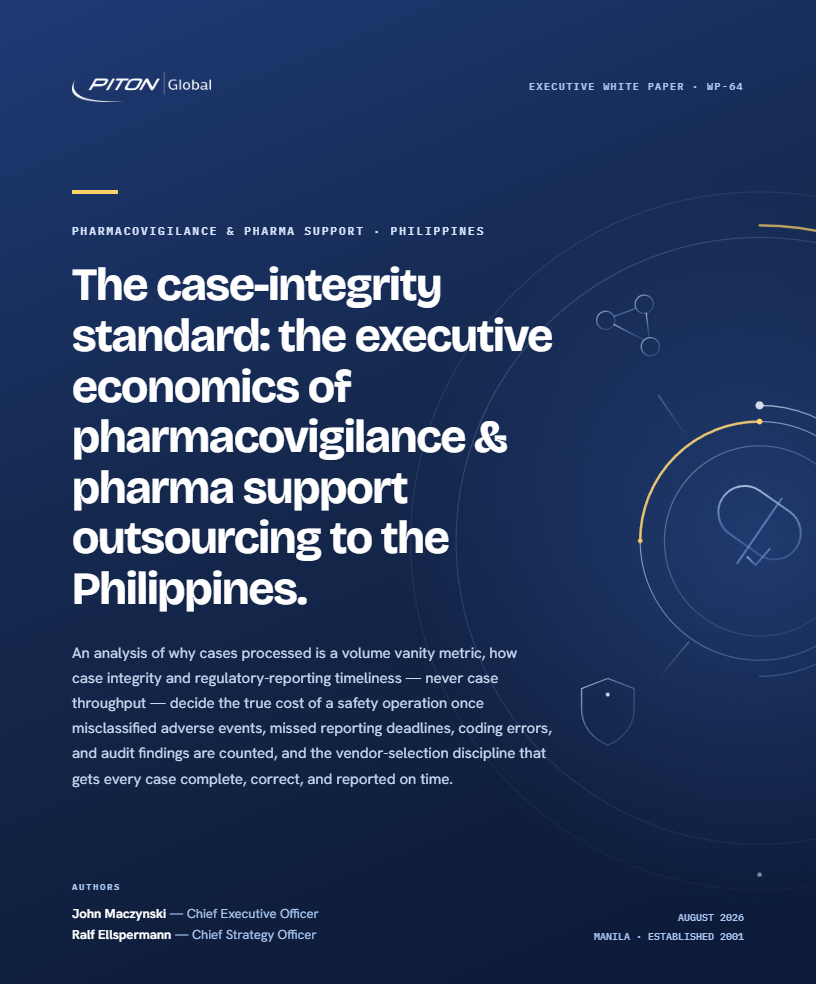
The case-integrity standard: the economics of pharmacovigilance & pharma support outsourcing.

Why cases processed is a volume vanity metric, how case integrity and regulatory-reporting timeliness — never case throughput — decide the true cost of a safety operation once misclassified adverse events, missed reporting deadlines, coding errors and audit findings are counted, and the vendor-selection discipline that gets every case complete, correct, and reported on time. Part of PITON-Global’s Executive White Paper Series, by John Maczynski and Ralf Ellspermann.

14 pages 9-min read Ellspermann & Maczynski
WHAT IS INSIDE
The volume mirage: cases processed versus compliant, audit-ready cases.
The case contract: intake it complete, assess it accurately, report it on time.
Case Study PV-089: a 70-seat pharmacovigilance operation re-based on case integrity — 6.2× first-year ROI.
Read the white paper (PDF) Free · no gate · published August 2026
ONE FDA FORM 483 IS ONE TOO MANY

The pharma vendors an inspector can’t fault.

Four gates stand between a shortlisted partner and your pharmacovigilance inbox: a live causality-assessment evaluation, a 21 CFR Part 11 system walkthrough, a MedDRA coding-accuracy test, and a GVP-aligned SOP review. The teams that clear all four carry no Scientific Literacy Gap and no GxP documentation debt — regulatory sovereignty, proven before you sign.

Request the pharma shortlist
Vendor-neutral · no cost to you · verified by John Maczynski, CEO
Our 24-Hour Response Guarantee — a reply within 24 hours, causality-assessment and Part 11 pre-screen included.
12ANSWERED BY OUR PRINCIPALS

What pharma leaders ask before they outsource.

In-depth answers to the questions that decide a pharma BPO engagement — from the principals who run them.

Are you compliant for regulated pharmacovigilance work?+
Yes. GxP-aware teams work on validated, access-controlled, audited systems, following your SOPs and regulatory requirements. Case handling, documentation and timelines are built to satisfy your quality function and inspectors, with a complete, traceable record behind every case.— John Maczynski, CEO
How do you keep case intake and processing accurate?+
Maker-checker controls and QA apply to every adverse-event case, validating coding, seriousness and completeness before submission. That holds accuracy high and protects regulatory timelines, so cases are handled right the first time rather than corrected under inspection pressure.— Ralf Ellspermann, CSO
What does outsourcing pharma operations save us?+
Typically 50 to 70 percent on cost versus onshore, with faster, compliant case handling. The deeper benefit is scalable, validated capacity for pharmacovigilance and back-office work that flexes with caseload without compromising quality or regulatory standing.— John Maczynski, CEO
How is sensitive patient and safety data protected?+
All work runs on ISO 27001-aligned, validated environments with no local storage, role-scoped access and complete audit trails. Every action is logged, data is scoped per project, and nothing leaves the secured environment — keeping you defensibly compliant.— Ralf Ellspermann, CSO
Can you scale with caseload and product launches?+
Yes. We flex case-processing and back-office capacity across launches, safety signals and seasonal volume, so backlogs and regulatory timelines stay controlled. Validated controls hold identically as volume climbs, protecting both accuracy and compliance.— Ralf Ellspermann, CSO
Will your teams work in our safety and CRM systems?+
Yes. Specialists work natively in your safety databases and CRM, with full audit trails, rather than re-keying across systems. That preserves data integrity across the case lifecycle and keeps your records and ours aligned and inspection-ready.— John Maczynski, CEO
Which pharma functions should we outsource first?+
Start with high-volume, well-defined work — case intake, triage, medical information and back-office — where validated controls and consistency move timelines and accuracy fastest. More complex signal and submission work follows once those controls are proven.— John Maczynski, CEO
How quickly can a pharma team be live?+
About eight weeks, through a gated stand-up. No cases process live until validated QA controls are signed off and a parallel run reconciles clean against your systems and SOPs. You see proven, compliant accuracy before any real caseload flows.— Ralf Ellspermann, CSO
How is performance measured and governed?+
Against compliance, case accuracy, timeliness and quality, in a live dashboard with monthly reviews. We deliberately never report raw volume — cases processed fast but wrong create regulatory exposure and rework, not genuine progress.— Ralf Ellspermann, CSO
Are you tied to one vendor or platform?+
No. We are vendor-neutral across pharma BPO providers and platforms. Systems, therapeutic areas and goals get assessed, the right-fit partner gets matched at no charge — and the decision never leaves your hands.— John Maczynski, CEO
Authorship, Review & Benchmark Verification
Authored by:
Ralf Ellspermann
Ralf Ellspermann
Chief Strategy Officer of PITON-Global
Two Decades Building and Advising Award-Winning Philippine BPO Operations

Ralf benchmarks pharmacovigilance-aware intake and adverse-event routing across Philippine vendors supporting pharmaceutical companies.

View full bio  →
Verified by:
John Maczynski
John Maczynski
CEO of PITON-Global
Former Global EVP of the World’s Largest Contact Center · Four Decades of Outsourcing Experience

John validates the quality and compliance terms behind each pharma program, holding benchmarks to GxP-aware standards.

View full bio  →
Last Reviewed & VerifiedJuly 7, 2026

Re-audited as GxP, pharmacovigilance reporting and SOC 2 obligations evolve. Every benchmark on this page is held to PITON-Global’s internal vetting standard.

Segments We Serve
Pharma Biopharma Generics OTC Specialty Pharma Pharmacovigilance Medical Information Commercial Support Adverse Events Compliance
Inquire Now