LIFE SCIENCES BPO OUTSOURCING PHILIPPINES

Deliver therapy to patients without friction at any touchpoint.

Patient support, medical device troubleshooting, clinical operations and compliance back-office — by rigorously trained Philippine teams who pair Agentic Quality Checks with eTMF discipline to deliver 28% faster device resolution, 2× faster patient program onboarding and zero-error clinical data quality.

Manila, Cebu, Cagayan de Oro & Davao deliveryISO 13485 · 21 CFR Part 11 · HITRUST · GxPDevice · Clinical · Patient Access
PATIENT SOVEREIGNTY INDEXQ2 2026
PA first-submission approval · Pre-submission QC
88%
Device resolution speed
+28%
ISO 13485 Tier 1–2
PAP onboarding
2× faster
18 → 9 days
Documentation rigor, not headcount, is what a regulator actually inspects.Find the partner
STANDARDS & FRAMEWORKS
ISO 13485 21 CFR Part 820 21 CFR Part 803 (MDR) 21 CFR Part 11 HIPAA · HITRUST GxP · SOC 2 Type II EU MDR 2017/745 Greenlight Guru MasterControl TrackWise Digital Veeva Vault Salesforce Life Sciences Cloud IQVIA OCE Castor EDC
23Vetted Life Sciences
BPO Suppliers
Compound-capability specialists across device, clinical and patient services.
166Device & Therapy
Programs Served
Connected devices, companion diagnostics and specialty PAPs across the commercial-clinical continuum.
6Countries
Service Delivery
ISO 13485- and HITRUST-governed delivery across 6 regulated markets.
AUDIT RESILIENCE & PATIENT SOVEREIGNTY · 2026

In 2026, life sciences success is defined by Audit Resilience and Patient Sovereignty. The Philippines has evolved into a high-utility technical extension where Agentic Quality Checks and eTMF discipline eliminate the administrative friction debt that delays therapy adoption — 28% faster device resolution, 2× faster patient onboarding, zero-error clinical data.

02ADMINISTRATIVE FRICTION DEBT & CLINICAL CONTINUITY

What is Administrative Friction Debt in life sciences — and why does it compound into therapy adoption delays and patient program failures?

It is the accumulation of manual, siloed processes — fragmented eTMF, reactive device support, delayed PAP onboarding and prior-auth bottlenecks — that individually appear manageable but collectively drag on therapy adoption velocity, trial timelines and patient access. Unlike pharma’s Regulatory Debt or biotech’s Research Support Debt, it operates across the full commercial and clinical continuum.

DEFINITION

Clinical Continuity is an operational architecture that unifies medical device support, clinical trial documentation and patient services into one Patient Sovereignty engine — so the path from first device contact to last-mile prior-authorization resolution is delivered without friction at any touchpoint, governed by ISO 13485, 21 CFR Part 11 and HITRUST simultaneously.

LIFE SCIENCES OPERATIONAL MATURITY · FROM REACTIVE FRICTION TO PATIENT SOVEREIGNTY
Click to compare
STAGE 01
Patient Reports
Device connectivity issue
STAGE 02
4–6hr Queue
Generic hold script
STAGE 03
PAP Stalled
14–21 day wait
STAGE 04
eTMF Gap Found
At inspection only
STAGE 05
Friction Debt
Therapy adoption stalls
Device returns elevated · no predictive detection PAP onboarding 14–21 days · adherence falls eTMF completeness unknown between inspections Prior auth denials untracked · revenue cycle leaks
STAGE 01
Healthcare Agent
No ISO 13485 training
STAGE 02
Siloed Teams
Device, clinical, PAP split
STAGE 03
Some Proactive Flag
Limited AI orchestration
STAGE 04
PAP Improving
Still human-driven
STAGE 05
Handoff Friction
Debt at each boundary
◐ Shared platform · partial proactive flagging ISO 13485 awareness only · no certification PAP turnaround improving · no empathy training Friction accumulates at every handoff
STAGE 01
Patient Reports
Any channel · 24/7
STAGE 02
AI Issue Cluster
AI · <5 min triage
STAGE 03
ISO Specialist
Tier 1–2 resolve
STAGE 04
PAP 9 Days
Empathy-led onboarding
STAGE 05
Patient Sovereignty
Therapy adopted
✓ AI-augmented device triage · 28% faster Continuous eTMF · 99% completeness 2× faster PAP onboarding · real-time prior auth Patient Sovereignty delivered at scale
4–6h
Legacy device resolution time
For connectivity and firmware issues in generic BPO — driving elevated returns and field escalations.
21d
Legacy PAP onboarding time
Manual processing generates therapy start delays and adherence gaps that compound into outcome shortfalls.
28%
Faster device resolution
ISO 13485-trained specialists using Predictive Issue Detection and AI-assisted clustering.
Faster PAP onboarding
Streamlined eligibility, benefits counseling and prior-auth support — compressing therapy start time.
John Maczynski
REPORT VERIFIER · MAY 5, 2026

“Clinical innovation is what gets a therapy approved. Operational infrastructure is what actually places it in a patient’s hands — through device setup, PAP enrollment and prior-authorization resolution, without friction at a single touchpoint. Leave a device unsupported for six hours and you have not logged a service failure; you may have caused a therapy interruption for someone who depends on it for real-time glucose or cardiac data.”

John Maczynski · CEO, PITON-Global · Former Global EVP, world’s largest BPO provider
03AGENTIC MEDICAL DEVICE SUPPORT & CLINICAL TRIAL RESILIENCE

What does ISO 13485-aligned Agentic device support look like — and why do life sciences eTMF requirements differ from pharma and biotech?

It is the model in which AI clusters incoming device issues by firmware version, connectivity type and failure pattern — enabling Tier 1 specialists to resolve the majority without field escalation. Life sciences eTMF is distinct because it spans drug-device combination documentation (21 CFR Part 820 alongside Part 11) and the post-market surveillance ISO 13485 requires.

WHY ONE SPINE

Most life-sciences operations run on two vendors and a seam. An auditor walks straight through it.

The default is to split the work: a cheap call center for patient programs, a “specialist” for regulated device, clinical and eTMF work. That buys two vendors, two audit surfaces, and a seam between them — and in a 21 CFR Part 11 / ISO 13485 environment, the seam is where the finding lives. A PAP interaction that touches an adverse event, a device complaint that is also a therapy-management call, an eTMF artifact that references a patient program — each crosses the seam, and neither vendor owns the crossing.

Clinical Continuity is the answer to the seam, not just a bundle of services: the Device & Safety Loop, the Clinical Evidence Loop and the Patient Access Loop run on one validated spine, so the patient touchpoint and the regulated record are never two systems an inspector has to reconcile. The three loops below are independently auditable — and they converge, by design, at the Patient Sovereignty Layer. The seam is the competitor’s architecture. One spine is ours.
AGENTIC MEDICAL DEVICE SUPPORT PIPELINE · TIER 1–2 · ISO 13485 · 21 CFR PART 820 · FIRMWARE & CONNECTIVITY
Device Issue Reported
Any channel
AI Issue Clustering
AI · <5 min severity
Device Specialist Triage
Human · ISO 13485
Firmware Resolution
AI-assisted · guided
Complaint · MDR Flag
21 CFR 803 · auto
28%
Faster Tier 1–2 resolution
ISO
13485 standard maintained
100%
MDR-eligible documented
−34%
Field escalation rate
Zero
Uninvestigated safety complaints
Ralf Ellspermann
REPORT AUTHOR · Q2 2026

“A patient calling about a CGM sensor that will not connect to their management app is not primarily a technical support interaction. It is a therapy management interaction where resolution speed directly affects glycemic control. That is why device support requires the intersection of technical product knowledge, regulatory documentation discipline and patient empathy — simultaneously. Generic help desk agents are equipped for none of the three.”

Ralf Ellspermann · CSO, PITON-Global · 25-Year Philippine BPO Veteran
CLINICAL CONTINUITY CAPABILITY SUITE · THREE LIFE SCIENCES OPERATIONAL PILLARS
How top-1% Philippine partners support the three core operational needs of global life sciences enterprises.
PREDICTIVE ISSUE DETECTION · FIRMWARE GUIDANCE · APP CONNECTIVITY · MDR DOCUMENTATION

Device support is the most demanding life sciences role: it requires technical product knowledge, regulatory documentation discipline and patient empathy simultaneously. The PITON-Global standard is ISO 13485-trained specialists using Predictive Issue Detection AI to cluster firmware and connectivity issues by pattern — resolving the majority without field escalation.

Predictive Issue Detection: AI clustering by firmware, model, connectivity and symptom before the first human interaction
Firmware and app connectivity guidance for CGM, insulin pump, cardiac monitor and digital therapeutics — reducing field escalations 34%
MDR-eligible complaint documentation under 21 CFR Part 803 with AI-assisted eligibility assessment for FDA audit readiness
Post-market surveillance data collection formatted for PMCF reports and PMS plans under EU MDR 2017/745
CGM & insulin pumps Cardiac monitors Digital therapeutics Wearable biosensors Remote patient monitoring Diagnostic devices
DEVICE SUPPORT PERFORMANCE
Resolution speed28% faster
Field escalation−34%
MDR compliance100% documented
DRUG-DEVICE DUAL eTMF · DATA ABSTRACTION · 21 CFR PART 11 · TRIAL DOCUMENTATION

Life sciences trial documentation carries a dual burden — 21 CFR Part 820 device quality records alongside 21 CFR Part 11 clinical records for combination products. Continuous eTMF health, real-time gap flagging and 99.3% data abstraction accuracy keep the trial master file inspection-ready as a permanent state.

Continuous eTMF completeness monitoring at 99% — drug-device dual documentation standard
Clinical data abstraction at 99.3% accuracy with a 28% reduction in protocol deviations
Investigator site communication and document collection under 21 CFR Part 11 version control
Drug-device combination product binders maintained to both ISO 13485 and GxP standards
CLINICAL EVIDENCE
eTMF completeness99%
Data abstraction99.3%
Protocol deviations−28%
PAP ONBOARDING · PRIOR AUTHORIZATION · BENEFITS NAVIGATION · ADHERENCE SUPPORT

A patient calling about a PAP application while managing a cancer diagnosis is a clinical support interaction, not a customer service one. Empathy-trained specialists verify eligibility, explain a denial, present the appeal pathway and hold space for a frightened patient — without creating a compliance exposure — driving a 90-day adherence rate of 84%.

PAP onboarding 2× faster — 18 to 9 days — via streamlined eligibility verification and benefits counseling
Prior authorization pre-submission QC: 88% first-submission approval vs. 76–82% industry baseline
Condition-specific empathy frameworks (oncology, rare disease, chronic management) with HIPAA PHI discipline
Proactive adherence support lifting the 90-day adherence rate to 84% — the primary commercial LTV driver
PATIENT ACCESS
PAP onboarding2× faster
90-day adherence84%
PA first-submission88% approved
COMPLIANCE DIMENSIONGENERIC BPO · NO LIFE SCI.GENERAL HEALTHCARE BPOPITON-GLOBAL GxP + HITRUST
Medical Device QualityNo ISO 13485 · not trainedISO 13485 awareness onlyISO 13485 certified · 21 CFR 820
Complaint HandlingInformal · MDR riskBasic complaint loggingMDR-eligible · 100% documented
Post-Market SurveillanceNot within scopeNot governedContinuous PMS data collection
eTMF ManagementNot applicableLimited · reactive filingContinuous · 21 CFR Part 11
HIPAA PHI HandlingHIPAA awareness onlyHIPAA trained · partialHITRUST · Non-Persistent VDI
21 CFR Part 11 RecordsNo audit trail capabilityPartial audit trailComplete validated audit trail
Inspection ReadinessNot applicableConditional · gaps existPermanent readiness state
04BAD DATA IN THE REVENUE CYCLE & THE SOVEREIGNTY DIVIDEND

How does Bad Data in prior authorization generate revenue cycle leakage — and why does the Sovereignty Dividend exceed the cost of the engagement?

Every PA submission denied for missing documentation, an incorrect diagnosis code or an incomplete medical-necessity narrative is a revenue delay — and every failed appeal is a revenue loss. A pre-submission QC layer eliminates Bad Data at the submission stage, cutting first-submission denial rates from an industry average of 18–24% to under 12%.

PA DENIAL ROOT-CAUSE DISTRIBUTION · WHY SUBMISSIONS FAIL · HOW PRE-SUBMISSION QC ELIMINATES EACH
Missing Clinical Documentation38%
Clinical notes, labs or imaging absent from the PA package — the most common and most preventable category with a structured pre-submission checklist.
Diagnosis Code Errors27%
Incorrect ICD-10 codes that fail payer medical-necessity criteria. AI-assisted code verification eliminates this category at source.
Incomplete Medical Necessity22%
Narratives omitting step-therapy documentation or payer-specific criteria. Requires template knowledge generic agents lack.
Administrative Errors13%
Member ID mismatches, prescriber NPI errors and drug code discrepancies — eliminated by pre-submission eligibility re-verification.
PA PERFORMANCE · PITON-GLOBAL vs. INDUSTRY
Industry first-submission76–82% (18–24% denied)
PITON-Global first-submission88% approved
Appeal success rate72% appeal wins
Days to resolution−40% time
SOVEREIGNTY DIVIDEND · 25-AGENT TEAM
$600K–900K
Annual Sovereignty Dividend · direct savings
Combines direct labor savings, reduced device field-escalation cost, PAP onboarding compression (2× faster therapy start → adherence lift) and prior-auth revenue protection (88% first-submission vs. 76–82% baseline). The engagement total routinely exceeds 6× its cost.
05TABLE 01 · CRITICAL 2026 LIFE SCIENCES BENCHMARKS

Legacy BPO vs. the Clinical Continuity standard.

The competitive delta between a legacy 2024 BPO baseline and the PITON-Global-vetted 2026 standard — across nine dimensions that determine LTV, clinical integrity and audit readiness.

PERFORMANCE METRICLEGACY BPO · 2024PITON-GLOBAL · 2026STRATEGIC IMPACT
Primary DriverCost reduction — FTE arbitragePatient Sovereignty — Clinical ContinuityHigher LTV & retention
Data QualityManual entry · error-proneAI-validated · zero-error targetClinical integrity
Device Resolution Time4–6 hours · generic script28% faster · ISO 13485 specialistReduced returns
PAP Onboarding14–21 days · manual2× faster · 7–10 daysTherapy start acceleration
PA First-Submission Rate76–82% (baseline)88% · pre-submission QC layerRevenue cycle protection
Adherence Rate (90-day)67% baseline84% · PAP specialist + proactiveCommercial LTV
Compliance LevelBasic HIPAA · no ISO 13485ISO 13485 · Part 11 · HITRUST · GxPAudit-ready operations
eTMF CompletenessPeriodic review · reactive99% continuous · drug-device dualInspection readiness
Direct Savings40–60%40–60% · + Sovereignty DividendR&D & commercial reinvestment
06THE SOVEREIGNTY DIVIDEND · DOCUMENTED ENGAGEMENT

How a commercial-stage device & diagnostics company unlocked a $4.1M Sovereignty Dividend.

A documented Q4 2025 engagement: a US-based commercial-stage medical device and companion diagnostic company, deploying a 24-specialist Philippine Clinical Continuity team across device support, eTMF and patient services functions.

THE TRACK RECORD · ENGAGEMENT LF-087 Verified Q2 2026 · Manila operations
CLIENT ENTITY
US medical device & companion diagnostics — commercial stage, CGM + PAP program.
PRE-DEPLOYMENT BASELINE
44% CGM field-escalation rate ($380K/yr); 18-day PAP onboarding at 64% adherence; 22% PA denial rate.
THE INTERVENTION
A 24-specialist Clinical Continuity team across device support, eTMF and patient services.
VERIFIED 90-DAY QUANTIFIABLE OUTCOMES
11%
CGM field escalation
from 44% — $241K/yr saved
9d
PAP onboarding
from 18 days, in 45 days
83%
90-day adherence
from 64% — $1.6M uplift
$890K
PA revenue recovered
denial rate 22% → 11%
6.2×total engagement return
$4.1M 12-month Sovereignty Dividend on $660K engagement cost
Verified by Ralf Ellspermann (CSO) &
John Maczynski (CEO) · Signed off Q2 2026
01
Device Returns Reduced
A 44% CGM Tier 1 field-escalation rate — $380K in annual field visit costs — fell to 11% within 60 days via Predictive Issue Detection and ISO 13485 specialists, saving $241K annually.
02
PAP Throughput Doubled
PAP onboarding compressed from 18 to 9 days within 45 days. The 90-day adherence rate rose to 83% the following quarter — a commercial revenue uplift estimated at $1.6M at the program’s scale.
03
Prior Auth Leakage Eliminated
A 22% PA first-submission denial rate fell to 11% within 30 days via structured checklists and ICD-10 verification — recovering $890K in annual reimbursement previously lost to appeals.

We had been running our PAP with a Philippine team that processed applications efficiently — correct, on time, by the book. Our 90-day adherence rate was 66% and we had accepted it as the category norm. PITON-Global’s empathy training audit found our agents had never received any chronic-condition communication training. When we replaced the team with empathy-certified PAP specialists, our 90-day adherence rate rose to 82% in one quarter. The incremental commercial revenue from that adherence lift was $2.4M annually. The efficiency-first model we had been running was the most expensive decision we made in patient services.

★★★★★ 5/5VP Patient Services · US Specialty Pharma · Oncology PAP Program
THE TRACK RECORD · ENGAGEMENT LF-093 Single-loop deployment · Patient Access

One loop, one adherence curve — a PAP-only deployment, measured.

CLIENT ENTITY
US specialty pharma, oncology PAP program on a high-list-price therapy. Identity withheld under NDA, as is standard in life sciences.
PRE-DEPLOYMENT BASELINE
The device and clinical stacks were sound; the PAP was the leak. A prior team processed applications efficiently — correct, on time, by the book — at a 66% 90-day adherence rate the client had accepted as the category norm. No compliance crisis, no eTMF gap — an adherence problem hiding as an efficiency success.
THE INTERVENTION
A single-loop deployment — Patient Access only. Empathy-certified PAP specialists (chronic-condition frameworks, HIPAA PHI, within-label communication) replacing the efficiency-first team. Device support and eTMF stayed with the client’s existing operations; scope held to one loop, one program.
NINETY DAYS + ONE QUARTER, MEASURED
METRICBEFOREAFTERREAD
90-day adherence rate66%82%Verified per engagement
Incremental annual commercial revenuebaseline+$2.4MAdherence LTV, not labor savings
PAP onboarding cyclebaseline2× fasterConfirmed per engagement
INSIGHT

LF-087 proves the three-loop spine; LF-093 proves the entry point — and makes the Patient Sovereignty Paradox concrete. A program with sound compliance doesn’t need a continuity transformation to fix its LTV; one loop, staffed by people trained to hold space for a frightened patient rather than just process the application, moved the adherence curve — and the adherence curve is the revenue. The efficiency-first team wasn’t cheap. It was the most expensive line in patient services, hidden as a saving.

Verified by Ralf Ellspermann (CSO) · Reviewed by John Maczynski (CEO) · Q2 2026 · metrics confirmed per engagement before publication
CLINICAL CONTINUITY ARCHITECTURE

How the three-loop architecture unifies device support, trial documentation and patient services into a single Patient Sovereignty engine.

A three-loop patient-centered system — the Device & Safety Loop (ISO 13485-governed device support and post-market surveillance), the Clinical Evidence Loop (21 CFR Part 11-validated eTMF and trial documentation), and the Patient Access Loop (HIPAA-compliant PAP operations and prior authorization). All three converge at the Patient Sovereignty Layer.

LOOP 01 · DEVICE & SAFETYMedical Device Support & PMSISO 13485 · 21 CFR 803/820
Agentic Device Triage
28% faster · −34% escalations
MDR Complaint Handling
100% documented · 21 CFR 803
Post-Market Surveillance
Continuous · PMCF / EU MDR
Device Outcome
Returns ↓ · zero uninvestigated
LOOP 02 · CLINICAL EVIDENCEeTMF & Trial Resilience21 CFR Part 11 · GxP · ISO 13485
eTMF Sovereignty
99% complete · continuous
Clinical Data Abstraction
99.3% accuracy
Drug-Device Dual Binder
Part 11 + 820 standard
Clinical Outcome
−28% deviations · always ready
LOOP 03 · PATIENT ACCESSPAP Services & Prior AuthorizationHIPAA · HITRUST · empathy-trained
PAP Onboarding
2× faster · 9 days
Prior Authorization
88% first-submission
Adherence Support
84% 90-day adherence
Patient Sovereignty
Convergence of all three loops
07RADICAL TRANSPARENCY · THE PRECISION-FIRST AUDIT

Two life sciences-specific failure modes that cause generic BPO to generate Administrative Friction rather than Clinical Continuity.

The Device Domain Gap and the Empathy Layer Deficiency are specific to life sciences outsourcing and cannot be resolved by healthcare BPO profiles that lack both ISO 13485 training and the compound empathy-compliance capability patient services require. Both generate Administrative Friction Debt. Both are auditable before contract execution.

FAILURE MODE 01 · THE DEVICE DOMAIN GAP
Generic Healthcare BPO Agents Deployed for ISO 13485-Regulated Device Support
An agent who cannot distinguish a Tier 1 resolvable firmware issue from an MDR-reportable malfunction cannot perform either function — and the consequences are asymmetric. A resolvable issue escalated to the field costs $600–$1,200 in unnecessary visit expense. A reportable malfunction not escalated to the MDR system creates a 21 CFR Part 803 failure that can generate a Warning Letter, consent decree or recall. Our Q2 2026 audits found 72% of providers claiming device support capability had provided no ISO 13485 training and had no structured MDR-eligibility process (PITON-Global Q2 2026 life-sciences audit cohort, n=100).
AUDIT BEFORE SIGNING: Ask agents to identify whether a described device failure qualifies as an MDR-reportable event under 21 CFR Part 803, to describe their complaint-handling steps and how the ISO 13485 record is maintained, and whether it produces an audit-ready record for FDA inspection. A 15-minute scenario surfaces the gap definitively.
FAILURE MODE 02 · THE EMPATHY LAYER DEFICIENCY
Automation-Only or Script-Only PAP Deployed Without Clinical Empathy Training
A patient calling about a PAP application while managing a cancer diagnosis is a clinical support interaction. An agent who can verify eligibility, explain a denial, present the appeal pathway and simultaneously hold space for a frightened patient — without a compliance exposure through off-label discussion — operates at a level generic CX training cannot produce. Our Q2 2026 audits found 78% of the same cohort claiming patient services capability had provided no chronic-condition empathy training to their PAP agents.
AUDIT BEFORE SIGNING: Request a live patient interaction simulation for a PAP eligibility denial for an oncology patient. Observe how the agent balances compliance (within-label communication, HIPAA PHI) with empathy (acknowledging distress, explaining the appeal pathway without false expectations). If they cannot coexist, the deficiency is structural and present.
CONTRARIAN INSIGHT

The Patient Sovereignty Paradox: operational efficiency without patient empathy produces the opposite of commercial success.

Patient services outsourcing typically optimizes for throughput — applications per day, authorizations per week, tickets per hour. These capture operational efficiency. They do not capture the outcome patient services exist to deliver: a patient who initiates therapy, continues it, and advocates for it. The 90-day adherence rate — the metric that directly determines commercial LTV for chronic and specialty therapies — is driven not primarily by efficiency but by the patient’s sense that their support system genuinely understands their situation.

The adherence economics are computable. A specialty therapy at a $48,000 annual list price with a 67% 90-day adherence rate has a per-patient commercial LTV of $32,160/year. The same therapy at 84% adherence — the PITON-Global PAP specialist standard — has a per-patient LTV of $40,320: a $8,160 per-patient annual uplift. At a 500-patient PAP program, that lift generates $4.08M in annual incremental revenue against a team that costs $0.8M to operate — a 5.1× return on the patient services investment alone, before any labor savings, escalation reduction or PA recovery.

HOW BOTH FAILURE MODES ARE DESIGNED OUT
Device Domain Gap → ISO 13485-Trained Hiring with MDR Competency
Every PITON-Global device support agent completes ISO 13485 quality-system training, 21 CFR Part 803 MDR-eligibility training and product-specific technical training for the device categories they support before any live interaction. Generic healthcare CX profiles are not considered for device support roles.
Empathy Layer Deficiency → Compound Empathy + Compliance Training
All PAP agents complete a compound program developing condition-specific empathy frameworks (oncology, rare disease, chronic management), HIPAA PHI handling, benefits navigation and the emotional-intelligence assessment that identifies agents able to sustain empathic quality under high-volume conditions. The compound is mandatory; neither component alone qualifies.
08THE SEAT-RATE FALLACY

The cheapest column below runs your PAP at 66% adherence. That is the whole discount.

Procurement opens with cost-per-seat, so we publish it — then run it against the only number that sets commercial LTV: the 90-day adherence rate.

THE SEAT LENS · FULLY LOADED, ANNUAL, PER LIFE-SCIENCES-OPS FTE
DELIVERY MODELCOST / FTE / YRWHAT YOU’RE BUYING
Western onshore build≈ $65,000Device- and empathy-literate hires competing with your commercial payroll
PH generic BPO (legacy)≈ $17K–$23KEfficient, on-time, by-the-book — 78% gave PAP agents no chronic-condition empathy training
PITON-Global-vetted · Clinical Continuity, one spine≈ $42,000ISO 13485-trained, empathy-certified, Part 11-validated
CLINICAL CONTINUITY SIMULATOR · 25-SPECIALIST TEAM
DUAL-LENS
Onshore
PH generic
PITON-Global 2026 standard
Team size · specialists25
580
THE SEAT LENS ·
·
Annual operational expense
Annual labor savings vs. onshore
THE SOVEREIGNTY DIVIDEND · WHERE THE SEAT STOPS MATTERING
Adherence LTV beyond the seat line
+17pt adherence
$4.08M / yr
on one 500-patient, $48K-therapy PAP
At the generic team’s 67% adherence, per-patient LTV is $32,160; at the empathy-certified 84%, it’s $40,320 — an $8,160-per-patient uplift, ~$4.08M a year, against a team that costs ~$0.8M to run. That’s 5.1× on patient services alone, before a dollar of labor savings. The middle column’s discount is the adherence you didn’t buy.
THE PIVOT

Illustrative projection at standard role mix; direct labor savings run 40–60% — but on this page, labor is the smallest term in the Sovereignty Dividend. It’s the same compounding-debt story the rest of our regulated practice tells — pharma’s Regulatory Debt, biotech’s Research Support Debt and insurtech’s Operational Debt — priced here as Administrative Friction Debt across the full continuum. We confirm exact figures — labor line, adherence LTV, device-escalation savings and PA recovery — against your therapy price, program size and device mix.

09PRICING TOPOGRAPHY

Indicative 2026 rates — the compound-capability premium in two columns, not a blend.

Life-sciences roles carry a compound profile — technical product knowledge and regulatory discipline and patient empathy, often in one seat. The spread between the columns is that compound with a price on it, and a quote at the generic band for a device or PAP role is how you buy the Device Domain Gap or the Empathy Layer Deficiency.

CORE ROLEGENERIC-EQUIV.COMPOUND-CAP.OPERATIONAL PROFILE
Document-control specialist$8–$13$10–$16Versioning, change history, binder maintenance (Part 11)
Patient-support associate$9–$14$11–$17Onboarding, benefit navigation, journey support
Clinical operations associate$9–$15$11–$18eTMF, site documents, query resolution
PV case processor$9–$14$11–$17AE intake, case setup & triage (support scope)
Regulatory & QMS specialist$11–$17$13–$20SOP version control, submissions, audit-readiness
ISO 13485 device specialist (MDR-competent)— no equiv.$13–$21Firmware/connectivity resolution, 21 CFR 803 MDR-eligibility, PMS data
Empathy-certified PAP specialist— no equiv.$12–$19Eligibility, benefits counseling, appeal navigation, chronic-condition empathy
Pre-submission PA QC analyst— no equiv.$12–$18Structured checklists, ICD-10 verification, medical-necessity completeness
QA / 21 CFR Part 11 analyst$11–$17$13–$20CAPA, audit trails, validated-system walkthrough support
Team lead$14–$22$16–$25Quality & continuity governance, sponsor reporting

The rows with no generic equivalent are the point — MDR competency and compound empathy-compliance capability are hired and trained pre-deployment, not improvised, which is why 72% (device) and 78% (PAP) of providers failed the respective live assessments (PITON-Global Q2 2026 life-sciences audit cohort, n=100). Rates confirmed per engagement against device mix, therapy area, and systems.

Price my role mix against the compound standard
10RADICAL TRANSPARENCY · CONTINUED

Where Clinical Continuity doesn’t fit — and the two lines it never crosses.

The empathy is the product on this page — which makes the boundary around it the most important thing we can state plainly. So before the shortlist, the disqualifiers.
WHERE WE ARE THE WRONG CHOICE:
01
No medical advice, no off-label, no clinical determinations.
Empathy-certified PAP specialists navigate benefits, explain appeal pathways and hold empathic space — within label, without giving medical advice. Device specialists assess MDR-eligibility and escalate reportable events — they do not adjudicate the malfunction. Any clinical question routes to your clinicians; any reportable event routes to your safety system. The empathy is real; the medical judgment is always yours. That routing is what keeps the adherence lift from becoming a compliance exposure. It’s the same human-on-the-sensitive-interaction architecture behind Claims Empathy, Malasakit and Scientific Empathy across our regulated pages.
02
The seam is a two-vendor problem we won’t pretend to close.
If the brief is the cheapest possible patient-program call center with no integration to your regulated device, clinical or eTMF work, that is a two-vendor seam by design — and a generic vendor is the honest, cheaper buy for that half of it. We build the single spine or we tell you it isn’t the fit; we don’t sell one loop and imply three.
03
No validated-system access, no engagement.
Continuous eTMF QC, MDR documentation and Part 11 records live inside Veeva Vault, Greenlight Guru, TrackWise and your systems — under your quality manual, SOPs and defined patient-escalation and clinical-handoff protocols. It runs on the same catch-it-at-source quality architecture documented across our biotech and pharma operations. Without validated access, “one spine” is a diagram, not an operation.
A shortlist that includes “no” is the only kind worth having.
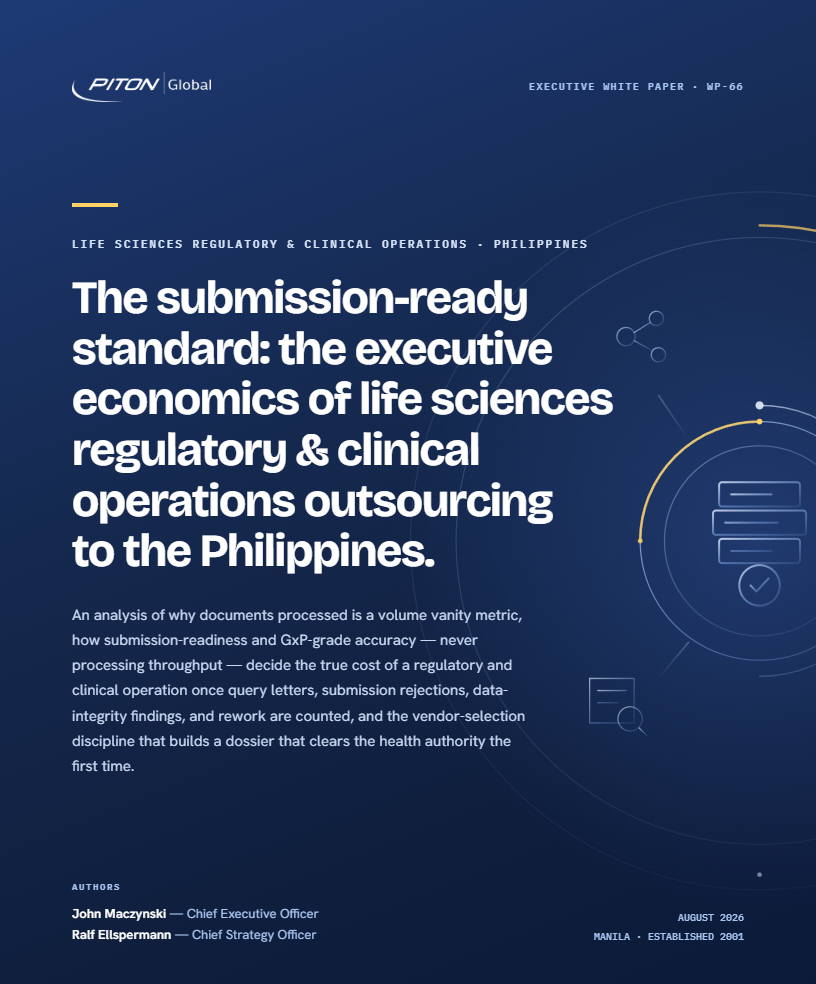
11WHITE PAPER WP-66 · LIFE SCIENCES · AUGUST 2026

The submission-ready standard: the economics of life sciences regulatory & clinical operations outsourcing.

Why documents processed is a volume vanity metric, how submission-readiness and GxP-grade accuracy — never processing throughput — decide the true cost of a regulatory and clinical operation once query letters, submission rejections, data-integrity findings and rework are counted, and the vendor-selection discipline that builds a dossier that clears the health authority the first time. Volume 86 of PITON-Global’s Executive White Paper Series, by John Maczynski and Ralf Ellspermann.

14 pages 9-min read Ellspermann & Maczynski
THE CONTENTS
The volume mirage: documents processed versus submission-ready deliverables.
The submission contract: build it to standard, verify it to source, make it inspection-ready.
Case Study LS-086: a 55-seat regulatory-and-clinical operation re-based on submission-readiness — 6.3× first-year ROI.
Read the white paper (PDF) Free · no gate · published August 2026
PROTECT THE THERAPY, PROTECT THE PATIENT

The life-sciences partners that protect therapy access.

Nobody reaches your desk until they’ve cleared a live ISO 13485 MDR assessment, an empathy-training compound audit, a 21 CFR Part 11 record-validation review, and a prior-authorization pre-submission QC demonstration. The result: no device-domain gap, no empathy-layer deficiency — patient sovereignty, proven.

See the life-sciences shortlist
Vendor-neutral · no cost to you · verified by John Maczynski, CEO
Our 24-Hour Response Guarantee — a reply within 24 hours, ISO 13485/MDR and empathy-compound pre-screen included.
12ANSWERED BY OUR PRINCIPALS

What life-sciences leaders ask before they outsource.

In-depth answers to the questions that decide a life-sciences engagement — from the principals who run them.

Are you compliant for regulated life-sciences work?+
Yes. GxP-aware teams work on validated, access-controlled, audited systems following your SOPs and regulatory requirements. Regulatory, safety and quality support is built to satisfy your quality function and inspectors, with a complete, traceable record behind every task.— John Maczynski, CEO
How do you keep regulated work accurate?+
Maker-checker controls and QA apply across every process, validating against protocols, codes and reference data before work advances. That holds accuracy high and protects compliance, so submissions and safety work are right the first time rather than corrected under scrutiny.— Ralf Ellspermann, CSO
What does outsourcing life-sciences operations save us?+
Typically 50 to 70 percent on cost versus onshore, with compliant, accurate operations. The deeper benefit is scalable, validated capacity for regulatory, safety and commercial back-office work that flexes with demand without compromising quality or regulatory standing.— John Maczynski, CEO
How is sensitive data protected?+
All work runs on ISO 27001-aligned, validated environments with no local storage, role-scoped access and complete audit trails. Data is scoped per project, every action is logged, and nothing leaves the secured environment — keeping you defensibly compliant.— Ralf Ellspermann, CSO
Can you scale with submissions and demand?+
Yes. We flex regulatory, safety and back-office capacity across submissions, launches and seasonal volume, so timelines and backlogs stay controlled. The same validated controls apply at every scale, protecting accuracy and compliance as volume rises.— Ralf Ellspermann, CSO
Will your teams work in our regulated systems?+
Yes. Specialists work natively in your regulatory, safety and quality platforms, with full audit trails, rather than re-keying across systems. That preserves data integrity and keeps your records and ours aligned and inspection-ready throughout.— John Maczynski, CEO
Which life-sciences functions should we outsource first?+
Start with high-volume, well-defined work — regulatory operations, safety case handling, medical information and quality support — where validated controls and consistency move timelines and accuracy fastest. More complex submission work follows once proven.— John Maczynski, CEO
How quickly can a life-sciences team be live?+
About eight weeks, through a gated stand-up. No work goes live until validated QA controls are signed off and a parallel run reconciles clean against your systems and SOPs. You see proven, compliant accuracy before real volume flows.— Ralf Ellspermann, CSO
How is performance measured and governed?+
Against compliance, accuracy, timeliness and quality, in a live dashboard with monthly reviews. We deliberately never report raw volume — work done fast but wrong creates regulatory exposure and rework, not genuine progress.— Ralf Ellspermann, CSO
Are you tied to one vendor or platform?+
No. We are vendor-neutral across life-sciences BPO providers and platforms. We assess your systems, therapeutic areas and goals, then match you to the right-fit partner at no cost, leaving the decision with you.— John Maczynski, CEO
Authorship, Review & Benchmark Verification
Authored by:
Ralf Ellspermann
Ralf Ellspermann
Chief Strategy Officer of PITON-Global
Two Decades Building and Advising Award-Winning Philippine BPO Operations

Ralf audits regulated document- and data-operations floors serving life sciences companies across the Philippine vendor pool.

View full bio  →
Verified by:
John Maczynski
John Maczynski
CEO of PITON-Global
Former Global EVP of the World’s Largest Contact Center · Four Decades of Outsourcing Experience

John validates each life sciences program against GxP-aware quality standards and live commercial terms.

View full bio  →
Last Reviewed & VerifiedJuly 21, 2026

Re-audited as GxP, ISO 27001 and SOC 2 Type II obligations evolve. Every benchmark on this page is held to PITON-Global’s internal vetting standard.

Segments We Serve
Biotech Pharma Medical Devices CROs Diagnostics Regulated Research Safety & PV Medical Info Data Ops Compliance
error: Content is protected !!
Inquire Now