BLOCKCHAIN BPO OUTSOURCING PHILIPPINES

The compliance perimeter that lets crypto scale without a halt.

AML/KYC, real-time transaction monitoring, Travel Rule, sanctions screening, on-chain investigations and 24/7 support — run by certified analysts who clear every alert within SLA and leave a SAR-ready, examiner-defensible trail.

Manila, Cebu, Dumaguete & Iloilo deliveryFATF / FinCEN / MiCA alignedSAR-ready audit trail
COMPLIANCE PERIMETER INDEXLIVE
Alerts triaged within SLA
up to99.2%
False-positive reduction
47%
risk-tiered triage
Compliance cost vs in-house
63%
certified analyst layer
A regulator wants the decision trail, not the alert count. See who keeps one.Vet compliance desks
TOOLING & FRAMEWORKS
Chainalysis Elliptic TRM Labs Sumsub ComplyAdvantage Notabene Fireblocks Blockaid Merkle Science Hypernative Unit21 FATF Travel Rule FinCEN MiCA SOC 2 Type II
16Vetted Crypto-Compliance
BPO Partners
Certified AML analysts and on-chain investigators — not generic agents.
37MMillion Alerts
Triaged / Year
Risk-tiered, dispositioned and documented across exchanges and VASPs.
5SAR-Ready
Delivery Hubs
Dual-site continuity with examiner-defensible audit trails at every hub.
COMPLIANCE IS THE LICENSE · 2026

In crypto, a compliance gap is not a fine — it is a frozen exchange, a pulled license, a delisting. As MiCA and the Travel Rule bite in 2026, the operators that scale are the ones who can triage every alert within SLA and hand a regulator a documented decision for each one.

02THE RISK-TIER MAP
COMPLIANCE IS THE LICENSE · CONTINUED

In crypto, the support contact and the compliance alert are the same event.

The contact that resets a wallet also tests for account takeover. The onboarding that verifies a user also screens for sanctions. The dispute that recovers funds also flags a possible drainer campaign. Support and compliance are not two floors — they are one surface, and a vendor who splits them across a cheap support desk and a separate compliance team leaves a seam exactly where losses and regulatory exposure collect.

The risk-tier map below runs through support, not beside it. PITON-Global-vetted operations disposition both on one decision-level audit trail — the regulator gets a documented decision on the alert that mattered, and the user gets it resolved, from the same operation. The compliance depth is the anchor; the support surface rides on it.

Not every alert is equal — where does each one go?

Risk-tiering is what separates a defensible program from a backlog. Every monitoring alert is scored and routed by severity — select a tier to see its share of volume, the disposition, the SLA and who acts.

DEFINITION

Risk-tiered alert disposition is a model where every transaction-monitoring alert is scored by severity and routed to a defined action — auto-clear, enhanced due diligence, escalation or SAR — each with an SLA and a documented rationale a regulator can audit.

Click to compare
Share of monitoring alerts · live 90-day blend
71%
Low risk
DISPOSITION
Auto-clear, documented
SLA
< 1 hour
WHO ACTS
Automated rules with sampled analyst QA
Routine, low-value transfers with clean counterparties — cleared and logged, sampled for QA.
19%
Medium risk
DISPOSITION
Enhanced due diligence
SLA
< 8 hours
WHO ACTS
Certified AML analyst
Patterns that warrant a closer look — counterparty research, source-of-funds checks, context.
7.5%
High risk
DISPOSITION
Escalate to MLRO
SLA
< 4 hours
WHO ACTS
Senior analyst + on-chain investigator
Exposure to mixers, sanctioned clusters or structuring — full on-chain trace and write-up.
2.5%
Severe risk
DISPOSITION
SAR filed
SLA
< 2 hours
WHO ACTS
MLRO with investigator-grade package
Confirmed illicit-finance indicators — documented, sourced and filed with a decision trail.
TRANSACTION-MONITORING FUNNEL · 100,000 ALERTS · PITON-GLOBAL DISPOSITION
Alerts generated
100,000100%
Auto-cleared (low risk, documented)
71,00071%
Enhanced due diligence
26,50026.5%
Escalated to MLRO
3,2003.2%
SAR filed
7400.74%
44%
Crypto firms citing compliance as their #1 scaling blocker
Alert volume outruns headcount; backlogs become enforcement risk.
99.2%
Alerts triaged within SLA
Every alert dispositioned and documented inside the regulatory clock.
63%
Compliance cost vs in-house
A certified analyst layer at a fraction of a domestic compliance desk.
47%
False positives, post risk-tiering
Analysts focus on genuine risk instead of drowning in noise.
Ralf Ellspermann
REPORT AUTHOR · Q2 2026

“In crypto, compliance is not overhead — it is the license to operate. A regulator does not ask how many alerts you cleared; they ask to see the documented decision on the one that mattered. That trail is what we build.”

Ralf Ellspermann · CSO, PITON-Global · 25-Year Philippine BPO Veteran
03GENERIC VS. REGULATOR-GRADE

Generic AML labor vs. regulator-grade crypto compliance.

The delta between a generic offshore AML team and the PITON-Global-vetted standard — across seven dimensions that determine examiner outcomes, cost and license risk.

DIMENSIONGENERIC AML · 2024PITON-GLOBAL · 2026STRATEGIC SIGNAL
Analyst ProfileGeneric agentsCertified AML / on-chain analystsDefensible decisions
Alert TriageFIFO backlogRisk-tiered by severityGenuine risk first
Travel RuleManual / partialAutomated VASP exchangeTransfers compliant
SanctionsName-list onlyPEP + behavioral + on-chainEvasion caught
SAR QualityThin narrativesInvestigator-grade, sourcedExaminer confidence
Audit TrailFragmentedImmutable, decision-levelSurvives exam
CoverageBusiness-hours24/7 follow-the-sunMarkets never close
04THE SUPPORT SURFACE, ON THE COMPLIANCE SPINE

The user-facing operations that share the risk-tier map — not a separate floor.

Because the support contact and the compliance signal are one surface, these operations run on the same certified layer, the same audit trail and the same risk-tiering — not a cheaper desk bolted alongside.

01 · WALLET & USER SUPPORT
Wallet-connection, transaction-status and onboarding support across the user lifecycle, where every contact is screened against the same risk signals the monitoring desk sees. A drainer reported in support is a monitoring alert, routed the same way.
02 · TRUST & SAFETY / MODERATION
Proactive Discord and Telegram moderation with scam-pattern and coordinated-toxicity detection, rapid takedown and human escalation. The fake-support impersonator and the seed-phrase-phishing campaign are caught where they live, before the drain.
03 · DISPUTE & ESCALATION
Chargeback, account-recovery and dispute resolution with the same documented, examiner-defensible audit trail the SAR desk produces — so a dispute that turns out to be fraud is already documented, not reconstructed.
THE THROUGH-LINE

These aren’t add-on support seats — they’re the user-facing edge of the same risk-tier map. The certified analyst who owns a high-tier monitoring alert and the specialist who resolves a wallet-drain report are looking at the same signals on the same trail. One surface, one operation, one defensible record.

FOR THE CHIEF COMPLIANCE OFFICER
Could your alert backlog survive a regulator walking in tomorrow?
A 45-minute scoping call maps your monitoring and SAR load — then points you to the regulator-grade operations built for it.
John Maczynski
John Maczynski
CEO, PITON-Global
+1 402 598-8740
Book the scoping call
05THE COST OF A COMPLIANCE GAP

Where does the 9.2× return come from when the license is on the line?

From four streams a per-alert quote ignores: enforcement avoided, analyst cost saved, false-positive waste removed and faster market entry. The most expensive alert is the one no one documented.

Enforcement & Penalty Avoidance
$2.0M – $4.5M
Analyst Cost Savings
$0.9M – $1.8M
False-Positive Waste Removed
$0.6M – $1.2M
Faster Market / License Entry
$0.7M – $1.6M
TOTAL ANNUAL NET BENEFIT · 45-ANALYST COMPLIANCE DESK
$4.2M – $9.1M
9.2×
Documented return
01
Enforcement Avoided — Primary Driver
A mid-tier exchange cleared a monitoring backlog of 40,000 alerts and stood up risk-tiered triage ahead of a regulator review — passing with no action. Avoided penalty exposure: $3.5M+.
02
False Positives — Recovered Capacity
Risk-tiering cut false positives 47%, freeing analysts to investigate genuine risk and cutting time-to-disposition 58% without adding headcount.
03
Market Entry — Unlocked Revenue
A Travel-Rule-compliant program cleared the bar for two new-market licenses, unlocking corridors worth $1.4M in annual trading revenue.
ENTITY PROOF · Q4 2025–Q2 2026
$3.5M
Penalty exposure avoided
A mid-tier exchange with 31M annual alerts moved compliance ops to PITON-Global. Total 12-month net benefit: $7.8M against an $850K engagement cost — a 9.2× return.
31M annual alerts · Manila & Cebu · SAR-ready audit trail
EXAM FILE · ENGAGEMENT BC-077 Verified Q2 2026 · Manila & Cebu operations
CLIENT ENTITY
Mid-tier crypto exchange processing 31M monitoring alerts a year.
PRE-DEPLOYMENT BASELINE
A 40,000-alert backlog, FIFO triage and thin SAR narratives ahead of a regulator review.
THE INTERVENTION
Risk-tiered triage across Manila & Cebu — certified analysts on Chainalysis + TRM Labs with SAR-ready documentation.
TWELVE MONTHS ON THE RECORD
99.2%
Alerts within SLA
from a 40K backlog
$3.5M
Penalty avoided
passed review, no action
−47%
False positives
risk-tiered triage
−58%
Time to disposition
no added headcount
9.2×total engagement return
$7.8M net benefit on $850K implementation
Verified by Ralf Ellspermann (CSO) &
John Maczynski (CEO) · Signed off Q2 2026
12-month measured net benefit against engagement cost (BC-077). The enforcement-avoidance component is modeled exposure — penalty risk removed, a counterfactual — not a booked figure.
EXAM FILE · ENGAGEMENT BC-084 Single-capability deployment · Risk-tiered monitoring

One capability, one clock — a monitoring-triage-only deployment, measured.

CLIENT ENTITY
US VASP / exchange, tens of millions of annual monitoring alerts, existing KYC retained. Identity withheld under NDA, as is standard in crypto compliance.
PRE-DEPLOYMENT BASELINE
KYC and support were adequate; transaction monitoring was the leak. A backlog cleared FIFO — the severe 2.5% waiting behind the harmless 71% — with thin SAR narratives and no risk-tiering, ahead of a review window. A triage-model and documentation absence.
THE INTERVENTION
A single-capability deployment — risk-tiered transaction monitoring only. Severity-scored routing with defined SLAs by tier, certified analysts on Chainalysis + TRM for high-tier on-chain investigation, and decision-level documentation. KYC, support and moderation stayed with the client; scope held to one capability, one clock.
NINETY DAYS, MEASURED
METRICBEFOREAFTERREAD
Alerts dispositioned within SLAbaseline99.2%Verified per engagement
False-positive ratebaseline−47%Analysts on genuine risk
Time to dispositionbaseline−58%No added headcount
INSIGHT

BC-077 proves the full regulator-grade desk; BC-084 proves the entry point. A platform with sound onboarding doesn’t need a full compliance transformation to survive its next exam — one capability, placed on the monitoring clock where the severe minority hides behind the harmless majority, moved the SLA and the false-positive rate in a quarter with the rest of the operation untouched. The perimeter is defended one tier at a time.

Verified by Ralf Ellspermann (CSO) · Reviewed by John Maczynski (CEO) · Q2 2026 · metrics confirmed per engagement before publication
06PER ALERT VS. PER DEFENSIBLE DECISION

Here is the cost per analyst-seat. Now here is what an undocumented alert costs when the examiner arrives.

Every RFP compares cost-per-alert-cleared, so we publish the seat math. Then we switch the denominator — because a regulator doesn’t count alerts cleared; they ask for the documented decision on the one that mattered, and the most expensive alert is the one no one wrote up.

THE SEAT LENS · FULLY LOADED, ANNUAL, PER CRYPTO-COMPLIANCE FTE
DELIVERY MODELCOST / FTE / YREFFECTIVE HOURLY
US onshore compliance desk≈ $61,000≈ $32/hr
PH generic AML labor (legacy)≈ $21,000≈ $11/hr
PITON-Global-vetted · certified-analyst layer≈ $16,000≈ $8.50/hr
CRYPTO-COMPLIANCE SIMULATOR · 45-ANALYST DESK
DUAL-LENS
Onshore
PH generic
PITON-Global 2026 standard
Desk size · analysts45
10100
THE SEAT LENS ·
Annual operational expense
Annual labor savings vs. onshore
What the seat quote ignores
COST PER DEFENSIBLE DECISION · WHAT THE PER-ALERT QUOTE CAN’T RENDER
Switch the denominator to documented decisions
$4.2–9.1M
annual net benefit on a 45-analyst desk
Enforcement avoided ($2.0–4.5M, modeled exposure), analyst cost saved ($0.9–1.8M), false-positive waste removed ($0.6–1.2M) and faster license entry ($0.7–1.6M) stack — which is how BC-077’s $850K engagement returned $7.8M (9.2×) on a 40,000-alert backlog cleared and an exam passed with no action. The most expensive alert is the one no one wrote up.
THE PIVOT

Illustrative projection at standard role mix; direct labor savings run 60–66% vs. onshore. Cost-per-defensible-decision is the value the seat rate can’t see — the same framework our practice names per vertical (Compliance, Containment, Uptime and the rest). The enforcement-avoidance stream is modeled exposure — penalty risk removed, not a booked figure — confirmed against your jurisdiction, alert volume and license footprint on the scoping call.

07PRICING TOPOGRAPHY

Indicative 2026 rates — the certified analyst shown apart from the generic agent.

Generic AML labor has a market; the certified analyst who passes a live on-chain investigation test does not — that’s the difference between a defensible disposition and an examiner finding, and a quote at the generic-agent band for investigation work is failure mode 01 (uncertified analysts) with a price on it.

CORE ROLERATE (USD)OPERATIONAL PROFILETIER
User & wallet-support agent$8–$12Wallet-connection, transaction status, onboardingSUPPORT SURFACE
Community-moderation analyst$8–$12Discord/Telegram moderation, scam-pattern & sentiment triageSUPPORT SURFACE
KYC / KYB analyst$9–$13Identity verification, document triage, onboarding screeningSCREENING
Compliance-documentation specialist$10–$14AML/KYC audit logging, examiner-ready SAR packagingDOCUMENTATION
QA / calibration analyst$10–$14Disposition QA, inter-rater calibration, coachingVERIFICATION
AML / fraud analyst$11–$16Transaction monitoring, sanctions & on-chain reviewCERTIFIED
Risk Pilot / certified AML analyst (forensic)$12–$16High-tier anomalies, on-chain investigation, EDD/SAR ownership — passes the live investigation testNO GENERIC EQUIV.
Team lead / MLRO-liaison$14–$20SLA, risk & KYC governance, examiner-liaison reportingLEADERSHIP

The forensic Risk Pilot has no generic equivalent because owning a high-tier disposition requires reading a blockchain trace and citing a typology — judgment a ticket queue isn’t staffed for — which is why 58% of crypto-compliance engagements fail an examiner review or build an unworkable backlog within a year (PITON-Global Q2 2026 crypto-compliance audit cohort, n=100). Rates confirmed per engagement against jurisdiction and alert volume.

Price my analyst mix against the certification standard
088-WEEK COMPLIANCE STAND-UP

A regulator-grade compliance desk in 8 weeks — audit-ready before go-live.

A gated stand-up. No analyst dispositions a live alert until they clear a calibrated test set and the SAR-documentation standard passes review.

01
WEEKS 1–2
Tooling & Risk Mapping
Chainalysis / TRM / Sumsub connectRisk-tiering & alert taxonomyTravel Rule & sanctions rulesBaseline backlog & SLA audit
02
WEEKS 3–4
Analyst Certification
Certified AML analyst recruitmentOn-chain investigation trainingSAR-narrative calibrationJurisdictional rule mapping (MiCA/FinCEN)
03
WEEKS 5–6
Shadow Triage & Drill
Shadow live alert stream100% QA against test setInter-rater reliability ≥ targetSAR dry-run & review
04
WEEKS 7–8
Cutover & Certification
Phased alert-volume rampLive SLA & disposition dashboardImmutable audit trail activePITON-Global Regulator-Grade certification
09THE RISK MATRIX

The four ways a crypto platform loses — and which tier catches each.

A wrong disposition isn’t one risk; it’s four, and each fails at a different point on the perimeter. A per-alert vendor clears the volume and books the loss downstream. A regulator-grade operation is built to contain each one before funds settle or an examiner calls.

RISK VECTORWHERE THE COST LANDSCONTAINMENT IN A REGULATOR-GRADE OPERATION
AML / KYC failureA sanctioned actor onboarded, an unverified user funded, a penalty filed.Agentic KYC/KYB triage with sanctions + PEP screening; every flagged onboarding adjudicated by a certified analyst; the disposition documented before funds move.
Wallet-drain & phishingSeed-phrase theft, fake-support impersonation, a drainer campaign in your community.Proactive Discord/Telegram moderation, scam-pattern detection, rapid takedown with human escalation — the support surface and the monitoring desk on one trail.
Transaction fraudAnomalous flows, mixer exposure, illicit on-chain activity clearing unreviewed.Predictive anomaly detection, on-chain investigation by a certified analyst, decision-level logging — the high-tier 2.5% investigated first, not last.
Volatility-driven surgeSupport and verification backlogs during a market spike — accuracy sacrificed to clear volume.Elastic Agentic triage absorbs the binary volume; certified analysts stay on the high-nuance escalations, so SLA and SAR quality hold under load.
THE THROUGH-LINE

Every row is a booked loss or a license event misfiled as a cleared ticket. A per-alert vendor counts the alert as handled; the risk matrix is the four ways “handled” becomes “the sanctioned wallet funded.” The risk-tier map is what routes each to the analyst who can defend the call.

10THE EXAMINER TEST · WHAT TO PROVE

What drives the 58% crypto-compliance outsourcing failure rate?

Three structural failure modes — uncertified analysts, flat triage, and thin documentation — each auditable before you sign. Fifty-eight percent of crypto-compliance engagements fail an examiner review or build an unworkable backlog within the first year, and the causes are never a mystery.

01
Uncertified Analysts
Generic agents who cannot read a blockchain trace or cite a typology will clear the wrong alerts and escalate the harmless ones. In an exam, an untrained disposition is an indefensible one.
AUDITABLE: Request a live on-chain investigation test
02
Flat Triage
Treating every alert the same — first-in, first-out — guarantees a backlog and buries genuine risk under noise. Without risk-tiering, the severe 2.5% waits behind the harmless 71%.
AUDITABLE: Request the risk-tiering model & SLA-by-tier data
03
Thin Documentation
A disposition with no documented rationale is worthless to a regulator. If you cannot reconstruct why an alert was cleared or a SAR was filed, you do not have a compliance program — you have a liability.
AUDITABLE: Request a sample SAR package & decision trail
THE REGULATOR-GRADE ARCHITECTUREhow each failure mode is designed out
Certified Analysts
Every analyst is AML-certified and passes a live on-chain investigation test on your tooling and typologies before dispositioning a single real alert.
Risk-Tiered Triage
Every alert is scored by severity and routed to a defined action with an SLA, so the severe minority is investigated first and false positives never bury genuine risk.
Decision-Level Audit Trail
Every disposition carries its rationale, evidence and analyst, written to an immutable trail, so any decision can be reconstructed and defended in a FATF, FinCEN or MiCA exam.
John Maczynski
CEO · PEER REVIEW

“I have sat across from regulators for forty years. They are not impressed by alert volume — they want the decision trail on the one alert that mattered. The 58% that fail bought cheap analysts and skipped the documentation. We do the opposite.”

John Maczynski · CEO, PITON-Global · Former Global EVP, world’s largest BPO provider
11RADICAL TRANSPARENCY · CONTINUED

Where the perimeter ends — and what always stays yours.

A regulator-grade operation only helps if the decision it defends is one you own. So before the shortlist, the disqualifiers.
WHERE WE ARE THE WRONG CHOICE:
01
You own policy, treasury, and the filing decision — always.
PITON-Global-vetted analysts disposition alerts, run investigations and produce examiner-ready SAR packages — but the SAR-filing decision, the risk appetite, the treasury and the regulatory posture remain yours, executed by your MLRO. The operation builds the defensible decision trail; your MLRO owns the decision. A vendor who offers to own your filing decision offshore is offering you an indefensible one.
02
AI clears the binary; a certified analyst owns everything that isn’t.
Agentic triage disposes the low-risk 71% at machine speed — but every EDD, escalation and SAR call passes through a certified analyst who passed a live on-chain investigation test on your tooling before touching a real alert. No disposition that carries regulatory weight is fully automated. The AI proposes; a qualified human decides, and signs the trail.
03
No admin-tool access, no deployment.
Risk-tiered monitoring runs inside your Chainalysis/TRM/Sumsub stack and admin tools under Zero-Trust VDI, with your AML/KYC, PII-handling and escalation protocols defined — customer PII and admin access never resting on local hardware. Without that access, we’d be a review desk watching an alert feed, the exact FIFO-backlog failure this page audits against.
A shortlist that includes “no” is the only kind worth having.
FOR CRYPTO COMPLIANCE LEADERS

A regulator won’t ask how many alerts you cleared — only about the one you missed.

Tell us where compliance strains — monitoring, Travel Rule, SAR ops — and we’ll hand you 6–10 vetted regulator-grade operations, each proven on a live on-chain investigation before reaching your shortlist.

Get my compliance shortlist
Vendor-neutral · no cost to you · prepared and presented by John Maczynski, CEO
Our 24-Hour Response Guarantee — a reply within 24 hours, on-chain-investigation and SAR-documentation pre-screen included.
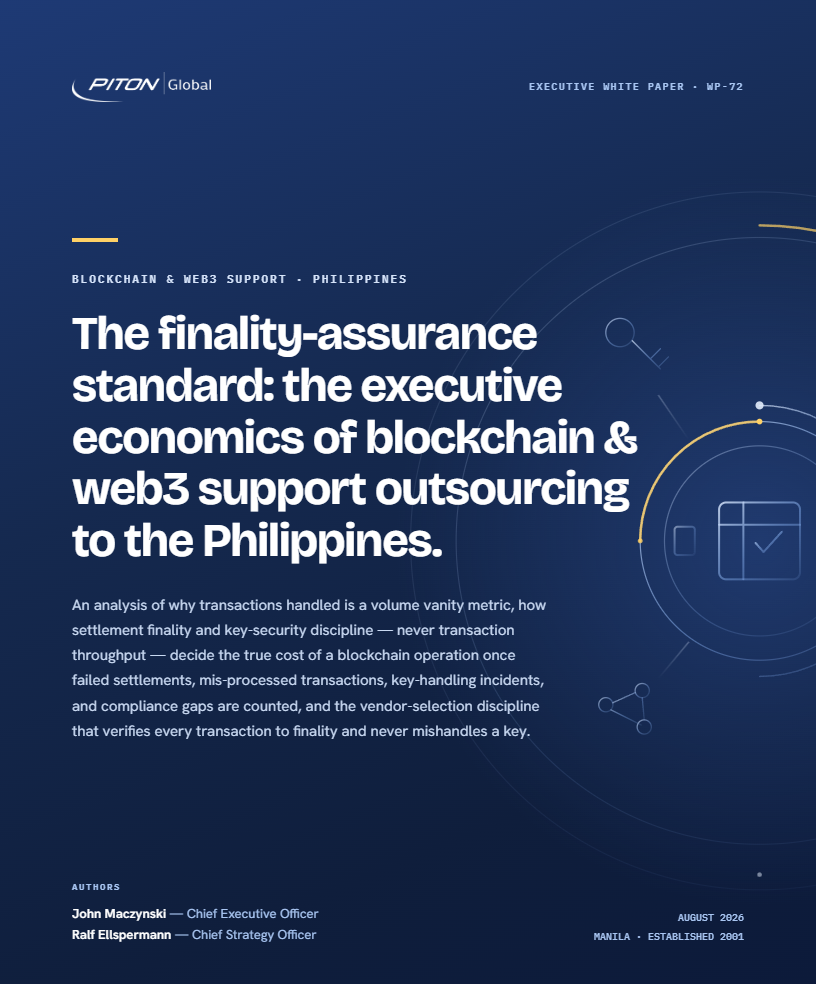
12WHITE PAPER WP-72 · BLOCKCHAIN & WEB3 · AUGUST 2026

The finality-assurance standard: the economics of blockchain & web3 support outsourcing.

Why transactions handled is a volume vanity metric, how settlement finality and key-security discipline — never transaction throughput — decide the true cost of a web3 operation once failed settlements, mis-processed transactions, key-handling incidents and compliance gaps are counted, and the vendor-selection discipline that verifies every transaction to finality and never mishandles a key. Volume 77 of PITON-Global’s Executive White Paper Series, by John Maczynski and Ralf Ellspermann.

14 pages 12-min read Ellspermann & Maczynski
INSIDE THE BRIEFING
The volume mirage: transactions handled versus verified to finality.
The operations contract: verify to finality, secure the keys, keep it compliant.
Case Study BK-077: a 44-seat web3 operations team re-based on settlement finality — 6.2× first-year ROI.
Read the white paper (PDF) Free · no gate · published August 2026
14ANSWERED BY OUR PRINCIPALS

The questions crypto leaders ask before they outsource.

In-depth answers to the questions that decide a crypto support engagement — from the principals who run them.

What blockchain and crypto support can you outsource?+
Player and user support, KYC/AML onboarding and verification, transaction and wallet support, fraud and compliance monitoring, and community management. The high-volume, regulated operational work around a crypto product, delivered by trained specialists so your engineers and compliance leads focus on protocol and policy.— John Maczynski, CEO
How do you handle KYC, AML and compliance?+
Trained risk teams run KYC, AML and transaction monitoring to your policies with audited controls and documented decisioning. Verification and escalation follow your compliance framework rather than improvised judgment, so onboarding stays fast for legitimate users while suspicious activity is caught and escalated correctly.— John Maczynski, CEO
How do you reduce fraud and abuse?+
Dedicated fraud-operations teams plus calibrated QA detect and act on suspicious patterns faster, lowering loss rates. Because crypto transactions are irreversible, speed matters; the operation is staffed and drilled to flag and freeze risk in real time rather than discovering it after funds have already moved.— Ralf Ellspermann, CSO
What does outsourcing crypto support save?+
Typically 50–60% on cost per contact versus in-house, with stronger 24/7 coverage and faster resolution. The larger value is risk reduction: faster KYC, tighter fraud control and responsive support protect both regulatory standing and user trust, the two things a crypto business most depends on to survive.— John Maczynski, CEO
Do you cover support around the clock?+
Yes. Crypto never sleeps, so we staff follow-the-sun teams that keep support and monitoring live 24/7 across your markets and languages. Users get help and risk gets watched at every hour, because a gap in coverage in this space is a gap a bad actor will find and exploit.— Ralf Ellspermann, CSO
How do you protect user and transaction data?+
Operations run in SOC 2- and ISO 27001-aware, access-controlled environments with no local storage and audited controls. Wallet, identity and transaction data stays inside the secure environment, access is role-based and time-limited, and every action is logged, so security holds as the user base and volume scale.— Ralf Ellspermann, CSO
Will you work in our platforms and tools?+
Yes. Specialists work natively in your support, KYC, blockchain-analytics and case-management tools with a clean audit trail, rather than toggling between disconnected systems. You keep one environment and source of truth, and we staff into it, so support and compliance stay accurate, traceable and where your team expects them.— John Maczynski, CEO
Can you scale for launches and volatility?+
Yes. We surge-staff for token launches, listings and volatility-driven support spikes, so service levels and monitoring hold when volume jumps. Capacity is planned before the event, which means a launch or a market move is met with coverage rather than a backlog that frustrates users and hides risk.— Ralf Ellspermann, CSO
How is crypto support measured?+
On resolution quality, KYC turnaround, fraud-loss rates, response times and user satisfaction, surfaced in a live dashboard with regular reviews. We govern to risk and experience outcomes rather than raw ticket counts, so the metrics reflect whether users are protected and helped, not merely processed.— John Maczynski, CEO
Are we locked into one provider?+
No. We are vendor-neutral and match you to the best-fit crypto-experienced partner at no cost, based on your product, compliance needs and geography. If a relationship ever underdelivers, we help you transition rather than trap you, because our incentive is your users’ trust, not one vendor’s contract.— Ralf Ellspermann, CSO
Authorship, Review & Benchmark Verification
Authored by:
Ralf Ellspermann
Ralf Ellspermann
Chief Strategy Officer of PITON-Global
Two Decades Building and Advising Award-Winning Philippine BPO Operations

Ralf audits exchange- and wallet-support floors on KYC, travel-rule and fraud-queue discipline across Philippine vendors.

View full bio  →
Verified by:
John Maczynski
John Maczynski
CEO of PITON-Global
Former Global EVP of the World’s Largest Contact Center · Four Decades of Outsourcing Experience

John reviews the compliance posture and commercial terms behind each blockchain program, keeping benchmarks grounded.

View full bio  →
Last Reviewed & VerifiedJune 12, 2026

Re-audited as evolving VASP, travel-rule and KYC/AML obligations evolve. Every benchmark on this page is held to PITON-Global’s internal vetting standard.

Segments We Serve
Exchanges VASPs Wallets DeFi NFT Platforms AML/KYC Transaction Monitoring Travel Rule Sanctions Screening On-Chain Investigations
error: Content is protected !!
Inquire Now