Clinical operations, run with accuracy and compassion.
HIPAA- and HITRUST-aligned RCM, clinical admin, patient CX and healthcare back-office — delivered by medically-literate Philippine specialists who pair Agentic AI with the Filipino value of Malasakit to turn administrative burden into margin.
BPO Suppliers
Health Systems Served
Philippines
In 2026, healthcare outsourcing has evolved into a care-delivery infrastructure decision. It is no longer about shifting admin work offshore — it is an integrated intelligence hub combining Filipino Malasakit with Agentic AI, delivering 95–98% clean claim rates and 45–60% denial-rate reductions.
Your payer mix and your EHR decide where the dividend starts.
Enterprise scale is where the HITRUST Blind Spot disqualifies vendors before pricing is discussed. Epic- and Cerner-native RCM, coding and patient access at health-system volume — in a CSF-assessed environment your compliance office can audit.
Encounter volume scales faster than authorization capacity. High-volume coding, prior-auth automation and clinical admin for virtual-care platforms — the setting where sub-24-hour authorization is a care-delivery metric, not a back-office one.
HC-069 was an 8-physician practice — this is the segment where the dividend is largest relative to size. Coding, denial management and patient support sized for independent and multi-site groups, with the pre-bill audit a small billing team can’t staff.
Overflow capacity that doesn’t dilute your own quality bar. Claims operations, coding-audit support and white-label denial management under the same certification and HITRUST standards your clients hold you to.
What is the Administrative Burnout Crisis — and how does it compound into EBITDA destruction?
It is healthcare-specific operational debt that erodes finances, physician satisfaction, patient experience and compliance simultaneously — four consequences from one architecture failure. Volume-focused BPOs cannot resolve it because they lack the clinical nuance for complex denials and patient navigation.
Autonomous Clinical Operations is an outsourcing model in which Agentic AI handles 65–75% of routine revenue-cycle tasks while medically-literate Philippine specialists manage complex denials, coding depth and Malasakit patient access — measuring success in clean claim rate and care quality, not ticket volume.
“The practices achieving sustainable margin expansion are not those with the largest billing teams. They are those whose Philippine Operational Pilots — with clinical coding depth, EHR-native access and Malasakit empathy — manage every claim at the standard payers require and every patient interaction at the standard retention demands.”
Three operational pillars, one EHR-native intelligence hub.
How top-1% Philippine partners deliver across patient experience, clinical administration and revenue cycle — for US providers, multi-specialty practices and health systems.
Patient experience in 2026 is a margin variable, not a satisfaction metric — CMS Value-Based Care ties reimbursement to HCAHPS, retention and care-gap closure. A Malasakit-trained specialist who confirms a diabetic patient’s monitoring appointment is closing a HEDIS-tracked care gap, not running a scheduling function — the same Malasakit-trained specialist protocol documented in our insurance claims operations.
Clinical administration is where coding accuracy meets compliance. Operational Pilots hold relevant coding certification (CPC, CCS or specialty-specific) and carry payer-LCD and medical-necessity training — the difference between filing an appeal and winning one.
The full revenue cycle runs EHR-native: AI handles 65–75% of routine eligibility, prior-auth and claim-status work, while specialists manage complex denials and medical-necessity appeals — compressing A/R from 55+ to 28–35 days.
“The organisations that engage PITON-Global arrive with a margin-recovery brief, not a cost-reduction target. They understand their 20–25% denial rate is not a billing problem — it is a clinical documentation, coding depth and prior-authorisation problem that all compound into the same cash-flow consequence.”
From patient access to paid claim — with the denial designed out at each stage.
The denial distribution shows where revenue dies; this is the cycle rebuilt so each root cause is intercepted at its own stage. AI clears the routine at machine speed; certified specialists own the judgment that carries audit and revenue risk; and PHI remains in your environment for the entire loop.
How root-cause denial classification generates an EBITDA dividend.
Predictive denial modeling identifies failure patterns before they compound into A/R aging and write-offs. CO-16, CO-4, CO-50 and prior-auth denials each have a distinct root cause — and each is preventable at a specific point in the cycle.
Here is the labor math. It is the only dividend component that appears on an invoice.
Every revenue-cycle RFP opens with the seat rate, so we publish it. Then note what HC-069 proved: the labor line was the smallest number in the engagement.
The seat lens prices the specialist. The EBITDA Dividend prices the revenue cycle. Illustrative projection at standard role mix; labor savings run 60–70% depending on the ratio of certified-coder and RN roles to volume roles. We confirm exact figures — labor line and full dividend — against your payer mix, charge volume, and EHR.
Indicative 2026 rates — with the certification premium shown, not blended.
Most rate cards blend the certified coder into an average with the biller and call it a healthcare rate. Ours shows the spread deliberately, because the spread is the Clinical Nuance Gap with a price on it: a CPC/CCS-certified coder or a US-trained nurse prices above a billing-workflow operator, and the difference is what separates filing an appeal from winning one. A quote at the volume band for a coding or appeals role is how you buy the 82% — billing training, no clinical depth.
Bolded rows carry the certification premium — the roles where the Clinical Nuance Gap lives. Every band assumes HITRUST-governed access with zero local PHI residency and an executed BAA. Rates confirmed per engagement against specialty mix and payer contracts.
Price my role mix against the certification standard →Assessment → Configuration → Training → Scale, with first-year ROI confirmed at the Week-12 gate.
Four explicit phases. No phase is compressed or skipped — clinical workflow complexity requires each phase’s deliverables before the next begins.
Legacy BPO vs. Autonomous Clinical Operations.
The competitive delta between a legacy 2024 BPO baseline and the PITON-Global-vetted 2026 standard — across eight dimensions that determine margin, compliance and patient outcomes.
Two healthcare-specific failure modes that generic BPO cannot resolve.
The Clinical Nuance Gap and the HITRUST Compliance Blind Spot are specific to healthcare and cannot be fixed by general CX profiles. Both compound Administrative Burnout. Both expose EBITDA and regulatory risk. Both are auditable before contract execution.
Where Autonomous Clinical Operations doesn’t fit — and one word we don’t use.
The fastest way to become one of the 2026 failure statistics is to force a certified, HITRUST-governed clinical operation into work it was never built for. So before the shortlist, the disqualifiers — ours, stated plainly.
How administrative burden became $3.4M in EBITDA.
A documented Q4 2025 engagement: a US multi-specialty practice with 8 physicians across 3 locations and $12M in annual charges, deploying a 22-specialist Autonomous Clinical Operations team.
$3.4M 12-month EBITDA dividend on $680K cost
John Maczynski (CEO) · Signed off Q2 2026
One pillar, one bottleneck — a patient-access-only deployment, measured.
HC-069 proves the full Autonomous Clinical Operations suite; HC-074 proves the entry point. A platform doesn’t need a revenue-cycle transformation to give its physicians their evenings back — one pillar, placed at the front door where CO-50 and prior-auth denials are born, moved a care metric, a patient metric and a burnout metric in one quarter. And the burnout metric is the one that retains clinicians.
PITON-Global audited our denial patterns and found 61% of our CO-16 denials came from the same documentation gap in our hospitalist group’s H&P notes — one our previous vendor never flagged because they filed appeals without understanding what the LCD required. They fixed the note templates, and our CCR reached 95% within 60 days.
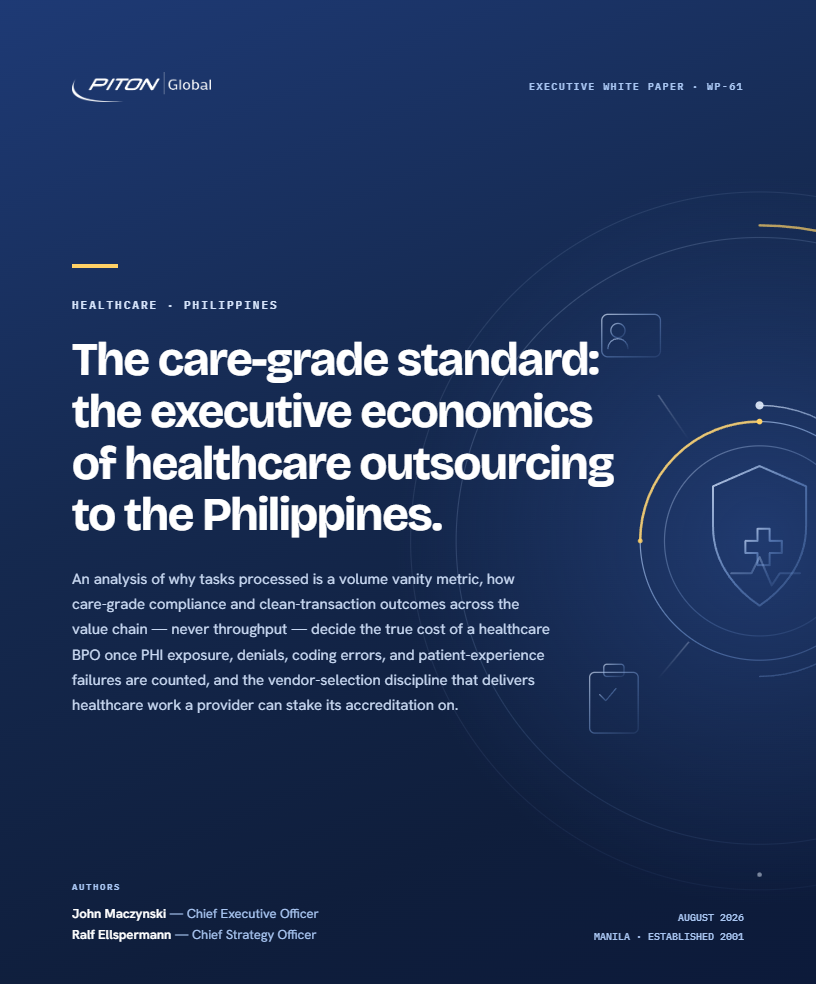
The care-grade standard: the economics of healthcare outsourcing.
Why tasks processed is a volume vanity metric, how care-grade compliance and clean-transaction outcomes across the value chain — never throughput — decide the true cost of a healthcare BPO once PHI exposure, denials, coding errors and patient-experience failures are counted, and the vendor-selection discipline that delivers healthcare work a provider can stake its accreditation on. Part of PITON-Global’s Executive White Paper Series, by John Maczynski and Ralf Ellspermann.
Independent coverage. Third-party validation.
What healthcare leaders ask before outsourcing the revenue cycle.
In-depth answers to the questions that decide a healthcare BPO engagement — from the principals who run them.