CIVIL & STRUCTURAL OUTSOURCING SERVICES PHILIPPINES

A miscalculated load or a missed code fails inspection — or worse.

Civil and structural detailing, rebar and steel detailing, and analysis support — delivered by Philippine-based, licensed-engineer-supervised teams who keep your drawings accurate and code-pinned, because in structural work an error is a plan-check rejection or a safety risk, not a lost ticket.

Manila, Cebu & Davao delivery ISO 9001-certified · designed to pinned codes Pinned-code, checked
DRAWING QUALITY · TURNAROUND Q2 2026
Design accuracy
98%
Code compliance rate
98%
Cost per structure
66%
A rework cycle is the real expense. Find the team that gets drawings right. Get matched
PLATFORMS & STANDARDS
AutoCAD Civil 3DRevit StructureTekla StructuresSTAAD.ProETABSSAFESAP2000RAM StructuralOpenBridgeACI / AISC / Eurocode
22Vetted Civil & Structural
Outsourcing Partners
Structural detailers measured on drawing accuracy, not output count.
120K+Structural Sheets
/ Year · Vetted Partners
Rebar, steel and infrastructure detailing, code-pinned.
8Checked & EOR-Ready
Delivery Hubs
ACI / AISC / Eurocode-aligned operations with senior-engineer checking.
A REWORK CYCLE IS THE REAL COST · 2026

In structural engineering, a miscalculated load or a missed code doesn’t cost you a ticket — it fails inspection, triggers a costly field change and risks structural safety. Structural engineering work here is a quality and compliance function, judged on accuracy and code compliance, not output volume.

01THE PROJECT DELIVERY ENGINE

Five stages from brief to issued-for-construction — click where yours leaks.

Each stage has its own failure mode — an error compounds downstream into a plan-check rejection or a costly field change. Select a stage to see the work, the control, and the metric that governs it.

DEFINITION

Civil & structural engineering takes a structure from analysis to issued-for-construction — structural analysis and load-path design, rebar and steel detailing, independent code checking, licensed-engineer review, and IFC delivery — under senior-engineer checking, measured by inspection success and code compliance, not output volume.

01
Modeling
02
Drafting
03
Detailing
04
Checking
05
Issued for Construction
01
Structural Analysis
WHAT WE RUN
Load takedown and structural analysis in STAAD/ETABS from the architectural brief and geotechnical report — the basis every later stage depends on.
CONTROL
Senior-engineer review of assumptions and model setup catches issues before they propagate into detailing.
GOVERNING METRIC
100%
model setup reviewed
John Maczynski
CEO · ENGINEERING OPERATIONS AUTHORITY

“In engineering, the drawing and the building are the same conversation. A detailing error doesn’t annoy anyone in the office — it shows up on the pour deck as a field change, a plan-check rejection or a safety risk. That is why structural accuracy and code compliance, not output volume, are the only metrics that matter here.”

John Maczynski · CEO, PITON-Global · 40-Year Global BPO Veteran
02A DRAFTING SHOP VS. A CHECKED-ENGINEERING TEAM

A drafting shop vs. an engineering team that protects compliance.

Seven dimensions, read as risk vs. protection — where a bare drafting shop leaves you exposed and where a checked team covers you.

Drawing Accuracy
Best-effort drafting
Senior-checked, >99%
Code issues
Found at the pour, field change
Detected & resolved
Code Compliance
Assumed, unchecked
Checked & stamped
Project Engineers
Offshore black box
Embedded design partner
Standards
Ad-hoc CAD
ACI / AISC, code-ready
Metric
Output volume
Accuracy & compliance
Coverage
Business-hours
24/7 follow-the-sun
03THE MATH OF A STRUCTURE DESIGNED RIGHT

Where does the 6.6× return come from when drawings are right the first time?

From four streams a per-drawing rate ignores: structural redesign and overdesign avoided, field changes and RFIs prevented, faster permit approval, and engineering labor arbitrage. The cheapest structure is the one designed right the first time — and the inspection it passes.

Field-Change Cost Retired (the divergence caught in the calc, not the pour)
$1.3M – $2.6M
Overdesign Trimmed (the tonnage the calc didn’t need, per tonne)
$1.1M – $2.2M
Permit-Cycle Compression (plan-check pass first submittal)
$0.9M – $1.8M
Fabrication-Error Prevention & Labor Arbitrage
$0.9M – $1.8M
TOTAL ANNUAL NET BENEFIT60-SEAT ENGINEERING TEAM
$4.3M – $8.0M
6.7×
Documented return
01
Drawing Accuracy — Primary Driver
A structural consultancy cut design-error rates 77% with senior-engineer checking — eliminating the detailing mistakes that had been generating field RFIs and rework. Annual rework cost avoided: $2.3M.
02
Detailing — Site Protected
Independent code checking lifted first-pass approval to 98%, keeping the site moving and protecting the schedule attached to it.
03
Delivery — Compressed
Delivery time shrinks when models coordinate and drawings arrive clean — issued-for-construction sets go out ahead of schedule.
ENTITY PROOF · Q4 2025–Q2 2026
77%
Design errors eliminated
The structural consultancy behind ST-058 moved detailing and analysis support to PITON-Global. Total 12-month net benefit: $2.1M against a $320K engagement cost — a 6.6× return.
9K tonnes rebar/yr · Manila, Cebu & Davao · first-pass plan approval
THE PROJECT FILE · ENGAGEMENT ST-058Verified Q2 2026 · Manila, Cebu & Davao
CLIENT ENTITY
structural consultancy detailing 9K tonnes of rebar a year.
PRE-DEPLOYMENT BASELINE
Design errors generating field changes, RFIs and a slow delivery cycle.
THE INTERVENTION
A senior-checked engineering operation across Manila, Cebu & Davao — structural modeling on Tekla + STAAD.Pro.
THE PROJECT, MEASURED
97%
First-pass approval
senior-checked
−77%
Design errors
RFIs avoided
98%
First-pass approval
from 86%
−22%
Delivery time
faster IFC
6.6×total engagement return
$2.1M net benefit on $320K program
Reviewed by John Maczynski (CEO) &
Ralf Ellspermann (CSO) · Q2 2026
CLIENT STORY · ENGAGEMENT ST-058 · STRUCTURAL CONSULTANCY

How a structural consultancy cut field RFIs by 77% on a 45-storey tower.

A detailing backlog was pushing errors downstream to the pour deck: member sizes drifting from the analysis model, code editions unpinned, congestion nobody caught until the cage wouldn’t assemble — each one a field change with a schedule attached.

98%
first-pass
approval
-63%
drawing
errors
22%
faster
delivery
THE CHALLENGE

A structural consultancy was producing detailing for 9K tonnes of rebar a year and falling behind. Weak checking meant code and detailing errors were caught at plan review and on the pour deck, not in the calc — each one a field change that stalled trades and threatened the schedule on a 45-storey tower.

WHAT WE SOURCED

We shortlisted senior-checked engineering providers and stood up a structural detailing team across Manila and Cebu — working in the firm’s own CAD and code standards, running independent ACI/AISC code checks to closure, and gating every deliverable through an independent licensed-engineer check before issue.

THE OUTCOME

First-pass approval rose to 98%, design errors fell 77%, and checked designs cut overall delivery time by 22%. Field RFIs traceable to design errors dropped by more than three quarters, and the tower build came back onto schedule.

“The drawings come back checked and coordinated, not just drafted. Our field RFIs collapsed and the schedule recovered. They work as an extension of our own studio, to our standards, on our hardest structural programs.”

— Structural Principal, structural consultancy
FOR THE ENGINEERING PRINCIPAL How many field RFIs traced back to design errors last quarter?
THE CALC IS YOUR EOR’S — WE RUN IT UNDER THEIR BASIS, AND PROVE IT

Analysis support means your design basis, your load criteria, your engineer’s assumptions — executed, documented, and checked by us; owned, judged, and sealed by them.

Drafting support has a fuzzy edge; analysis support does not. Unqualified, “load takedown and structural analysis” is the practice of structural engineering — the one lane where the EOR boundary isn’t professional etiquette but life-safety law. So we say precisely whose engineering the analysis is.

THE DESIGN BASIS IS RECEIVED, NEVER INVENTED

Every analysis engagement opens with your EOR’s design-basis document — or our drafting one for their signature: governing code editions, load criteria, seismic and wind parameters, material assumptions, analysis-method decisions. We execute within it; deviations route back with the analysis attached (a support team quietly choosing a seismic response factor has designed your building without a license). The model runs under their assumptions; the run-log proves it.

DELEGATED DESIGN, STRUCTURED AS THE INDUSTRY WORKS

Connection design and specialty components run on the delegated-design model where your project uses it: we produce the calculation packages and details in support of the delegated-design engineer of record — the licensed engineer (yours or the fabricator’s) who reviews, owns, and seals. The deliverable is the sealable package: methodology stated, code clauses cited by edition, load paths traced, assumptions listed — because “review and seal this” is only fair when the package answers the reviewer’s questions first.

INDEPENDENT CHECK IS NOT INDEPENDENT DESIGN

Our senior-engineer check verifies the work against the basis — the calc re-performed, the code clause confirmed, the drawing tied to the model — it never substitutes its judgment for the EOR’s.

THE ONE DUTY THAT OUTRANKS THE BOUNDARY

Where the checker believes the basis itself is wrong, that finding escalates to your EOR as a flagged concern with the reasoning attached — stated in writing, because in this lane silence about a suspected basis error isn’t deference; it’s negligence with good manners.

THE BUYER’S QUESTIONAsk any structural outsourcer who owns the design basis on their current projects, and how a support engineer’s disagreement with it gets handled. A vendor without a documented answer to the second half is either overstepping the line or swallowing concerns — and in this lane, both end in the news.
04CODE-COMPLIANT IS A DATED CLAIM

ACI 318-what? ASCE 7-which? Amended by whom? The design-basis sheet pins every edition, parameter, and local amendment — because the code that changed last cycle is the resubmittal you get next month.

The seismic provisions that changed between ASCE 7-16 and 7-22 aren’t formatting differences — they change member sizes, and a team detailing to the remembered code on a jurisdiction that adopted the new one is producing confident non-compliance.

THE PINNING SHEET, PER PROJECT

Governing editions (ACI 318, AISC 360/341, ASCE 7, the IBC year, Eurocode parts where applicable), jurisdiction amendments, seismic design category and its inputs (site class, mapped accelerations, importance factor), wind parameters, and load-combination set — pinned at kickoff, signed into the design basis, and named on every calc cover and drawing general note, so “compliant” always answers “with what, as of when.”

THE AMENDMENT WATCH

Jurisdictions in the active book monitored for adoption changes: a code-cycle adoption mid-project triggers the impact memo to your EOR — what changed, which elements it touches, whose call the response is (theirs) — because the adoption date nobody tracked is the plan-check comment everybody gets.

UNITS AND LOCALIZATION, EXPLICIT

Imperial/metric declared per project and enforced at the template level — a bar schedule that mixes systems is a field error with a mill certificate.

THE PRINCIPLE“Compliant” without an edition is a claim without a referent. The pinning sheet makes it a dated, checkable fact — the difference between passing plan check and reprinting the set.
05DETAILED FOR THE BENDER, THE FAB SHOP, AND THE POUR

Structural detailing’s product isn’t drawings; it’s buildable steel — schedules a bender can run, cages a crew can pour around, NC data a fab shop can load.

Rebar: the cage that can be poured

Schedules generated from the model (never hand-transcribed — machine-truth in bar marks), development and lap lengths computed per the pinned code edition (the numbers that change between editions), bend types to the standard your fabricator runs, and congestion review at every beam-column joint and coupler zone — the constructability check that asks the only question the site will: can this cage physically be assembled, and can concrete physically get through it? The joint that models beautifully and can’t be poured is a field redesign performed by whoever’s standing there.

Steel: fabrication data down the pipeline

Tekla-native detailing with fabrication data down the pipeline — NC files, bolt lists, assembly and erection drawings — under the shop-drawing submittal discipline, because a detailing error at the fab shop is priced in tonnes and weeks.

THE MODEL AND THE DRAWINGS MUST AGREE — AND SOMEONE MUST CHECK

A member resizes in drafting and the analysis model never hears about it — the drawings now describe a structure the calc never approved.

The classic structural drift: a clash, a client change, a “small” adjustment — and the two layers split silently. The gate closes it.

EVERY ISSUEruns a model-to-drawing diff — member sizes, reinforcement, connection references — divergences resolved in both directions before IFC (either the model re-runs under the change, or the drawing reverts; never a silent split), and the reconciliation logged to the release record. Changed is not checked; re-analyzed is.
068-WEEK ENGINEERING STAND-UP

Eight weeks to a live, senior-checked structural bench — quality demonstrated before anything scales.

A gated stand-up. Until senior checking signs off and a pilot package meets your standards, nothing issues.

01
Wk 1–2
Standards & CAD Mapping
Connect Tekla/STAAD/ETABS, ingest the design basis, pin the code editions, and baseline the calc-drawing reconciliation.
02
Wk 3–4
Team & Checking Build
Recruit and train structural detailing engineers, build standards templates, checking and code-check workflows.
03
Wk 5–6
Parallel Run
Pilot package first: daily senior checks, accuracy proven to target, then — and only then — full handover.
04
Wk 7–8
Cutover & Govern
Phased project ramp, live accuracy/code-compliance/turnaround dashboard, monthly business reviews — PITON-Global Checked-Engineering certification.
07RADICAL TRANSPARENCY

The cluster’s boundaries inherited, sharpened for the lane where errors are measured in life safety.

01
The EOR boundary at full strength.
Checked, never stamped; analyzed, never owned; and the basis-concern escalation duty stated in writing (Section 1).
02
Seismic and life-safety-critical judgment always escalates.
SDC determinations, irregularity classifications, special-system detailing decisions: flagged with analysis, decided by your EOR, every time.
03
The territory, on-page.
Production drafting is CAD & Drafting; model federation is BIM Coordination; product design is Mechanical & Product Design; the umbrella is Engineering. This page owns civil/structural analysis support, detailing, and the fabrication pipeline.
04
IP at Mechanical & Product Design grade — and calibration caps per pod.
Project-walled, VDI-locked, NDA-per-program. Code-jurisdiction count and system complexity cap the span; tender and pour-sequence crunches ride the surge bench.
A shortlist that includes “no” is the only kind worth having.
08PRICING TOPOGRAPHY · ROLE VIEW

Indicative 2026 rates — the structural bench shown apart from the seat.

CORE ROLERATE (USD/HR)OPERATIONAL PROFILETIER
Structural drafter$8–$12Plans, sections, general notes in your templates.T
Rebar detailer$9–$14Schedules, bar marks, placement drawings (Section 3).R
Steel detailer (Tekla)$10–$15Connections modeled, fabrication data, erection drawings.R
Analysis support engineer$12–$18STAAD/ETABS execution under the design basis (Section 1).R
Civil/infrastructure drafter$9–$14Grading, drainage, alignment sheets in Civil 3D.R
Connection-design support engineer$16–$24The delegated-design package: calcs cited to edition, sealable by the responsible engineer — the hardest handoff in the lane (Section 1).NO GENERIC
EQUIVALENT
Rebar-constructability lead$13–$19The congestion review: joint-zone buildability, pour-sequence sanity, the cage a crew can actually make (Section 3).NO GENERIC
EQUIVALENT
QA / checking engineer$13–$18Independent check against the basis, the calc-drawing diff (Section 4).QUALITY
Program lead$14–$20Pod governance, submittal calendar, EOR liaison.LEADERSHIP

The two premium rows have no commodity equivalent because a drafting shop staffs neither: connections get “typ.” and congestion gets discovered by the pour crew. Rates confirmed per engagement against systems, codes, and volume.

09WHO WE SERVE

Four kinds of structure, engineered four different ways.

01Structural consultancies

The flagship’s home: the 45-storey tower, field changes collapsed, the schedule recovered. ST-058 is this program, measured.

02Fabricators & rebar suppliers

The fabrication pipeline: Tekla-to-NC, bender-ready schedules, the delegated-design support lane.

03Civil & infrastructure

Bridges, transportation, land development, water — Civil 3D production with the same pinned-basis discipline.

04Seismic & high-consequence work

The escalation-first lane: SDC-driven detailing, special systems, the boundary at its brightest.

THE BASIS FILE · ENGAGEMENT ST-058 · RECONCILIATION AUDIT ONLY

Reconciliation audit only — 60 released structural sets, three layers diffed: the basis, the calc, the drawings. The site checks the building against the drawings. Nobody checks the drawings against the calc.

CLIENT ENTITY

Structural consultancy, live projects retained, 60 sets across 14 projects in scope. Identity withheld under NDA.

PRE-DEPLOYMENT BASELINE

The sets had lived full lives: designed under one code cycle, revised through value engineering, re-detailed after coordination, issued and re-issued — and at each step, the three layers (design basis, analysis model, issued drawings) drifted a little. The symptoms were quiet: the plan-check comment citing a parameter the calc didn’t use, the general note naming a code edition the jurisdiction had left, the member on Sheet S-301 two sizes different from the model nobody had opened since the resize. Each layer was maintained by someone; the agreement between them was maintained by no one.

THE INTERVENTION

A ring-fenced three-layer diff — live projects untouched. Per set: basis-to-calc verification (the model’s actual inputs extracted and diffed against the stated basis — the seismic parameters, load combinations, and material strengths the run really used), calc-to-drawing reconciliation (member schedules, reinforcement, connection references diffed model-to-sheet — Section 4’s gate, applied retroactively), edition audit (general notes vs. jurisdiction’s current adoption), and findings triaged by consequence: capacity-relevant divergences escalated to the EOR same-day with the analysis (we find; the EOR judges), documentation divergences batched for correction, and edition drift mapped to the amendment watch.

8 WEEKS, MEASURED
METRICAS RELEASEDAS AUDITEDWHAT IT WAS
Sets with all three layers in agreementassumed82%The word “issued,” tested
Calc-drawing divergences found0 known31 (4 cap.-rel.)Drawings the calc never approved
Basis parameters diverging from stated0 known7The run that used different numbers
Code-edition drift flaggeduntracked5 setsCompliant with the wrong year
STRATEGIC INSIGHT

The audit family’s twenty-sixth member extends MD-065’s epistemics to the highest stakes: three layers, each individually maintained, collectively divergent — and unlike the tolerance stack, the emergent defect here is load-bearing. The second row’s parenthetical is the entire escalation logic (most divergences are paperwork; the capacity-relevant few are why the EOR is on speed-dial), and the close is the family tell in a plan-check queue: pick one released set and diff Sheet S-301 against the model, today. If nobody in the office knows which is current, you’ve found the finding — and the building inspector hasn’t. Yet.

10THE DRAWING-QUALITY TEST · WHAT TO VERIFY

Ask first: can this vendor show the checking will pass before a single drawing starts?

A checked-engineering team differs from a drafting shop on three controls, and every one can be demonstrated pre-contract. In engineering, the cost of getting one wrong is a plan-check rejection and a field RFI.

01
Senior Checking on Every Deliverable
Drafting without an independent check ships code errors and miscalcs. A real team runs senior-engineer checking on every deliverable, so an error is caught in the calc, not on the pour deck.
VERIFY: Ask for the drawing-accuracy rate and checking process
02
Code Checking, Not Hoping
A shop that issues uncoordinated models has already failed. The teams worth hiring run independent code and calc checks so errors are caught in the calc, not on the pour deck.
VERIFY: Ask for the first-pass approval rate and checking workflow
03
Standards-Native, Not Ad-Hoc
CAD without your standards produces inconsistent, unusable drawings. A real team works natively in your templates and code-based detailing workflows with full revision control.
VERIFY: Confirm your CAD standards and detailing workflow, not ad-hoc
THE CALC-OWNED ARCHITECTUREhow each risk is designed out
Senior-Engineer Checking
Every deliverable is independently checked by a senior engineer before issue, holding accuracy above 99% and catching code errors before site.
Independent Code Check
Structures are calc-checked and code-checked before issue, not after, keeping conflicts out of the field and the schedule.
Standards-Native Operations
Engineers work directly in your CAD standards and code-based detailing workflows with full revision control, so drawings stay consistent and coordinated.
Ralf Ellspermann
CSO · ENGINEERING OPERATIONS

“Give a prospective partner a drawing package with deliberate code violations and calc errors salted in. A checked-engineering team catches nearly all of them before issue. A drafting shop issues right past them, and three weeks later they surface as RFIs, a plan-check rejection and a stalled site.”

Ralf Ellspermann · CSO, PITON-Global · 25-Year Philippine BPO Veteran
FOR ENGINEERING & AEC LEADERS

A design error you can’t see is an inspection you’re about to fail.

Tell us where engineering strains — analysis backlogs, detailing volume, rebar scheduling, connection design — and we’ll hand you 6–10 vetted, engineer-supervised providers, each one proven on a drawing-quality test before it reaches your shortlist.

Get my engineering shortlist
Vendor-neutral · no cost to you · 24-hour response guarantee, reconciliation-audit sampling estimate included · prepared and presented by John Maczynski, CEO
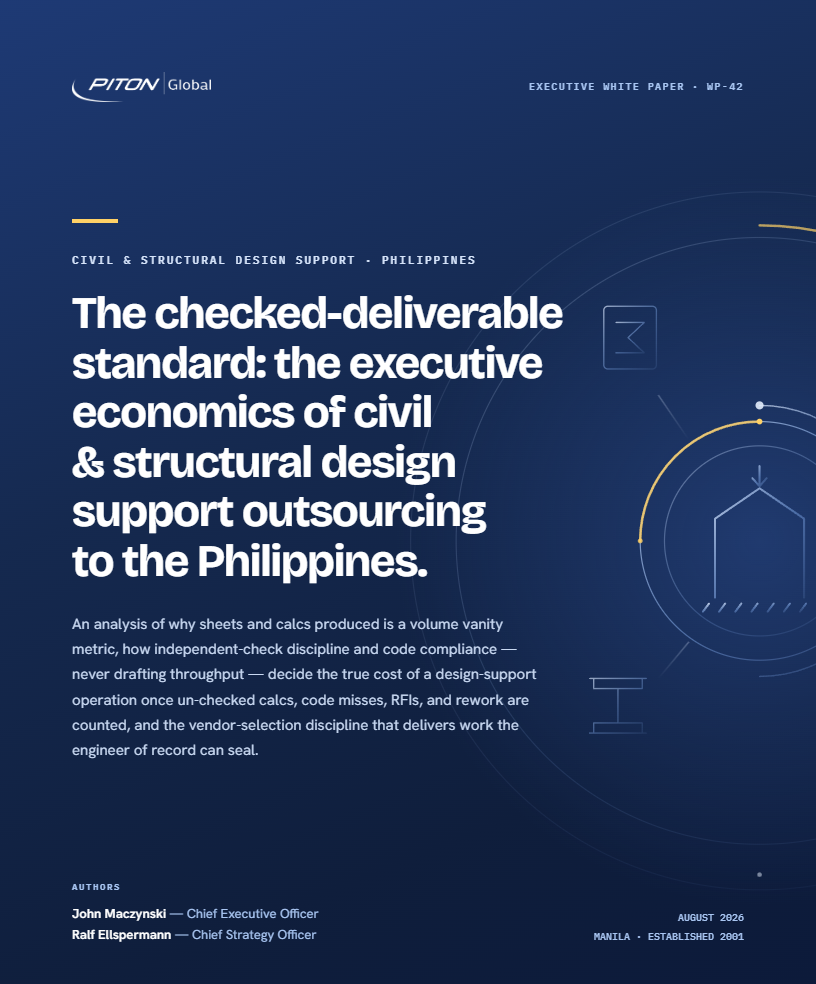
WP-42 Civil & Structural Design Support Outsourcing white paper cover
PDF · 14 PAGES
68WHITE PAPER WP-42 · DESIGN SUPPORT · AUGUST 2026

The checked-deliverable standard: the economics of civil & structural design support outsourcing.

Why sheets and calcs produced is a volume vanity metric, how independent-check discipline and code compliance — never drafting throughput — decide the true cost of a design-support operation once un-checked calcs, code misses, RFIs and rework are counted, and the vendor-selection discipline that delivers work the engineer of record can seal. Volume 68 of PITON-Global’s Executive White Paper Series, by John Maczynski and Ralf Ellspermann.

14 pages9-min readMaczynski & Ellspermann
IN THESE PAGES
The volume mirage: sheets produced versus checked, code-compliant deliverables.
The design-support contract: model it to standard, check it independently, sign it to code.
Case study: a 40-seat structural design-support pod re-based on independent checking — 6.2× first-year ROI.
Read the white paper (PDF) Free · no gate · published August 2026
12ANSWERED BY OUR PRINCIPALS

What engineering and AEC leaders ask before they outsource structural work.

In-depth answers to the questions that decide a civil & structural engineering outsourcing engagement — from the principals who run them.

Are outsourced drawings actually checked and code-pinned?+
Yes. No deliverable issues without an independent check — senior-level, supervised by licensed engineers — against your standards and the applicable codes. That review gate is what makes it engineering support rather than drafting — and what keeps the stamp on your drawings defensible.— Ralf Ellspermann, CSO
What does outsourcing structural engineering actually save us?+
Typically 50 to 70 percent on cost per drawing versus onshore, with faster delivery. The larger saving is avoided rework: senior checking and code compliance eliminate the detailing errors that otherwise surface on the pour deck as costly field changes, RFIs and schedule slips.— John Maczynski, CEO
How do you ensure code compliance and structural accuracy?+
We run independent code and calc checks against ACI, AISC and Eurocode across every structuraltural, structural and MEP models, with resolution tracked to closure before documents issue. Catching a conflict in the model costs pennies; catching it in the field costs the schedule.— Ralf Ellspermann, CSO
Will your engineers work to our CAD standards and templates?+
Yes. Every program starts by mapping your CAD standards, title blocks, layering and code basis, and engineers work natively in your templates and code-based detailing workflows. Under full revision control, the output is consistent, coordinated, and reads exactly like your own team produced it.— John Maczynski, CEO
How do you protect our project data and IP?+
Work happens on access-controlled, ISO 27001-aligned infrastructure — zero local storage, full revision control, audit trails end to end. Each project file is visible only to its team, all changes are logged, and data remains within the secured environment start to finish.— Ralf Ellspermann, CSO
Can you scale across multiple projects and bid deadlines?+
Yes. We flex analysis, detailing and modeling capacity across your project pipeline and bid cycles, then scale back as deadlines pass, so you carry throughput rather than idle drafting staff. Senior checking applies at every scale, so quality holds under deadline pressure.— Ralf Ellspermann, CSO
What engineering disciplines can you actually support?+
Structural analysis, structural modeling, rebar and steel detailing, foundation and seismic design support, connection design, and infrastructure detailing, foundation design and connection design — all under licensed-engineer supervision. Authority over the design stays with your engineers; the scale, capacity and consistency come from the bench behind them.— John Maczynski, CEO
Which engineering work should we outsource first?+
Begin with high-volume, well-defined production work — analysis, detailing and structural modeling — where standards and checking deliver immediate, measurable gains. Structural and MEP design support layers in once the foundation — standards, checking, rhythm — has proven itself.— Ralf Ellspermann, CSO
How fast can an engineering team be live and producing?+
Eight weeks or so, gated at every step. Live issue requires two things: senior-engineer sign-off and a pilot package passed against your codes and standards. You see proven, checked output before any real project volume flows through.— John Maczynski, CEO
How will we measure and govern the engagement?+
Against design accuracy, rebar/steel detailing accuracy, code compliance, RFI reduction and cost per structure, in a live dashboard with monthly reviews. Reporting raw output would be dishonest — a fast, wrong drawing merely bills its true cost to the site team later.— Ralf Ellspermann, CSO
Authorship, Review & Benchmark Verification
Authored by:
Ralf Ellspermann
Ralf Ellspermann
Chief Strategy Officer of PITON-Global
Two Decades Building and Advising Award-Winning Philippine BPO Operations

Ralf audits civil-structural floors on code-compliance and calculation-review discipline.

View full bio  →
Verified by:
John Maczynski
John Maczynski
CEO of PITON-Global
Former Global EVP of the World’s Largest Contact Center · Four Decades of Outsourcing Experience

John validates the project economics and commercial terms behind each civil-structural program on this page.

View full bio  →
Last Reviewed & VerifiedJuly 19, 2026

Re-audited as ISO 9001-aware quality obligations evolve. Every benchmark on this page is held to PITON-Global’s internal vetting standard.

Inquire Now