

On this page
- Key Takeaways
- What Financial Drivers Generated by Philippine Outsourcing Expand EBITDA Margins?
- How Does Operating Scale Influence the Realized EBITDA Trajectory?
- What Strategic Considerations Protect Anticipated Margins?
- What Does EBITDA Optimization Look Like in Practice?
- Why Do Executive Leaders Rely on PITON-Global for BPO Execution?
- Frequently Asked Questions
The EBITDA improvement from BPO services in the Philippines is typically several hundred basis points of margin expansion for mid-market and enterprise organizations that strategically migrate core front- and back-office operations, with high-volume back-office programs reaching four-digit gains. The lift is driven by an immediate and deep reduction in fully burdened labor cost alongside a substantial increase in transactional process efficiency—which is why the analysis has to begin with price versus total cost of an offshore team, not the hourly quote.
Key Takeaways
- Direct margin lift: Standard BPO deployments in the Philippines deliver a direct 300–800 bps improvement to operating margin, with high-volume back-office transformations exceeding 1,000 bps in mature operating models.
- Capital expense conversion: Transitioning fixed onshore payroll and facility overhead into a variable operating expense model eliminates capital expenditure requirements while unlocking immediate balance-sheet liquidity.
- Process productivity multipliers: Beyond raw wage arbitrage, structured Philippine BPO programs generate a substantial increase in processing output and a marked reduction in error rates through specialized workflows.
- Avoidable payback erosion: Partnering with misaligned vendors or failing to standardize operating procedures before deployment can erode a large share of anticipated EBITDA gains through operational drag and elevated turnover.
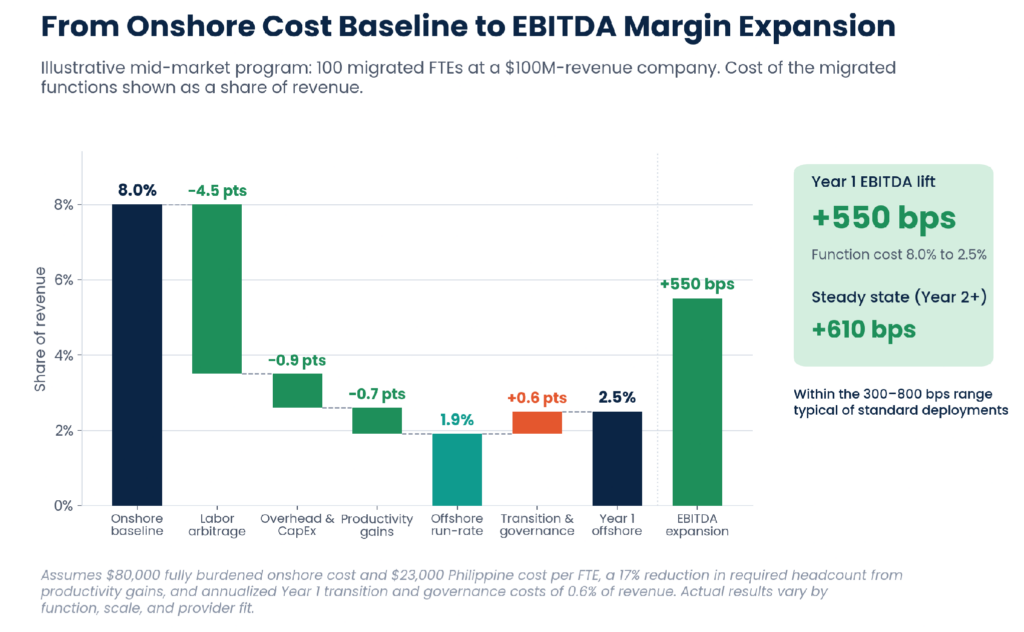
Figure 1. From onshore cost baseline to EBITDA margin expansion: labor arbitrage, overhead reduction, and productivity gains net of transition costs (illustrative).
What Financial Drivers Generated by Philippine Outsourcing Expand EBITDA Margins?
The primary catalyst is the fully burdened labor cost differential: an onshore FTE’s annual cost including taxes, benefits, facilities, and management is a multiple of what Philippine BPO pricing charges once infrastructure, management, technology, and statutory benefits are bundled in. Facility CapEx elimination, 24/7 coverage that lifts customer lifetime value, and accelerated collections add margin on top; the three-year TCO view shows how the differential compounds after transition costs.
EBITDA expands through two channels at once. Operating expense falls as fully burdened onshore wages give way to a far lower offshore rate and local facility capital expenditure is eliminated entirely; at the same time, revenue and working capital improve as round-the-clock coverage raises customer lifetime value and faster processing shortens days in accounts receivable. Both channels converge on the income statement from Month 3 onward, as the framework below shows.
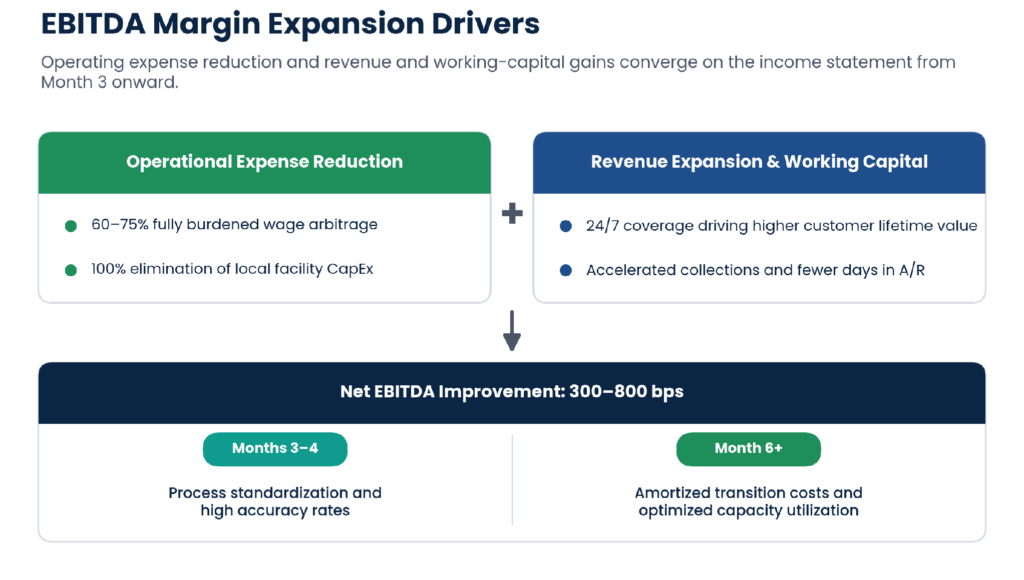
Figure 2. EBITDA margin expansion drivers: operating expense reduction and revenue and working-capital gains converge into a 300–800 bps net improvement.
Fully burdened onshore labor costs in North America and Western Europe include baseline salaries, employment taxes, health insurance, 401(k) matching, office space, hardware provisioning, and administrative management. Philippine BPO pricing, by contrast, covers all infrastructure, operational management, technology stack, and statutory benefits within a single predictable hourly or transaction-based rate card. The table below shows the resulting savings per FTE by function and how directly each function’s savings reach operating margin.
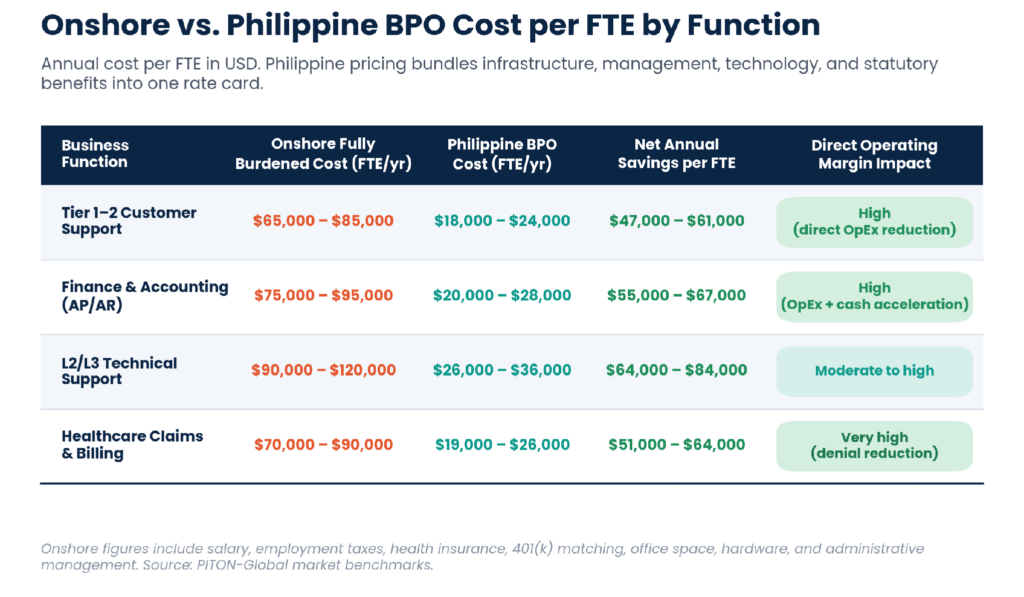
Figure 3. Fully burdened onshore cost versus Philippine BPO cost per FTE by function, with net annual savings and direct operating margin impact.
Beyond direct cost reduction, operating margins improve through accelerated collections and enhanced customer lifetime value. Expanding service coverage to a 24/7 model without incurring onshore night-differential penalties reduces customer churn and accelerates accounts receivable cycles, so top-line preservation compounds the cost reduction rather than merely accompanying it. Churn falls further when agents are trained for empathy, not just procedure—see emotional intelligence training in BPO.
How Does Operating Scale Influence the Realized EBITDA Trajectory?
EBITDA velocity and magnitude scale with program size. Small pods of 10–25 FTEs realize 150–350 bps with payback in 90–120 days; mid-market operations of 25–100 FTEs capture 300–600 bps as dedicated management, QA frameworks, and automated workflows create economies of scale; enterprise deployments above 100 FTEs yield 600–1,000+ bps as fixed overhead is spread across large operating units.
The velocity and magnitude of EBITDA improvement are tied directly to program scale, procedural standardization, and deployment complexity. All three tiers pass through the same transition trough in the first quarter, but larger programs amortize fixed setup costs across more monthly savings and reach a steeper, higher plateau, as the chart below illustrates.
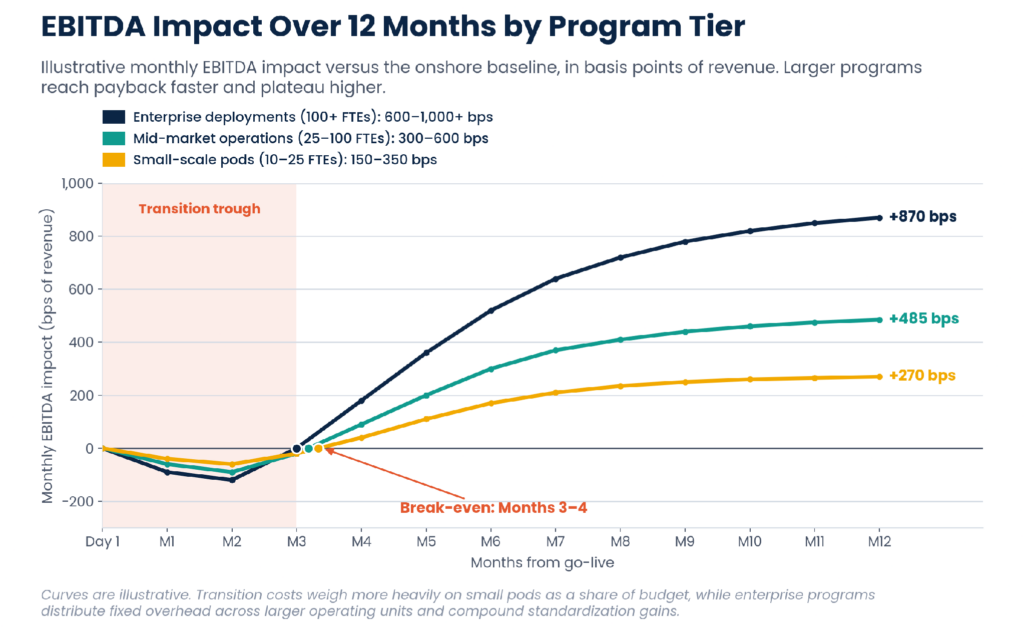
Figure 4. Illustrative EBITDA impact over 12 months by program tier: larger programs reach payback faster and plateau higher.
Small-Scale Pods (10–25 FTEs)
Organizations migrating targeted functions typically realize a 150 to 350 bps EBITDA improvement. Transition costs represent a larger share of total budget during the early months, but payback is achieved within 90 to 120 days, and the pod becomes the proof point for a broader program.
Mid-Market Operations (25–100 FTEs)
Mid-sized organizations capture 300 to 600 bps of EBITDA growth. At this scale, dedicated management layers, custom quality assurance frameworks, and automated workflows drive meaningful economies of scale, and per-FTE governance overhead begins to compress.
Enterprise Deployments (100+ FTEs)
Large-scale business process migrations yield 600 to 1,000+ bps in EBITDA expansion. Fixed overhead is distributed across large operating units while standardized processes yield substantial ongoing efficiency gains; high-volume back-office transformations in mature operating models are where four-digit basis-point improvements occur.
What Strategic Considerations Protect Anticipated Margins?
Three risks erode target margins if unmanaged: attrition drag, which raises recruitment and training spend and creates productivity gaps; poor knowledge transfer from undocumented or changing SOPs, which prolongs learning curves and error rates; and misaligned contracting models that pay for headcount rather than outcomes. Together they can consume up to half of projected savings.
Executing an offshore migration carries operational risks that can erode target EBITDA improvements if improperly managed. Vendor misalignment sits behind most of them: a provider without deep operational maturity in the buyer’s vertical tends to exhibit all three of the risk factors below at once.
Attrition Drag
High turnover rates increase recruitment and training expenditure while creating productivity gaps that strain remaining staff and depress quality scores. Attrition history should be a scored selection criterion, and retention practices such as structured career development should be contractual commitments rather than sales-deck claims.
Poor Knowledge Transfer
Undocumented or changing standard operating procedures prolong learning curves, raising initial error rates and resolution times. Standardizing SOPs before deployment, rather than during it, is the single most effective protection for the payback schedule.
Misaligned Contracting Models
Relying on simple headcount pricing rather than outcome-based SLAs can disincentivize productivity improvements, because the provider is paid the same whether output rises or not. Contracts built around throughput, accuracy, and resolution metrics align the provider’s incentives with the buyer’s margin targets—the measurement discipline covered in our framework for BPO performance management.
Many corporate buyers enter the Philippine market focused solely on entry-level hourly rates, failing to realize that vendor misalignment can destroy initial margin projections. If a BPO provider lacks deep operational maturity in your specific vertical, high agent attrition, extended onboarding ramps, and poor quality compliance will consume up to half of your projected savings. Capturing lasting EBITDA gains requires aligning with a provider whose delivery model matches your operational complexity.
— John Maczynski, CEO, PITON-Global
What Does EBITDA Optimization Look Like in Practice?
EBITDA optimization in practice pairs a specialized healthcare provider with automated validation tools. A middle-market healthcare administrative platform established a 45-FTE back-office and patient support pod in Manila, expanded operating margins by several hundred basis points within the first full year, cut transaction costs to a fraction of the onshore figure, and reduced claims denial rates by more than half.
Client Challenge
A middle-market healthcare administrative platform faced declining EBITDA margins due to rising domestic labor costs and high staff turnover. Patient scheduling and claims processing costs per transaction had climbed well above industry norms, while processing backlogs lengthened payment cycles and tied up working capital.
Vendor Selection
To avoid lengthy open-market RFP delays, the client partnered with PITON-Global. Analyzing strict HIPAA compliance requirements and target financial profiles, PITON-Global evaluated its network of more than 100 audited Philippine BPO centers and identified two specialized healthcare delivery partners within 72 hours.
Solution Implemented
A dedicated 45-FTE back-office and patient support pod was established in Manila, using structured automated validation tools alongside dedicated claims specialists, with regulatory compliance and security audits completed during provider selection rather than after contracting.
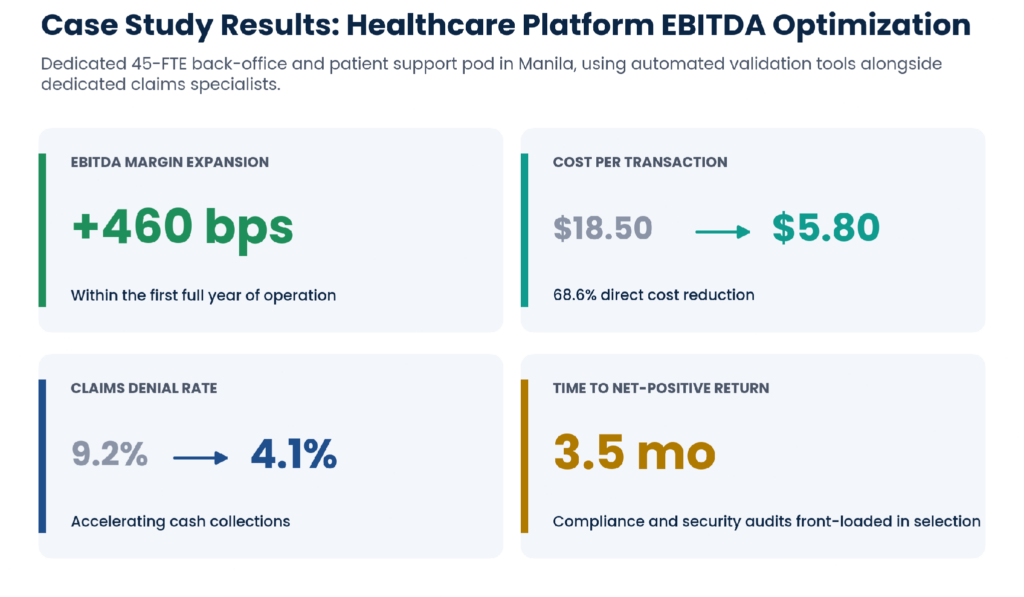
Figure 5. Quantifiable business outcomes of the healthcare platform’s EBITDA optimization program.
Outcomes and Lessons
Operating margins expanded by several hundred basis points within the first full year of operation. Transaction processing costs fell to a fraction of the prior level, and claims denial rates fell by more than half, accelerating cash collections. The lesson: front-loading regulatory compliance and security audits during provider selection eliminated transition friction and enabled the organization to reach net-positive financial return in 3.5 months.
Why Do Executive Leaders Rely on PITON-Global for BPO Execution?
Executive leaders rely on PITON-Global because evaluating more than 1,000 Philippine BPO operations creates procurement friction and selection risk that traditional commission-based brokers compound. As an independent, advisory-led consultancy guided by senior operators with decades of global BPO governance, it provides vendor-neutral, data-backed matching across 100+ audited providers to protect baseline EBITDA performance.
Who Is PITON-Global?
PITON-Global is an independent, advisory-led outsourcing consultancy headquartered in Manila. Guided by senior industry operators with more than 65 combined years of global BPO governance experience, the firm provides vendor-neutral matching services that ensure alignment across technical, financial, and cultural criteria—turning a landscape of more than 1,000 providers into a short, defensible list.
How Does PITON-Global Differ from Traditional Outsourcing Brokers?
Traditional commercial brokers often operate on commission models that route buyers toward preferred vendors regardless of operational fit, with limited options and built-in vendor bias. PITON-Global’s advisory model is data-led and vendor-agnostic: providers are selected on audited operational metrics, historical agent retention rates, domain expertise, and security compliance, and the firm stays engaged through contracting and transition.
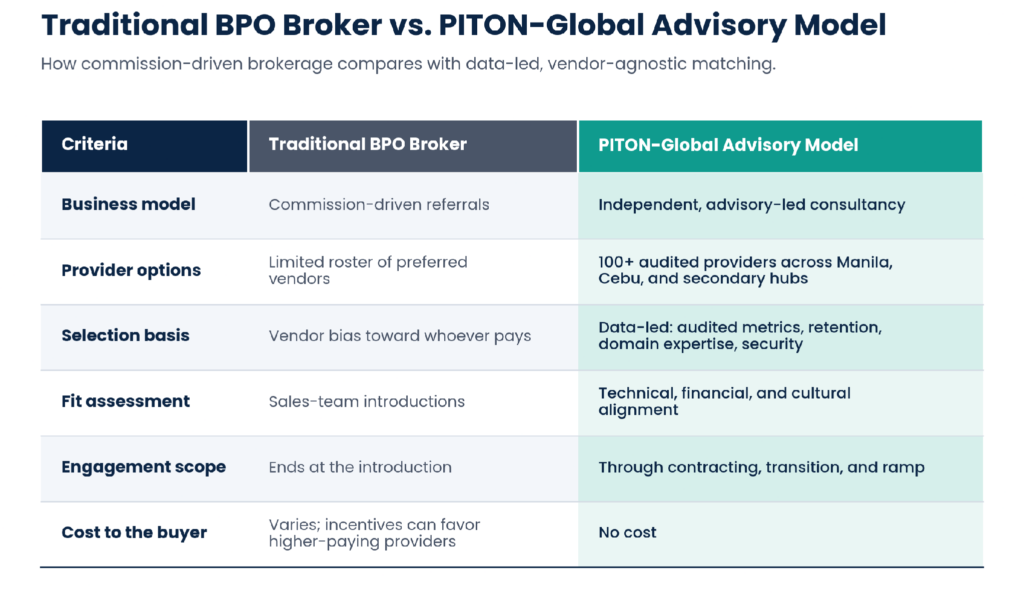
Figure 6. Traditional BPO broker model versus PITON-Global’s advisory model.
How Does PITON-Global’s Network of 100+ Vetted Philippine BPO Providers Benefit Organizations?
Access to more than 100 audited mid-market and enterprise BPO operators across Manila, Cebu, and key secondary hubs lets organizations bypass open-market RFP delays. Because every provider has already been assessed for operational metrics, retention, domain expertise, and security posture, buyers move directly to capability-matched candidates.
How Does PITON-Global’s Advisory-Led Vendor Matching Process Work?
The process runs from financial and operational assessment to execution support: defining target EBITDA impact, compliance requirements, volumes, and complexity; filtering the audited network for vertical maturity and right-sized capacity; delivering a shortlist of specialized providers within 48–72 hours with benchmarked pricing; verifying retention history, security certifications, and SLA performance; then supporting outcome-based contracting and transition oversight.
Why Do Organizations Use PITON-Global?
Organizations use PITON-Global to accelerate procurement timelines, avoid hidden costs, and protect baseline EBITDA performance by matching specific operational needs with proven delivery capabilities. Because vendor misalignment can consume up to half of projected savings, and the advisory service carries no cost to the buyer, the engagement pays for itself before the first invoice.
Frequently Asked Questions
How long does it take for Philippine BPO savings to impact EBITDA?
Most organizations achieve operational break-even between Months 3 and 4, with net-positive EBITDA expansion reflected on income statements by Month 6 after absorbing one-time transition expenses.
What upfront capital investments are required to start an offshore BPO program?
Upfront costs typically cover legal and compliance vetting, system integration, knowledge transfer, and parallel operational running during initial onboarding. These one-time expenses are generally amortized within 90 to 180 days.
Which back-office processes deliver the highest margin improvement?
High-volume, rules-based functions such as finance and accounting (AP/AR), medical billing, claims processing, and multi-channel customer support deliver the fastest and highest financial returns.
How do BPO providers in the Philippines protect sensitive corporate data?
Top-tier Philippine BPO centers operate from secure facilities featuring biometric access controls, clean-desk environments, network firewalls, and compliance certifications including ISO 27001, SOC 2 Type II, HIPAA, and PCI DSS.
How do I ensure my BPO partner maintains service quality over time?
Establish clear Service Level Agreements with performance-linked KPIs, conduct regular operational audits, and partner with BPOs that offer structured career development programs to maintain low agent attrition.