

On this page
- Key Takeaways
- How Does Labor Arbitrage Translate to Bottom-Line Capital Retention?
- What Secondary Financial Benefits Drive Enterprise ROI Beyond Wage Savings?
- What Financial Risks and Tradeoffs Must Procurement Teams Navigate?
- What Does a Successful Enterprise CX and Back-Office Program Look Like?
- How Does PITON-Global’s Advisory Model Mitigate Sourcing Risk?
- Frequently Asked Questions
Enterprises outsourcing business processes to the Philippines consistently cut direct operating costs by more than half against onshore baselines—a saving you can check against an offshore cost model with no sales gate. Beyond labor arbitrage, buyers unlock a further layer of systemic efficiency through CREATE MORE Act tax incentives, eliminated capital expenditure for real estate and technology infrastructure, and AI-augmented workforce productivity that accelerates time-to-value across front- and back-office operations.
Key Takeaways
- Substantial labor savings: Fully loaded hourly rates for offshore BPO specialists run at a fraction of the rates for equivalent onshore roles in North America and Western Europe.
- Shift from CapEx to OpEx: Outsourcing converts fixed capital expenditure (facilities, telecom, hardware refresh) into variable operating expense, freeing balance-sheet capital for core R&D and market expansion.
- Tax and fiscal incentives: Programs operating in Philippine Economic Zone Authority (PEZA) IT parks benefit from reduced corporate income tax rates, VAT exemptions, and streamlined duty-free imports under the CREATE MORE Act.
- Efficiency gains via AI integration: Modern providers in the country combine human talent with agentic AI workflows, materially reducing transaction handling times and minimizing repeat-contact costs.
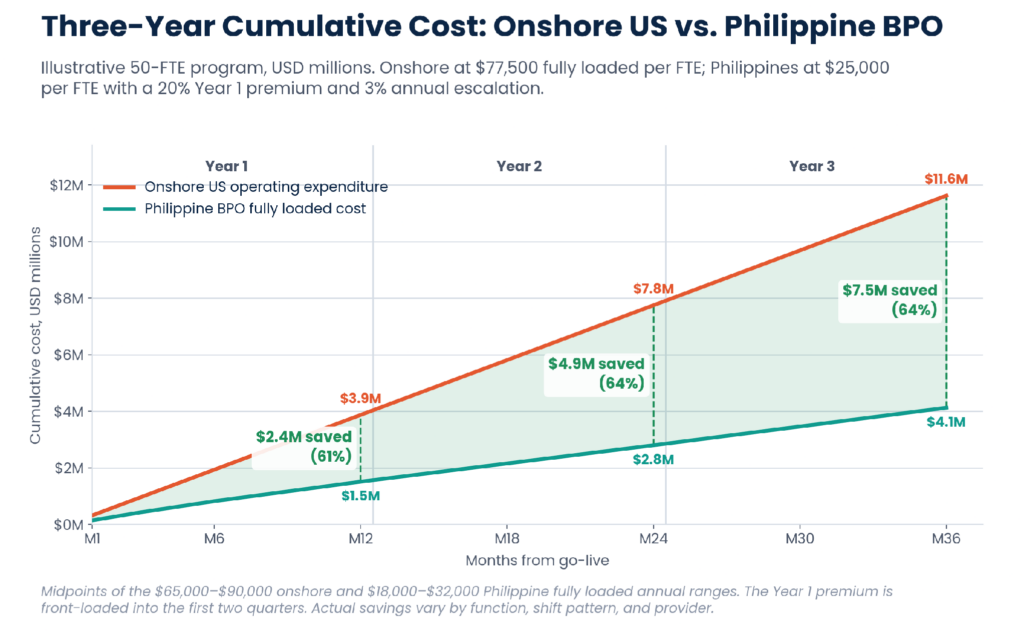
Figure 1. Three-year cumulative cost projection for an illustrative 50-FTE program: onshore US operating expenditure versus fully loaded Philippine BPO cost over 36 months.
How Does Labor Arbitrage Translate to Bottom-Line Capital Retention?
Labor arbitrage is the foundational driver: an onshore support or back-office specialist carries a fully loaded annual cost that is a multiple of what an equivalent Philippine FTE delivering voice, digital CX, finance and accounting, or sales operations costs. Modeled on fully loaded rates rather than base wages, each offshore seat retains a substantial block of capital every year.
Direct wage differentials remain the foundational economic driver of offshore business process transformation, but procurement teams must evaluate fully loaded labor models—statutory benefits, facility overhead, and supervisory ratios included—rather than raw base wages. In Western markets, healthcare, payroll taxes, retirement benefits, software licensing, and office space push an onshore specialist’s annual cost far above the headline salary. Offshore, the all-inclusive rate for an equivalent FTE comes in at a fraction of that figure, and the table below shows how the difference plays out by function.
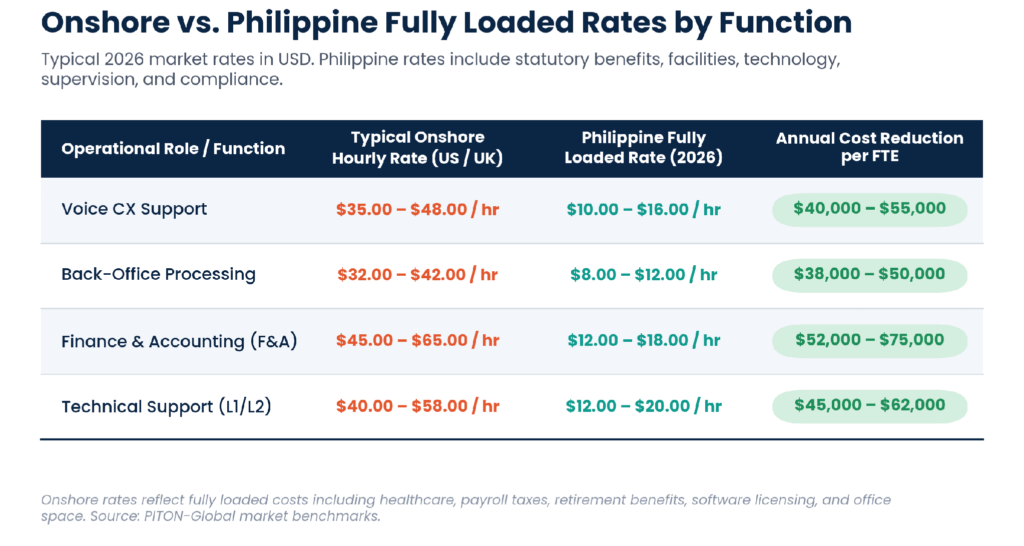
Figure 2. Typical onshore hourly rates versus Philippine fully loaded rates by function, with the annual cost reduction per FTE.
Expressed as annual fully loaded cost per FTE, the gap per seat is substantial and varies by function. For a 50-seat program, it compounds into millions of dollars of capital retained every year—capital that would otherwise be consumed by domestic payroll, benefits, and facilities rather than reinvested in product, marketing, or margin.
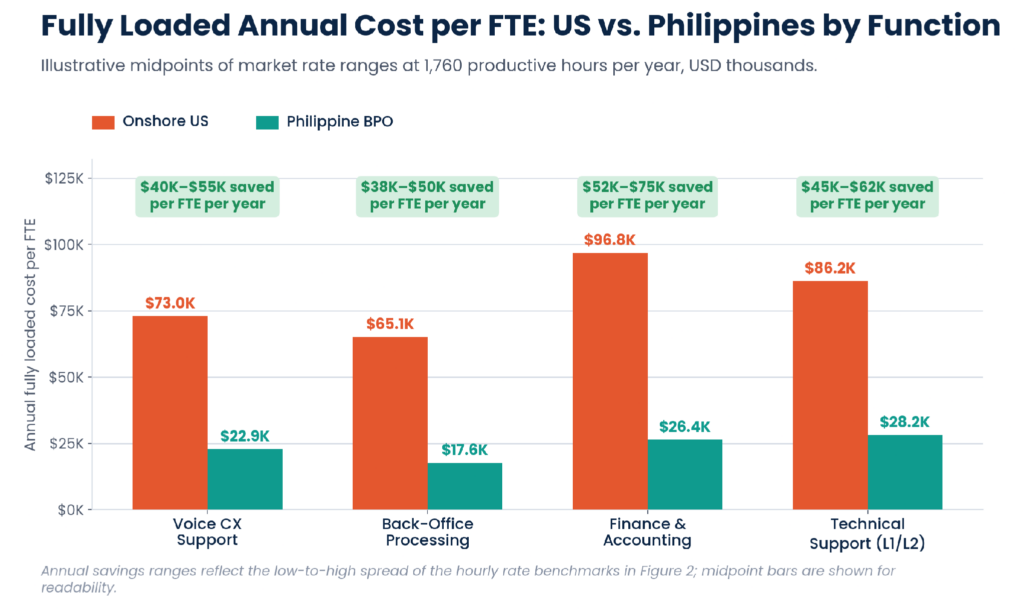
Figure 3. Illustrative fully loaded annual cost per FTE across four functions, US versus Philippines (midpoints at 1,760 productive hours).
What Secondary Financial Benefits Drive Enterprise ROI Beyond Wage Savings?
Long-term ROI is sustained by three structural efficiencies built into the country’s IT-BPM ecosystem: avoided capital expenditure for Class-A real estate, redundant power, network equipment, and SOC 2 compliance infrastructure; fiscal stability and pass-through tax savings under the CREATE MORE Act; and human-in-the-loop AI that cuts handling time materially while lifting First Contact Resolution.
While labor arbitrage delivers immediate balance-sheet impact, the second layer of value comes from what the buyer no longer has to build, fund, or manage. Three benefits deserve their own lines in the financial case.
Infrastructure Capital Avoidance
Operating through accredited local service providers eliminates capital expenditure for Class-A real estate, dual-redundant power generators, enterprise network switches, and SOC 2 Type II compliance infrastructure. A 50-seat onshore operation can tie up several hundred thousand dollars in fit-out, hardware, and security tooling before the first contact is handled; the provider carries all of it within the hourly rate, and refresh cycles become the provider’s responsibility rather than a future capital request.
Fiscal Legislative Benefits
The enactment of the CREATE MORE Act enhances tax stability for offshore delivery centers registered with PEZA, allowing providers to pass through tax savings, duty exemptions on technical hardware, and reduced local business taxes. The buyer never files a Philippine tax return; the benefit arrives as a lower, more stable rate card and greater confidence that pricing will hold across a multi-year term.
Agentic AI and Workflow Automation
Philippine BPOs increasingly run human-in-the-loop AI architectures: automated ticket routing, real-time agent-assist tools, automated speech and sentiment analytics, and agentic workflows that complete routine transactions without human touch. The measurable effects are lower Average Handling Time (AHT), higher First Contact Resolution (FCR), and fewer repeat contacts—each of which reduces cost per resolution rather than cost per hour, which is why buyers should negotiate pricing that shares those gains.
In 2026, the global paradigm has shifted. Nearshore locations serve real-time collaboration needs, but the Philippines remains the world’s premier destination to scale a high-efficiency operational engine. At an $8 to $18 per hour baseline, call centers and back-office hubs in the Philippines are not just cost-reduction centers—they are innovation accelerators where AI handles process speed and skilled human talent handles customer trust and complex decision-making.
— John Maczynski, CEO, PITON-Global
What Financial Risks and Tradeoffs Must Procurement Teams Navigate?
Maximum return requires managing three predictable costs: a Year 1 implementation premium for knowledge transfer, secure VPN/MPLS integration, and double payroll during shadowing; attrition and recruitment drag at unvetted vendors; and statutory accruals such as 13th-month pay, night shift differentials for US hours, and local holiday premiums. Each belongs in the projection before signing.
Unlocking maximum financial return requires proactive management of hidden program costs and operational tradeoffs. None of them undermines the business case, but each will surface as budget variance if it is left out of the model, which is why the CFO’s ROI calculation should net them out explicitly.
Transition and Onboarding Spikes
Year 1 budgets must account for an implementation premium covering knowledge transfer, secure VPN/MPLS pipeline integration, compliance auditing, and double payroll during initial shadowing. Because the premium concentrates in the first two quarters, first-year savings typically land well below the steady-state level the program reaches from Year 2.
Attrition and Recruitment Drag
High agent turnover at unvetted vendors erodes financial gains through continuous retraining costs and quality dips. Partnering with providers that offer competitive compensation, structured career paths, and specialized recruitment funnels stabilizes long-term unit economics, and attrition history should be a scored criterion in vendor selection rather than a reference-check afterthought.
Statutory Compliance Accruals
Financial projections must incorporate mandatory local items such as 13th-month pay, night shift differentials for US business hours, and local holiday premiums. Fully loaded rates from reputable providers already include them, as our line-by-line breakdown of call center running costs shows; the risk arises when a headline rate quoted without them is compared against a competitor’s all-inclusive rate. The framework below sequences these decisions from evaluation to steady state.
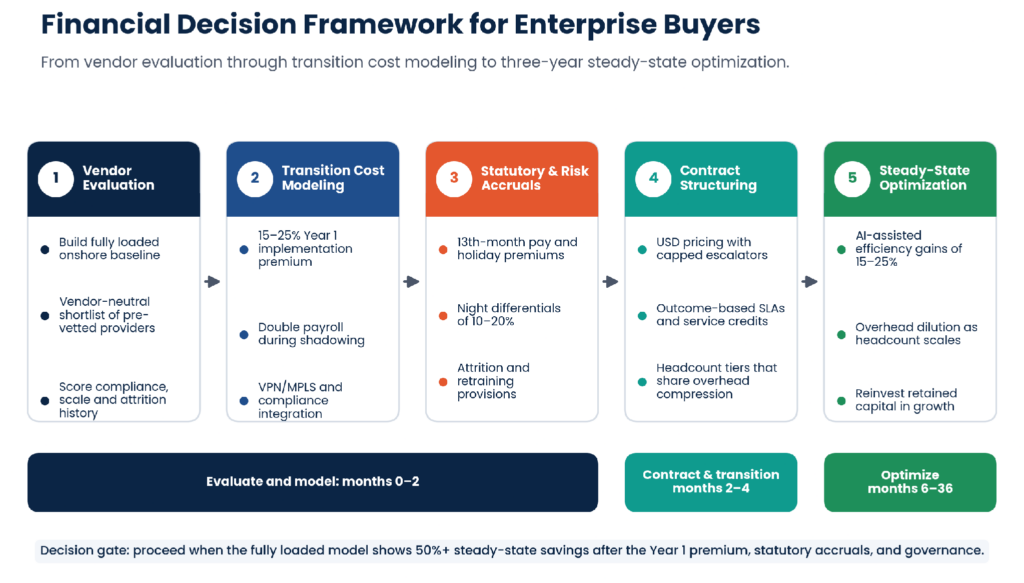
Figure 4. A financial decision framework for enterprise buyers, from vendor evaluation through transition cost modeling to three-year steady-state optimization.
What Does a Successful Enterprise CX and Back-Office Program Look Like?
A successful program pairs a specialized provider with agentic AI tooling and a phased ramp. A fast-growing North American e-commerce logistics platform deployed 60 FTEs in Cebu over 90 days, cut operating costs for the outsourced functions by more than half in Year 1, improved First Contact Resolution materially, and reached payback in 4.5 months.
Client Challenge
A North American e-commerce logistics platform experiencing rapid year-over-year transaction growth faced severe operating margin compression as domestic support and billing administration costs rose faster than revenue.
Vendor Selection
PITON-Global conducted a vendor-neutral assessment across its network of more than 100 vetted Philippine BPO operators and matched the client with a mid-sized, specialized delivery partner in Cebu offering dedicated omnichannel capabilities and HIPAA- and PCI DSS-certified environments.
Solution Implemented
A phased 60-FTE team was deployed over 90 days, combining 40 customer experience specialists with 20 back-office billing and exception-handling analysts. The delivery model integrated agentic AI workflow tools for automated ticket tagging and real-time sentiment analysis, so agents concentrated on complex and high-value interactions.
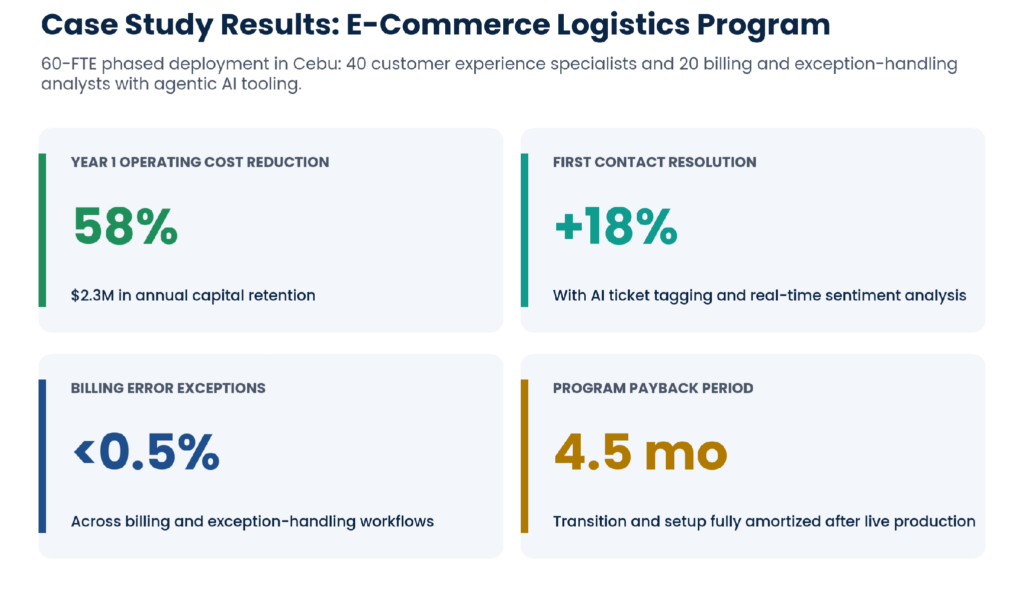
Figure 5. Quantifiable business outcomes of the e-commerce logistics CX and back-office program.
Outcomes and Lessons
Operating costs for the outsourced functions fell by more than half in Year 1, translating to millions in annual capital retention. First Contact Resolution improved materially while billing error exceptions dropped to a negligible rate, and total transition and setup expenses were fully amortized within 4.5 months of live production. The lesson: upfront investment in process documentation and secure technology integration during the first 60 days eliminates operational friction and accelerates steady-state financial returns.
How Does PITON-Global’s Advisory Model Mitigate Sourcing Risk?
PITON-Global is an independent BPO advisory and vendor-matching firm headquartered in Manila. Led by CEO John Maczynski and CSO Ralf Ellspermann, who bring over 65 combined years of global BPO governance, it applies a vendor-neutral, operator-led methodology that compresses selection from more than 1,000 providers to a pre-vetted shortlist in days, at zero cost to the buyer.
Who Is PITON-Global?
PITON-Global is an independent BPO advisory and vendor-matching firm headquartered in Manila and operating on the ground in the Philippine market. Spearheaded by CEO John Maczynski and Chief Strategy Officer Ralf Ellspermann, who bring more than 65 combined years of global BPO governance, the firm eliminates the complexity of selecting from more than 1,000 local providers by bringing operator-level expertise to requirements definition, provider evaluation, and contract structuring.
How Does PITON-Global Differ from Traditional Outsourcing Brokers?
Traditional outsourcing brokers work from a narrow roster and earn transactional referral fees, which biases recommendations toward whoever pays. PITON-Global employs a vendor-neutral, operator-led matching methodology: it evaluates each provider independently, recommends on the basis of the enterprise’s technical requirements, compliance parameters, and scale rather than provider promotion, and stays engaged through contracting and transition.
How Does PITON-Global’s Network of 100+ Vetted Philippine BPO Providers Benefit Organizations?
Access to a pre-vetted network of more than 100 top-tier Philippine BPOs—spanning voice and digital CX, back-office processing, finance and accounting, technical support, and sales operations across Manila, Cebu, Clark, and regional hubs—lets enterprises skip the long, complex vendor search. Because each provider has already been assessed for compliance certifications, infrastructure, retention performance, and pricing transparency, buyers move directly to qualified candidates matched on fit.
How Does PITON-Global’s Advisory-Led Vendor Matching Process Work?
The process runs from requirements assessment to selection support: mapping technical requirements, compliance parameters, volumes, and growth plans; filtering the vetted network for specialization, hub, and right-sized capacity; delivering a curated shortlist within 48–72 hours with benchmarked fully loaded rates; verifying security, business continuity, attrition history, and statutory accruals; then supporting site visits, negotiation, and transition oversight.

Figure 6. PITON-Global’s five-stage advisory-led matching process, from requirements to signed contract.
Why Do Organizations Use PITON-Global?
Organizations use PITON-Global to accelerate vendor selection from months to days, avoid the hidden-cost and attrition pitfalls that erode financial gains, and partner with providers built to scale without sacrificing quality. Because the advisory service is delivered at zero cost to the enterprise buyer, it adds expert due diligence at the exact point in the sourcing process where mistakes are most expensive.
Frequently Asked Questions
What is the average fully loaded hourly rate for BPO services in the Philippines?
In 2026, fully loaded hourly rates for voice CX, digital support, and back-office processing range between $8.00 and $18.00 per hour, depending on technical complexity, shift timing, and required compliance certifications.
How does outsourcing to the Philippines impact capital expenditure (CapEx)?
Outsourcing converts fixed CapEx—building acquisition, server room construction, desktop hardware—into predictable, variable operating expenditure (OpEx), allowing companies to reinvest capital into core strategic growth, the pattern high-growth companies follow when they scale with offshore teams.
Are tax incentives available for foreign enterprises outsourcing to the Philippines?
Yes. BPO providers operating in PEZA zones or registered under the CREATE MORE Act benefit from income tax holidays, reduced corporate tax rates, and duty-free equipment importation, creating cost efficiencies that are passed through to enterprise clients in the rate card.
How do Philippine BPOs manage currency fluctuation risks?
Most enterprise BPO contracts in the Philippines are priced in US dollars, British pounds, or euros, providing currency stability and budget predictability for international buyers; residual peso exposure sits with the provider.
What transition costs should an enterprise expect during Year 1?
Year 1 budgets typically include a setup buffer covering telecommunications integration, compliance auditing, specialized recruitment funnels, and overlapping payroll during initial training and shadowing periods.