
Back
How Does Call Center Outsourcing to the Philippines Work?

By Ralf Ellspermann / 4 June 2026
 Authored by Ralf Ellspermann, CSO of PITON-Global, & 25-Year Philippine BPO Veteran | Executive | Verified by John Maczynski, CEO of PITON-Global, and Former Global EVP of the World's Largest BPO Provider on June 4, 2026

Call center outsourcing to the Philippines works through one of several engagement models — managed service, dedicated team, hybrid/co-managed, or build-operate-transfer (with a captive GCC beyond that) — chosen along a spectrum of control versus overhead. The work is then migrated in phases: scope and pilot a contained workflow, build SOPs and train, ramp seats as quality holds, then optimize. The real decision is not whether to outsource, but which engagement model fits your control, risk, and growth needs.
Key Takeaways
- The model is the decision. Managed service, dedicated team, hybrid, and build-operate-transfer differ in control, overhead, and ownership — picking the wrong one is the most common outsourcing mistake.
- Control trades against overhead. Managed service minimizes your management burden; a dedicated or BOT model gives you more control and a path to ownership, at higher involvement.
- Migrate in phases, not at once. Scope and pilot a contained workflow, build and train, ramp as quality holds, then optimize — don’t lift-and-shift an entire operation overnight.
- Keep ownership of what matters. Policy, brand standards, escalation thresholds, and performance targets stay with you; the partner delivers operational execution against them.
- Governance is the success factor. Clear SLAs, calibration, reporting cadence, and a named relationship owner determine whether the engagement delivers.
What Are the Engagement Models for Call Center Outsourcing to the Philippines?
Four main models on a control-vs-overhead spectrum: managed service, dedicated team, hybrid/co-managed, and build-operate-transfer — with a fully-owned captive (GCC) beyond them.
“Outsourcing” is not one thing; it is a choice among engagement models that differ fundamentally in how much you run versus how much the provider runs. In a managed service, the provider owns the operation end-to-end against your SLAs — least overhead for you. In a dedicated team, you direct a team that the provider staffs, houses, and supports — more control, balanced overhead. In a hybrid or co-managed model, operations and governance are shared. In build-operate-transfer (BOT), the provider stands up and runs the operation, then transfers it to you later — a path to a captive. And beyond BOT sits the captive global capability center (GCC), which you own and operate outright.
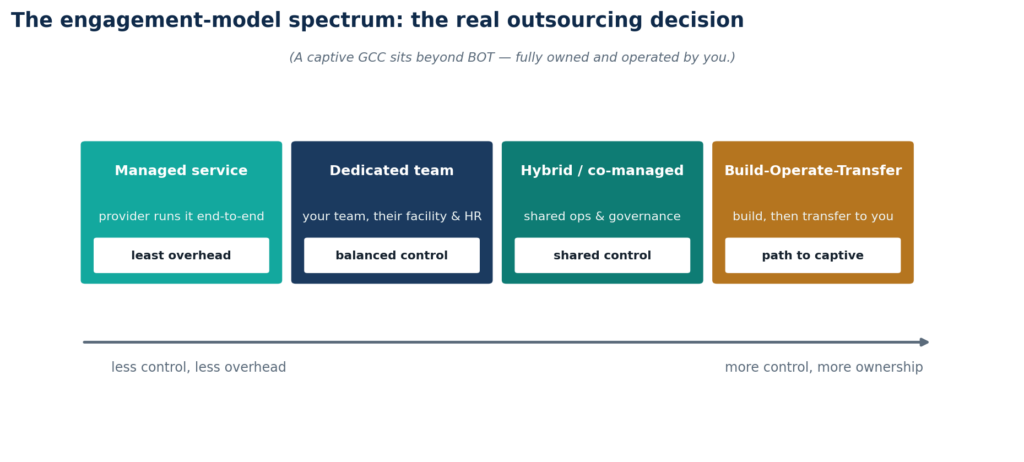
Figure 1 — Models sit on a spectrum from least control/least overhead to most control/most ownership.
“The single biggest predictor of whether an outsourcing relationship succeeds is whether the client picked the right engagement model on day one. A startup that needs speed and zero overhead should not be running a build-operate-transfer; an enterprise protecting a core capability should not hand it to a pure managed service. Match the model to your actual control and risk needs, and most of the usual problems never arise.” John Maczynski — CEO, PITON-Global; former Global EVP of the world’s largest BPO provider
How Do You Choose the Right Engagement Model?
By weighing how much control you need, your tolerance for management overhead, the strategic importance of the function, and whether you eventually want to own the operation.
The choice comes down to a few honest questions. How much day-to-day control do you need over the operation? How much management overhead can your team absorb? Is this function a commodity to be run efficiently, or a strategic capability you may want to own one day? And how fast do you need to be live? Managed service wins on speed and low overhead for non-core, well-defined work. Dedicated and hybrid models suit functions where you need control and brand consistency. BOT suits companies that want offshore scale now and ownership later. The wrong fit — too much control where you wanted convenience, or too little where you needed it — is what produces most outsourcing regret.
| Model | Best When You Want… | Trade-Off |
| Managed service | Speed and minimal overhead | Less day-to-day control |
| Dedicated team | Control with provider support | More involvement required |
| Hybrid / co-managed | Shared governance and flexibility | Clear role-split needed |
| Build-operate-transfer | Scale now, ownership later | Longer, more complex setup |
| Captive GCC | Full ownership and control | Highest cost and responsibility |
How Is a Call Center Operation Actually Migrated to the Philippines?
In phases: scope and pilot a contained workflow, build SOPs and train the team, ramp seats as quality metrics hold, then optimize by adding channels, AI, and scope.
Successful migrations are sequenced, not switched on. The proven path starts by scoping and piloting a single contained workflow — enough to prove the model without betting the whole operation. Next comes the build: documenting SOPs, standing up tooling and integrations, and training and calibrating the team against your standards. Then the ramp, where seats scale only as quality metrics hold steady. Finally, optimization — adding channels, introducing AI augmentation, and expanding scope once the foundation is proven. A typical program reaches a stable steady state within a few months when sequenced this way; lift-and-shift attempts that skip the pilot are where quality collapses.
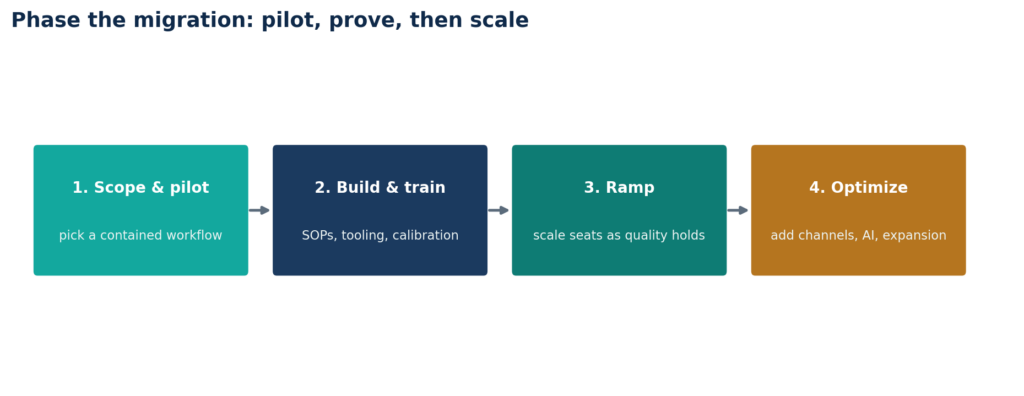
Figure 2 — Pilot, prove, then scale — the sequence that protects quality during migration.
“The fastest way to fail at outsourcing is to move everything at once to save time. The fastest way to succeed is to pick one workflow, get it genuinely excellent, and let that prove the playbook before you scale. We have watched that patience pay off for twenty-five years — the phased programs are the ones that last.” Ralf Ellspermann — CSO, PITON-Global; 25-year Philippine BPO veteran
What Stays Your Responsibility When You Outsource?
Policy, brand standards, escalation thresholds, performance targets, and governance — the partner delivers operational execution against the framework you own.
Outsourcing the operation does not mean outsourcing accountability for the customer experience. You retain the policy and brand standards agents enforce, the escalation thresholds, the performance targets and SLAs, and the governance that holds the relationship to them — calibration sessions, reporting cadence, and a named relationship owner on both sides. The provider supplies recruitment, training, facilities, technology, and day-to-day management within that framework. Run this way, an outsourced Philippine operation behaves like an extension of your own team, and the governance layer is what keeps it aligned as volumes and requirements change.
Frequently Asked Questions
How Does Call Center Outsourcing to the Philippines Work?
Through an engagement model — managed service, dedicated team, hybrid, or build-operate-transfer — chosen along a control-vs-overhead spectrum, then a phased migration: scope and pilot, build and train, ramp, and optimize.
What Is the Difference Between Managed Service and a Dedicated Team?
A managed service means the provider runs the operation end-to-end against your SLAs (least overhead, less control). A dedicated team means you direct a team the provider staffs and houses (more control, more involvement).
What Is Build-Operate-Transfer (BOT)?
A model where the provider builds and runs the operation, then transfers it to you later — giving you offshore scale immediately and a path to a fully-owned captive (GCC) over time.
How Long Does Migration Take?
Sequenced properly — scope and pilot, build and train, ramp, optimize — a program typically reaches a stable steady state within a few months. Lift-and-shift attempts that skip the pilot tend to fail on quality.
Related in This Series
Why Are Call Centers in the Philippines the Global CX Standard — and Is AI Changing That?
The full picture and industry context.
What Call Center Services Can You Outsource to the Philippines?
The full service taxonomy, voice to omnichannel.
What Does It Cost to Run a Call Center in the Philippines?
The TCO cost-stack and 2026 benchmarks.
Why Is Call Center Pricing Moving From Per-Hour to Outcome-Based?
How the commercial model is changing in the AI era.
How Do Philippine Call Centers Deliver CX Quality?
The metrics that govern quality, and the voice edge.
Is AI Replacing Call Centers in the Philippines?
The AI-human division of labor, in depth.
How Do You Choose the Right Call Center Partner?
The vendor scorecard and the quality-tier gap.
Where Should You Locate: Manila, Cebu & Beyond?
The city-tiering framework for hub selection.
About PITON-Global
PITON-Global is a vendor-neutral outsourcing advisory with 25+ years in the Philippine market. We help companies choose the right engagement model — managed, dedicated, hybrid, BOT, or captive — and source and structure the partner to deliver it, free of charge and with no obligation.
Achieve sustainable growth with world-class BPO solutions!
PITON-Global connects you with industry-leading outsourcing providers to enhance customer experience, lower costs, and drive business success.
Get Your Top 1% Vendor List
Author
Ralf Ellspermann is a multi-awarded outsourcing executive with 25+ years of call center and BPO leadership in the Philippines, helping 500+ high-growth and mid-market companies scale call center and customer experience operations across financial services, fintech, insurance, healthcare, technology, travel, utilities, and social media.
A globally recognized industry authority - and a contributor to The Times of India, CustomerThink, and The AI Journal - he advises organizations on building compliant, high-performance offshore contact center operations that deliver measurable cost savings and sustained competitive advantage.
Known for his execution-first approach, Ralf bridges strategy and operations to turn call center and business process outsourcing into a true growth engine. His work consistently drives faster market entry, lower risk, and long-term operational resilience for global brands.
EXECUTIVE GOVERNANCE & ACCURACY STANDARDS
Authored by:
Ralf Ellspermann
Founder & CSO of PITON-Global,
25-Year Philippine BPO Veteran,
Multi-awarded Executive
Specializing in strategic sourcing and excellence in Manila
View Full Bio
Verified by:
John Maczynski
CEO of PITON-Global, and former Global EVP of the World’s largest BPO provider | 40 Years Experience
Ensuring global compliance and enterprise-grade service standards
View Full Bio
Last Peer Review: June 4, 2026
This service framework is audited quarterly to meet shifting global outsourcing regulations and COPC standards.