

On this page
- Key Takeaways
- How Do Fully Loaded Onshore Costs Compare to Philippine BPO Pricing Models?
- What One-Time Transition and Implementation Expenses Must Be Modeled?
- How Do Currency Movements, Inflation, and Retention Impact Long-Term ROI?
- What Does a Well-Built Business Case Deliver in Practice?
- How Does PITON-Global Guide Executive Decision-Making?
- Frequently Asked Questions
A robust BPO business case must include a fully loaded direct labor baseline—start from our live pricing calculator rather than a base wage—operational overhead, one-time transition and migration capital, ongoing governance costs, and operational risk buffers. Adding localized Philippine wage dynamics, exchange-rate protections, and productivity ramp adjustments turns a static projection into a dynamic model that accurately measures net operating margin expansion.
Key Takeaways
- Fully loaded direct labor arbitrage: Base salary is only a little over half of total onshore FTE expense; accurate business cases must model healthcare, payroll taxes, physical workspace, and software licensing.
- One-time transition and knowledge transfer expenses: Upfront outlays—parallel runs, vendor integration, dual-redundancy network provisioning, and travel—are a material fraction of first-year Annual Contract Value (ACV) and must be capitalized.
- Operational ramp and productivity curve adjustments: Models must account for a 60–90 day efficiency dip during knowledge transfer, factoring in initial First Contact Resolution (FCR) variances.
- Foreign exchange and inflation hedging: Long-term projections require explicit currency buffers and annual Philippine wage adjustments in the low single digits to insulate operating margins.
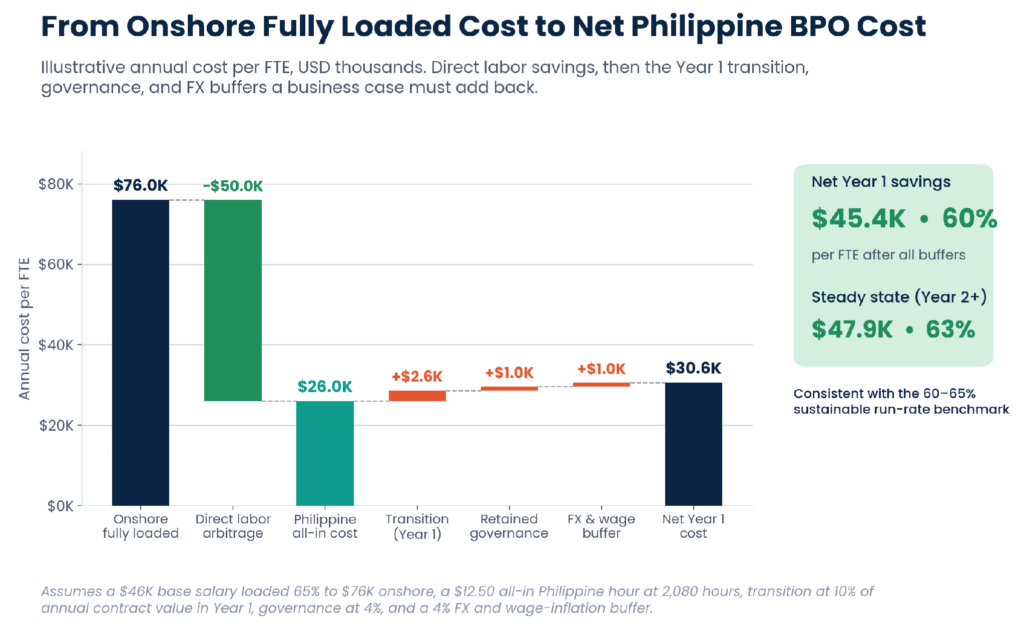
Figure 1. Multi-layered waterfall from onshore fully loaded cost to net Philippine BPO cost: direct labor savings minus transition, governance, and FX buffers (illustrative, per FTE per year).
How Do Fully Loaded Onshore Costs Compare to Philippine BPO Pricing Models?
Fully loaded onshore costs add roughly half again above base wages for mandatory benefits, local taxes, facility overhead, recruitment, and technology. Philippine BPO pricing consolidates those expenses into an all-inclusive hourly rate or dedicated monthly FTE fee that sits at a fraction of the onshore figure, producing net cost reductions of well over half by function.
Building an enterprise-grade business case requires moving beyond simple hourly base-pay comparisons. In North American and Western European markets, the fully loaded cost of an internal full-time equivalent (FTE) includes mandatory benefits, local taxes, facility overhead, recruitment costs, and technology stacks—which together add substantially to base wages and explain why base salary is only a little over half of true FTE expense. In the Philippines, BPO pricing models consolidate these expenses into an all-inclusive hourly rate or dedicated monthly FTE fee. The table below sets out standard financial benchmarks across core service functions.
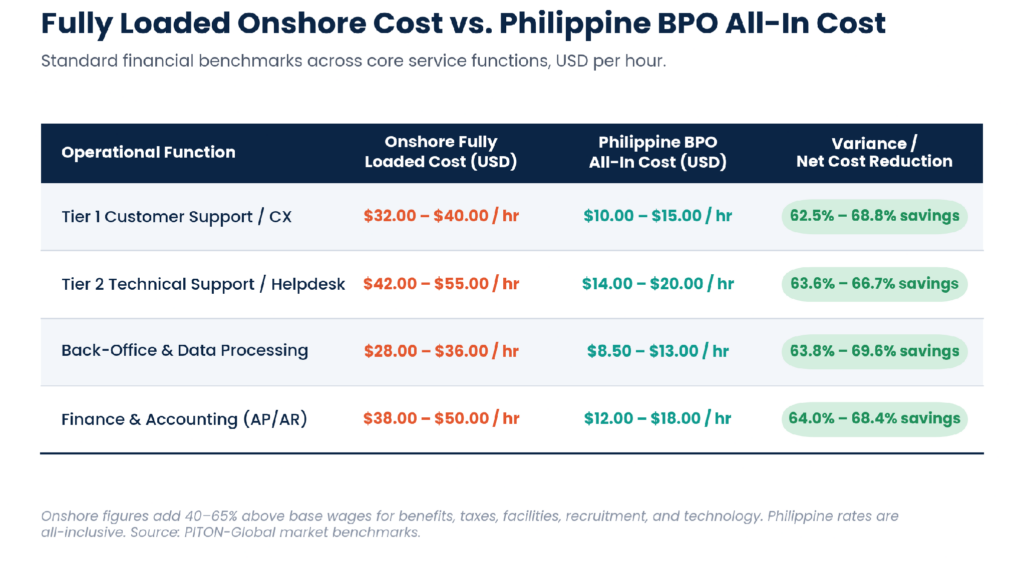
Figure 2. Fully loaded onshore cost versus Philippine BPO all-in cost by function, with net cost reduction.
By capturing the entire cost baseline, financial officers prevent gross savings estimates from masking hidden internal operational expenses. The choice of pricing model matters too: fixed hourly or per-FTE monthly billing suits core, predictable workloads and simplifies budgeting, while transaction-based or gain-share models suit high-volume, variable processes and capture productivity gains automatically. A business case should state which model is assumed, because the two produce different savings curves as volumes change.
What One-Time Transition and Implementation Expenses Must Be Modeled?
One-time transition costs are a material share of Annual Contract Value and must be capitalized in the model: dual-run staffing during the 30–60 day shadowing phase, knowledge transfer and process documentation including travel, technology and connectivity provisioning such as API integration, VDI, and dedicated network lines, and legal and procurement overhead for MSA negotiation and compliance auditing. Our framework for BPO transition management covers how each of those lines is sequenced.
A major flaw in BPO financial modeling is the failure to capitalize one-time implementation and onboarding costs. Transitioning processes to Manila or Cebu incurs immediate upfront expense that temporarily offsets initial wage arbitrage, which is why cumulative cash flow dips before it climbs. Modeled correctly, the break-even point lands between Month 4 and Month 6 after migration, as the chart below shows—consistent with typical timelines to positive ROI for offshore programs.
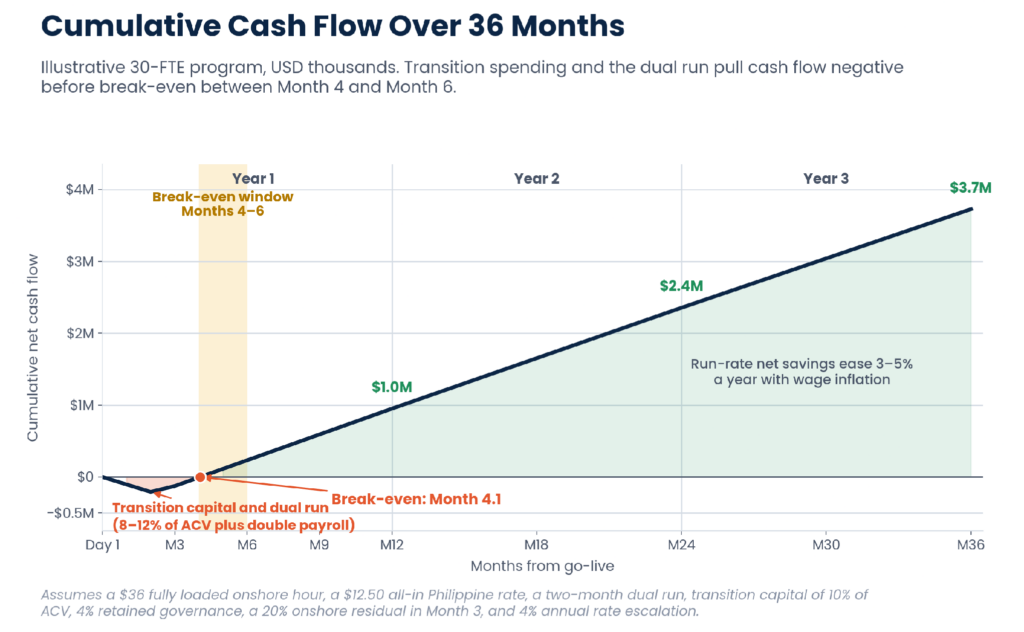
Figure 3. Illustrative cumulative cash flow over 36 months for a 30-FTE program, with break-even between Month 4 and Month 6.
Dual-Run Operational Costs
Maintaining parallel onshore and offshore staffing during the 30–60 day shadowing phase ensures continuous SLA performance while the offshore team ramps. It is usually the single largest transition line, and it should be modeled as double payroll for the overlap period rather than smoothed into the run-rate.
Knowledge Transfer and Process Documentation
On-site sender-team training expenses, travel, and specialized curriculum development. Programs that document SOPs before contracting shorten this phase materially; programs that document during transition pay for it twice, once in travel and again in a longer ramp.
Technology and Connectivity Provisioning
Custom API integration, client-side software licenses, virtual desktop infrastructure (VDI), and secure dedicated network lines. These are genuinely one-time, but the recurring license and circuit costs they create belong in the ongoing model, not the transition budget.
Legal and Vendor Procurement Overhead
External legal reviews, master service agreement (MSA) negotiations, and third-party compliance auditing such as SOC 2 and HIPAA verification. Budget them explicitly; they are small relative to ACV, but they are also the items most often omitted.
The most common mistake CFOs make when evaluating Philippine BPO models is underestimating the ramp curve and omitting retained organization governance costs. When you factor in a realistic 90-day learning curve alongside active vendor management, your net run-rate savings settle somewhat below the gross arbitrage headline but at a highly sustainable level—giving you predictability without unexpected budget variances.
— John Maczynski, CEO, PITON-Global
How Do Currency Movements, Inflation, and Retention Impact Long-Term ROI?
Multi-year assumptions must absorb three macro and operational variables: annual Philippine wage inflation, which surfaces as renewal escalators even under USD billing; agent attrition, with contract terms defining who absorbs retraining; and a retained governance team funded as a fixed share of contract value. Explicit buffers for each keep Year 2 and Year 3 margins intact.
Financial assumptions extending past Year 1 must account for macro-economic variables that alter operating costs in offshore locations. While Philippine BPO contracts are typically billed in US dollars, shifts between the Philippine peso and the dollar influence underlying provider margins and therefore annual renewal terms. The decision matrix below pairs each long-term risk variable with the assumption to model and the tactic that mitigates it.
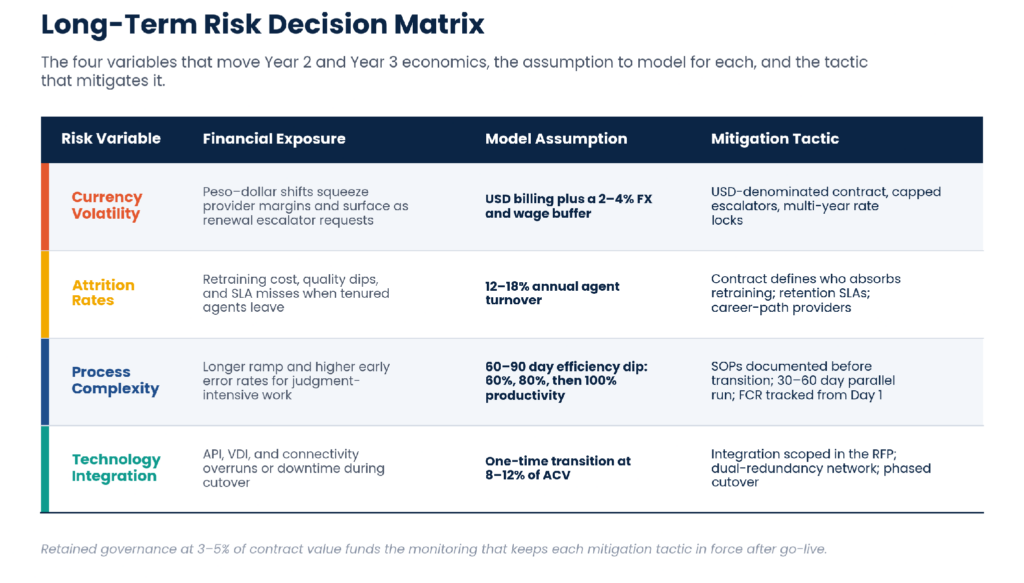
Figure 4. Decision matrix of long-term risk variables—currency volatility, attrition, process complexity, and technology integration—with model assumptions and mitigation tactics.
Wage Inflation and Merit Increases
Incorporate an annual salary adjustment benchmark in line with local market movement to maintain competitive retention rates in primary hubs such as Metro Manila and Cebu. Negotiating escalator caps at signing converts an open-ended assumption into a contractual ceiling.
Attrition Mitigation Allocations
Model an explicit annual agent turnover assumption drawn from the provider’s own retention history, and ensure vendor contract terms explicitly define who absorbs retraining costs. A provider that retains agents above that benchmark is worth a modest rate premium; one that cannot will consume the difference in rework—which is why total vendor value, not the bill rate, belongs in the scoring model.
Retained Governance Team (a Fixed Share of Contract Value)
Budget for internal vendor managers, quality auditors, and operational leads tasked with monitoring provider performance. This is a permanent line, not a transition cost, and its omission is the most common reason realized savings undershoot the business case.
What Does a Well-Built Business Case Deliver in Practice?
A well-built business case turns an estimate into a predictable result. A mid-market healthcare technology provider modeled its claims-processing migration on fully loaded costs, deployed a 45-seat unit in Cebu at an all-inclusive hourly rate that was a fraction of its onshore baseline, cut operating expenditure by well over half, recouped its transition investment by Month 5, and banked seven-figure net annual savings.
Client Challenge
A mid-market healthcare technology provider struggled with rising internal claims-processing costs on a fully loaded basis and needed an accurate outsourcing business case—covering transition capital, ramp, and governance—before committing to migrate operations.
Vendor Selection
Leveraging advisory benchmarks, the organization evaluated SOC 2 Type II and HIPAA-compliant Philippine providers with proven healthcare operational retention, scoring candidates on fully loaded pricing transparency and attrition history rather than headline rates.
Solution Implemented
A 45-seat dedicated claims-processing unit was deployed in Cebu, featuring an all-inclusive hourly FTE structure, a structured 60-day parallel transition schedule, and a fixed retained governance budget written into the business case from the outset.
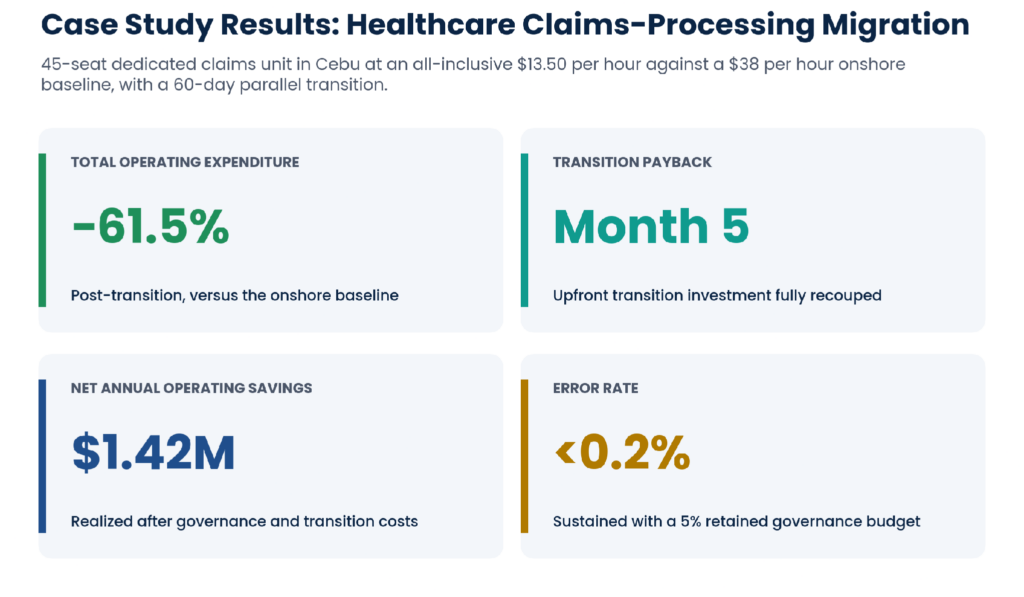
Figure 5. Quantifiable business outcomes of the healthcare claims-processing migration.
Outcomes and Lessons
Total operating expenditure dropped by well over half post-transition. The upfront transition investment was fully recouped by Month 5, yielding seven-figure net annual operating savings. The lesson: including a dedicated retained governance budget ensured continuous quality oversight, keeping error rates negligible throughout the contract life—and because every cost line had been modeled upfront, the realized savings matched the business case rather than undershooting it.
How Does PITON-Global Guide Executive Decision-Making?
PITON-Global is a vendor-neutral BPO advisory and sourcing firm headquartered in Manila, backed by leadership with over three decades of hands-on BPO executive experience. Acting as an executive advisor rather than a sales broker, it guides decision-makers through detailed financial modeling, cost-benefit analysis, and partner selection across more than 100 vetted Philippine providers, at zero cost to the client.
Who Is PITON-Global?
PITON-Global is a vendor-neutral BPO advisory and sourcing firm headquartered in Manila, backed by leadership with more than three decades of hands-on BPO executive experience, including CEO John Maczynski’s 25-plus years of operational leadership in Southeast Asia. The firm guides enterprise decision-makers through financial modeling, cost-benefit analysis, and partner selection in a market of more than 1,000 providers.
How Does PITON-Global Differ from Traditional Outsourcing Brokers?
Traditional sales brokers earn commissions on placement and have little stake in whether the business case holds. PITON-Global acts as an executive advisor: it builds the fully loaded baseline with the client, applies proprietary market benchmarks and custom RFP frameworks to normalize bids, recommends on the client’s financial outcomes rather than provider promotion, and stays engaged through contracting and transition.
How Does PITON-Global’s Network of 100+ Vetted Philippine BPO Providers Benefit Organizations?
Access to more than 100 vetted Philippine call centers and back-office providers—across Manila, Cebu, and secondary hubs—lets procurement teams skip months of discovery. Every provider has already been assessed for pricing transparency, compliance certifications, retention performance, and domain expertise, so bids arrive on a comparable, fully loaded basis.
How Does PITON-Global’s Advisory-Led Vendor Matching Process Work?
The process runs from business-case assessment to selection support: building the fully loaded baseline, transition budget, and governance allocation; filtering the vetted network for domain fit, retention, and right-sized capacity; issuing a custom RFP and delivering a normalized shortlist within 48–72 hours; verifying security, SLA history, escalator terms, and hidden-cost exposure; then supporting negotiation, SLA-protected agreements, and transition oversight.
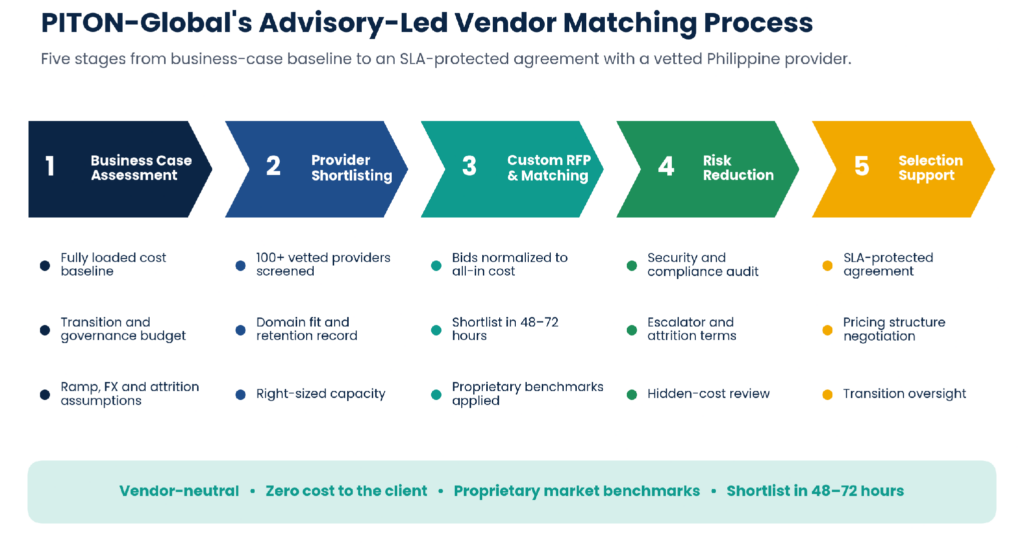
Figure 6. PITON-Global’s five-stage advisory-led matching process, from business-case baseline to SLA-protected agreement.
Why Do Organizations Use PITON-Global?
Organizations use PITON-Global to mitigate implementation risk, structure SLA-protected agreements, and maximize long-term return on investment. Because the advisory service is delivered at zero cost to the client, it adds expert financial modeling and negotiation leverage at the point where a mis-specified business case is most expensive.
Frequently Asked Questions
What is the typical payback period for initial BPO transition costs?
Most enterprise BPO transitions achieve full payback on initial implementation and training capital within 4 to 6 months after reaching full operational steady state.
Should business cases assume fixed or variable pricing models?
Fixed hourly or per-FTE monthly billing models are best for core, predictable workloads, while transaction-based or gain-share models suit high-volume, variable processes.
How do we account for the productivity ramp-up period in financial projections?
Model a stepped efficiency ramp—partial productivity in Month 1, most of it in Month 2, and full steady-state performance by Month 3—to accurately reflect training and learning curves.
What percentage of savings should be allocated to internal governance?
Set aside a small fixed share of the total annual outsourcing contract value—the same governance allocation modeled above—to fund internal vendor management, quality monitoring, and executive oversight.
How does outsourcing impact enterprise valuation and EBITDA?
Direct SG&A cost reductions convert directly into expanded EBITDA margins, often resulting in immediate enterprise value multiples for private equity-backed or public firms.