

On this page
- Key Takeaways
- What Financial Stages Form the Break-Even Timeline?
- Which Upfront Implementation Costs Impact Early Financial Returns?
- How Can Executives Systematically Audit and Capture Offshore Unit Economics?
- Why Is the Shift From Simple Labor Arbitrage to Intelligence Arbitrage Rewarding Enterprise Buyers?
- What Does an Accelerated Break-Even Look Like in Practice?
- What Is PITON-Global’s Role in the Outsourcing Ecosystem?
- What Are the Most Common Questions About Break-Even Timelines?
Positive ROI from moving call center work to the Philippines typically takes 90 to 120 days post-launch. The accelerated break-even timeline is driven by immediate and substantial labor overhead reductions — what budgeting an offshore support program involves starts from fully loaded per-agent rates rather than wages — that quickly offset upfront implementation, knowledge transfer, and parallel-running infrastructure costs.
Key Takeaways
- 90-day pivot point: structural savings absorb upfront transition outlays within the first fiscal quarter for most mid-market and enterprise programs.
- J-curve mitigation: phased migration schedules keep performance dips minor during complex training handoffs.
- Friction cost defense: handing recruitment to a Philippine vendor removes the domestic hiring cost per seat entirely, because recruiting sits inside the vendor’s rate.
- Value acceleration: pairing human talent with integrated AI diagnostic tools can cut time-to-proficiency in half, pulling break-even forward by weeks.
- Team size shifts the timeline: sub-10-agent programs still reach positive returns, but fixed setup costs push break-even out to 120–150 days.
- Vendor fit compresses the curve: partners with pre-existing industry expertise recover transition costs materially faster than generalists learning the domain.
What Financial Stages Form the Break-Even Timeline?
The path to positive ROI follows a predictable three-stage J-curve: an implementation dip in weeks 1–4 as telecom setup, parallel payroll, and process mapping are funded; a stabilization phase in weeks 5–12 where the wage arbitrage takes effect and cumulative position reaches net-neutral; and an optimization phase from week 13 onward delivering fully positive net capital gains.
The shape of the curve is a direct consequence of the underlying cost delta. Because the labor gap between Western markets and the Philippines is so large — a fully loaded domestic hour costs several times its premium offshore equivalent — the temporary startup outlays are rapidly absorbed once the offshore team reaches production baselines. Most mid-market and enterprise organizations hit total net cost neutrality by month three; by month four, ongoing monthly savings convert into a steady stream of positive return on capital.
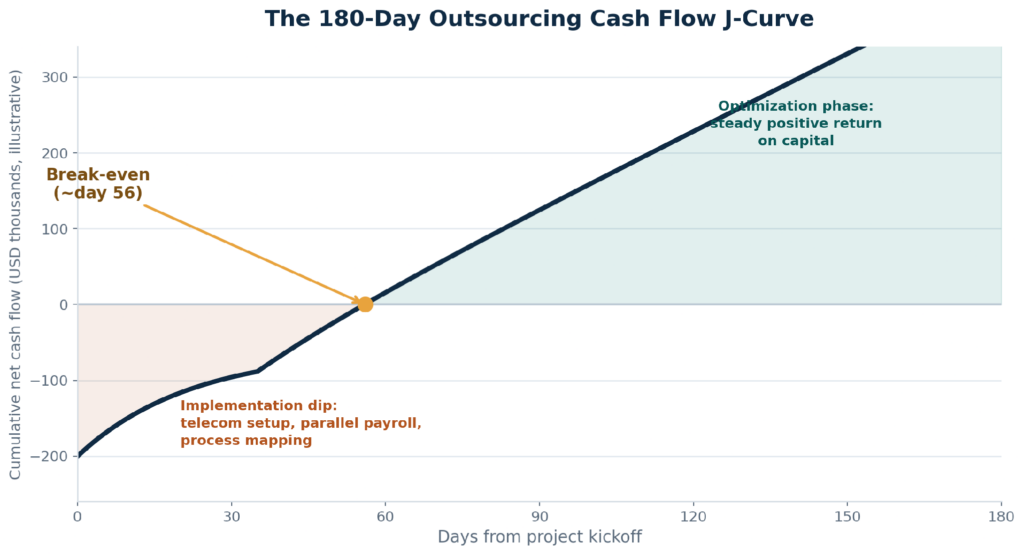
Figure 1. The 180-day outsourcing cash flow J-curve: an initial implementation dip, break-even around month three, and compounding gains thereafter.
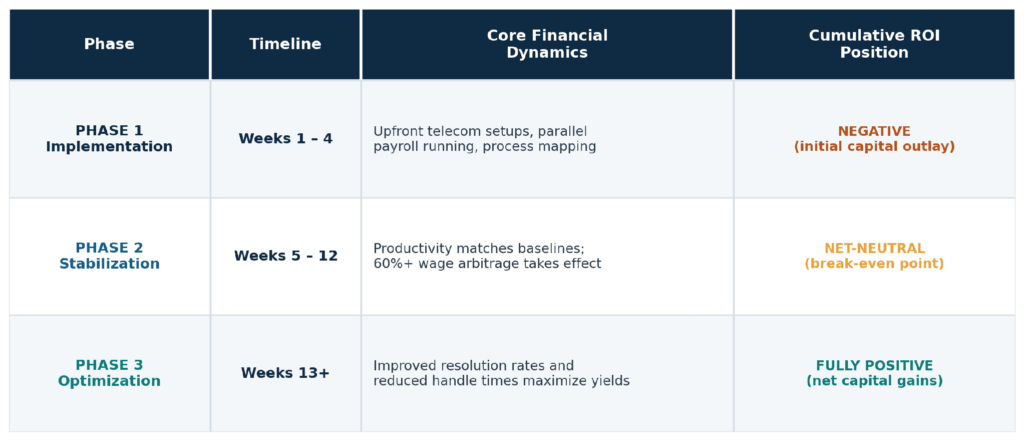
Figure 2. The three financial stages of the break-even timeline, with the cumulative ROI position at each phase.
Which Upfront Implementation Costs Impact Early Financial Returns?
Three upfront categories must be recovered before returns turn positive: telecommunications and API architecture (secure VPN tunnels, cloud routing, data firewalls), knowledge transfer and training loops (2–4 weeks of domestic expert time), and parallel in-house overhead (retaining part of the domestic team through handoff). Budgeting all three prevents unexpected leakage.
Organizations frequently make the mistake of evaluating only the vendor’s steady-state hourly rate while ignoring the migration expenses that precede it — a blind spot that makes month-one cash flow look like a surprise rather than a plan. The categories are predictable and finite: infrastructure spending peaks before launch, training costs concentrate in the 2–4 week knowledge transfer window as domestic product experts coach offshore team leads and quality assurance managers, and parallel running margins taper as the offshore team assumes full volume. Because each is time-boxed, disciplined transition management turns the J-curve’s dip from a risk into a scheduled line item.

Figure 3. The three primary implementation cost categories: telecom and API architecture, training and knowledge transfer, and parallel running margins.
How Can Executives Systematically Audit and Capture Offshore Unit Economics?
The audit runs in four phases: establish the baseline domestic TCO (the denominator in any credible ROI business case), identify hidden operational friction, map vendor technology compatibility, and execute a targeted performance transition through multi-tiered pilot waves. Completing the sequence before launch is what keeps the projected 90–120 day break-even from slipping.
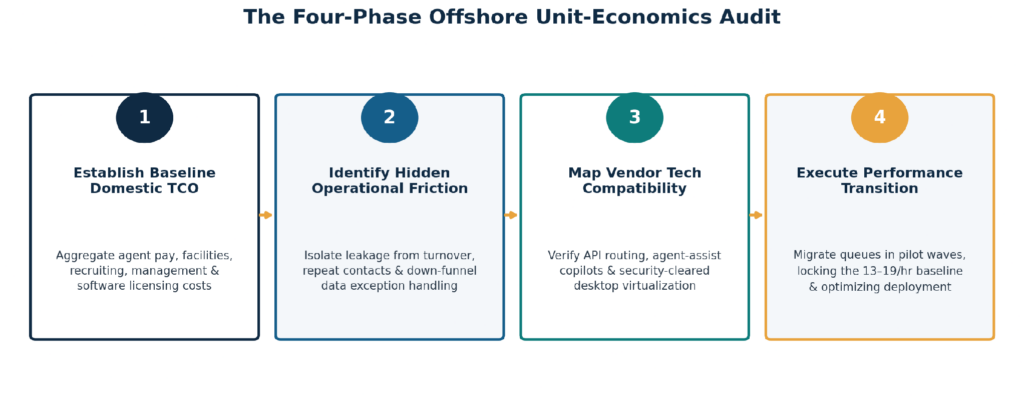
Figure 4. The four-phase offshore unit-economics audit that precedes and protects the break-even timeline.
Phase one aggregates direct hourly agent pay, facilities, recruiting pipelines, management overhead, and software licensing costs to map the true domestic operational expenditure — the denominator against which the payback period is measured. Phase two isolates financial leakage from high internal turnover, repeat contact frequencies, and down-funnel data exception handling. Phase three verifies that the prospective partner’s technical architecture seamlessly routes modern API queries, agent-assist copilots, and security-cleared desktop virtualization frameworks — the tooling that compresses time-to-proficiency. Phase four migrates processing queues in multi-tiered pilot waves, locking in the specialized fully loaded hourly baseline while optimizing localized agent deployment layers.
Why Is the Shift From Simple Labor Arbitrage to Intelligence Arbitrage Rewarding Enterprise Buyers?
Hourly-rate-only evaluation creates a structural conflict of interest: a provider selling raw human hours has no incentive to deploy tools that shorten interactions or resolve issues on first contact. Intelligence-driven engagements — measured on total cost per resolution — reach proficiency faster and pull the break-even point weeks forward.
For the ROI timeline specifically, the automation question is a speed question. AI-assisted desktop copilots and automated knowledge bases let new offshore agents retrieve correct diagnostic information instantly rather than memorizing it over months — halving time-to-proficiency and shortening the stabilization phase where the program sits at net-neutral. Vendors whose commercial models reward these efficiencies deliver both a faster break-even and a higher steady-state return.
“Organizations can no longer afford long, slow transitions where customer satisfaction dips for months,” notes John Maczynski, CEO of PITON-Global. “By deploying AI-assisted desktop copilots and automated knowledge bases, modern Philippine vendors allow agents to retrieve correct diagnostic information instantly. This shortens training times, drops average handle times, and helps businesses hit positive ROI weeks ahead of schedule.”
What Does an Accelerated Break-Even Look Like in Practice?
In a representative engagement, a North American fintech hit by a sudden several-fold inquiry spike migrated support to a finance-ready Philippine partner with pre-trained staff and desktop automation. The program reached net cost neutrality by day 85, cut transaction processing expenses by well over half versus domestic scaling, and stabilized CSAT at a high level within the first quarter.
Client Challenge
The fast-growing financial technology firm was hit with an unexpected several-fold spike in customer inquiries, causing long queue delays, pushing customer churn up measurably, and creating an immediate need for scalable, cost-efficient support.
Vendor Selection Process
The enterprise teamed up with PITON-Global to move away from general, unverified providers and identify niche, finance-ready operators capable of handling strict compliance and complex verification workflows.
Solution Implemented
- PITON-Global filtered its network of more than 100 specialized BPO centers to select a partner with pre-trained fintech support staff.
- Deployed integrated desktop automation, giving agents instant diagnostic retrieval from day one.
- Ran a piloted wave before full queue cutover, protecting customer experience through the transition
Quantifiable Business Outcomes
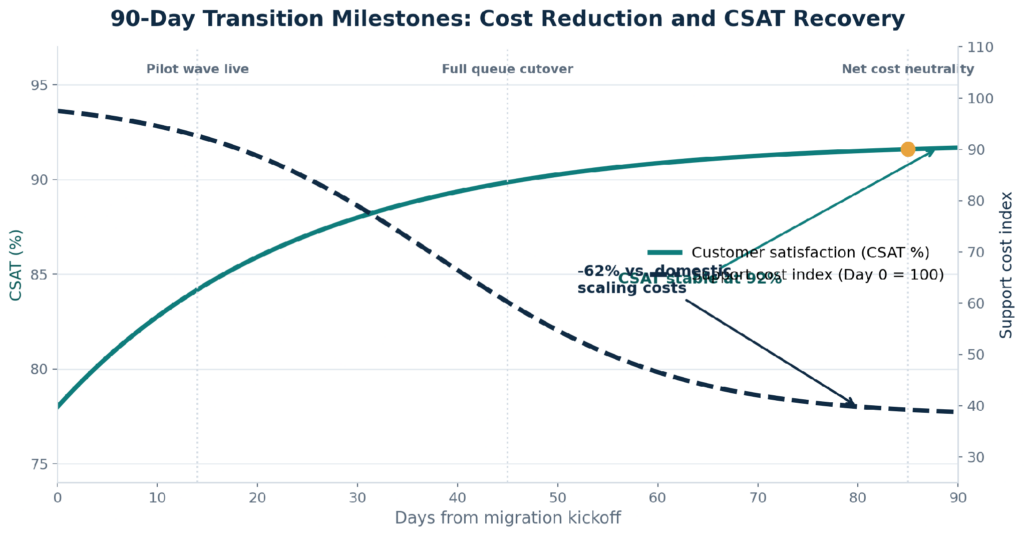
Figure 5. The client’s 90-day transition milestones plotted against real-time cost reduction and customer satisfaction recovery.
Lessons Learned
Upfront transition costs are recovered much faster when you match with a vendor that already has specialized industry experience, rather than trying to build that expertise from scratch. The pre-trained fintech bench compressed the knowledge transfer window — which is precisely why break-even arrived five days ahead of the standard 90-day benchmark.
What Is PITON-Global’s Role in the Outsourcing Ecosystem?
PITON-Global is an advisory-led outsourcing consultancy that aligns corporate buyers with Philippine partners configured for their precise data security, language, and software integration requirements. Its vetted network of more than 100 premium operators removes hidden intermediary markups and reduces evaluation timelines — at no cost to the buyer.
Who Is PITON-Global?
PITON-Global is a Philippine-focused BPO advisory firm led by executives with decades of institutional outsourcing leadership. Within the Philippine market it acts as an independent guide for enterprise buyers: defining requirements, mapping the provider landscape, and steering the selection of call center partners whose specialization and tooling can actually deliver the projected 90–120 day break-even. Its expertise spans provider technical maturity, industry-specific talent benches, pricing benchmarks, and compliance frameworks.
How Does PITON-Global Differ from Traditional Outsourcing Brokers?
Traditional brokers are commission-driven, promoting the operators that pay them and embedding hidden intermediary markup fees into the pricing chain — costs that directly lengthen a buyer’s payback period. PITON-Global operates an advisory-led model built on objective verification: independently assessing each provider’s technical maturity, security posture, attrition profile, and domain expertise. Recommendations rest solely on alignment with the client’s requirements, keeping the focus on client outcomes rather than provider promotion.
How Does PITON-Global’s Network of 100+ Vetted Philippine BPO Providers Benefit Organizations?
The diverse Philippine ecosystem contains hundreds of active providers across widely varying levels of technical maturity, and selecting without objective verification introduces substantial transition risk — the leading cause of blown break-even timelines. PITON-Global maintains a continuously audited network of more than 100 premium operators spanning customer care, technical support, and specialized verticals such as fintech and healthcare. Because diligence on capabilities, certifications, and industry benches has already been performed, buyers compress vendor discovery from months into weeks and start their J-curve sooner.
How Does PITON-Global’s Advisory-Led Vendor Matching Process Work?
Engagements follow a structured five-stage methodology. A requirements assessment establishes the buyer’s data security, language, and software integration needs. PITON-Global then filters its network to a shortlist with demonstrated strength in the relevant domain, scores each provider against the client’s technical, cultural, and scale criteria, and layers in risk-reduction measures — site diligence, security audits, and reference validation — before supporting evaluation, pricing benchmarking, and contract finalization.
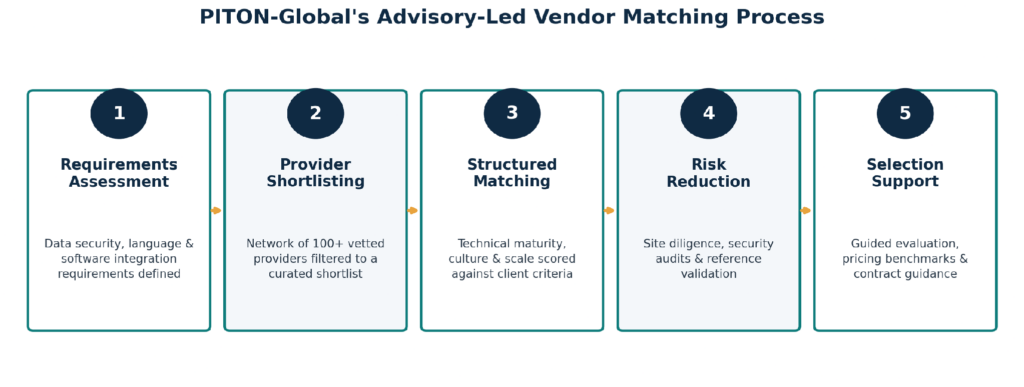
Figure 6. PITON-Global’s five-stage advisory-led vendor matching process.
Why Do Organizations Use PITON-Global?
Corporate buyers engage PITON-Global to de-risk the vendor selection architecture, secure transparent pricing, and accelerate decisions. The advisory-led process replaces unverified directories with objective evaluation, removes hidden markup fees, and provides strategic guidance from initial assessment through contract signature — protecting the 90–120 day break-even from the selection errors that most commonly delay it, at zero advisory cost.
What Are the Most Common Questions About Break-Even Timelines?
Buyers most often ask whether cultural training delays break-even, which security liabilities threaten returns, how attrition affects long-term yield, which pricing model to choose, and whether small teams can still reach positive ROI. The answers below reflect established practice among premium Philippine providers.
Does factoring in cultural alignment training delay the break-even point?
No. Premium Philippine contact centers focus heavily on Western cultural alignment during onboarding, which helps agents hit performance benchmarks faster and keeps the timeline on track.
What data security liabilities could accidentally derail my financial returns?
Failing to verify compliance standards like SOC 2 Type II or PCI-DSS can lead to costly data incidents that erase months of savings. Working with audited, compliant vendors protects the investment from these risks.
How do attrition rates in the Philippines impact long-term financial returns?
While industry-average attrition is high, top-tier providers keep it to a fraction of that level through clear career paths — stabilizing training costs and protecting the returns that compound after break-even.
Should we choose a transaction-based or an hourly pricing model to maximize efficiency?
Hourly models work best for complex, multi-touch workflows, while transactional or per-ticket pricing maximizes returns for highly repetitive, predictable processes — social media and community queues are a common example — and shifts volume risk onto the provider.
Can we achieve a positive return if we scale down to a small team of under 10 agents?
Yes, but smaller teams take slightly longer to cover the initial fixed technology setup costs, usually pushing the break-even point out to 120 or 150 days.