
Trust & Safety (T&S) outsourcing means delegating the operational work of keeping a platform safe — content moderation, child-safety review, fraud and scam defense, platform integrity, and AI-output review — to specialist partners. The Philippines leads this market because it pairs a large, English-fluent, culturally-aligned workforce with a mature “AI-filters, humans-judge” model and wellbeing-first operations. Done right, you outsource the execution and scale while keeping policy ownership and the highest-risk decisions in-house.
Key Takeaways
- T&S is an umbrella, not a single task. It spans content moderation, child safety, fraud and scams, platform integrity, moderator wellbeing, and AI/Gen-AI safety — each with its own workflow and risk profile.
- The model is hybrid by default. Hash-matching and AI classifiers handle volume; Philippine human reviewers apply contextual judgment; the highest-risk Tier-3 cases stay closest to the platform.
- The market is scaling fast. Content-moderation outsourcing was roughly $12B in 2024 and is projected toward $22.7B–$42.3B over the next decade as UGC, generative AI, and regulation expand.
- The Philippines is the category leader. English fluency, cultural alignment, 24/7 scale, SOC 2 / ISO 27001 / GDPR-aligned operations, and a wellbeing-first shift make it the default destination.
- Outsourcing scale ≠ outsourcing accountability. Policy, safety-by-design, and final high-risk decisions stay in-house; you delegate the operational execution around them.
What Does “Trust & Safety” Actually Cover?
Every operational function that keeps users safe and a platform compliant — spanning six core domains, from content moderation to AI-output review.
Trust & Safety is the discipline of protecting users, communities, and the platform itself from harm and abuse. It is not one queue but an umbrella over several distinct operations, each demanding different skills, tooling, and risk controls. For any platform that hosts user activity — social, marketplace, gaming, dating, fintech, or AI — these functions are now core infrastructure, not a back-office afterthought.
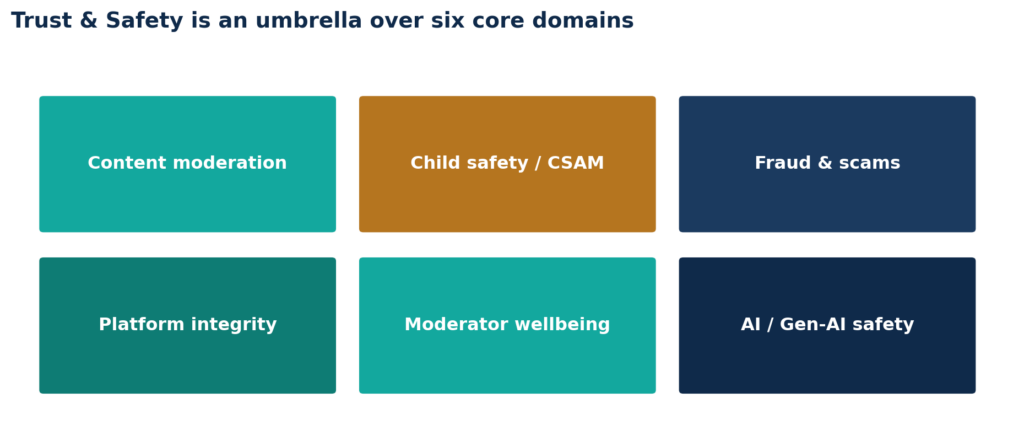
Figure 1 — Trust & Safety spans six core domains, each explored in a dedicated guide in this series.
Because the domains differ so sharply — a child-safety queue has little in common operationally with marketplace fraud defense — the right outsourcing approach is domain-specific. This pillar maps the whole category; the linked spoke guides go deep on each.
Why Do Platforms Outsource Trust & Safety at All?
Because the work is high-volume, 24/7, judgment-heavy, and emotionally demanding — a combination almost no platform can staff economically in-house at scale.
Three forces push T&S toward specialist partners. First, volume: user-generated content and AI-generated content have outpaced any in-house team’s ability to review it. Second, regulation: rules such as the EU’s Digital Services Act and a wave of online-safety legislation demand auditable enforcement, fast turnaround, and immutable decision logs. Third, the nature of the work: it requires round-the-clock coverage, deep cultural and linguistic judgment, and rigorous wellbeing safeguards for the people doing it. Building all of that internally, in every market and language, is prohibitively slow and expensive — which is why hybrid models that combine internal ownership with outsourced operational scale tend to outperform pure in-house or pure-vendor approaches.
“Trust & Safety stopped being a back-office cost line years ago — it is now core platform infrastructure that determines whether users, advertisers, and regulators trust you at all. The platforms that win treat it that way: they own the policy and the hardest calls, and they partner for the scale, the languages, and the round-the-clock execution.”
John Maczynski — CEO, PITON-Global; former Global EVP of the world’s largest BPO provider
How Does the Modern T&S Operating Model Actually Work?
As a funnel: hash-matching blocks known illegal content, AI classifiers triage by risk, human reviewers judge the hard cases, and the highest-risk cases escalate to the platform.
The 2026 industry standard is unambiguously hybrid — not humans or AI, but both, in sequence. Known illegal material is blocked at upload through hash-matching. AI classifiers then score the remainder for toxicity, risk, and virality, auto-clearing low-risk content and routing high-risk items to people in seconds. Human reviewers — overwhelmingly based in hubs like the Philippines — apply the contextual and cultural judgment that algorithms cannot, and the most dangerous Tier-3 cases escalate to platform specialists or in-house teams.
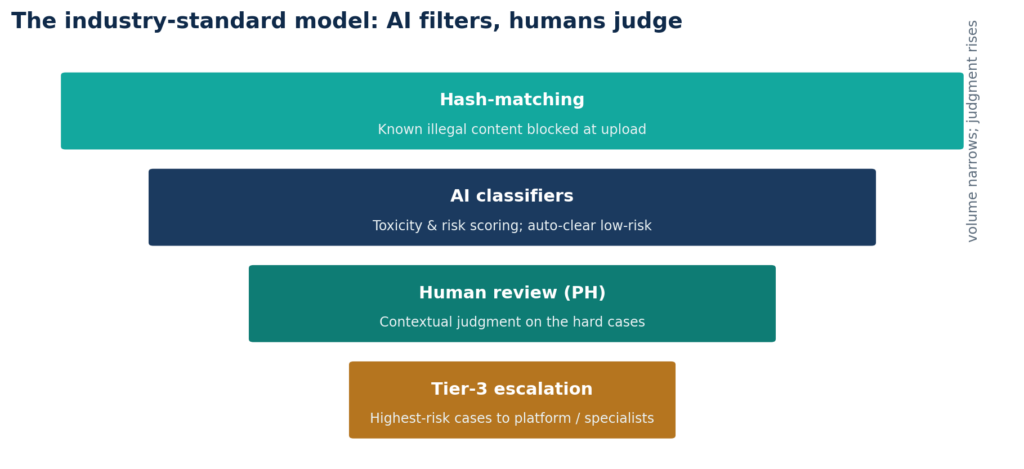
Figure 2 — AI handles volume; humans handle judgment; the platform keeps the highest-risk decisions.
The strategic implication is that AI does not remove the need for human reviewers — it concentrates their work on exactly the hardest, highest-stakes, most context-dependent cases, which raises the premium on reviewer skill, consistency, and wellbeing.
Why Is the Philippines the Leading Destination for T&S Outsourcing?
Because it uniquely combines English fluency, cultural alignment with Western platforms, 24/7 scale, security certifications, and a wellbeing-first operating culture.
The Philippines built the world’s deepest bench for judgment-based digital work. Its advantages map precisely onto what T&S requires: high English proficiency and strong cultural alignment with U.S., U.K., and ANZ user bases; a large, scalable workforce that delivers genuine 24/7 coverage; providers operating under SOC 2 Type II, ISO 27001, and GDPR-aligned frameworks with audit-ready SOPs; and — increasingly decisive — a shift to wellbeing-first operations that use AI to monitor reviewer stress and mandate decompression, directly addressing the trauma-related litigation now reshaping the industry.
| Requirement | Why the Philippines Leads |
| Language & culture | High English fluency and cultural alignment with Western platforms and policies. |
| Scale & coverage | Large, flexible workforce delivering true 24/7 review across time zones. |
| Judgment quality | Deep bench in nuanced, policy-driven, context-dependent decisions. |
| Security & compliance | SOC 2 Type II, ISO 27001, GDPR-aligned operations with audit-ready SOPs. |
| Wellbeing-first | AI-assisted stress monitoring and decompression that reduce trauma risk. |
| AI-plus-human | Mature hybrid workflows where people supply the context AI cannot. |
“We have watched the Philippines move from ‘cost-effective moderation’ to the global center of excellence for high-judgment Trust & Safety. The differentiator now is not price — it is the quality of judgment and the seriousness of moderator care. The best Philippine partners protect your community and the people defending it, and that is exactly what regulators and the courts are now demanding.” Ralf Ellspermann — CSO, PITON-Global; 25-year Philippine BPO veteran
How Big Is the Market — and Where Is It Heading?
Content-moderation outsourcing was about $12 billion in 2024 and is projected toward $22.7–$42.3 billion within a decade, driven by UGC, generative AI, and regulation.
The category is in sustained expansion. Industry estimates place the content-moderation market at roughly $12 billion in 2024, with projections ranging from about $22.7 billion by 2029 to $42.3 billion by 2035 depending on methodology. The drivers are structural and compounding: the explosion of user-generated content, the new flood of generative-AI content that itself must be reviewed, and a tightening global regulatory environment that turns safety failures into legal and financial liabilities.
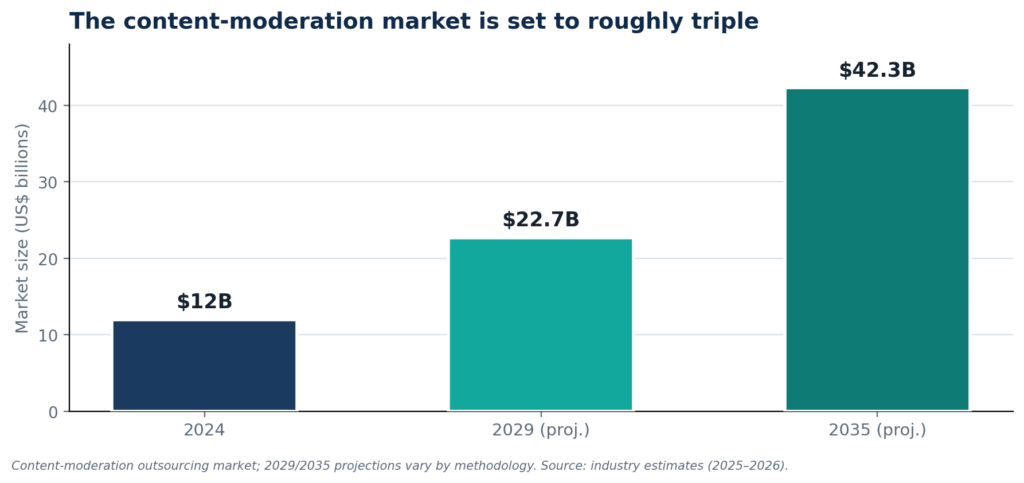
Figure 3 — A market set to roughly triple, pulling T&S outsourcing demand with it.
How Do You Outsource Trust & Safety the Right Way?
Keep policy and the highest-risk decisions in-house, outsource Tier-1/Tier-2 operational scale, and choose a partner on judgment quality, security, and moderator wellbeing — not price.
Outsourcing T&S well is a question of structure. Policy development, safety-by-design, and the highest-risk escalations should remain in-house; the high-volume Tier-1 and Tier-2 operational work — review, appeals, QA — is what you delegate. The partner you choose should be evaluated on accuracy, turnaround, calibration discipline, security certifications, and — critically — demonstrable moderator-wellbeing programs, because reviewer trauma is now both an ethical and a legal exposure. The right partner functions as an extension of your team, with clear escalation paths, immutable decision logs, and regular calibration and incident reviews.
Because each T&S domain demands different expertise, the practical next step is to go deep on the ones that matter most to your platform. The linked guides below do exactly that.
Frequently Asked Questions
What Is Trust & Safety Outsourcing?
Delegating the operational work of keeping a platform safe — content moderation, child-safety review, fraud and scam defense, platform integrity, moderator wellbeing operations, and AI-output review — to specialist partners, while the platform retains policy ownership and the highest-risk decisions.
Does AI Replace Human Moderators?
No. AI blocks known illegal content and triages by risk, but human reviewers handle the contextual, cultural, and high-stakes judgment AI cannot. AI concentrates human work on the hardest cases rather than eliminating it.
Why the Philippines Specifically?
It combines English fluency, cultural alignment, 24/7 scale, SOC 2 / ISO 27001 / GDPR-aligned security, mature hybrid AI-plus-human workflows, and a wellbeing-first operating culture — the full set of capabilities modern T&S requires.
What Should Stay In-House?
Policy development, safety-by-design, risk appetite, and the highest-risk Tier-3 escalations. Tier-1 and Tier-2 operational review, appeals, and QA are what most platforms outsource.
Explore the Series
How Does Content Moderation Outsourcing to the Philippines Work at Scale?
The core operation: queues, policy enforcement, QA, and throughput.
How Do You Outsource Child-Safety & High-Harm Moderation to the Philippines Safely?
The most sensitive workflow and its hard boundaries.
How Do You Outsource Fraud, Scam & Platform-Integrity Operations to the Philippines?
Defending the money and the network from abuse.
How Do You Protect Content Moderators’ Wellbeing When Outsourcing to the Philippines?
The duty-of-care and legal-risk imperative.
How Do Platforms Outsource Trust & Safety for AI & Gen-AI to the Philippines?
Red-teaming, RLHF safety, and synthetic-media review.
About PITON-Global
PITON-Global is a vendor-neutral outsourcing advisory with 25+ years in the Philippine market, connecting global platforms with industry-leading BPO providers across the full Trust & Safety spectrum. We help platforms source and structure the right Philippine T&S partner — free of charge and with no obligation — earning through our provider network, not from the platform.