
By outsourcing the operational review layer — not the legal duty. Specially vetted, trained reviewers work behind automated detection (hash-matching and classifiers) in restricted, secure environments with mandatory wellness support, confirming policy violations and preparing escalations. The legal obligation to report to authorities such as NCMEC is non-delegable and stays with the platform and its officers. The Philippines provides this specialist capacity with the
This guide addresses the operational and governance model for outsourcing high-harm moderation. It deliberately contains no detail about harmful material itself; the focus is how to structure this work responsibly, safely, and lawfully.
Key Takeaways
- This is the highest-stakes T&S queue. Child-safety and other high-harm review carries legal obligations and severe human-impact risk, so it is governed far more tightly than ordinary moderation.
- Detection is automated; judgment is human; reporting is the platform’s. AI flags at upload, specialist reviewers confirm, and the legal report to authorities stays in-house.
- The reporting duty is non-delegable. Filing to NCMEC or equivalent authorities is a legal responsibility that cannot be outsourced; the partner supports detection and escalation only.
- Safeguards are the differentiator. Specialist vetting, restricted secure environments, strict access logging, AI pre-filtering to reduce exposure, and mandatory wellness define a credible partner.
- The Philippines offers specialist capacity with care. Experienced trust-and-safety teams, strong security certifications, and wellbeing-first operations make it a leading destination for this sensitive work.
What Makes Child-Safety and High-Harm Moderation Different from Ordinary Moderation?
Legal obligations and extreme human-impact risk — which means tighter governance, specialist staffing, and a hard reporting boundary that ordinary queues never touch.
High-harm moderation — child-safety being the most acute category — sits apart from the rest of Trust & Safety. The consequences of a wrong or slow decision are severe, the work carries statutory reporting duties, and the psychological toll on reviewers is real. As a result, this queue is never run like a general one: it requires specially selected and trained reviewers, hardened environments, explicit legal-reporting chains, and the strongest wellbeing safeguards in the industry. The operational goal is to confirm violations accurately and route them correctly while protecting both the legal position of the platform and the people doing the work.
“This is the most serious work in our industry, and it has to be treated that way. You do not staff a child-safety queue like a comment queue — you vet differently, you train differently, you protect people differently, and you draw an absolutely bright line at the legal reporting duty. Getting that structure right is non-negotiable.”
John Maczynski — CEO, PITON-Global; former Global EVP of the world’s largest BPO provider
What Exactly Can Be Outsourced — and What Cannot?
The operational layer (automated detection support, specialist confirmation, secure escalation) can be outsourced; the legal duty to report to authorities cannot.
The workflow runs in clear stages with a firm boundary at the end. Automated systems detect and flag suspected material at upload through hash-matching and classifiers. Specially trained reviewers then confirm whether a policy violation has occurred. Confirmed cases are preserved and escalated securely to the platform. The final, legally-mandated step — reporting to the appropriate authority, such as the National Center for Missing & Exploited Children (NCMEC) in the U.S. — is a non-delegable obligation that remains with the platform and its designated officers.
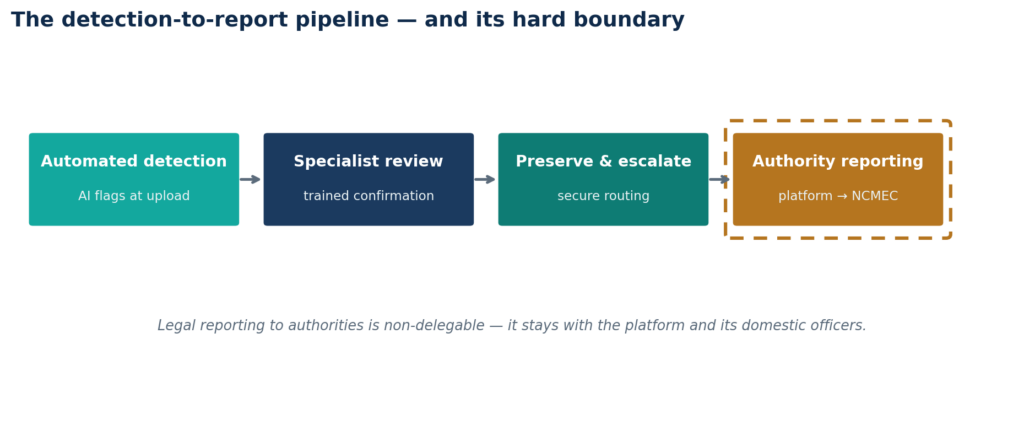
Figure 1 — Detection and review scale through a partner; legal reporting to authorities never leaves the platform.
This boundary is both a legal and an ethical line. A capable outsourcing partner is explicit about it: they accelerate accurate detection and preparation, but they never become the entity of legal record for reporting.
What Safeguards Must a Credible Partner Have in Place?
Specialist vetting and training, restricted secure environments, strict access controls and logging, AI pre-filtering to limit exposure, a clear legal reporting chain, and mandatory wellness support.
Because the work is uniquely sensitive, the safeguards are what separate a responsible partner from an unacceptable one. A credible operation provides specially vetted and trained reviewers; restricted, access-controlled, fully-logged secure environments; AI pre-filtering and tooling that minimize unnecessary human exposure to disturbing material; an unambiguous legal-reporting chain back to the platform; and — critically — mandatory, proactive wellness and counseling support for the people doing the work.
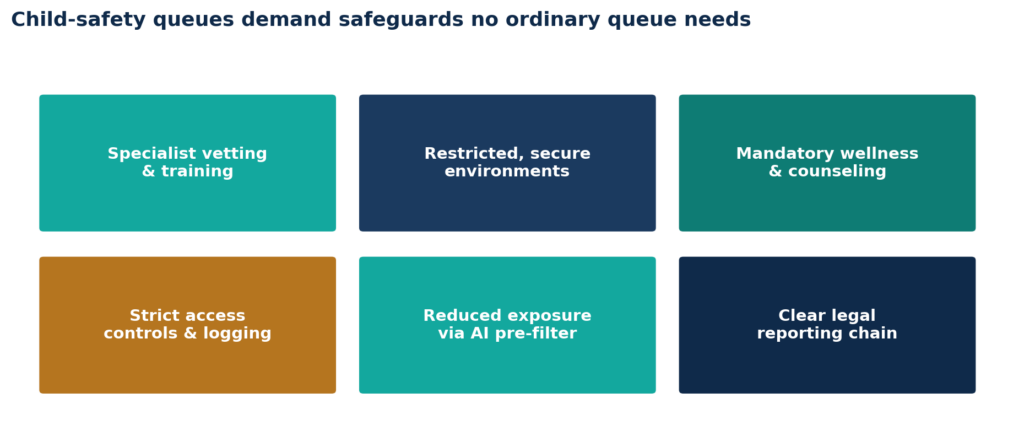
Figure 2 — Safeguards that an ordinary moderation queue does not require — and that define a credible high-harm partner.
“In this category, how you protect your reviewers is not a ‘nice to have’ — it is the first thing we audit. Specialist vetting, hardened environments, exposure-reduction tooling, and real clinical wellness support are the baseline. A provider that cannot evidence all of it should never be handling this work, full stop.”
Ralf Ellspermann — CSO, PITON-Global; 25-year Philippine BPO veteran
Why Outsource This Sensitive Work to the Philippines?
Because it combines deep, specialized trust-and-safety experience with strong security certifications and the wellbeing-first operating culture this work demands.
The Philippines’ leadership in high-judgment trust-and-safety work extends to its most sensitive categories, handled by experienced specialist teams rather than general moderators. Leading providers operate under SOC 2 Type II, ISO 27001, and GDPR-aligned frameworks with controlled-access secure environments and audit-ready SOPs, and have moved decisively toward wellbeing-first operations — using AI to reduce exposure and monitor reviewer stress, and mandating decompression and counseling — precisely because the industry’s duty-of-care standards have risen. That combination of specialist capability, security rigor, and human care is what this work requires.
| Requirement | Why the Philippines Fits |
| Specialist staffing | Experienced trust-and-safety reviewers vetted and trained for high-harm queues. |
| Secure environments | Controlled-access, fully-logged facilities under SOC 2 / ISO 27001 / GDPR-aligned controls. |
| Exposure reduction | AI pre-filtering and tooling that limit unnecessary human exposure. |
| Duty of care | Mandatory wellness, decompression, and counseling programs. |
| Clear escalation | Disciplined, auditable hand-off and legal-reporting chain to the platform. |
| Scale & coverage | 24/7 specialist capacity that scales with detection volume. |
How Do You Keep the Platform Legally and Ethically Protected?
Keep the reporting duty and decision-of-record in-house, demand evidenced safeguards and audit trails from the partner, and treat reviewer wellbeing as core compliance.
Protection comes from structure and evidence. The platform retains the legal reporting obligation and the decision of record, supported by an immutable audit trail of every action the partner takes. The partner must be able to evidence — not merely assert — its vetting, security controls, exposure-reduction tooling, and clinical wellness programs, because reviewer trauma is now a documented source of litigation as well as an ethical duty. Regular calibration, incident review, and independent audit keep the arrangement defensible. Handled this way, outsourcing strengthens the platform’s safety posture and its compliance position simultaneously.
Frequently Asked Questions
Can Child-Safety Reporting Be Outsourced?
No. The legal obligation to report to authorities such as NCMEC is non-delegable and remains with the platform and its designated officers. A partner supports automated detection, specialist confirmation, and secure escalation — not the legal report itself.
What Is Actually Outsourced in High-Harm Moderation?
The operational review layer: AI-assisted detection support, specialist confirmation of policy violations, secure preservation, and escalation preparation — all under strict access controls with full audit logging.
How Are Reviewers Protected in This Work?
Through specialist vetting and training, restricted secure environments, AI pre-filtering that reduces exposure, strict access controls, and mandatory proactive wellness and counseling support.
Why the Philippines for High-Harm Moderation?
Experienced specialist trust-and-safety teams, SOC 2 / ISO 27001 / GDPR-aligned secure operations, and a wellbeing-first culture provide the specialist capacity and duty-of-care this sensitive work requires.
Related in This Series
What Is Trust & Safety Outsourcing to the Philippines?
The full category and operating model.
How Does Content Moderation Outsourcing to the Philippines Work at Scale?
The core operation: queues, policy enforcement, QA, and throughput.
How Do You Outsource Fraud, Scam & Platform-Integrity Operations to the Philippines?
Defending the money and the network from abuse.
How Do You Protect Content Moderators’ Wellbeing When Outsourcing to the Philippines?
The duty-of-care and legal-risk imperative.
How Do Platforms Outsource Trust & Safety for AI & Gen-AI to the Philippines?
Red-teaming, RLHF safety, and synthetic-media review.
About PITON-Global
PITON-Global is a vendor-neutral outsourcing advisory with 25+ years in the Philippine market, connecting global platforms with specialist trust-and-safety providers. We help platforms source and structure partners for sensitive, high-harm moderation — with the security controls, legal boundaries, and reviewer-wellbeing standards this work demands — free of charge and with no obligation.