
Back
How Do Platforms Outsource Trust & Safety for AI & Gen-AI to the Philippines?

By Ralf Ellspermann / 3 June 2026
 Authored by Ralf Ellspermann, CSO of PITON-Global, & 25-Year Philippine BPO Veteran | Executive | Verified by John Maczynski, CEO of PITON-Global, and Former Global EVP of the World's Largest BPO Provider on June 3, 2026

By supplying the human-judgment layer that AI safety depends on. Generative AI creates a two-sided problem — making models safer at build-time (red-teaming, RLHF labeling, safety evals) and catching harm at run-time (output moderation, jailbreak monitoring, deepfake review). Both require large, skilled, well-supported human teams, and the Philippines has become a leading source of that human-in-the-loop capacity for AI platforms.
Key Takeaways
- AI safety is two jobs, not one. Build-time work makes the model safer (red-teaming, RLHF, evals); run-time work catches harm in live use (output moderation, jailbreak monitoring, deepfakes).
- It is intensely human. Preference labeling, adversarial probing, and nuanced output review all depend on trained human judgment — AI cannot fully self-supervise.
- Gen-AI created new harm types. Synthetic media and deepfakes, prompt injection and jailbreaks, and convincing AI-generated abuse all need specialized review.
- The same wellbeing duty applies. Adversarial and red-teaming work exposes people to disturbing content, so duty-of-care safeguards are essential here too.
- The Philippines supplies the human layer. English-fluent, judgment-strong teams with mature T&S operations and wellbeing-first standards — at the scale AI platforms need.
What Does “Trust & Safety for AI” Actually Involve?
Six human-in-the-loop workstreams spanning model development and live operation — from red-teaming and RLHF to output moderation and deepfake review.
As generative AI moved into the mainstream, it created an entirely new Trust & Safety surface. Protecting an AI product is not one task but a set of human-in-the-loop workstreams: adversarial red-teaming, RLHF and preference labeling, output moderation, deepfake and synthetic-media review, prompt-abuse and jailbreak monitoring, and safety evaluation and benchmarking. Each turns on human judgment that the model itself cannot reliably supply.
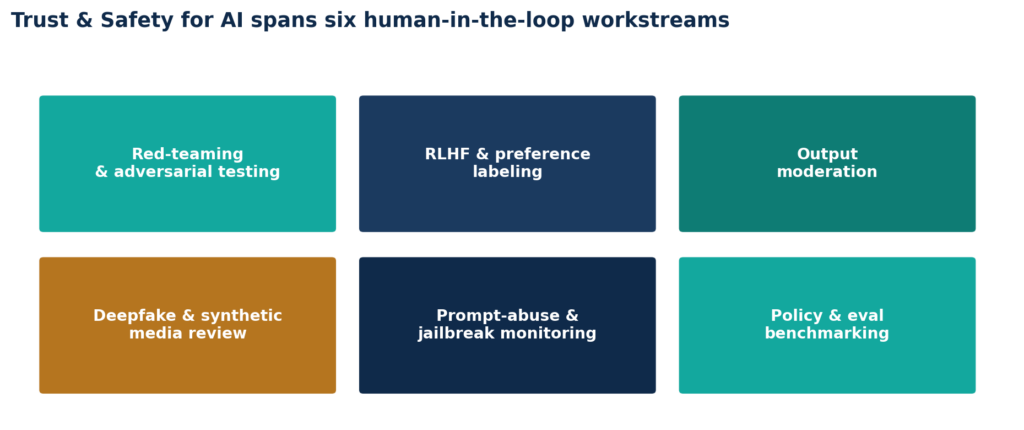
Figure 1 — AI safety is delivered through six distinct human-in-the-loop workstreams.
These workstreams are why AI labs and AI-powered platforms have become major consumers of trust-and-safety services: the more capable the model, the more human oversight it needs to deploy responsibly.
Why Is AI Trust & Safety a Two-Sided Problem?
Because you must both make the model safer before release (build-time) and catch harm once it is live (run-time) — and each side needs different human work.
AI safety splits cleanly into two jobs. Build-time work makes the model itself safer: red-teaming and adversarial probing to find failure modes, RLHF and preference labeling to align behavior, safety evaluation and benchmarking, and policy-taxonomy development. Run-time work catches harm in the wild: moderating model outputs, monitoring for prompt abuse and jailbreaks, reviewing deepfakes and synthetic media, and triaging incidents so lessons feed back into the model. A serious AI safety program staffs both.
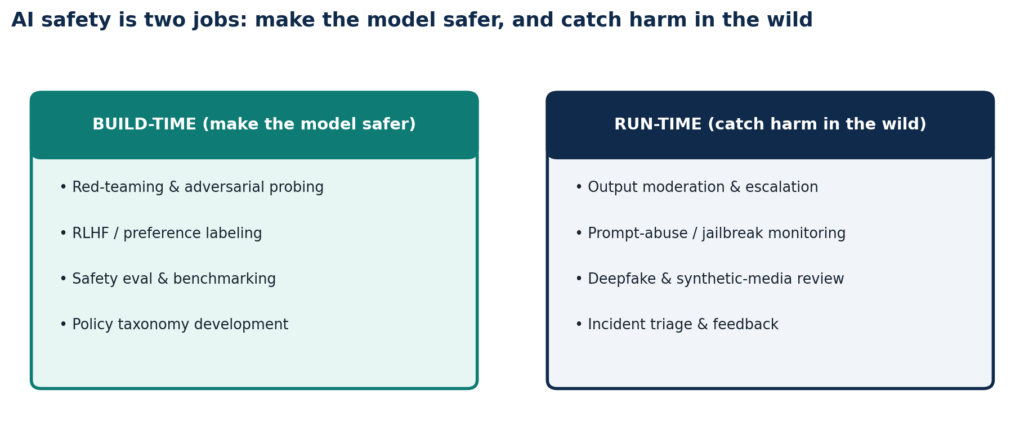
Figure 2 — Two distinct jobs: make the model safer at build-time, and catch harm at run-time.
“Everyone fixates on the model, but a safe AI product is built on an enormous amount of human judgment — before launch and after. You red-team it, you teach it with labeled human preferences, and then you watch what it actually does in the wild and catch what slips through. Take the humans out of that loop and the safety claims are hollow.” John Maczynski — CEO, PITON-Global; former Global EVP of the world’s largest BPO provider
What New Harms Did Generative AI Introduce?
Synthetic media and deepfakes, prompt injection and jailbreaks, and highly convincing AI-generated abuse — each needing specialized human review.
Generative AI did not just scale old problems; it created new ones. Synthetic media and deepfakes blur authenticity and demand reviewers who can assess provenance and intent. Prompt injection and jailbreak attempts are an adversarial cat-and-mouse that fixed filters cannot win alone. And the sheer fluency of generative output makes AI-produced scams, misinformation, and abuse more convincing than ever — raising the bar for the human reviewers who adjudicate edge cases. These are precisely the contextual, judgment-heavy tasks that the hybrid AI-plus-human model exists to handle.
Why Outsource AI Trust & Safety to the Philippines?
Because it offers large-scale, English-fluent, judgment-strong human teams with mature trust-and-safety operations and wellbeing-first standards — exactly what AI safety work requires.
The capabilities that made the Philippines the leader in platform Trust & Safety transfer directly to AI. AI labs need large pools of people who can label preferences consistently, probe models adversarially, and review nuanced outputs with cultural and contextual judgment — at scale and around the clock. Philippine providers bring exactly that: English fluency and cultural alignment, deep experience in policy-driven judgment work, SOC 2 / ISO 27001 / GDPR-aligned secure operations, and the wellbeing-first safeguards that adversarial and red-teaming work makes essential.
| AI-Safety Need | Why the Philippines Fits |
| RLHF & labeling | Large, consistent, trainable workforce for high-quality preference data. |
| Red-teaming | Judgment-strong reviewers who probe models adversarially with context. |
| Output moderation | Mature content-moderation muscle applied to model outputs. |
| Deepfake review | Trust-and-safety experience assessing synthetic media and provenance. |
| Secure operations | SOC 2 / ISO 27001 / GDPR-aligned environments with audit-ready SOPs. |
| Wellbeing-first | Duty-of-care safeguards for exposure-heavy adversarial work. |
“The AI labs we work with discovered what the platforms learned years ago: the human-in-the-loop layer is the product’s safety, not a side task. The Philippines already has that muscle — the judgment, the scale, and now the wellbeing standards — which is why so much AI red-teaming and labeling work is flowing here. Ralf Ellspermann — CSO, PITON-Global; 25-year Philippine BPO veteran
What Stays with the AI Platform When This Work Is Outsourced?
Model decisions, safety policy, and release judgment — the partner supplies labeled data, adversarial findings, and output review that inform those decisions.
As across Trust & Safety, the AI developer keeps the decisions that define the product: safety policy, the taxonomy of acceptable behavior, model-release judgment, and accountability for what ships. The Philippine partner supplies the human inputs and oversight that make those decisions sound — preference labels, red-team findings, output-moderation decisions, and incident triage — with the security controls and reviewer-wellbeing safeguards the work demands. The result is the human scale modern AI safety requires, without ceding ownership of the model or its policies.
Frequently Asked Questions
What Is Trust & Safety for AI?
The human-in-the-loop work of making AI models safer and catching harm in their use — red-teaming, RLHF and preference labeling, safety evals, output moderation, jailbreak monitoring, and deepfake review.
Can AI Safety Be Automated End-to-End?
No. Models cannot fully self-supervise; aligning and overseeing them depends on human judgment for labeling, adversarial testing, and nuanced output review. AI assists, but humans remain central.
What New Harms Does Generative AI Create?
Synthetic media and deepfakes, prompt injection and jailbreaks, and highly convincing AI-generated scams, misinformation, and abuse — all requiring specialized human review.
Why the Philippines for AI Trust & Safety?
Large-scale, English-fluent, judgment-strong teams with mature trust-and-safety operations, secure certified environments, and wellbeing-first standards — the human-in-the-loop capacity AI platforms need.
Related in This Series
What Is Trust & Safety Outsourcing to the Philippines?
The full category and operating model.
How Does Content Moderation Outsourcing to the Philippines Work at Scale?
The core operation: queues, policy enforcement, QA, and throughput.
How Do You Outsource Child-Safety & High-Harm Moderation to the Philippines Safely?
The most sensitive workflow and its hard boundaries.
How Do You Outsource Fraud, Scam & Platform-Integrity Operations to the Philippines?
Defending the money and the network from abuse.
How Do You Protect Content Moderators’ Wellbeing When Outsourcing to the Philippines?
The duty-of-care and legal-risk imperative.
About PITON-Global
PITON-Global is a vendor-neutral outsourcing advisory with 25+ years in the Philippine market, connecting AI labs and AI-powered platforms with industry-leading trust-and-safety providers for red-teaming, RLHF labeling, output moderation, and synthetic-media review. We help source and structure the right Philippine partner — free of charge and with no obligation.
Achieve sustainable growth with world-class BPO solutions!
PITON-Global connects you with industry-leading outsourcing providers to enhance customer experience, lower costs, and drive business success.
Get Your Top 1% Vendor List
Author
Ralf Ellspermann is a multi-awarded outsourcing executive with 25+ years of call center and BPO leadership in the Philippines, helping 500+ high-growth and mid-market companies scale call center and customer experience operations across financial services, fintech, insurance, healthcare, technology, travel, utilities, and social media.
A globally recognized industry authority - and a contributor to The Times of India, CustomerThink, and The AI Journal - he advises organizations on building compliant, high-performance offshore contact center operations that deliver measurable cost savings and sustained competitive advantage.
Known for his execution-first approach, Ralf bridges strategy and operations to turn call center and business process outsourcing into a true growth engine. His work consistently drives faster market entry, lower risk, and long-term operational resilience for global brands.
EXECUTIVE GOVERNANCE & ACCURACY STANDARDS
Authored by:
Ralf Ellspermann
Founder & CSO of PITON-Global,
25-Year Philippine BPO Veteran,
Multi-awarded Executive
Specializing in strategic sourcing and excellence in Manila
View Full Bio
Verified by:

John Maczynski
CEO of PITON-Global, and former Global EVP of the World’s largest BPO provider | 40 Years Experience
Ensuring global compliance and enterprise-grade service standards
View Full Bio
Last Peer Review: June 3, 2026
This service framework is audited quarterly to meet shifting global outsourcing regulations and COPC standards.