

TL;DR: The Key Takeaway
Sentiment analysis training outsourcing in the Philippines has transcended basic annotation, evolving into a sophisticated discipline where expert human trainers teach AI to interpret complex emotional nuances. This strategic approach to outsourcing delivers a profound impact on AI model accuracy and, consequently, on a company’s ability to understand and respond to its customers with genuine insight. It is one of the most specialized forms of human-guided AI in outsourced customer operations.
Sentiment analysis training outsourcing in the Philippines is the specialized process of teaching AI to detect complex human emotions, sarcasm, and cultural subtext. By 2026, this sector has evolved into a $42 billion industry, where Filipino specialists provide the high-fidelity “ground truth” data required to move AI beyond keyword matching toward genuine emotional intelligence.
Executive Briefing
- Emotional Granularity: Transition from basic positive/negative tagging to a full spectrum of emotion (e.g., frustration, urgency, delight, or skepticism).
- Sarcasm & Irony Detection: Utilize Filipino trainers’ high cultural affinity with Western markets to identify “hidden” negative sentiment in seemingly positive text.
- Aspect-Based Analysis: Train models to evaluate sentiment toward specific product features (e.g., “love the battery, hate the camera”) rather than broad generalizations.
- Strategic ROI: Achieving high-accuracy sentiment detection is linked to higher upsell revenue and a significant reduction in customer churn.
- C-Suite Imperative: Filipino CEOs are increasingly confident in integrating AI, viewing human-led sentiment training as a defensive “moat” against robotic customer interactions.
Beyond Keywords: The Cognitive Leap in Sentiment Analysis
Early sentiment analysis was notoriously “brittle.” A review saying, “The service was sick!” might be flagged as a health complaint by a keyword-based bot, while a human recognizes it as high praise. In 2026, the cost of these errors is too high; an AI that misses a customer’s escalating frustration is a liability.
The contemporary challenge is the cognitive leap from recognition to comprehension. This requires training data that captures the intensity of emotion and the underlying “why.” Filipino sentiment specialists are uniquely positioned to provide this, annotating messy, multi-modal data from social media, audio calls, and video reviews to teach AI the art of “reading between the lines,” with the rigor that life-sciences data work for biotech AI also demands.
The Filipino Advantage in a Nuanced World
The Philippines holds a leading share of the global BPO market, largely due to a workforce that ranks #2 in Asia for English Proficiency. However, the real advantage in sentiment analysis is Cultural Resonance.
Filipino trainers are often more adept at catching American sarcasm or British understatement than annotators from other regions. This cultural alignment reduces misinterpretation in training sets, ensuring that the resulting AI is not just linguistically accurate, but emotionally resonant.
| Metric | 2026 Philippine BPO Reality |
| Total Revenue | $42 Billion (Projected $59B by 2028) |
| Workforce Size | 2 Million Employees |
| AI Skills Adoption | 86% of Filipino professionals |
| Cost Savings | 60–75% vs. Onshore (US/UK) |
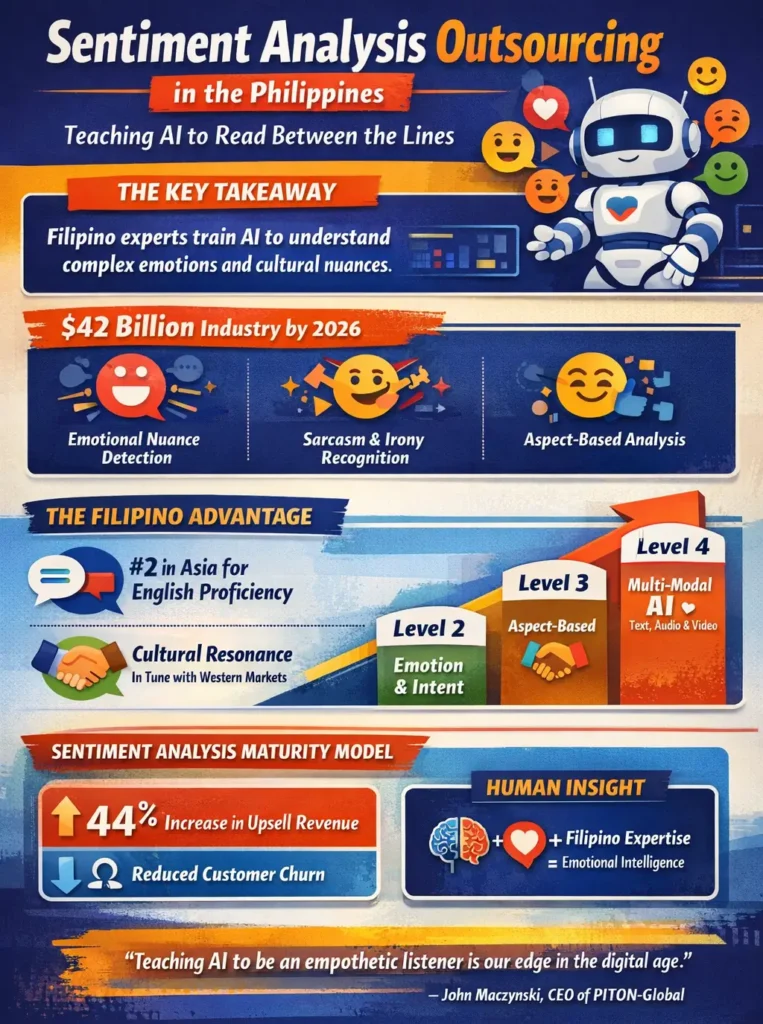
Emotion-Detection Maturity Model
As firms move up the maturity curve, they shift from simple monitoring to proactive customer experience management.
| Level | Analytical Goal | Core Capability | Business Value |
| 1: Basic | Polarity (Pos/Neg/Neu) | Keyword counting. | Basic brand monitoring. |
| 2: Advanced | Emotion & Intent | Sarcasm & Irony detection. | Predictive churn analysis. |
| 3: Aspect-Based | Feature-specific sentiment | Deep entity-sentiment linking. | Targeted product R&D. |
| 4: Multi-Modal | Text + Audio + Video | Tone & facial cue analysis. | Hyper-personalized CX. |
Intelligence Arbitrage: From Emotional Data to Market Advantage
In 2026, we have moved from “Labor Arbitrage” to Intelligence Arbitrage. The value is no longer about the number of comments labeled per hour, but the accuracy gain provided by the trainer, a shift that fits the broader blueprint for scaling AI outsourcing.
“Our clients aren’t just labeling data; they are teaching AI to become a sophisticated, empathetic listener. This human insight is the foundation of competitive advantage. In the digital age, the ability to truly understand the customer’s heart is what wins the market.” — John Maczynski, CEO, PITON-Global
Human-led training remains critical because, while many CX leaders believe AI can replace agents, most consumers still believe human agents are more accurate than AI for complex, emotional issues. By using Filipino “AI Pilots,” companies can blend machine speed with human empathy.
Agentic Governance: The Human Safeguard
As AI agents take on more autonomous roles—like negotiating refunds or handling complaints—Agentic Governance becomes the “emotional firewall.” Filipino specialists act as these guardians, monitoring AI interactions to ensure they don’t respond to a grieving or angry customer with a “cheerful” canned response. This ensures that the AI’s “behavior” remains brand-aligned and ethically sound.
Expert FAQs
Can’t LLMs like GPT-4 do sentiment analysis automatically?
While LLMs are powerful, they still suffer from “hallucinations” and bias. Human trainers from the Philippines are required to provide the “Ground Truth” that validates these models, ensuring they haven’t misinterpreted a regional idiom or a nuanced emotional shift.
How does the Philippines handle “Multi-Modal” sentiment?
This involves analyzing video or audio. Filipino specialists watch for facial micro-expressions or listen for vocal pitch changes (prosody) that contradict the spoken words, a task that remains incredibly difficult for pure algorithms to master without human training.
What is the impact of the “CREATE MORE” Act?
This 2024 law offers a 20% Corporate Income Tax and 100% deductions on training, making it even more cost-effective for global firms to build their AI training hubs in the Philippines, as our breakdown of the CREATE MORE incentives explains.
Is AI replacing these jobs?
No. While routine tagging is automated, the industry has added 80,000 new high-value jobs in AI oversight and data curation. Filipino workers are being “upgraded” to AI Pilots rather than being phased out.