
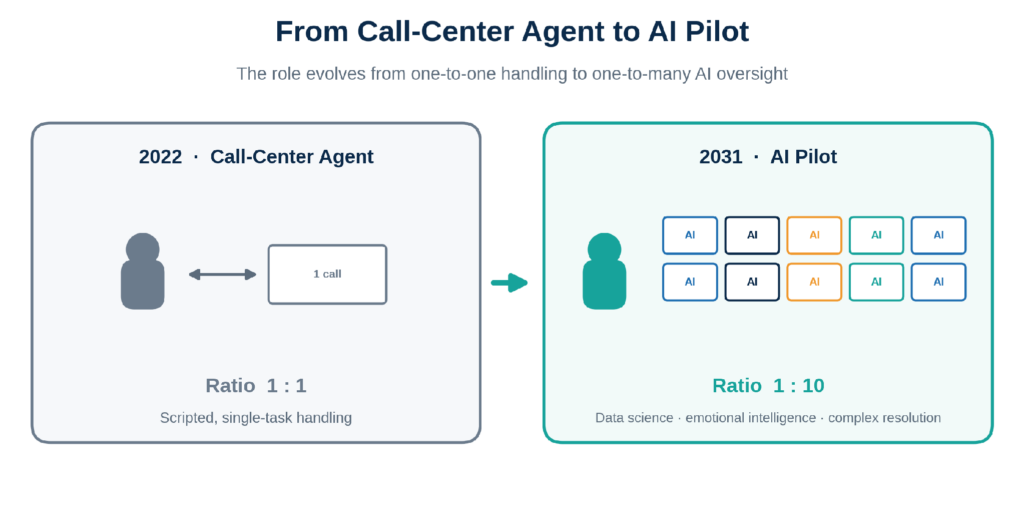
Between 2026 and 2031 the Philippine BPO sector pivots from labor arbitrage to “intelligence arbitrage,” becoming the global command center for AI-augmented services and for agentic AI and hybrid teams in outsourced delivery. Industry roadmaps project strong growth and a workforce of 2.5 million by 2028, as Filipino professionals become “AI Pilots” who oversee high-value workflows that blend human empathy with machine efficiency.
The Philippine outsourcing story is changing chapters. The next five years are less about wages and more about who can govern AI at scale. The sections below explain why the country is positioned to lead, how buyer benchmarks will change, what intelligence arbitrage means for your strategy, and where the jobs are heading.
Why Is the Philippine BPO Sector Uniquely Positioned for the AI Era?
Because it treats automation as a force multiplier, not a threat. While other regions compete only on cost, the Philippines pairs AI with “Malasakit” — genuine care that AI cannot replicate. By 2031 it aims to move beyond call-center tasks to become the world’s primary hub for high-complexity knowledge process outsourcing and AI oversight.
For two decades the Philippine advantage was cost; the next decade rests on a harder-to-copy asset — people who can supervise AI and supply the empathy customers still demand. Generic AI handles password resets, but complex, emotionally charged cases still need a human. That care layer is why the country is climbing the value chain toward knowledge process outsourcing and AI oversight rather than defending the call-center floor.
How Will Operational Benchmarks Change for Outsourcing Buyers Over the Next Five Years?
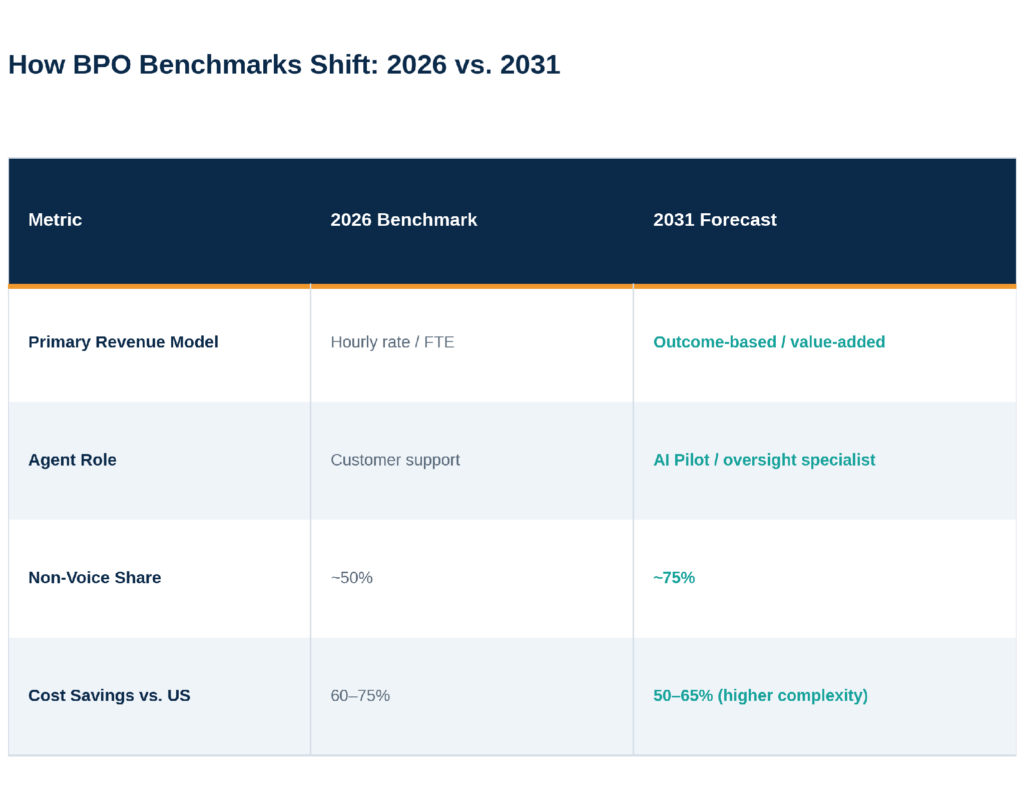
The yardstick shifts from “cost-per-hour” to “outcome-based pricing” as AI absorbs routine, script-based work. Procurement must prioritize vendors with deep AI integration and rigorous data-sovereignty compliance. Expect non-voice work to become the large majority of the mix and agent roles to become AI-oversight specialties.
As AI absorbs scripted interactions, buyers stop paying for time and start paying for results — the contract conversation moves from headcount and hourly rates to resolved outcomes and value delivered. Two structural shifts accompany it: non-voice knowledge work grows toward three-quarters of the mix, and the surviving human roles become higher-complexity oversight positions. The table below maps the change.
From Cost-Per-Hour to Outcome-Based Pricing
When AI handles the volume, paying by the seat rewards the wrong thing. Outcome-based contracts tie spend to resolution rates, conversion, or containment — aligning the vendor’s incentives with your customer-experience goals rather than with billable hours.
Data Sovereignty Becomes Non-Negotiable
As more sensitive data flows through AI workflows, where and how it is processed matters as much as the price. Buyers will favor providers that can prove local data handling and certified controls, treating compliance as a selection criterion rather than a checkbox. The same scrutiny extends to how providers ground AI models in client-specific data.
What Does the Shift to “Intelligence Arbitrage” Mean for Your Strategy?
Success will hinge on the sophistication of a partner’s “human-in-the-loop” architecture, not its wage rates. Companies that choose Philippine providers investing in proprietary AI training and strong cybersecurity (SOC 2 Type II and beyond) gain durable advantages in operational agility and AI governance.
Intelligence arbitrage reframes the entire value proposition. The cheapest vendor is no longer the safest choice; the best-governed one is. A mature human-in-the-loop architecture — with proprietary AI training, clear escalation paths, and certified security — is what keeps an AI deployment from becoming a brand liability. SOC 2 Type II is now a floor, not a differentiator.
“The global outsourcing narrative has reached a tipping point. We are no longer competing on headcount; we are competing on the ability to govern AI. The firms that thrive will be those that view their Philippine partners not as a cost-saving measure, but as their frontline for AI-driven CX innovation.”
— John Maczynski, CEO, PITON-Global
How Does Strategic Vendor Matching Work in Practice?
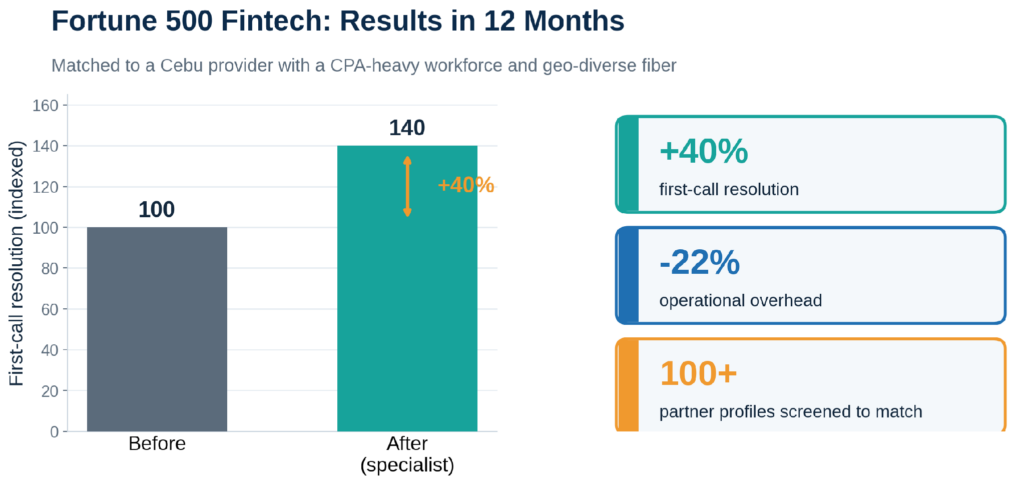
Generic directories breed mismatches; a vendor-agnostic methodology fixes them. PITON-Global screened 100+ partner profiles for a Fortune 500 fintech needing secure, AI-integrated billing and matched it to a Cebu provider with a CPA-heavy workforce and geo-diverse fiber. The result: lower overhead and markedly higher first-call resolution within 12 months.
The lesson is that fit beats brand. A generalist call center would have failed the fintech’s security and accounting requirements; a specialized, CPA-heavy provider with redundant fiber was the right match precisely because it was screened against the client’s actual constraints rather than pulled from a directory. The payoff showed up in both cost and quality inside a year. Buyers mapping the wider service landscape can start with the 2026 guide to services and AI-hybrid delivery.
What Is the Long-Term Outlook for Jobs in the Industry?
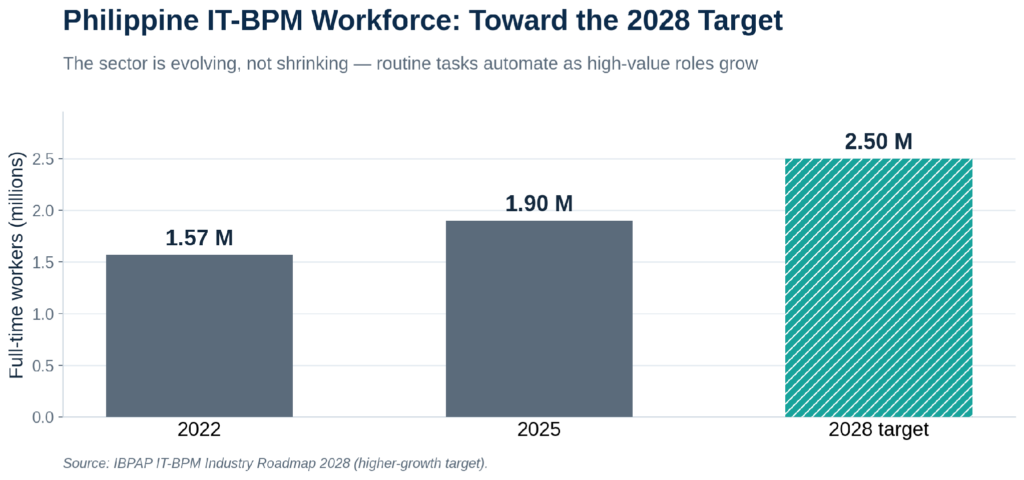
The industry is evolving, not shrinking. IBPAP’s Roadmap 2028 targets a 2.5-million-strong workforce, and the automation of routine tasks is creating demand for new specialties — AI training and prompt engineering, data ethics and compliance, and complex-resolution roles that AI cannot handle, alongside trust-and-safety work such as outsourced AI content moderation.
Automation is reshaping the work, not erasing it. The roles being created cluster around AI rather than away from it:
- AI training and prompt engineering — managing the logic behind customer-facing AI.
- Data ethics and compliance — ensuring AI responses meet GDPR, HIPAA, and regional rules.
- Complex-resolution specialists — handling the high-touch cases that AI cannot close.
To prepare for 2031, weight procurement toward providers actively upskilling their people. Look for participation in government-backed programs such as Project UNLAD (Uplifting National Labor through Advanced Digital Upskilling), a roughly ₱740-million IBPAP–DICT–TESDA initiative retraining BPO workers for higher-value, AI-assisted roles. A partner investing in tomorrow’s skills is the clearest signal it will still be the right partner in 2031.