

On this page
- Key Takeaways
- What Pricing Structures Define BPO Expansion in the Philippines?
- How Do Hidden Overhead Charges Infiltrate Expansion Billing?
- What Financial Safeguards Protect CFOs During Rapid Scaling?
- How Should CFOs Model Total Cost of Quality Alongside the Rate?
- What Does a Well-Structured Scale-Up Rate Card Look Like in Practice?
- How Does PITON-Global De-Risk Offshore Growth?
- Frequently Asked Questions
CFOs should evaluate expansion pricing by auditing direct-to-indirect cost ratios, securing tiered volume discounts on management fees, enforcing open-book statutory pass-throughs, and linking scale to operational efficiency rebates. The starting point is knowing what sits inside the rate you already pay; the loaded hourly rate explained component by component is the baseline every expansion quote gets measured against. Rigorous benchmarking ensures headcount growth produces marginal cost reductions rather than proportional ones, without eroding frontline retention or service quality.
Key Takeaways
- Decouple fixed overhead from scale. As headcount grows past the initial cohort, management fees and facility overhead should fall on a per-FTE basis, not simply multiply.
- Audit statutory tier thresholds. Verify SSS, PhilHealth, Pag-IBIG, and 13th-month pay are billed at exact statutory rates rather than as a flat percentage surcharge.
- Insist on volume-based margin compression. Structure the contract so vendor management margin compresses by 150 to 300 basis points across defined FTE expansion tiers.
- Model total cost of quality. Re-boarding fees, hardware provisioning markups, and attrition-induced training churn all belong in the net expansion ROI calculation.
- Establish FX stabilization bands. Dual-currency corridor protections keep exchange rate volatility from consuming a mid-term expansion budget.
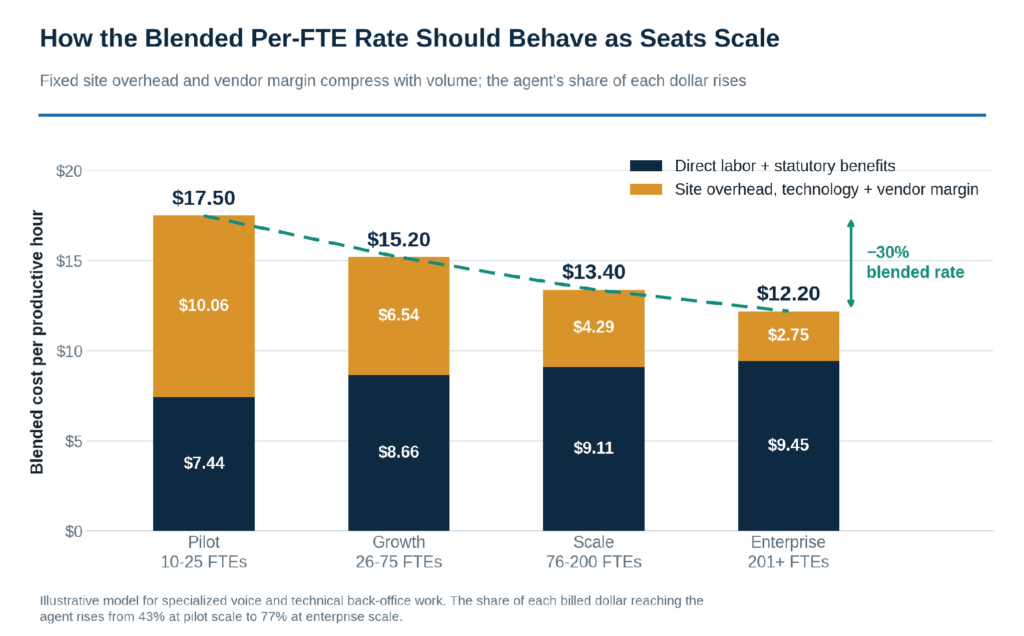
Figure 1. How the blended per-FTE rate should behave across expansion tiers, and how the composition of each billed dollar shifts toward direct labor.
What Pricing Structures Define BPO Expansion in the Philippines?
Four structures map to four stages of growth: fixed hourly at pilot scale, hybrid unbundled during growth, cost-plus open book at scale, and a custom managed service at enterprise volume. The transition point matters more than the model — most overpayment comes from staying on pilot-tier pricing at scale-tier volume.
Expanding an offshore operation requires looking past the base hourly rate to how the provider’s cost structure behaves under volume. Traditional flat-rate pricing charges a fixed hourly rate for specialized voice or technical back-office support regardless of team size. That predictability is genuinely useful during a 10 to 20 seat pilot, when the provider is carrying real fixed cost against a small billable base. The same structure becomes expensive at 100 seats, because the fixed site overhead the rate was built to recover has already been recovered several times over. What that base rate is made of is laid out in our breakdown of the fully loaded cost per FTE.
The Unbundling Threshold
In an unbundled framework, fixed site overhead — real estate, core IT infrastructure, executive governance — is amortized across a larger seat count, reducing per-FTE management cost materially past the 50-seat threshold. This is the practical trigger point for renegotiation. A provider that resists moving to an unbundled or cost-plus structure at that scale is signaling that the current allocation is worth defending, which is itself useful information.

Figure 2. Expansion pricing structures by scale tier, with the billing model, cost allocation, and recommended vendor margin for each stage.
Read the Table as a Trajectory, Not a Menu
The value of the tier framework is in the direction of travel. Base salary ratio should climb steadily from pilot to enterprise scale until it takes a clear majority of each billed dollar, while vendor margin compresses sharply. If a provider’s expansion proposal holds these ratios flat while headcount quadruples, the buyer is funding the same overhead structure four times. The CFO question at every milestone is not “what is the rate?” but “which of these ratios moved, and by how much?”
How Do Hidden Overhead Charges Infiltrate Expansion Billing?
Expansion proposals often duplicate fixed investments already absorbed during initial deployment. The recurring four: re-charged IT and software setup, inflated supervisory ratios, blanket night-shift surcharges above the statutory minimum, and recurring recruitment fees for routine attrition backfill that margin should cover.

Figure 3. Legitimate expansion cost versus duplicated overhead, line item by line item.
Duplicated IT and Software Seat Licenses
Net new seats genuinely require net new workstations, circuit capacity, and software licenses. What they do not require is a second payment for the core network, firewall allocation, or site build-out already funded in the original deployment. Licenses deserve particular scrutiny: providers acquire CCaaS and CRM seats at volume discounts and frequently bill them at list price, a spread that grows with every cohort added.
Inflated Supervisory Ratios
A 1:8 team lead ratio is appropriate for a new, complex workflow in its first months. Billing that same ratio on a mature process that runs safely at 1:15 adds roughly one supervisor for every fifteen agents with no operational purpose. Expansion is the moment to reset the ratio to what the workflow now needs, and the addendum should state it explicitly.
Night Differential Surcharges
Philippine law mandates a minimum night-shift premium for hours actually worked between 10:00 p.m. and 6:00 a.m. A blanket surcharge well above that minimum, applied across every seat regardless of shift pattern, converts a statutory obligation into a margin line. Require the differential to be billed against actual scheduled night hours, with the shift pattern named in the addendum.
Recruitment and Training Re-Billing
Initial wave training for a genuine expansion cohort is a real cost and should be billed at raw direct labor rates without full management markup. Replacement training for routine attrition is different: it is the cost of the provider’s own turnover, and the management margin exists in part to absorb it. Contracts that leave this ambiguous convert a provider performance problem into a client expense line.
Expansion pricing shouldn’t simply multiply your initial unit economics by your new headcount. True operational scale in the Philippines must yield compounding cost efficiencies, where expanded infrastructure footprint directly lowers per-seat management friction.
— John Maczynski, CEO, PITON-Global
What Financial Safeguards Protect CFOs During Rapid Scaling?
Embed four protections in the master services agreement before signing any expansion addendum: a marginal margin compression schedule tied to headcount milestones, true pass-through technology audits, an FX band with defined risk sharing, and total cost of quality clauses covering re-boarding, hardware, and attrition churn.
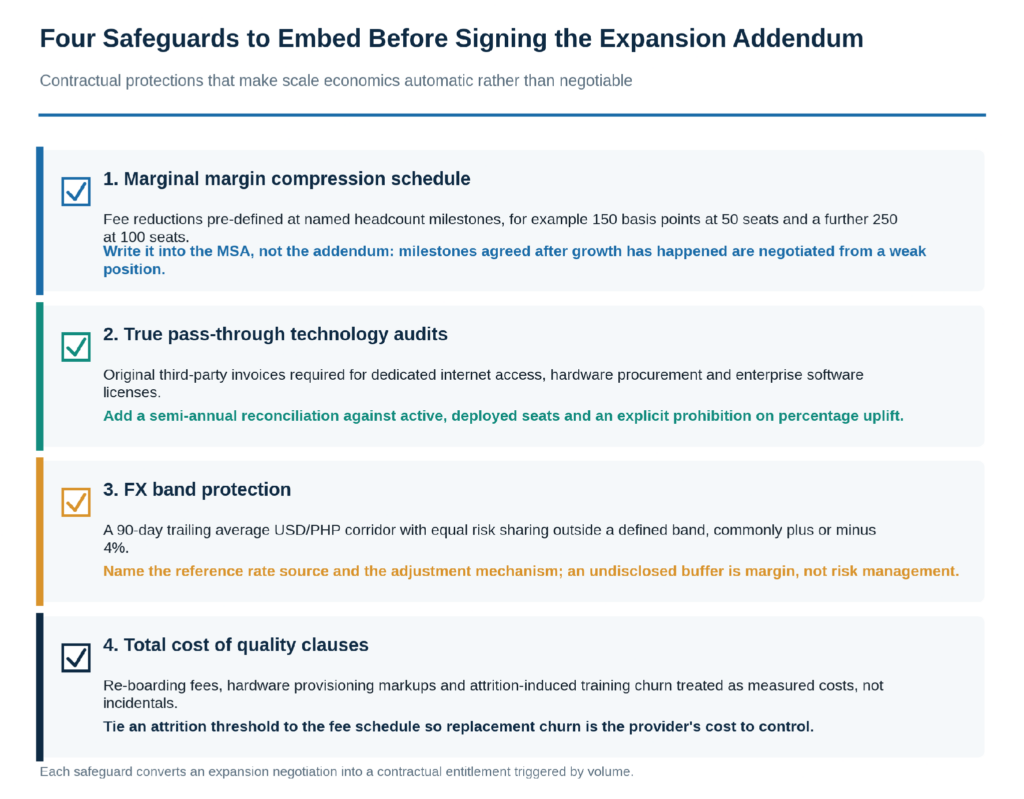
Figure 4. The four safeguards to embed before signing an expansion addendum, with the specific action each requires.
Write the Compression Schedule Before You Need It
A compression schedule pre-defines fee reductions at named milestones — for example 150 basis points at 50 seats and a further 250 at 100. The timing of the agreement matters more than the size of the steps. Milestones negotiated in the original MSA are automatic entitlements triggered by volume; the same milestones raised after the growth has occurred are a renegotiation, conducted at the point of maximum switching cost, when the provider knows the buyer has 100 trained agents it cannot easily move.
Structure FX as a Mechanism, Not a Buffer
Providers billing in USD while paying peso-denominated costs carry genuine exchange rate exposure, and sharing it is reasonable. A defensible structure holds USD rates fixed while the USD/PHP spot rate stays inside a pre-agreed band — commonly a narrow symmetric range against a 90-day trailing average — with shared adjustment outside it. What is not defensible is an undisclosed premium built into the rate, which is margin dressed as risk management and never reverses when the currency moves the other way.
How Should CFOs Model Total Cost of Quality Alongside the Rate?
Rate is one input; the cost of instability is the other. Model attrition-driven replacement, ramp productivity loss, re-boarding fees, and hardware provisioning markups as explicit lines. On a 120-seat program, the difference between high and low annual attrition is more than a dozen replacement cycles a year.
Total cost of quality is where a lower headline rate frequently loses. Each replacement agent carries recruitment cost, classroom and nesting time, and a productivity ramp during which the client is billed for output it does not fully receive. Philippine industry attrition runs high, so the difference between a provider running at the top of the range and one running at a fraction of it is not a rounding error on a program of any size — it is a recurring line worth tens of thousands of dollars a year in direct replacement cost alone, before counting the service impact of a perpetually junior floor.
This is also why direct labor allocation is a CFO metric rather than an HR one. Expansion cohorts hired at suppressed wages to protect a headline rate are the cohorts that leave first, and they take the domain knowledge accumulated during the ramp with them. The practical control is to make attrition contractual: set a threshold, tie it to the fee schedule, and require the provider to absorb backfill training above it.
What Does a Well-Structured Scale-Up Rate Card Look Like in Practice?
A US healthcare SaaS provider scaling a Manila team from 30 to 120 seats was offered a token flat discount on its existing rate. Repricing the account as a tiered cost-plus structure cut annual expansion spend by more than a fifth against flat-rate projections while attrition fell sharply.
Client Challenge
A fast-growing US healthcare technology provider needed to expand its Manila patient support and claims processing team from 30 to 120 seats. The incumbent offered a token flat discount on its original hourly rate. Quadrupling the account size produced a discount worth less than a dollar an hour, because nothing in the structure allowed the fixed overhead already embedded in the rate to be re-absorbed across the larger base.
Vendor Selection Process
PITON-Global audited the account, identified the specific overhead lines being duplicated, and evaluated proposals across its network of more than 100 vetted Philippine providers to identify those offering genuine tiered cost-plus scaling. Willingness to open the cost base was a selection criterion in its own right, and it narrowed the field considerably.
Solution Implemented
The account moved to a specialized provider in Clark under a tiered cost-plus agreement: direct labor at competitive market rates, itemized statutory benefits, fixed site overhead, and a scaled vendor fee roughly half what the incumbent structure had carried. Hardware and software licenses were billed at net pass-through against original invoices, and the migration itself followed the knowledge-transfer discipline described in our guide to managing a BPO transition.
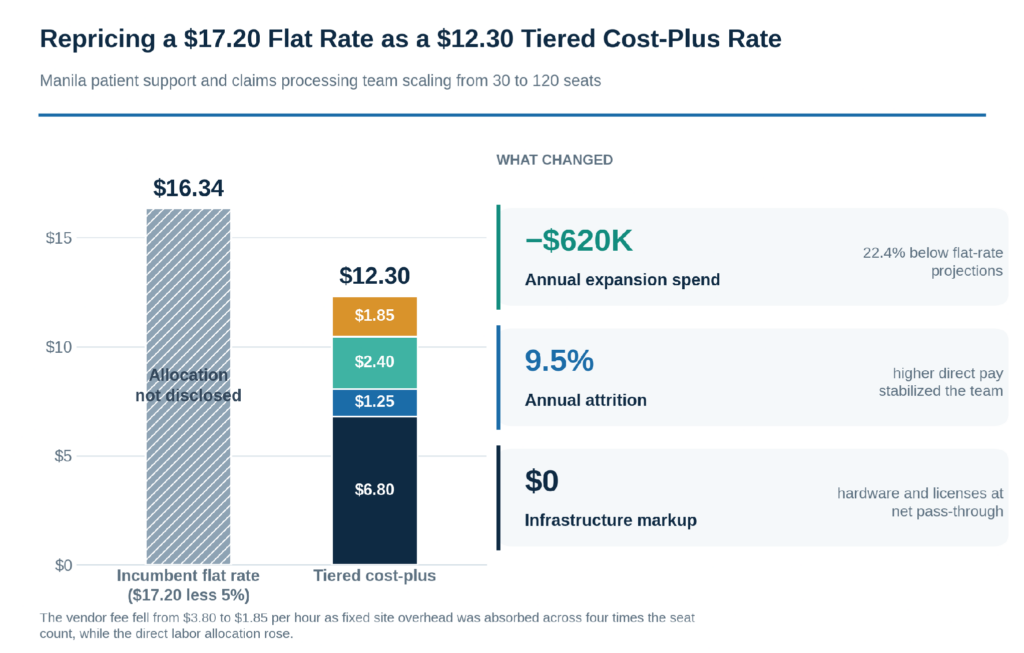
Figure 5. Repricing the flat rate as a tiered cost-plus rate, with the resulting operational outcomes.
How the Savings Compound
The year-one saving is only part of the picture. Because the flat-rate structure carried an annual escalator applied to the whole number while the cost-plus structure passes through statutory increases on a disclosed base, the two lines diverge further in years two and three, once the program reaches steady state at 120 seats.

Figure 6. Cumulative expenditure across 36 months: flat-rate scaling versus tiered cost-plus expansion.
Lessons Learned
Scaling without an unbundled cost structure leaves substantial operating capital on the table and provides no guarantee that frontline wages stay competitive. The two failures are connected: the same opacity that lets overhead be double-billed also lets the direct labor allocation drift downward, which is why the transparent structure delivered both a lower client cost and a materially more stable team.
How Does PITON-Global De-Risk Offshore Growth?
PITON-Global is an executive BPO advisory and management consultancy that guides enterprise buyers through provider selection, contract negotiation, and operational scaling in the Philippines. It represents client interests through financial modeling and governance rather than earning transactional placement fees.
Who Is PITON-Global?
PITON-Global advises enterprise buyers on Philippine outsourcing, working across provider selection, commercial structuring, and the governance that follows. Its relevance to expansion work is specific: pricing a scale-up correctly requires knowing what site overhead actually costs in Manila versus Clark, what margin is defensible at 200 seats, and which providers have genuinely absorbed fixed cost across their portfolio. In a market of more than 1,000 contact centers and back-office operations, none of that is visible from a rate card.
How Does PITON-Global Differ from Traditional Outsourcing Brokers?
Conventional brokers charge transactional finder’s fees, which narrows their recommendation set to whichever providers pay best and ends their involvement at the introduction — precisely the point before expansion pricing is negotiated. An advisory-led model is organized around the client’s outcome: independent evaluation, objective recommendations that may include providers with no commercial relationship to the advisor, and continued engagement through modeling, negotiation, and governance. On expansion work the difference is concrete, since an intermediary paid on placement has no reason to tell a CFO that the incumbent’s token discount is worth a fraction of what scale should deliver.
How Does PITON-Global’s Network of 100+ Vetted Philippine BPO Providers Benefit Organizations?
The network spans enterprise-grade providers across voice, back-office processing, IT services, and AI-assisted operations in Manila, Cebu, Clark, and Davao, including the analytical back-office work that our review of which functions return the most when outsourced ranks highest. Because candidates are pre-assessed for capacity, certifications, financial stability, and attrition performance — and screened for willingness to price transparently at scale — buyers move directly to providers that can absorb a 100-seat expansion without degrading delivery. Qualification compresses from months to weeks, and the shortlist reflects genuine scaling capability rather than stated capacity.
How Does PITON-Global’s Advisory-Led Vendor Matching Process Work?
The process runs from needs assessment to selection support. Volumes, skill tiers, coverage hours, compliance obligations, and growth projections are documented; the vetted network is filtered for specialization, location tier, and right-sized capacity; competing proposals are restated onto one fully loaded, like-for-like basis so each cost line can be tested against market corridors; shortlisted providers are validated on security posture, continuity planning, attrition history, and SLA record; and the buyer is supported through negotiation, addendum construction, and the design of the compression schedule and audit rights that govern the expansion. Risk reduction is built into each stage rather than addressed at signature.
Why Do Organizations Use PITON-Global?
- Reduced outsourcing risk. Independent diligence on scaling capability, statutory compliance, and attrition history surfaces problems before they are contractual.
- Better provider fit at scale. Matching on domain expertise and right-sized capacity ensures the expanded account remains strategic revenue for the provider.
- Accelerated vendor selection. A pre-qualified shortlist compresses a discovery cycle that typically runs for months into weeks.
- Stronger expansion economics. Compression schedules, pass-through audits, and FX bands are engineered into the agreement rather than negotiated after growth.
- Governance through the lifecycle. Support continues through SLA structuring, MSA negotiation, and the audits that keep transparency enforceable.
Frequently Asked Questions
What is a reasonable discount expectation when doubling BPO seat capacity in the Philippines?
Doubling team size, for example from 50 to 100 seats, should yield a double-digit percentage reduction in per-seat billing cost. The saving comes primarily from fixed overhead absorption and reduced management margin, not from cutting the direct labor line — a discount delivered by lowering agent pay will reappear as attrition.
How do Philippine statutory benefit adjustments impact expansion budgets?
Statutory benefits — SSS, PhilHealth, Pag-IBIG, and 13th-month pay mandated under Presidential Decree 851 — add a meaningful layer above base direct labor wages. Regional wage orders also move on their own cycle, so budgets should assume periodic increases. Transparent contracts itemize these contributions so vendors cannot apply an administrative markup on top of a statutory obligation.
Should expansion hardware be leased or purchased outright?
For multi-year programs scaling past 50 seats, purchasing PC hardware outright or using a pass-through equipment lease is significantly more cost-effective than recurring monthly workstation rental embedded in the hourly rate. Model the crossover point explicitly: embedded rental usually exceeds purchase cost somewhere between month 18 and month 30.
How are training costs handled during account expansion?
Initial wave training for expansion cohorts should be billed at raw direct labor cost without full management markup. Ongoing replacement training for standard turnover should be absorbed by the provider, since it reflects the provider’s own retention performance. Write the distinction into the addendum, because it is the most common source of post-signature billing disputes.
What foreign exchange mechanism best protects BPO expansion budgets?
A currency corridor agreement, under which USD billing rates remain fixed while the USD/PHP spot rate stays inside a pre-agreed band, with shared adjustment triggered only outside it. Name the reference rate source, the averaging period — a 90-day trailing average is standard — and the adjustment formula, so the mechanism works symmetrically in both directions.