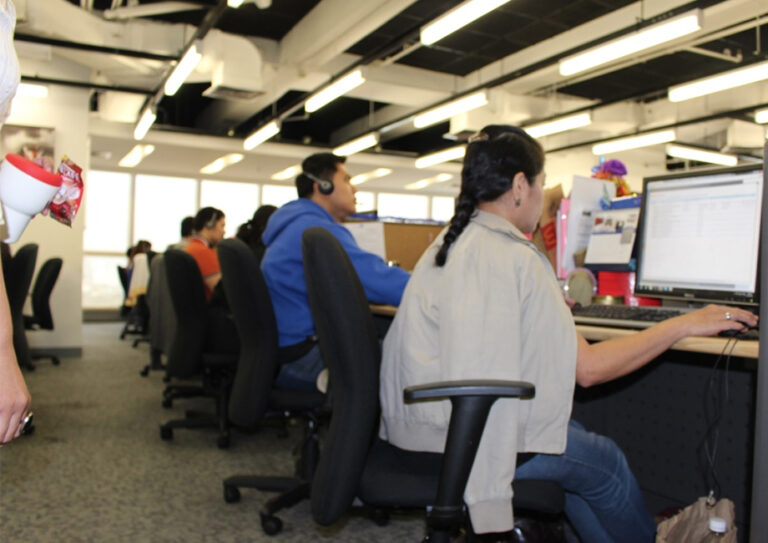

Call centers in Canada and teams in the Philippines are often weighed against each other by US and Canadian companies, and the choice usually turns on three things: language, hours and cost. This comparison belongs to our side-by-side review of outsourcing destinations, and it gives Canada full credit where it is the better home for the work.
The short answer: Canada is the stronger choice for French-language service, for work that must stay in Canada, and for programs where same-hour contact with your own staff matters more than price. The Philippines is the stronger choice for English-language volume, overnight and 24/7 coverage, and budgets that need a lower cost per resolved contact. Many North American companies use both.
Why buyers keep call centers in Canada
Canada offers what a domestic team offers, with a few extras: native English, official French, the same time zones as the United States, and a workforce with deep experience in customer-facing work. For many US companies it feels like an extension of home rather than an offshore move.
Canadian agents share the cultural references, spelling conventions and consumer expectations of US callers, so there is little adaptation on either side. Service centers are spread across Ontario, Quebec, British Columbia and the Atlantic provinces, and a manager in Chicago or New York can reach most of them in a short flight. Canadian service also carries a reputation for patience and courtesy that suits complicated or emotional conversations.
The industry has moved toward what practitioners call high-touch service: problem solving, empathy and judgment rather than scripted, high-volume handling. That suits subscription businesses, direct-to-consumer brands and financial services, where one badly handled call can cost a long-term customer. Canadian providers have leaned into that niche rather than competing on price with lower-cost regions.
Language: English, French and Quebec
Canada is officially bilingual, and that gives it an advantage no Asian location can match for French-language service. If you serve Quebec, or French-speaking customers anywhere, a Canadian team is usually the natural fit.
Quebec’s language law expects businesses to serve consumers there in French, so companies with Quebec customers need French-language support that sounds local, not translated. Canadian teams in Montreal, Quebec City and New Brunswick provide exactly that, and they can switch between English and French within one queue. Filipino providers can staff small French queues, but they cannot match that depth.
For English-language service, the comparison is closer. Filipino agents speak fluent English with an accent that North American callers tend to find familiar, backed by decades of work for US brands. The Philippines scored 569 and ranked 28th worldwide in the EF English Proficiency Index 2025, the kind of result that makes English-language hiring at scale practical. Test both on your own calls: run mock interactions with your hardest scenarios and score them on your own quality form.
Hours and coverage
Canada works your day; the Philippines works your night. Canada spans six time zones, four of which match the continental US zones, so a Canadian team covers North American business hours on a normal day shift.
Manila is 12 to 13 hours ahead of US Eastern time, which turns its day shift into your overnight coverage. Overnight queues, weekend backlogs and early-morning email get cleared while your own staff sleep, and US-daytime coverage from Manila runs on a night shift that Filipino providers have organized for decades. If you need true round-the-clock service, our page on round-the-clock coverage from Filipino teams explains how those shifts are staffed.
For daytime-only programs that need live contact with your managers, product owners or field teams, Canada’s overlap is a real advantage. For programs that must never close, the Philippines usually covers the night at lower cost than a Canadian night shift.
What the work costs on each side
Canadian labor costs sit close to US levels, while Filipino costs are substantially lower. That gap is the main reason companies look beyond Canada for high-volume English-language work.
Canada’s Job Bank reports a median wage of C$22.00 an hour for call center customer service representatives, based on Statistics Canada survey data for the 2023–2024 reference period, last updated in November 2025. In the United States, the median wage for customer service representatives was $21.53 an hour in 2025, according to the Bureau of Labor Statistics. Those are wages only; benefits, space, technology, training and supervision come on top.
On the Philippine side, our 2026 pricing guide models a $12 per hour fully loaded base rate that already includes team-lead and QA supervision, against a $33 per hour US in-house benchmark, and puts typical savings at 50–70% against a US in-house team. A fair comparison sets that fully loaded rate against a fully loaded Canadian rate for the same scope, not against a bare wage.
Price is not the whole story. Compare cost per resolved contact, the cost of managing a distant team, and what each option does to customer satisfaction. For sensitive, low-volume work, a Canadian team may justify its price; for high-volume English service, the Philippine savings are hard to ignore.
Service culture and quality
Both countries have strong service cultures, and in both the provider matters more than the flag. Canadian agents are valued for courtesy and calm problem solving; Filipino agents are valued for warmth, patience and a habit of going out of their way for the customer.
What separates good programs from weak ones is the same everywhere: structured onboarding, simulated calls before live traffic, regular calibration between the provider’s quality team and yours, and coaching based on recorded interactions. Ask each bidder how long agents on similar accounts have stayed, how it measures first-contact resolution, and how quickly it acts on a failing score.
The same qualities explain why Filipino teams serve customers far beyond North America; our piece on guest support for UAE hotels shows how hospitality groups use them.
Privacy, data location and regulated work
Where data may be stored or accessed can decide the question before cost does. Canada’s federal privacy law, PIPEDA, and Quebec’s own privacy rules apply to personal information, and some public bodies and regulated firms have policies on where Canadian data can be held or viewed.
If your contracts or regulators require that Canadian personal data stay in Canada, a Canadian team is the simplest answer. If they do not, Filipino providers can work under SOC 2 Type II, ISO 27001, PCI DSS and HIPAA controls, with data kept in your own systems and accessed through secured virtual desktops. The Philippine Data Privacy Act adds a national layer of protection. Read the auditor’s reports, not the logos on a proposal.
Wellbeing, remote work and technology
Burnout is a risk in customer-facing work everywhere, and the better providers in both countries invest against it. Canadian providers have added mental health support, flexible hours and career development; Filipino providers use similar programs, along with growth in second-tier cities where the labor market is less crowded.
Remote work has reshaped the industry in both places. It has lowered overhead and widened talent pools, but it has also made team culture and security harder to manage, so ask how remote agents are supervised, coached and secured. Technology is augmenting agents rather than replacing them: agent-assist tools, customer histories on one screen and automated summaries free people for the conversations that need a human. Ask each bidder which tasks its automation handles alone and where a person reviews the result.
Choosing between them
A hybrid is common: Canadian or domestic staff for French-language service, regulated work and daytime escalations, and a Filipino team for English volume, nights, weekends and back-office follow-up. Hold every site to the same quality standards and reporting.
Before adding any provider, test the case against simply hiring more of your own staff; our guide to comparing an offshore team with domestic hiring sets out that decision. If you are also weighing Asia’s other large market, our look at how Indian call centers compare covers where India fits.
Frequently asked questions
Is Canada cheaper than the United States for customer service?
Median agent wages are similar in local currency in the two countries, so savings from moving work to Canada depend largely on the exchange rate and the city you choose. The larger savings come from offshore delivery.
Can Filipino teams provide French-language support?
For small queues, yes. For Quebec customers or programs where much of the traffic is in French, a Canadian team is the better base.
Which option is better for 24/7 coverage?
The Philippines, in most cases. Its day shift covers the North American night, so overnight coverage carries no special premium, while Canadian overnight shifts cost more to staff.
Can I keep sensitive work in Canada and move the rest offshore?
Yes, and many companies do exactly that. Keep regulated or French-language work in Canada, move high-volume English service to the Philippines, and manage both against one set of service levels.