
Back
How Do You Protect Content Moderators’ Wellbeing When Outsourcing to the Philippines?

By Ralf Ellspermann / 3 June 2026
 Authored by Ralf Ellspermann, CSO of PITON-Global, & 25-Year Philippine BPO Veteran | Executive | Verified by John Maczynski, CEO of PITON-Global, and Former Global EVP of the World's Largest BPO Provider on June 3, 2026

With a layered, evidenced wellbeing program — not a perk. Leading Philippine providers reduce exposure through AI pre-filtering and blurring, design workloads with rotation, caps, and decompression breaks, provide on-site clinical counseling and resilience training, and use AI to detect reviewer stress in real time. After high-profile moderator-trauma litigation, this duty of care is now both an ethical baseline and a legal-risk control — and it directly improves accuracy and retention.
Key Takeaways
- Moderator wellbeing is now a legal-risk issue. Investigative reporting and litigation over moderator psychological harm have made legacy, unsupported models both unethical and unsafe to operate.
- Wellbeing is delivered as a stack. Exposure reduction, workload design, clinical support, and predictive stress monitoring layer together — no single measure is sufficient.
- AI now reduces exposure, not just workload. Pre-filtering, blurring, grayscale, and muting limit what reviewers must see; AI also flags reviewer stress in real time.
- It is also a business case. Wellbeing improves decision accuracy, cuts attrition and rehiring cost, lowers legal risk, and strengthens brand and ESG standing.
- It is now a partner-selection criterion. Evidenced wellbeing programs separate credible Philippine partners from unacceptable ones — and should be audited, not assumed.
Why Has Moderator Wellbeing Become a Board-Level Issue?
Because moderator psychological harm has moved from a welfare concern to documented litigation and reputational risk — legacy models are no longer legally safe.
The industry is in the middle of a Trust & Safety reckoning. Investigative reporting — including BBC coverage of the psychological risks faced by social-media moderators — and a wave of trauma-related litigation against global platforms have made one thing clear: legacy outsourcing models that exposed reviewers to disturbing content without serious safeguards are no longer ethically acceptable or legally safe. Wellbeing has moved from an HR footnote to a board-level risk and procurement requirement, reshaping how platforms vet partners.
“The industry learned the hard way that you cannot build a safe platform on the backs of unsupported people. Moderator wellbeing used to be treated as a welfare nicety; today it is a legal exposure, a quality driver, and a procurement requirement. We pivoted our own vetting standards specifically because of the litigation reshaping this space.” John Maczynski — CEO, PITON-Global; former Global EVP of the world’s largest BPO provider
What Does a Modern Moderator-Wellbeing Program Actually Include?
Four layers: exposure reduction, workload design, clinical support, and predictive stress monitoring — working together, not in isolation.
Credible wellbeing is delivered as a stack, because no single measure protects a reviewer on its own. Exposure reduction uses AI pre-filtering, blurring, grayscale, and audio muting to limit what a person must directly perceive. Workload design adds rotation away from the most disturbing queues, volume caps, and mandated decompression breaks. Clinical support provides on-site counseling and resilience training. And predictive monitoring uses AI to detect reviewer stress in real time, triggering breaks before harm compounds.
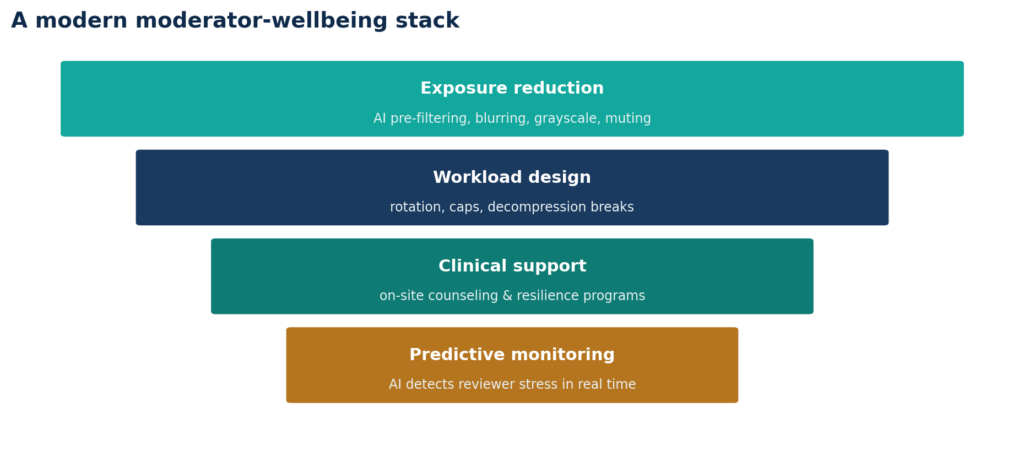
Figure 1 — Wellbeing is layered: reduce exposure, design the workload, support clinically, and monitor stress.
The most advanced 2026 operations describe this as predictive wellness — using AI to address the root causes of reviewer trauma rather than reacting after the fact. The aim is a sustainable, high-accuracy environment that protects both the brand and the people defending it.
Does Protecting Moderators Actually Help the Platform — or Just Cost More?
It helps measurably: wellbeing raises decision accuracy, cuts attrition and rehiring cost, reduces legal exposure, and strengthens brand and ESG standing.
Wellbeing is not a cost center traded off against performance — it is a driver of it. Reviewers who are protected and supported make more accurate decisions and stay longer, which lowers the substantial cost of constant rehiring and retraining. Robust, evidenced programs reduce the litigation exposure now hitting platforms with weak safeguards, and they strengthen brand reputation and ESG standing with users, advertisers, and regulators. The ethical case and the business case point the same direction.
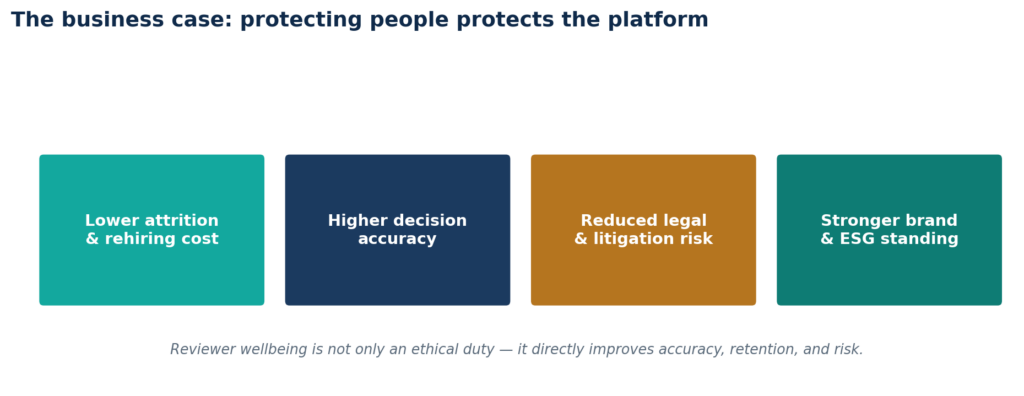
Figure 2 — Protecting people protects accuracy, retention, legal standing, and brand simultaneously.
“When people ask whether wellbeing is worth the investment, I point to the numbers we see: supported reviewers are more accurate and they stay. You are not choosing between caring for people and running an efficient operation — the care is what makes the operation work. The providers who understand that are the ones we put in front of clients.” Ralf Ellspermann — CSO, PITON-Global; 25-year Philippine BPO veteran
Why Is the Philippines Positioned to Lead on Moderator Wellbeing?
Because leading Philippine providers have made wellbeing-first operations a core standard — pairing exposure-reduction tooling and clinical support with cultural strengths in resilience and care.
As global standards rose, leading Philippine providers moved early to wellbeing-first operations, mandating predictive wellness monitoring and embedding clinical support into the workflow. Combined with the country’s cultural strengths in empathy and community and its mature, certified operating environments, this has made the Philippines a destination where high-volume moderation and serious duty-of-care can coexist — the combination platforms increasingly require.
| Wellbeing Element | How Leading Philippine Partners Deliver It |
| Exposure reduction | AI pre-filtering, blurring, grayscale, and muting built into tooling. |
| Workload design | Queue rotation, volume caps, and mandated decompression breaks. |
| Clinical support | On-site counseling and resilience programs as standard. |
| Predictive monitoring | AI-based real-time stress detection that triggers breaks. |
| Cultural strengths | Empathy- and community-oriented workforce suited to care models. |
| Governance | Documented programs, auditable against rising duty-of-care standards. |
How Should Platforms Evaluate a Partner’s Wellbeing Program?
Demand evidence, not assertions — audit the exposure tooling, workload rules, clinical provision, monitoring, and outcome metrics like attrition and accuracy.
Because wellbeing is now a risk control, it should be procured like one. Platforms should require a partner to evidence each layer of the stack: what exposure-reduction tooling is in place, how workloads are rotated and capped, what clinical support is actually available and how often it is used, how stress is monitored, and what the outcome metrics — attrition, accuracy, and reviewer-reported wellbeing — look like over time. A partner that treats these as auditable commitments rather than marketing claims is the one that will hold up ethically, operationally, and legally.
Frequently Asked Questions
Why Does Content-Moderator Wellbeing Matter to Platforms?
Because moderator psychological harm is now a documented source of litigation and reputational risk, and because supported reviewers make more accurate decisions and stay longer. It is both an ethical duty and a business and legal imperative.
What Does a Strong Wellbeing Program Include?
Exposure reduction (AI pre-filtering, blurring, grayscale, muting), workload design (rotation, caps, decompression breaks), clinical support (counseling and resilience), and predictive AI stress monitoring — layered together.
Does Wellbeing Reduce Moderation Quality or Speed?
The opposite. Supported, lower-trauma reviewers make more accurate decisions and have lower attrition, which improves consistency and reduces the cost and quality loss of constant rehiring.
How Do I Verify a Partner’s Wellbeing Claims?
Audit them. Require evidence of exposure tooling, workload rules, clinical provision, stress monitoring, and outcome metrics such as attrition and accuracy — treating wellbeing as a procurement and risk-control requirement.
Related in This Series
What Is Trust & Safety Outsourcing to the Philippines?
The full category and operating model.
How Does Content Moderation Outsourcing to the Philippines Work at Scale?
The core operation: queues, policy enforcement, QA, and throughput.
How Do You Outsource Child-Safety & High-Harm Moderation to the Philippines Safely?
The most sensitive workflow and its hard boundaries.
How Do You Outsource Fraud, Scam & Platform-Integrity Operations to the Philippines?
Defending the money and the network from abuse.
How Do Platforms Outsource Trust & Safety for AI & Gen-AI to the Philippines?
Red-teaming, RLHF safety, and synthetic-media review.
About PITON-Global
PITON-Global is a vendor-neutral outsourcing advisory with 25+ years in the Philippine market. We vet trust-and-safety providers against wellbeing-first standards and help platforms source partners whose duty-of-care programs hold up ethically, operationally, and legally — free of charge and with no obligation.
Achieve sustainable growth with world-class BPO solutions!
PITON-Global connects you with industry-leading outsourcing providers to enhance customer experience, lower costs, and drive business success.
Get Your Top 1% Vendor List
Author
Ralf Ellspermann is a multi-awarded outsourcing executive with 25+ years of call center and BPO leadership in the Philippines, helping 500+ high-growth and mid-market companies scale call center and customer experience operations across financial services, fintech, insurance, healthcare, technology, travel, utilities, and social media.
A globally recognized industry authority—and a contributor to The Times of India and CustomerThink —he advises organizations on building compliant, high-performance offshore contact center operations that deliver measurable cost savings and sustained competitive advantage.
Known for his execution-first approach, Ralf bridges strategy and operations to turn call center and business process outsourcing into a true growth engine. His work consistently drives faster market entry, lower risk, and long-term operational resilience for global brands.
EXECUTIVE GOVERNANCE & ACCURACY STANDARDS
Authored by:
Ralf Ellspermann
Founder & CSO of PITON-Global,
25-Year Philippine BPO Veteran,
Multi-awarded Executive
Specializing in strategic sourcing and excellence in Manila
View Full Bio
Verified by:

John Maczynski
CEO of PITON-Global, and former Global EVP of the World’s largest BPO provider | 40 Years Experience
Ensuring global compliance and enterprise-grade service standards
View Full Bio
Last Peer Review: June 3, 2026
This service framework is audited quarterly to meet shifting global outsourcing regulations and COPC standards.