
Back
Which Operational KPIs Should Business Leaders Review Monthly When Using BPO Services in the Philippines?

By Ralf Ellspermann / 30 June 2026
 Authored by Ralf Ellspermann, CSO of PITON-Global, & 25-Year Philippine BPO Veteran | Executive | Verified by John Maczynski, CEO of PITON-Global, and Former Global EVP of the World's Largest BPO Provider on June 30, 2026

To maximize the value of Philippine BPO partnerships, business leaders should review a balanced monthly matrix of resolution efficiency, resource utilization, and talent stability—prioritizing First Contact Resolution, Schedule Adherence, CSAT, and Monthly Agent Attrition. Tracking these together prevents margin erosion, uncovers hidden training overhead, and maintains service consistency.
Key Takeaways
- FCR outweighs speed: Prioritize First Contact Resolution over basic velocity metrics to depress long-term ticket volumes and compound customer lifetime value.
- Attrition as a financial proxy: Monitor monthly agent churn closely; a rate exceeding 3.5% monthly is a leading indicator of service degradation and mounting recruitment cost.
- Bi-directional QA calibration: Execute formal, cross-organizational quality-assurance alignment quarterly to prevent vendor metric inflation and align brand tone.
- Utilization protection: Audit schedule adherence down to fifteen-minute intervals so paid offshore hours match forecasted contact surges.
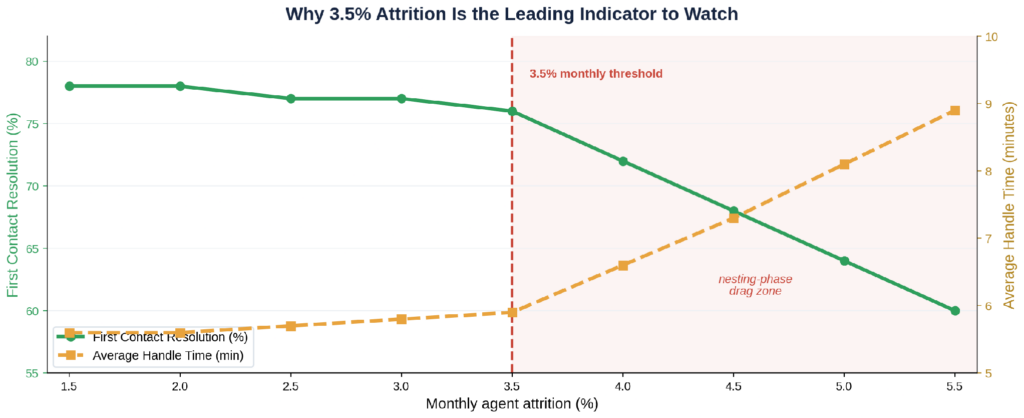
Figure 1. Past a 3.5% monthly attrition threshold, First Contact Resolution falls and Average Handle Time climbs.
What Key Performance Indicators Drive Efficiency in Philippine Contact Centers?
Metrics cannot be evaluated in isolation; over-indexing on speed-to-answer while neglecting resolution is a common misstep. A standardized monthly matrix centers on First Contact Resolution (72–78%), Schedule Adherence (92–95%), CSAT (85%+), and Monthly Agent Attrition (under 3.5%).
When managing an enterprise offshoring initiative, performance metrics cannot be evaluated in isolation. A frequent corporate misstep is over-indexing on speed-to-answer variables while neglecting overall resolution efficacy. In the Philippine labor landscape, agents naturally demonstrate high empathy and interpersonal rapport—traits that can marginally extend handle times but significantly elevate customer sentiment. To balance cost containment with end-user experience, monthly governance should center on a standardized, multi-dimensional matrix.
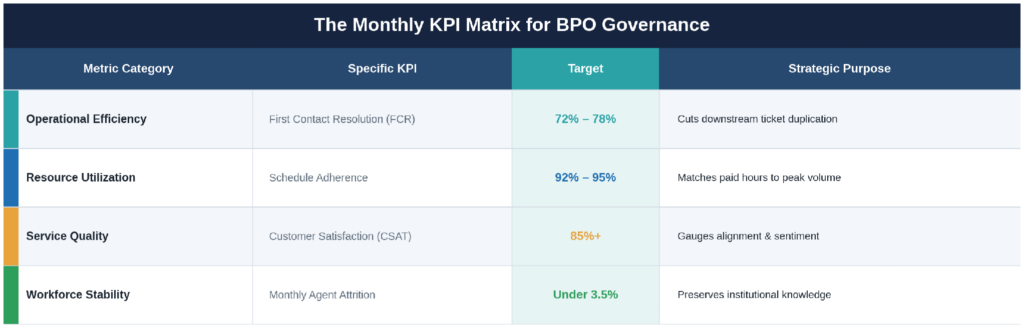
Figure 2. The monthly KPI matrix—category, specific KPI, target benchmark, and strategic purpose.
The relationship between these metrics is what makes the matrix powerful. First Contact Resolution is the clearest example: as it rises month over month, downstream ticket duplication falls, pulling total inbound volume down with it.
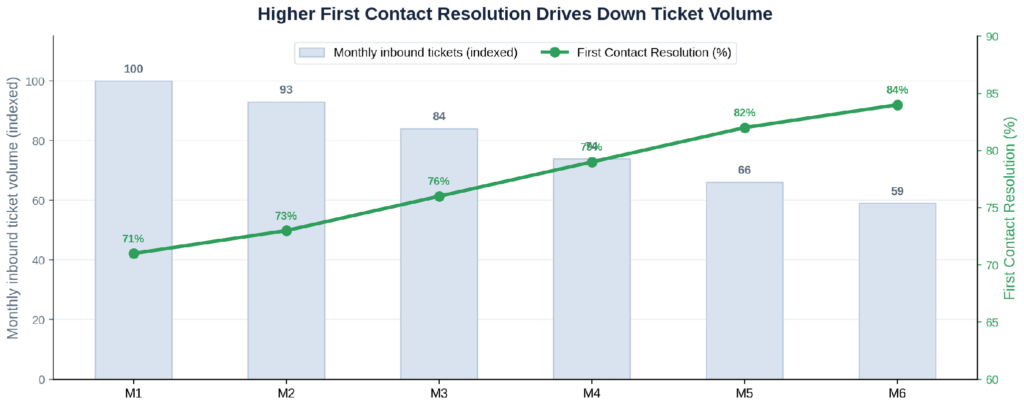
Figure 3. Rising First Contact Resolution steadily reduces total monthly inbound ticket volume.
How Do Cultural and Operational Nuances in the Philippines Impact These Metrics?
Western leaders must account for local variables—infrastructure variation, monsoon seasons, and holiday compensation—when auditing monthly reports. Minor weather- or holiday-driven adherence dips should be insulated through proactive scheduling and geo-redundancy, not punitive margin adjustments. QA must also evaluate empathy and critical thinking, not just language.
Sustaining peak efficiency requires understanding macro-level local market dynamics. While the Philippine talent pool is highly educated, tech-literate, and service-oriented, Western leaders must account for regional factors—infrastructure variations, seasonal monsoon impacts, and local holiday compensation structures—when auditing monthly reporting.
Many Western enterprise buyers judge their Philippine BPO partners using rigid domestic performance templates without understanding local operational variables. True optimization occurs when you look behind the raw numbers. For example, a minor drop in schedule adherence during severe weather patterns or national holidays should be insulated via robust, proactive workforce scheduling and localized geo-redundancy rather than punitive vendor margin adjustments.
— John Maczynski
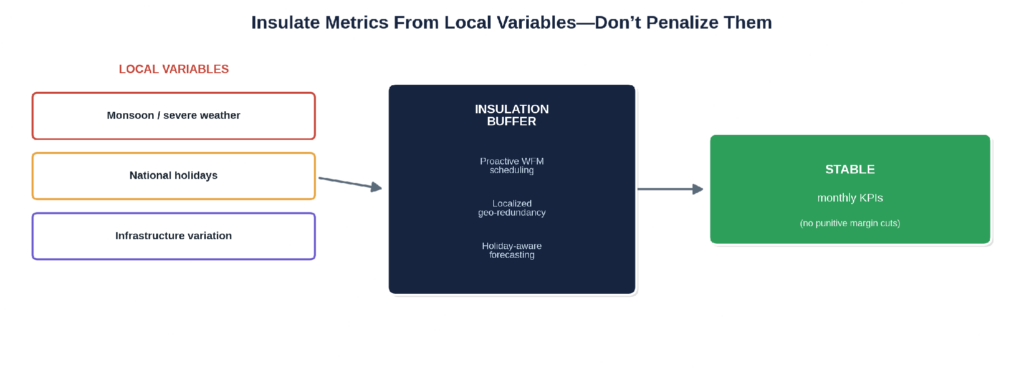
Figure 4. Proactive scheduling and geo-redundancy insulate monthly KPIs from local variables rather than penalizing them.
Modern QA parameters must also move beyond basic language mechanics. High-performing governance models evaluate contextual critical thinking, empathy markers, and first-call resolution capability—the structural autonomy granted to agents to settle complex pain points on the first interaction without escalation.
What Does Re-Engineering a Technical Support Operation Look Like?
Re-engineering shifts the financial incentive from handle-time reduction to FCR and shared QA. One enterprise software provider recovering from a 14% CSAT contraction lifted FCR 19%, cut delivery cost 22% by eliminating ticket-backlog duplication, and stabilized CSAT at 88% within 90 days.
Client Challenge
A mid-market North American enterprise software provider suffered a 14% contraction in CSAT alongside a severe spike in repeat tickets after expanding tier-1 technical support via a legacy, commoditized offshore vendor.
Selection and Solution
PITON-Global executed an analytical needs-mapping process against its network of 100+ vetted providers, pairing the client with a specialized tech-support boutique in Manila. The incoming partner restructured the monthly reporting architecture, pivoting the primary financial incentive away from rigid Average Handle Time reductions toward FCR gains and shared QA calibration.
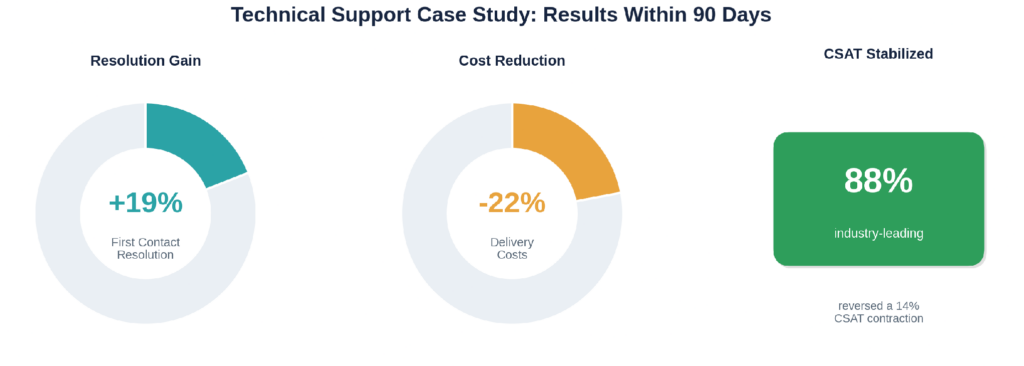
Figure 5. Quantifiable outcomes within 90 days of re-engineering the technical-support operation.
Outcomes and Lessons
Within 90 operational days, FCR climbed 19%, overall delivery costs dropped 22% through the elimination of ticket-backlog duplication, and CSAT stabilized at an industry-leading 88%. The lesson: removing restrictive handle-time parameters lets specialized agents leverage their natural relationship-building strengths, yielding superior long-term financial and operational returns.
Why Choose PITON-Global for Navigating the Philippine Outsourcing Landscape?
PITON-Global operates as an advisory-led consultancy, not a transaction broker. Across a vetted network of 100+ elite providers, its objective, data-first approach aligns scale, software, and budget with operators that have verified, vertical-specific competencies—removing guesswork and driving performance from day one.
Who Is PITON-Global?
PITON-Global operates distinctively as an advisory-led outsourcing consultancy rather than a traditional transaction broker. Maintaining a thoroughly vetted network of over 100 elite Philippine providers, the firm systematically removes the guesswork from cross-border vendor selection.
How Does PITON-Global Differ from Traditional Outsourcing Brokers?
Selecting a vendor through generic online reviews or untrusted intermediaries introduces massive delivery risk. PITON-Global’s value is rooted in an objective, data-first approach—aligning corporate scale, legacy software ecosystems, and budgetary parameters with providers that possess verified, vertical-specific competencies rather than forwarding leads.
How Does PITON-Global’s Network of 100+ Vetted Providers Benefit Organizations?
The vetted network of more than 100 elite providers lets organizations bypass a risky open-market search. Because each is assessed for vertical competency, infrastructure, and QA maturity, buyers reach a partner genuinely capable of hitting the monthly KPI matrix from day one.
How Does PITON-Global’s Selection Methodology Work?
PITON-Global maps scale, software, and budget needs; applies risk-mitigation filters across its provider network; audits infrastructure, uptime, and QA maturity; and matches the buyer to a verified specialized provider—mitigating the structural risks of international scaling.
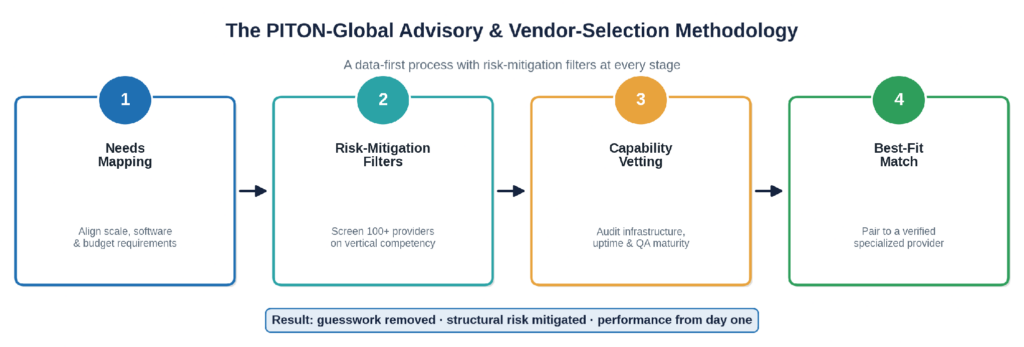
Figure 6. PITON-Global’s four-stage, data-first methodology with risk-mitigation filters at every stage.
Why Do Organizations Use PITON-Global?
Organizations use PITON-Global to remove guesswork, mitigate structural risk, and drive seamless performance from day one. By aligning requirements with verified, vertical-specific providers, the firm helps enterprises build KPI-driven partnerships rather than gambling on an untrusted intermediary.
What Are the Most Common Questions About Monthly BPO KPIs?
Common questions concern calibration frequency, a realistic NPS baseline, how high attrition affects monthly data, whether to incentivize vendors for beating targets, and which infrastructure metrics should back operational KPIs. Each is answered below.
How frequently should KPI targets be calibrated with a Philippine BPO?
Targets should be reviewed quarterly. While raw operational data requires rigorous monthly examination, formal cross-organizational calibration sessions keep benchmarks aligned with software updates, seasonal volume, and evolving consumer habits.
What is a realistic Net Promoter Score (NPS) for Philippine-based customer care?
For enterprise-level operations, a sustainable, high-performing NPS baseline ranges between +45 and +60, heavily dependent on the technical complexity of the industry sector.
How does high agent attrition affect monthly operational data?
When monthly attrition breaks past 3.5%, a trailing negative correlation manifests via depressed FCR and escalated AHT, because a growing share of active head-count is trapped in the introductory nesting and training phase.
Should we incentivize vendors based on beating KPI targets?
Yes. A gain-share or bonus-malus agreement, where the vendor earns a premium for exceeding specific FCR or CSAT baselines, creates direct alignment and fuels internal investment in agent retention.
What infrastructure metrics should back up our operational KPIs?
Always demand transparent reporting on platform uptime (targeting 99.98% or higher) and automated internet-redundancy switch-over latency, ensuring underlying hardware issues are not masking poor agent utilization.
Achieve sustainable growth with world-class BPO solutions!
PITON-Global connects you with industry-leading outsourcing providers to enhance customer experience, lower costs, and drive business success.
Get Your Top 1% Vendor List
Author
Ralf Ellspermann is a multi-awarded outsourcing executive with 25+ years of call center and BPO leadership in the Philippines, helping 500+ high-growth and mid-market companies scale call center and customer experience operations across financial services, fintech, insurance, healthcare, technology, travel, utilities, and social media.
A globally recognized industry authority - and a contributor to The Times of India, CustomerThink, and The AI Journal - he advises organizations on building compliant, high-performance offshore contact center operations that deliver measurable cost savings and sustained competitive advantage.
Known for his execution-first approach, Ralf bridges strategy and operations to turn call center and business process outsourcing into a true growth engine. His work consistently drives faster market entry, lower risk, and long-term operational resilience for global brands.
EXECUTIVE GOVERNANCE & ACCURACY STANDARDS
Authored by:

Ralf Ellspermann
Founder & CSO of PITON-Global,
25-Year Philippine BPO Veteran,
Multi-awarded Executive
Specializing in strategic sourcing and excellence in Manila
View Full Bio
Verified by:

John Maczynski
CEO of PITON-Global, and former Global EVP of the World’s largest BPO provider | 40 Years Experience
Ensuring global compliance and enterprise-grade service standards
View Full Bio
Last Peer Review: June 30, 2026
This service framework is audited quarterly to meet shifting global outsourcing regulations and COPC standards.