

After outsourcing revenue-cycle work, hospital executives should move beyond basic labor-cost savings to track revenue-cycle integrity, claim-processing precision, and operational agility. Success is defined by a measurable reduction in Days in Accounts Receivable (A/R), a consistently high Clean Claim Rate, and a material improvement in operating margins through variable, scalable administrative support from a Philippine partner for health-system back offices.
Key Takeaways
- Revenue-cycle velocity: Focus on cash-flow acceleration rather than simple labor arbitrage.
- Precision benchmarking: Prioritize denial rates and net collection rates to protect revenue integrity.
- Operational elasticity: Use “agile pod” models to convert fixed overhead into scalable, volume-based costs.
- Governance-led compliance: Embed HIPAA/HITRUST protocols directly into service-level agreements to mitigate data-breach liability.
- Strategic integration: Treat offshore hubs as extensions of the domestic C-suite, leveraging real-time performance dashboards.
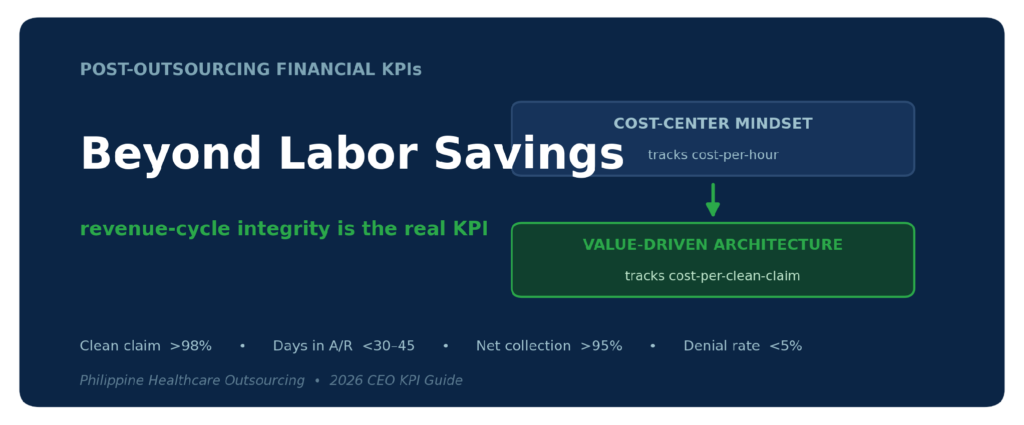
How Do You Distinguish “Cost-Center Outsourcing” From “Value-Driven Architecture”?
A cost-center approach tracks only cost-per-hour; a value-driven architecture tracks cost-per-clean-claim and total cost of ownership. The decisive move is converting rigid, fixed administrative overhead into a variable, scalable cost structure that aligns spending with patient volume.
Many health systems enter the Philippine market seeking only to reduce payroll. The most successful instead treat the Philippines as a strategic engine for operational resilience—and the difference shows up in the metrics they watch. Where a cost-center mindset fixates on cost-per-hour, a value-driven architecture measures cost-per-clean-claim and total cost of ownership.
Shifting non-clinical functions to specialized hubs converts fixed overhead into a variable cost that flexes with patient volume, so administrative spending tracks demand rather than sitting idle at low volume. That is the logic behind measured, value-based healthcare partnerships. It also lets clinical staff reclaim thousands of hours a year from coding, transcription, and scheduling.
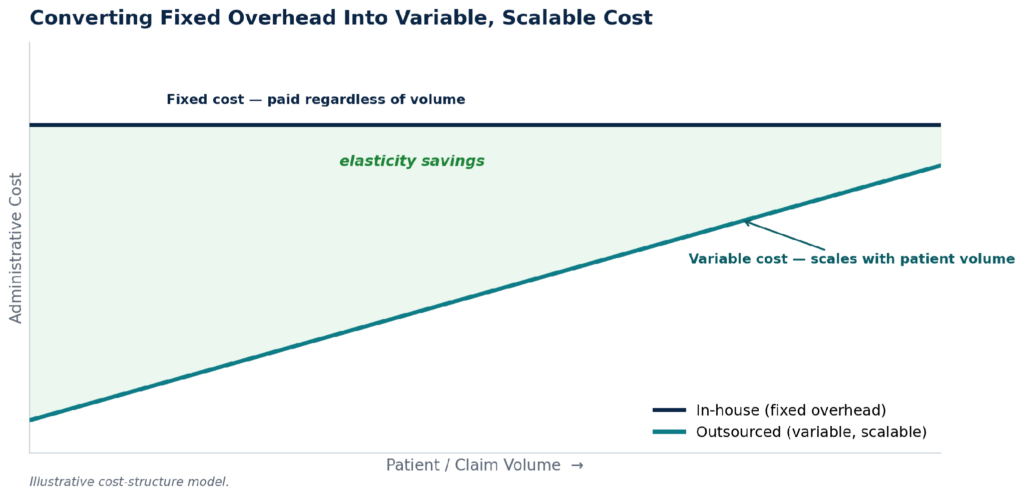
Figure 1. A variable, scalable cost structure flexes with volume, capturing elasticity savings against fixed overhead.
What Are the Critical Financial Indicators of Outsourcing Success?
Four KPIs act as the primary health indicators of an outsourced revenue cycle: Clean Claim Rate, Days in A/R (<30–45), Net Collection Rate, and Denial Rate — each held to a contracted benchmark. Together they reveal whether a partnership is delivering real financial impact or only surface-level savings.
Financial oversight should center on four performance pillars. Revenue integrity is measured by the clean-claim rate, which minimizes rework and speeds cash realization. Cash flow is measured by days in A/R, which accelerates liquidity and capital availability. Profitability is captured by the net collection rate, ensuring maximum capture of earned revenue. Efficiency is measured by the denial rate, which drives down expensive administrative rework. These financial pillars sit alongside the operational KPIs health system CEOs should review monthly.

Figure 2. The four KPIs, their success benchmarks, and the financial impact each one drives.
How Can Hospital Leaders Measure the “Clinical Literacy” of an Offshore Partner?
Clinical literacy means staffing your programs with professionals fluent in U.S. healthcare workflows and platforms like Epic, Cerner, or Athenahealth. Monitor First-Pass Yield and Average Handle Time per clinical task—strong, stable numbers signal a true extension of your team rather than a “black box.”
A common failure point is partnering with generalist BPOs that lack the domain expertise to navigate complex U.S. healthcare workflows. True operational success requires partners who provide clinical literacy—staffing programs with professionals experienced in the platforms your teams already use. To verify it, monitor first-pass yield and average handle time per clinical task: when a team is culturally and clinically attuned to your protocols, these metrics reflect a seamless extension of your domestic team and prevent the “black box” syndrome where visibility into the offshore process is lost.
What Does a Successful Implementation Look Like in Practice?
A mid-sized U.S. health system facing rising denials and appointment cancellations partnered with a specialized Philippine provider for revenue cycle management and patient engagement. Within six months it cut Days in A/R by 12, lifted appointment show-rates markedly, and delivered substantial annual operating savings.
The system was contending with high administrative burnout and revenue leakage. After partnering with a specialized Philippine-based provider focused on revenue cycle management and patient engagement, the results landed within two quarters—and the single most critical success factor was early, continuous involvement of domestic clinical leadership in the offshore team’s training.
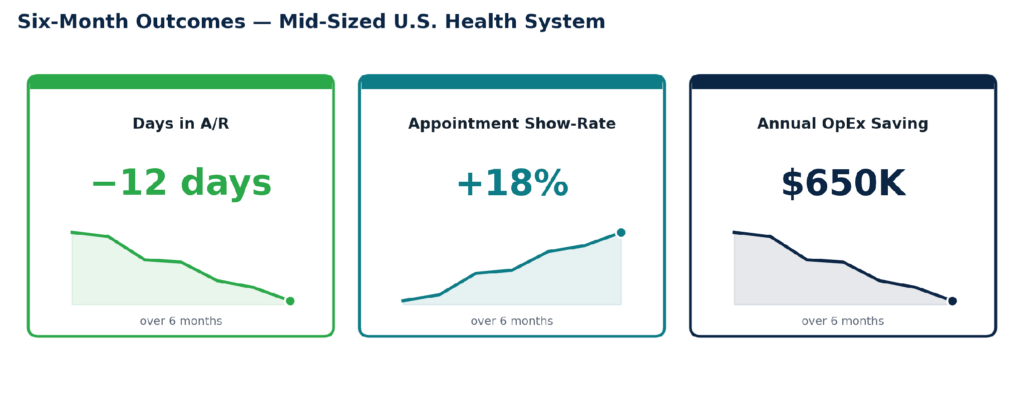
Figure 3. Six-month outcomes for a mid-sized U.S. health system.
“The most successful healthcare organizations treat their Philippine partners as an extension of their own hospital staff. It’s not just about labor; it’s about leveraging specialized intelligence to handle the complex, high-stakes tasks that define your bottom line.” — John Maczynski, CEO of PITON-Global.
How Does PITON-Global Help Hospitals Select the Right Partner?
PITON-Global is an independent advisory bridge between U.S. providers and the Philippine BPO ecosystem. Rather than simply issuing RFPs, it applies a proprietary, advisory-led matching process backed by 40+ years of experience and a network of 100+ vetted “hidden champions”—so hospitals avoid the costly “double penalty.”
Who Is PITON-Global?
PITON-Global is an independent advisory firm that bridges U.S. healthcare providers and the Philippine BPO ecosystem. Drawing on more than 40 years of operational experience, it partners with over 100 vetted, high-performing “hidden champions” in the Philippines and matches hospitals to vendors whose operational culture aligns with their clinical standards.
How Does PITON-Global Differ From Traditional Outsourcing Brokers?
Unlike traditional brokers, PITON-Global does not simply issue RFPs. It uses a proprietary, advisory-led matching process and an audit-heavy framework, so hospitals avoid the “double penalty”—paying for enterprise-scale infrastructure that doesn’t actually fit their specific program size or technical needs.
How Does a Network of 100+ Vetted Philippine BPO Providers Benefit Organizations?
The curated network of vetted “hidden champions” gives hospitals access to high-performing specialists that fit their exact program size and technical profile. Because each provider is pre-screened through a rigorous framework, organizations are matched with a vendor whose operational culture aligns with their clinical standards—without an exhaustive market search.
How Does PITON-Global’s Advisory-Led Vendor Matching Process Work?
PITON-Global follows an audit-heavy roadmap: audit, shortlist, competitive benchmarking, governance framework, and implementation. The phased timeline supports an agile-pod pilot within roughly 30–45 days and full stabilization by about 90 days, with governance and compliance embedded before scale-up.

Figure 4. PITON-Global’s advisory roadmap, with an agile-pod pilot by day 30–45 and stabilization by day 90.
Why Do Organizations Use PITON-Global?
Organizations partner with PITON-Global to de-risk selection and avoid the “double penalty” of a poor structural fit. Its proprietary, advisory-led process and audit-heavy framework ensure the chosen partner matches the hospital’s program size, technical needs, and clinical standards—accelerating time-to-value and protecting long-term financial performance.
What Else Should Hospital CEOs Know About Offshore KPIs and Governance?
Common questions cover HIPAA compliance, operational visibility, transition timing, talent quality, and cultural fit. In short: top hubs use clean-room environments and DLP controls, real-time dashboards preserve visibility, an agile pilot launches in 30–45 days, Philippine staff are clinically trained, and cultural affinity with the U.S. is high.
How do we ensure HIPAA compliance when moving data offshore?
Top-tier Philippine hubs use “clean-room” environments with no personal devices, advanced Data Loss Prevention software, and biometric access controls to maintain strict HIPAA and HITRUST compliance.
How do we maintain visibility into offshore operations?
Modern governance models provide real-time dashboards and direct communication channels, letting local managers monitor KPIs, call recordings, and workflow queues as if the team were in the next room. The same dashboards should carry patient-experience data, as our guide to monitoring patient satisfaction after go-live explains.
What is the typical timeframe for a full transition?
With an advisory-led approach, hospitals can typically launch an agile-pod pilot within 30–45 days, reaching full stabilization within about 90 days.
How does offshore talent compare to domestic hires?
Philippine healthcare-trained staff often hold clinical or tertiary degrees and are specifically trained in U.S. medical terminology, so work quality matches or exceeds domestic administrative counterparts.
How do we avoid the risks associated with cultural differences?
The Philippines offers a high level of cultural affinity with the U.S., supported by a long history of professional collaboration, which significantly reduces the friction seen with other offshore destinations.