

On this page
- Key Takeaways
- How Is the Total Financial ROI of Philippine Outsourcing Quantified?
- What Metrics Beyond Cost Reductions Drive Long-Term Operational Yields?
- How Can Executives Systematically Audit and Capture Offshore Unit Economics?
- Why Is the Shift From Simple Labor Arbitrage to Intelligence Arbitrage Rewarding Enterprise Buyers?
- What Does This ROI Look Like in a Real Migration?
- What Is PITON-Global’s Role in the Outsourcing Ecosystem?
- What Are the Most Common Questions About Philippine Call Center ROI?
Firms can realistically project a strongly positive first-year return on investment when outsourcing call center operations to the Philippines—typically a multiple of the transition outlay. The return combines a steep decrease in fully loaded operational overhead with a measurable increase in customer resolution efficiency and throughput, and the pricing page lays out the hidden fees and the TCO math that determine where in that range a given program lands.
Key Takeaways
- Immediate capital relief: direct reduction of cost-per-interaction overhead yields substantial payroll savings from the first production month.
- Scale flexibility boost: operations scale up or down with volume, without onshore recruiting liabilities or severance exposure.
- Technological force multipliers: top Philippine providers embed AI-assisted diagnostic tools that drastically accelerate workflows and compress handle times.
- Value beyond savings: true ROI includes lower customer churn via improved first contact resolution (FCR) — a revenue effect, not just a cost effect.
- Fast payback: most enterprises recover their full transition and training outlays within 90–120 days of launch.
- Selection determines the multiple: advisory-led matching, such as PITON-Global’s, is what separates a modest outcome from an exceptional one.
How Is the Total Financial ROI of Philippine Outsourcing Quantified?
True ROI is quantified against fully loaded cost models, not base salary comparisons. Once real estate, hardware, recruitment, compliance, and benefits are counted, onshore operations carry an all-inclusive hourly burden several times that of premium Philippine environments, which deliver equivalent or superior performance at the lower loaded rate — a structural delta that recovers capital from day one.
The comprehensive model must also price in what disappears alongside the payroll line. Onshore recruiting friction and attrition impose a significant recurring cost per frontline agent in Western markets — an expense that scales with turnover, not with headcount. By transferring talent acquisition and retention liabilities to an offshore partner for whom talent management is a core discipline, enterprises insulate themselves from payroll volatility entirely. Layered against a representative 50-FTE operation, the gap between the two models is not incremental; it is structural:
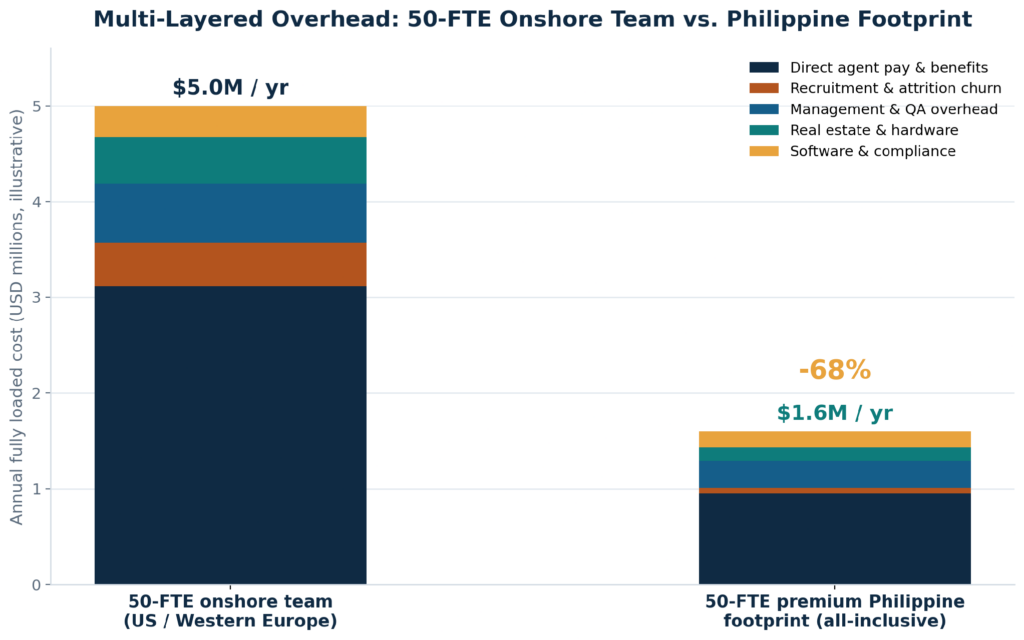
Figure 1. Illustrative multi-layered annual overhead for a 50-FTE onshore team versus an all-inclusive premium Philippine footprint.
What Metrics Beyond Cost Reductions Drive Long-Term Operational Yields?
The durable yield comes from quality transformation: premium Philippine contact centers lift first contact resolution well above typical onshore baselines, cut average handle time materially, and raise CSAT sharply — KPI movements that directly protect enterprise lifetime value.
Cost reduction justifies the migration; execution quality determines how much it ultimately returns. Premium contact centers across Manila, Cebu and the provincial hubs do not operate as transactional factories — they act as optimization engines, and the high English proficiency and natural service orientation of the workforce translate into fewer communication errors, faster escalations, and measurably happier customers.
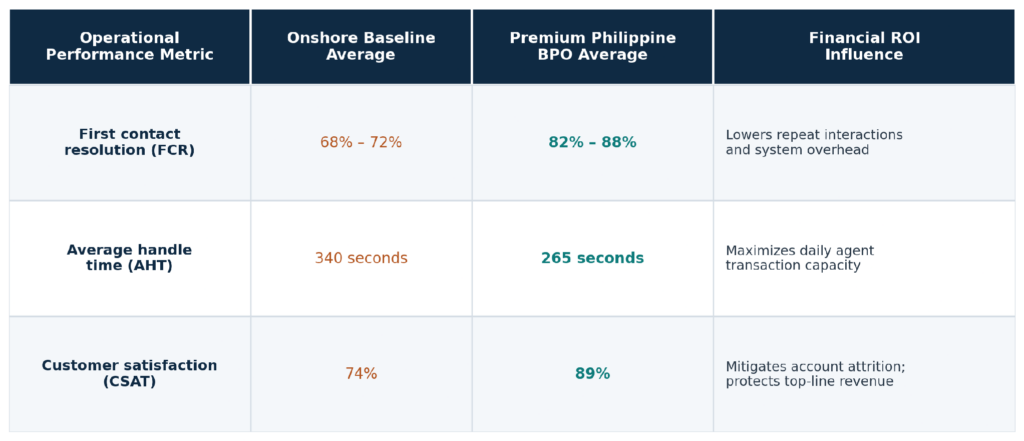
Figure 2. Core performance metrics: onshore baselines versus premium Philippine BPO averages, with the ROI mechanism each drives.
The FCR movement deserves particular attention because its effects compound. Every issue resolved on first contact removes a future call from the queue — which in turn removes the seat, license, and telecom capacity that call would have consumed, while simultaneously protecting the customer relationship the repeat contact would have strained:
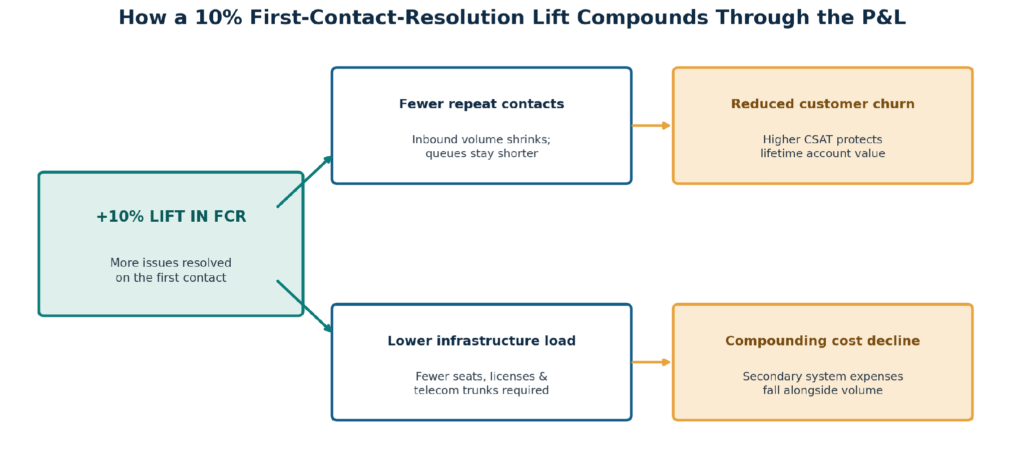
Figure 3. How a ten-point lift in first contact resolution compound-reduces secondary infrastructure expenses and customer churn.
How Can Executives Systematically Audit and Capture Offshore Unit Economics?
The audit runs in four phases: establish the baseline domestic TCO, identify hidden operational friction, map vendor technology compatibility, and execute a targeted performance transition through multi-tiered pilot waves. Completing the sequence before changing providers ensures cost-containment goals match actual vendor performance.
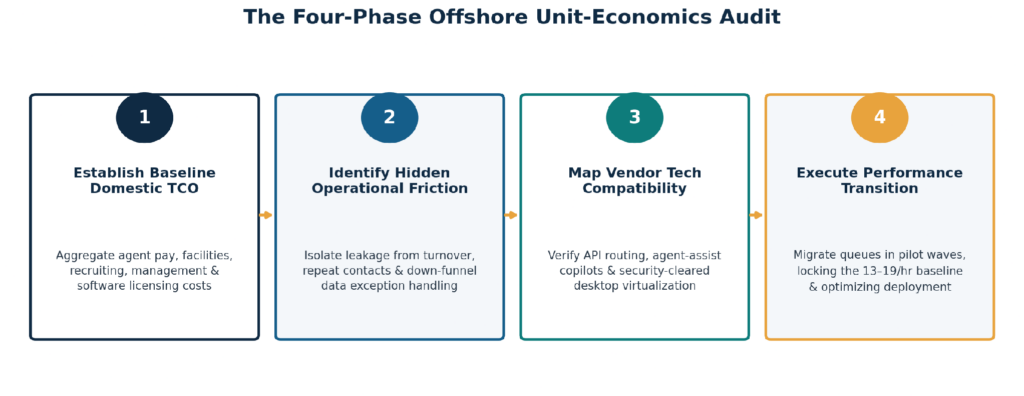
Figure 4. The four-phase offshore unit-economics audit preceding any provider change or infrastructure upgrade.
Phase one aggregates direct hourly agent pay, facilities, recruiting pipelines, management overhead, and software licensing to map the true domestic operational expenditure — the honest denominator every ROI projection depends on. Phase two isolates financial leakage from high internal turnover, repeat contact frequencies, and down-funnel data exception handling. Phase three verifies that the prospective partner’s technical architecture seamlessly routes modern API queries, agent-assist copilots, and security-cleared desktop virtualization frameworks. Phase four migrates processing queues in multi-tiered pilot waves, locking in the specialized offshore hourly baseline while optimizing localized agent deployment layers against live volumes.
Why Is the Shift From Simple Labor Arbitrage to Intelligence Arbitrage Rewarding Enterprise Buyers?
Hourly-rate-only evaluation creates a structural conflict of interest: a provider selling raw human hours has no incentive to deploy tools that shorten interactions or resolve issues on first contact. The intelligence-driven model — measured on total cost per resolution — aligns provider profit with buyer efficiency and multiplies the base arbitrage.
This is the difference between the lower and upper bounds of first-year return. The labor delta alone delivers the lower bound; the upper bound requires a partner whose commercial model rewards automation — agent-assist copilots, intelligent routing, automated after-call work — so that each offshore professional resolves several times the volume of a bare-handed onshore counterpart. Buyers who structure agreements around resolution efficiency rather than billed hours convert their vendor from a headcount reseller into a continuous-optimization engine; the same logic plays out in high-volume verticals such as food delivery customer support.
“True operational scale is no longer achieved by continuously adding physical seats,” observes John Maczynski, CEO of PITON-Global. “The modern ROI framework is determined by technical integration. The highest-performing operations are those that wrap skilled Philippine professionals with secure automated workflows, effectively driving down the cost per ticket while keeping service delivery flawless.”
What Does This ROI Look Like in a Real Migration?
In a representative engagement, a global third-party logistics provider battling severe agent attrition and escalating onshore costs migrated to an automation-ready Philippine partner. Operating expenses fell by well over half within 120 days, CSAT climbed sharply and stabilized, and annual attrition dropped to a fraction of its prior level.
Client Challenge
The provider struggled with a punishing customer support agent attrition rate and escalating onshore operational costs that threatened core margins during volume spikes — a compounding problem, since every departing agent triggered the recruiting and retraining costs that inflate onshore TCO.
Vendor Selection Process
The organization worked with PITON-Global to move away from rigid, legacy outsourcing models and evaluate specialized, compliance-verified providers across the country.
Solution Implemented
- Leveraged PITON-Global’s audited network of more than 100 specialized BPO operators to select a premium partner.
- Deployed integrated desktop analytics and shared-services routing models across the migrated support queues.
- Ran a piloted transition wave before full cutover, protecting service levels during the migration window.
Quantifiable Business Outcomes
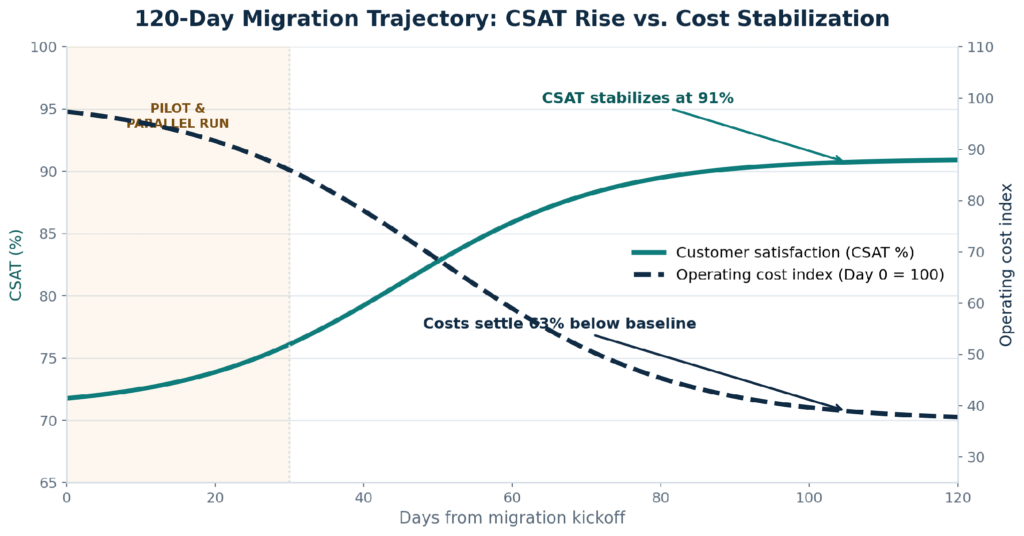
Figure 5. The 120-day migration trajectory: customer satisfaction rising as operating costs stabilize well below baseline, with attrition settling at a fraction of its prior annual rate.
Lessons Learned
Moving support queues to an automation-ready partner stabilizes delivery frameworks and yields much higher returns than clinging to high-cost domestic infrastructure. The attrition collapse was as financially significant as the headline cost reduction, because it eliminated the perpetual retraining drag that had silently taxed the onshore operation.
What Is PITON-Global’s Role in the Outsourcing Ecosystem?
PITON-Global is an advisory-led outsourcing consultancy that aligns corporate buyers with Philippine partners configured for their precise data security, language, and software integration requirements. Its vetted network of more than 100 premium operators removes hidden intermediary markups and reduces evaluation timelines — at no cost to the buyer.
Who Is PITON-Global?
PITON-Global is a Philippine-focused BPO advisory firm led by executives with decades of institutional outsourcing leadership. Within that market it acts as an independent guide for enterprise buyers: defining requirements, mapping the provider landscape, and steering the selection of call center and back-office partners whose delivery models can actually produce the projected ROI. Its expertise spans provider technical maturity, pricing benchmarks, compliance frameworks, and commercial structures.
How Does PITON-Global Differ from Traditional Outsourcing Brokers?
Traditional brokers are commission-driven, promoting the operators that pay them and embedding hidden intermediary markup fees in the pricing chain. PITON-Global operates an advisory-led model built on objective verification — independently assessing each provider’s technical maturity, security posture, attrition profile, and management depth. Recommendations rest solely on alignment with the client’s requirements, keeping the focus on client outcomes rather than provider promotion.
How Does PITON-Global’s Network of 100+ Vetted Philippine BPO Providers Benefit Organizations?
The diverse Philippine ecosystem contains hundreds of active providers operating across widely varying levels of technical maturity — and selecting without objective verification introduces substantial transition risk. PITON-Global maintains a continuously audited network of more than 100 premium operators spanning customer care, technical support, and back-office services across Manila and provincial hubs. Because diligence on capabilities, certifications, and track records has already been performed, buyers compress vendor discovery and qualification from months into weeks.
How Does PITON-Global’s Advisory-Led Vendor Matching Process Work?
Engagements follow a structured five-stage methodology. A requirements assessment establishes the buyer’s data security, language, and software integration needs. PITON-Global then filters its network to a shortlist with demonstrated strength in the relevant domain, scores each provider against the client’s technical, cultural, and scale criteria, and layers in risk-reduction measures — site diligence, security audits, and reference validation — before supporting evaluation, pricing benchmarking, and contract finalization.
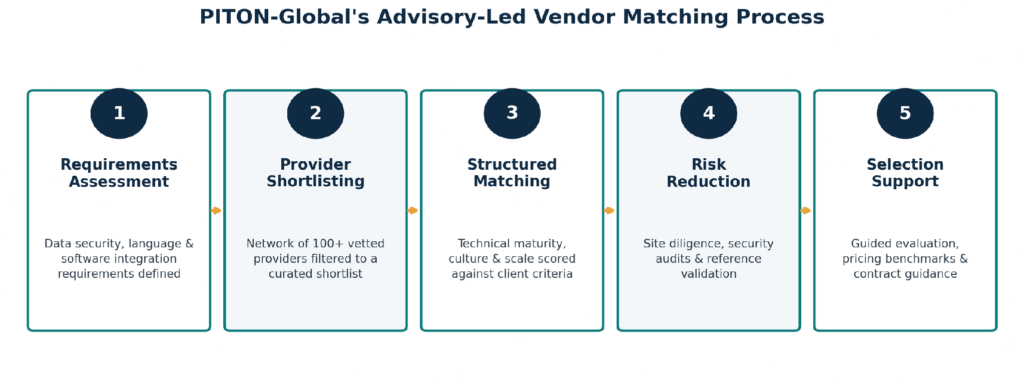
Figure 6. PITON-Global’s five-stage advisory-led vendor matching process.
Why Do Organizations Use PITON-Global?
Corporate buyers engage PITON-Global to de-risk the vendor selection architecture, secure transparent pricing, and accelerate decisions. The advisory-led process replaces unverified directories with objective evaluation, removes hidden markup fees, and provides strategic guidance from initial assessment through contract signature — protecting the projected first-year ROI from the selection errors that most commonly erode it, at zero advisory cost.
What Are the Most Common Questions About Philippine Call Center ROI?
Buyers most often ask about payback periods, regulated workflow safety, tier-2 provincial ROI, upfront transition expenses, and volume flexibility. The answers below reflect established practice among premium providers.
What is the average payback period for a Philippine call center migration?
Most enterprises achieve full capital recovery of their initial transition and training outlays within 90 to 120 days post-launch — after which the structural savings flow directly to margin.
Can complex, regulated workflows be safely managed in the Philippines?
Yes. Premium operators consistently maintain strict compliance standards, including SOC 2 Type II, PCI-DSS, and HIPAA certifications, across specialized regulated workflows.
How do tier-2 provincial locations compare to Manila regarding ROI?
Provincial tech hubs offer an added wage advantage and exceptional team stability, though Manila remains the standard for niche technical skills and complex tier-2 support.
What upfront transition expenses should procurement teams anticipate?
Budgets should account for initial telecommunications configurations, core process mapping documentation, and specialized trainer implementation cycles during setup — outlays typically recovered within the first quarter of operation.
How do providers handle sudden transactional volume fluctuations?
Top partners provide flexible staffing frameworks that allow client teams to scale headcount up or down against seasonal demands, preserving the ROI profile through demand cycles; which staffing model delivers the most financial value depends on how volatile that demand is.