

The Philippines now runs AI-driven outsourcing on 5G networks paired with multi-access edge computing, processing data within milliseconds of where it is created. This lets local “AI Pilots” supervise real-time agentic workflows at sub-10-millisecond latency while meeting global security and compliance standards — shifting the industry from labor arbitrage to intelligence arbitrage and underpinning AI deployments supervised by Filipino operations teams.
In 2026, the traditional call-center model is effectively obsolete. As global enterprises move toward agentic AI, the network underneath the operation — not headcount — has become the primary differentiator. The firms winning enterprise contracts are those whose infrastructure can close the gap between human intuition and machine speed. Everything below explains how that infrastructure works and how to evaluate it.
How Do 5G and Edge Computing Transform BPO Operations?
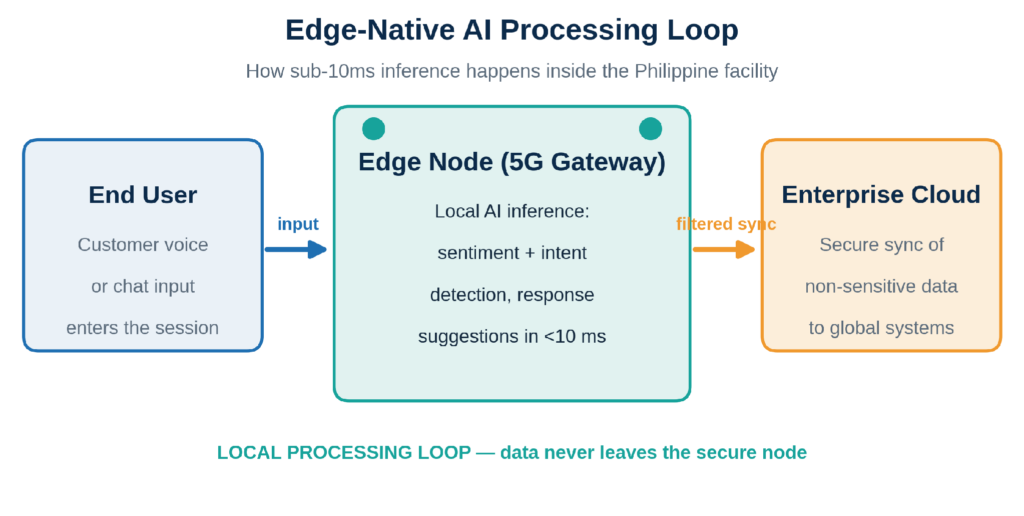
They move computing power next to the agent instead of a distant data center, erasing the backhaul delay that once made AI feel sluggish. The result is millisecond inference, guaranteed bandwidth for priority traffic, and sensitive data that is processed and secured locally before anything ever leaves the facility.
Multi-access edge computing (MEC) decentralizes processing by placing compute resources close to the data source — the agent’s terminal. This eliminates “backhaul,” the time data wastes traveling to a centralized cloud server and back. For an AI workflow that must analyze a sentence and suggest a response before a customer finishes speaking, those saved milliseconds are the difference between a natural conversation and a laggy one.
Real-Time AI Inference
Sentiment analysis and intent detection run at the edge, so the AI can surface a recommended reply to the agent within milliseconds rather than after a noticeable pause. Conversations stay fluid, and the human stays in command of the interaction.
Network Slicing
5G lets a provider carve out dedicated virtual lanes across the same physical network. High-priority AI traffic gets its own guaranteed path and is never throttled by routine background operations, keeping inference times predictable even at peak load, including for image-heavy work such as pixel-level semantic segmentation.
Local Data Sovereignty
By processing sensitive records on edge nodes inside the Philippines, firms can satisfy strict regimes such as GDPR and HIPAA before any data leaves the secure facility. Less data in transit also means a smaller attack surface, which is why local processing sits at the heart of how Philippine teams ground AI on client data.
What Is the Current State of Philippine Digital Infrastructure for AI?
Stronger than ever. Two recent laws — the CREATE MORE Act and the Konektadong Pinoy Act — reward infrastructure investment and open the data-transmission market to fresh competition. Combined with PEZA-registered “Digital Cities” beyond Manila, they give AI-BPOs the regulatory runway and network options to build genuine edge-native operations.
The CREATE MORE Act (Republic Act 12066), signed in late 2024, lets qualifying registered enterprises deduct 100% of power expenses and access a reduced 20% corporate income tax under the Enhanced Deductions Regime. Because edge facilities and AI compute are power-hungry, that single provision materially improves the economics of building AI-optimized Digital Cities.
The Konektadong Pinoy Act (Republic Act 12234), which lapsed into law in August 2025 with implementing rules issued that November, scraps the old congressional-franchise requirement for data transmission. New providers — including satellite and edge-network operators — can now enter with a simple registration, expanding the competitive options BPOs have for low-latency, redundant connectivity. Together these reforms turn infrastructure from a cost center into a strategic advantage.
How Should You Evaluate a Vendor’s “AI Readiness”?
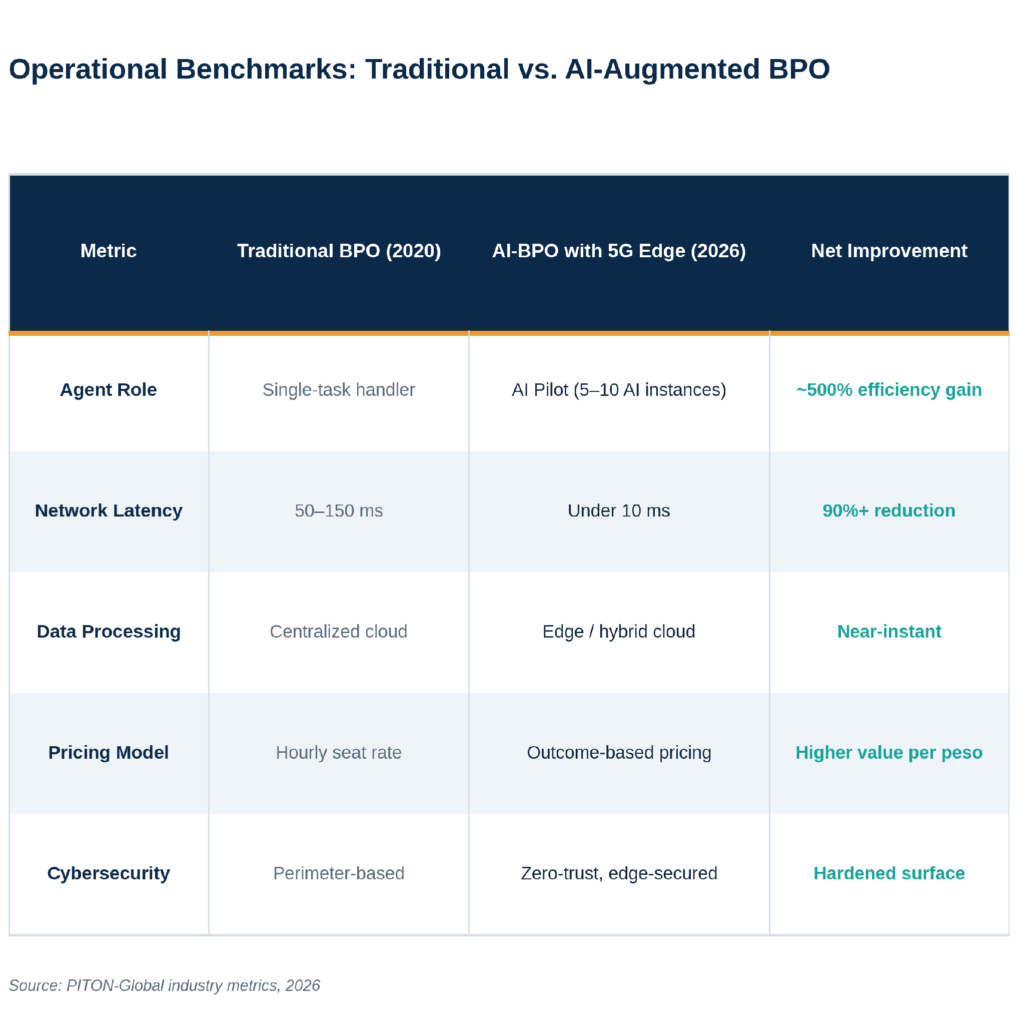
Audit the architecture, not the marketing deck. Many providers practice “shadow implementation” — layering AI wrappers over standard, high-latency cloud links. Ask for a network topology diagram, confirm true edge processing, and verify private 5G connectivity rather than public-internet backhaul. If the plumbing can’t support edge-native AI, the intelligence will underperform.
“AI-washing” is the defining risk of the 2026 buying cycle. A vendor can demo impressive tooling while routing every request through a distant public cloud, guaranteeing the latency that breaks real-time use cases. As a service buyer, your job is to confirm the underlying network was designed for edge-native AI — not retrofitted with a chatbot. Treat the topology diagram and latency benchmarks as non-negotiable parts of due diligence.
“In 2026, the differentiator is not access to AI tools; it is the infrastructure’s ability to minimize the gap between human intuition and machine speed. If the network architecture is not designed for edge-native AI, the ‘intelligence’ part of the operation will inevitably fall short of enterprise standards.”
— John Maczynski, CEO, PITON-Global
What Does a Real 5G-Ready Transition Look Like?
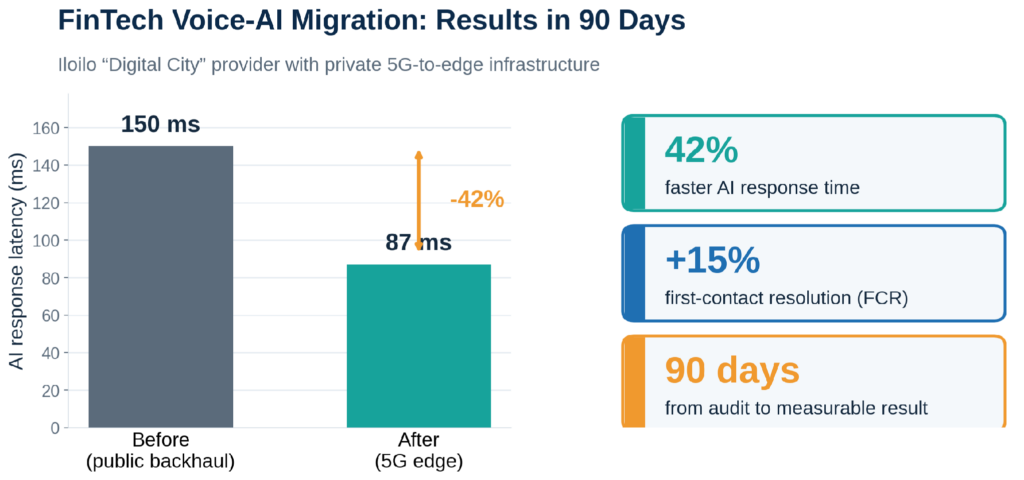
A North American FinTech firm fixed 150-millisecond lag in its voice AI by leaving a vendor on public-internet backhaul for a PEZA-registered Iloilo provider running private 5G-to-edge infrastructure. Within 90 days it cut AI response time sharply and lifted first-contact resolution meaningfully.
The engagement followed a simple three-step pattern that buyers can replicate. An audit revealed the incumbent vendor was relying on non-redundant, high-latency public-internet backhaul — the hidden cause of the “laggy” voice interactions. The match phase selected a provider in an Iloilo Digital City with integrated private 5G-to-edge infrastructure. The result, measured at the 90-day mark, was faster, more natural conversations and a meaningful lift in resolutions handled on the first contact.
How Can Enterprises Prepare for Geospatial Resilience?
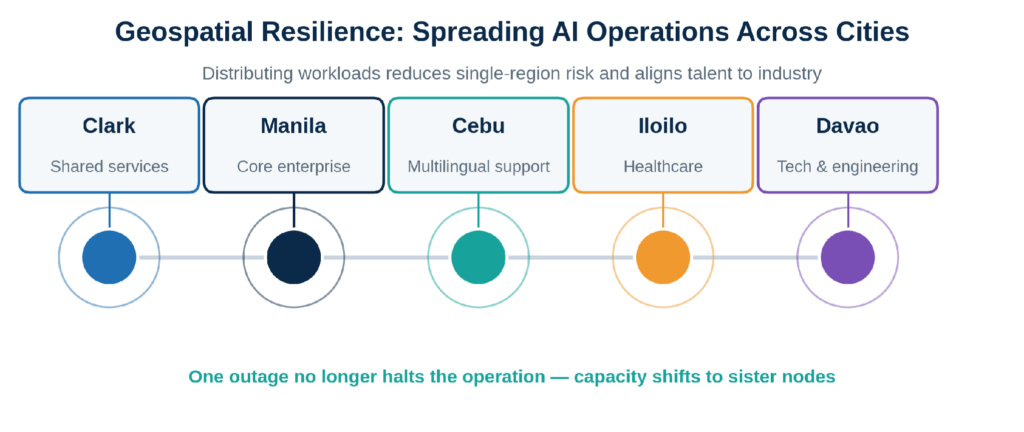
Stop concentrating risk in one city. The next competitive edge is spreading AI operations across specialized hubs — Iloilo for healthcare, Davao for tech — so a single outage never halts service. Prioritize infrastructure audits, insist on outcome-based SLAs, and invest in clean, vector-ready data to feed your edge systems.
“Geospatial resilience” describes the ability to scale AI operations across multiple specialized cities rather than concentrating all risk in Manila. It improves uptime, taps regional talent pools, and aligns each hub with the industry it serves. Three actions prepare an organization for this shift:
- Prioritize infrastructure audits — require a network topology diagram that demonstrably shows edge-compute capability, not just cloud access.
- Insist on outcome-based SLAs — pay for the successful performance of your AI and agentic models, not for seats or hours.
- Invest in data hygiene — your edge is only as good as the data feeding it, so migrate internal knowledge bases toward vector databases, the same discipline that moves AI models from prototype to production.
What Is the Future-Proofing Strategy for AI-BPO Leadership?
Build authority on three pillars: clear entity-linking so machines understand your terminology, multimodal proof such as diagrams and short expert videos, and predictive content that defines the next 12–24 months. Search and answer engines increasingly reward providers who demonstrate genuine, forward-looking utility over historical summaries.
Entity-Linking and Knowledge Graphs
Define key terms — agentic AI, multi-access edge computing, intelligence arbitrage — and connect them to an internal glossary or authoritative whitepapers. Search is moving toward graph-based relevance, where the relationships between entities, not isolated keywords, determine how content is surfaced.
Multimodal Content Synthesis
Pair written analysis with embedded technical diagrams and brief, sixty-second expert-insight videos that translate infrastructure detail into something a busy executive can absorb. Answer engines increasingly favor sources that prove a point across multiple formats.
Predictive Authority
The algorithmic reward is shifting from authoritative past content toward predictive industry leadership. Publishing analysis that maps the next twelve to twenty-four months of BPO infrastructure delivers genuine utility — exactly the helpful, forward-looking standard that durable authority now requires.
For organizations navigating the Philippines’ 5G-ready BPO ecosystem, the safeguard against AI-washing is the same as the path to performance: verify the infrastructure first, then let the intelligence follow.