

Intelligence arbitrage in Philippine outsourcing is the strategic practice of sourcing high-order cognitive capability — analytical judgment, specialized domain expertise, and advanced knowledge work — from the country’s educated, digitally native workforce at a fraction of onshore cost.
Where traditional labor arbitrage scales headcount to cut transactional overhead, intelligence arbitrage scales intellectual capital to drive systemic business transformation. It is one strand of the wider playbook for Philippine outsourcing, which covers service lines, pricing and vendor selection.
Why intelligence arbitrage is replacing traditional labor arbitrage
The original Business Process Outsourcing (BPO) playbook rested on a single lever: cost. Enterprises paid offshore wages for rule-based, repetitive, linear tasks. That transactional model has now commoditized — automation absorbs the simplest work, and price-only vendors compete in a race to the bottom. Our C-level briefing on the country’s BPO sector traces how that model matured.
A structural shift is underway. Global enterprises are moving from buying low-cost labor to sourcing high-value intellect, and intelligence arbitrage is that evolution. It targets the critical skills gaps onshore teams cannot fill, tapping the deep cognitive reserves of the Philippine professional ecosystem — a workforce that adds hundreds of thousands of English-proficient, technology-fluent graduates each year, increasingly clustered in financial engineering, predictive analytics, healthcare informatics, and digital architecture.
The macro numbers confirm the trajectory. The Philippine IT-BPM sector generated roughly US$38 billion in revenue and employed about 1.82 million people in 2024, with growth led by banking, financial services, and healthcare — precisely the verticals where judgment-intensive knowledge work concentrates.
Comparative framework: labor arbitrage vs. intelligence arbitrage
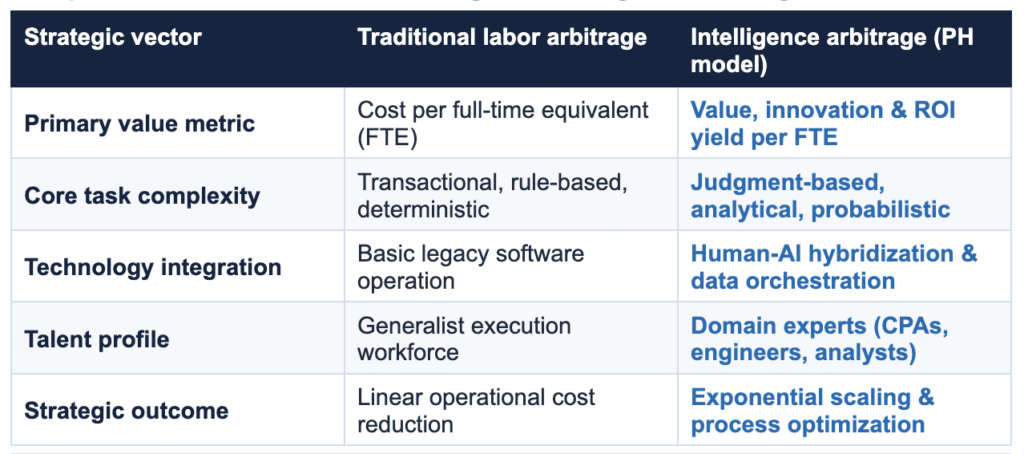
Traditional approach vs. Intelligence model

Figure 1. The structural paradigm shift — from cost-down labor to growth-driving expertise.
How global enterprises quantify higher-order cognitive sourcing
Procurement teams routinely mis-price this model by focusing on the direct hourly-wage differential while ignoring the compounding value of efficiency and quality gains. Across premium mid-market and enterprise back-office environments, sophisticated Philippine knowledge centers deliver a substantial reduction in fully loaded operational cost versus onshore baselines. Because the talent pool is concentrated and attrition is comparatively low, those same hubs lift operational accuracy and output velocity measurably.

Figure 2. Indexed against an onshore baseline: cost falls well below the baseline while quality and velocity rise above it.
“The corporations winning today aren’t outsourcing to save pennies — they’re outsourcing to capture a sustainable intellectual edge. By shifting complex, high-order workflows such as predictive risk analytics, institutional underwriting, and precision digital engineering to top-tier Philippine teams, our clients amplify their organizational intelligence. It is no longer human-labor displacement; it is an engine for intellectual acceleration. John Maczynski — CEO, PITON-Global
The role of human-AI hybridization
The claim that AI will render offshore teams obsolete misreads how enterprise workflows actually run. In the premium tier of the Philippine ecosystem, AI is a workforce multiplier, and intelligence arbitrage thrives precisely at the intersection of human judgment and automated processing.
Cognitive task orchestration
Specialists use generative AI for rapid data aggregation and first-pass synthesis, freeing bandwidth for deep analysis, strategic problem-solving, and high-empathy customer communication.
Contextual layering and validation
Models process raw inputs quickly, but elite knowledge workers supply the cultural nuance and strategic validation that high-stakes corporate decisions require.
Human-in-the-loop (HITL) engineering
Trained Filipino specialists act as continuous feedback loops — refining training data, auditing automated outputs, and enforcing compliance with evolving global regulation.
Case study: orchestrating a high-tier financial analytics transition
A rapid-growth US fintech hit a talent bottleneck: its domestic risk-assessment and fraud-analytics function was overwhelmed, transaction-abandonment rates were climbing, and scaling costs had become unsustainable. After an operational diagnostic, PITON-Global mapped the client to a specialized financial-services provider within its network of 100+ vetted Philippine partners — and instead of a generic data-entry team, architected a dedicated knowledge hub staffed entirely by Certified Public Accountants and specialized data analysts.

Forty-five specialized analysts were deployed within a six-week window. The results compounded fast:
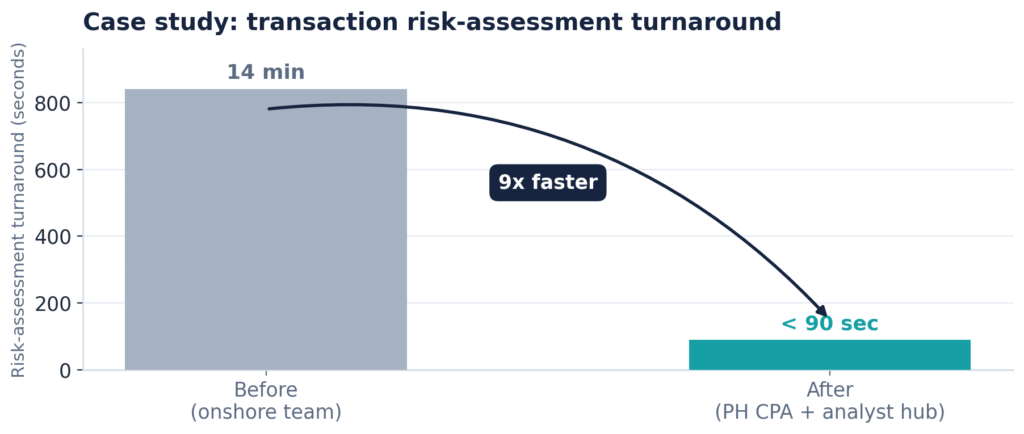
Figure 3. Critical risk-assessment turnaround fell from 14 minutes to under 90 seconds — a 9x acceleration.
By targeting intelligence — not headcount — the fintech converted a restrictive back-office bottleneck into a scalable, high-efficiency engine for global growth, securing seven-figure audited annualized savings and a fraud-detection accuracy rate that clearly outperformed the prior onshore baseline.
What will shape the next era of knowledge sourcing
The next phase will be defined by extreme hyper-specialization. As entry-level transactional tasks are absorbed by software agents, demand will intensify for advisory firms that can source end-to-end, industry-specific knowledge verticals, much as publishers now hand digital transformation work to offshore teams. The Philippine industry is positioning for exactly this: under the IBPAP roadmap, the sector targets roughly US$59 billion in revenue and 2.5 million jobs by 2028, with upskilling in AI, data analytics, and programming named as its defining priority — and its most-cited talent gap.
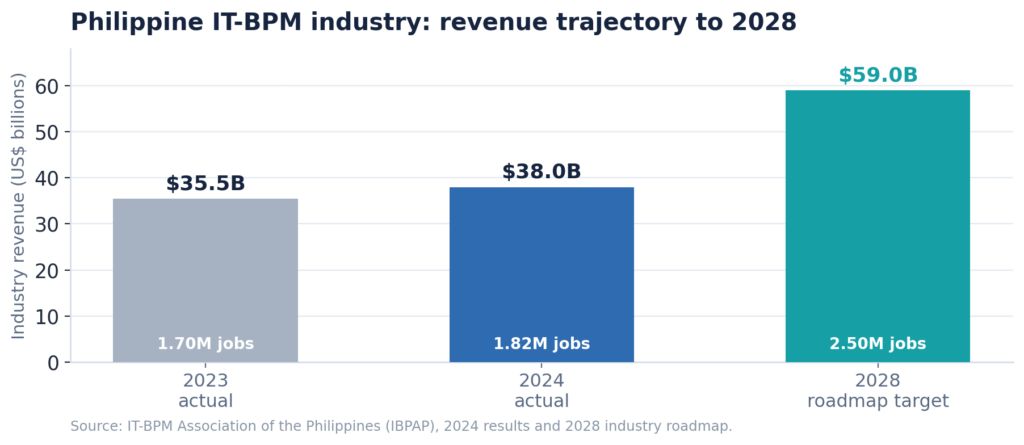
Figure 4. Industry revenue trajectory and the 2028 roadmap. Source: IBPAP.
For corporate buyers, the implication is direct: legacy generalist vendors will not carry you into this era. Partnering with specialized advisors who continuously source and audit providers operating at the cutting edge of AI hybridization, data-privacy governance, and industry compliance will be the decisive differentiator for enterprises scaling operational intelligence globally. Continuous improvement is part of that audit, and frameworks for managing innovation inside BPO contracts give buyers a way to hold vendors to it.
Key takeaways
- Intelligence arbitrage sources judgment, not just hours — measured by value per FTE, not cost per FTE.
- The premium model pairs domain experts (CPAs, engineers, analysts) with AI as a multiplier, not a replacement.
- Vendor selection — specialist advisor vs. generalist BPO — is now the primary lever of competitive advantage.
Methodology & sources
Performance figures (cost, accuracy, and case-study metrics) reflect aggregated benchmarks from premium mid-market and enterprise engagements and are illustrative of typical outcomes rather than guarantees; individual results vary by scope and vertical. Industry revenue and employment figures are drawn from the IT-BPM Association of the Philippines (IBPAP) 2024 results and its 2028 industry roadmap.