

Key Takeaways
- Top-tier Philippine BPOs ground AI by feeding proprietary client data into hardware-isolated RAG pipelines — not public LLMs.
- A Tri-Layer Zero-Trust architecture (secure ingestion → grounded retrieval → human governance) keeps PII off Philippine hardware via non-persistent VDIs.
- Disciplined grounding plus human-in-the-loop auditing compresses hallucination from a serious liability to a low, tightly governed operational floor.
- The sector is reskilling its workforce from script execution toward AI governance, prompt engineering, and semantic auditing.
Top-tier Philippine BPOs handle enterprise AI grounding, a core discipline of agentic AI inside a managed offshore program, by integrating proprietary client data into secure, hardware-isolated Retrieval-Augmented Generation (RAG) architectures and agentic workflows. Rather than exposing sensitive corporate data to public large language models (LLMs), these providers use localized vector databases, non-persistent Virtual Desktop Infrastructures (VDIs), and strict Human-in-the-Loop (HITL) auditing. This methodology suppresses hallucination to a low, audited operational floor, converting raw enterprise data into brand-compliant, execution-ready customer intelligence.
The Framework That Keeps Client Data Isolated
Enterprise buyers migrating from legacy “agent-plus-script” operations to intelligent automation routinely run into “AI-washing” — generic LLM wrappers that lack localized grounding, leak corporate context toward public training sets, and return hallucination rates high enough to create real liability. To eliminate that exposure, premier providers in Manila and Cebu deploy a Tri-Layer Zero-Trust RAG Architecture built on certified compliance frameworks. It walls off client-specific assets — internal ERP records, dense technical manuals, decade-long voice-to-text (VTT) logs — from the open internet at every hop.
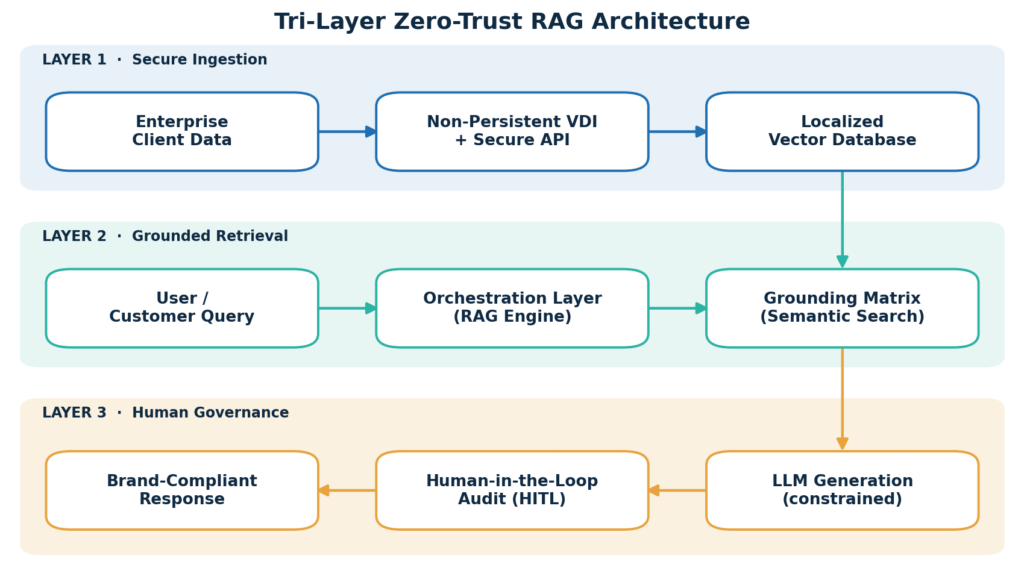
Figure 1 — Data flows through secure ingestion, grounded retrieval, and a human-governance overlay before any response reaches a customer.
Layer 1 — Vector Embeddings & Non-Persistent Storage
Client documents are chunked and converted into mathematical vectors by an embedding model (for example, text-embedding-3-large), then written to an isolated vector store mapped exclusively to that client’s instance. Under a zero-trust access model, no personally identifiable information (PII) persists on Philippine hardware: non-persistent VDIs wipe text strings and transaction states from RAM the moment a session ends.
Layer 2 — Hardware-Locked Knowledge Coupling
The LLM is constrained at the API orchestration layer and denied access to open-web datasets during inference. The orchestrator forces the model to retrieve context only from the vetted vector database. When a query falls outside the semantic bounds of the approved corpus, the system triggers a “hard-handoff” to a live specialist instead of letting the model improvise an answer.
Where the Knowledge Actually Lives — Vector Store Options in Production
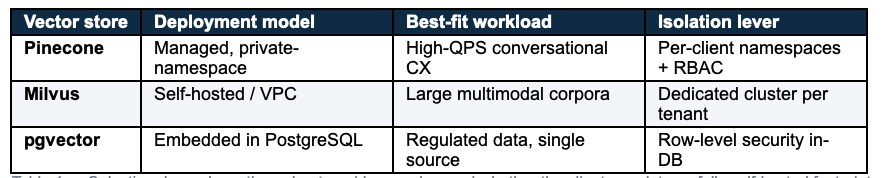
Table 1 — Selection depends on throughput, residency rules, and whether the client mandates a fully self-hosted footprint.
Compliance Backbone
Grounding pipelines are layered on certified controls — ISO/IEC 27001:2022, SOC 2 Type II, HIPAA, and the Philippine Data Privacy Act of 2012 enforced by the National Privacy Commission. Certification is the floor for entry, not the differentiator.

Figure 2 — Disciplined grounding plus human auditing pushes error rates into a low, tightly governed operating band.
How Human-in-the-Loop Workflows Optimize Accuracy
Grounding is not a “set-and-forget” software install; it is a continuous data-sanitization and optimization lifecycle. The local BPO sector is rapidly shifting its workforce from routine execution toward AI governance, prompt engineering, and semantic auditing — the human disciplines that keep a grounded model honest, and the skills behind the rise of the AI Pilot in the talent market.
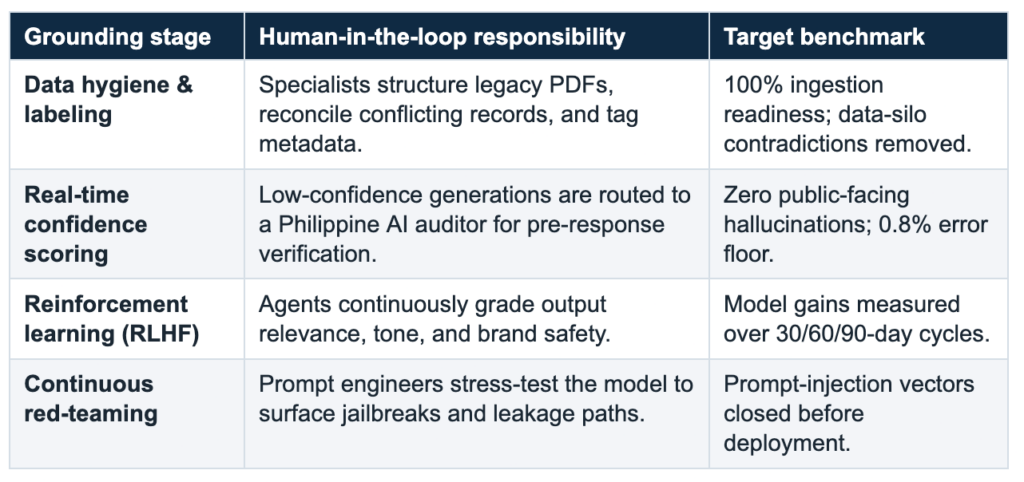
Table 2 — The four human checkpoints that convert a raw RAG pipeline into a governed production system.

Figure 3 — Seats are migrating from script execution toward oversight roles that grounding makes essential.
“AI without data isn’t intelligence; it’s a hallucination machine. The market is flooded with generic wrappers that expose corporate buyers to massive liability. True competitive advantage in 2026 comes from combining highly sanitized, client-specific data with elite human oversight — that is why the top 1% of Philippine providers are winning. They don’t just supply software; they supply the operational governance that makes AI safe and contextually flawless.”
— John Maczynski, CEO, PITON-Global
Mini Case Study: Scaling Agentic CX for an Insurtech Disrupter
The Challenge
A fast-growing US insurtech partnered with PITON-Global after an off-the-shelf conversational AI tool produced a crippling hallucination rate, eroding retention and creating compliance exposure.
The Solution
Using a vendor-agnostic advisory framework, PITON-Global matched the client to a tier-one Philippine partner from its 100+ vetted providers. The provider built a custom RAG architecture grounded in eight years of structured claims data, policy terms, and historical voice logs, then deployed 45 Philippine AI auditors and Tier-2 escalation experts to run live reinforcement learning.
The Results
Hallucinations fell to a small fraction of their former level within 45 days; first-contact resolution rose sharply through grounded voice-bots; and structural costs dropped substantially versus an equivalent US in-house data-engineering and support operation.
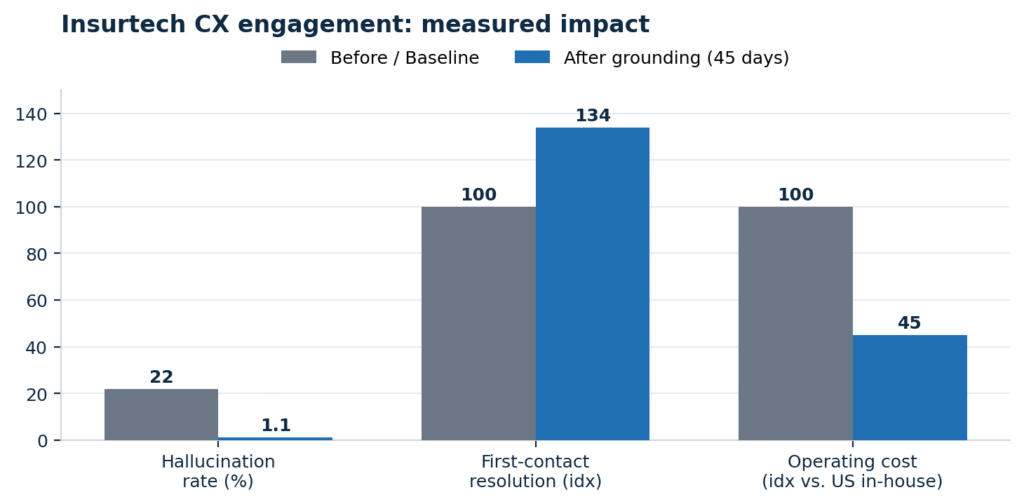
Figure 4 — Before-and-after metrics across hallucination rate, first-contact resolution, and operating cost (indexed).
What Comes Next: Agentic Orchestration
Through 2026 and beyond, dependence on heavy manual data-cleansing will decline as agentic orchestration matures. Expect multi-agent systems in which one AI agent audits data hygiene, a second manages real-time vector updates, and an elite human overlay concentrates on hyper-complex edge cases and semantic calibration, the same human-judgment layer that trust and safety work for generative AI relies on. The strategic lesson for buyers is blunt: stop treating outsourcing as pure labor arbitrage. Brand equity now depends on selecting partners that can govern the entire data-readiness, grounding, and security lifecycle within global regulatory bounds.
Frequently Asked Questions
Does my proprietary data train a public model?
No. In a zero-trust RAG setup, your data is embedded into an isolated vector store and used only for retrieval at inference. The LLM is blocked from open-web training data and from retaining your context after the session.
What hallucination rate is realistically achievable?
Well-governed deployments operate in a low, tightly audited band. Rates above that band usually signal a generic wrapper without localized grounding or human auditing.
How fast can a grounded pipeline go live?
Production timelines of 30–45 days are common once source data is consolidated; the gating factor is data hygiene, not model selection.
What happens when the AI doesn’t know the answer?
A confidence threshold triggers a hard-handoff to a human specialist rather than allowing the model to fabricate a response — the same routing logic used in human-reviewed content moderation queues.
Find a Vetted, AI-Capable Partner
Seeking an AI-ready outsourcing partner in the Philippines? PITON-Global provides premium, vendor-neutral advisory services at zero cost to your organization. Contact PITON-Global →
About This Briefing
This guide is produced by the PITON-Global Advisory Research Desk and reviewed by solutions architects working across 100+ vetted Philippine BPO providers. Performance figures reflect aggregated, anonymized deployment data and published industry benchmarks; sector-size references track widely reported Philippine IT-BPM sector estimates. Architecture and configuration details are illustrative of common production patterns and should be validated against your own compliance requirements.