
Back
What Employee Attrition Rates Are Common Among Call Centers in the Philippines?

By Ralf Ellspermann / 1 July 2026
 Authored by Ralf Ellspermann, CSO of PITON-Global, & 25-Year Philippine BPO Veteran | Executive | Verified by John Maczynski, CEO of PITON-Global, and Former Global EVP of the World's Largest BPO Provider on July 1, 2026

The average annual employee attrition rate among Philippine call centers typically ranges between 30% and 45%. Frontline, voice-heavy customer service runs highest at 45–50% due to nocturnal schedules and metric fatigue, while non-voice and specialized technical lines stay far more stable, with attrition dropping to 15–25%.
Key Takeaways
- Macro segment variance: Baseline industry turnover sits between 30% and 45%, but execution risk varies sharply between transactional voice queues and complex back-office roles.
- The first-year horizon: Roughly 65% of voluntary resignations occur within the first twelve months, marking onboarding as a critical risk period.
- Geographic mitigation: Establishing operations in next-wave regional hubs outside Metro Manila reduces annual attrition by 10 to 15 percentage points.
- The hybrid retention offset: Integrating flexible or work-from-home models yields a 25% to 35% reduction in annual agent turnover versus strictly on-site operations.
How Does Attrition Vary Across Different BPO Segments?
A single aggregate number hides fragmented realities. Frontline voice runs 45–50% under nocturnal schedules and metric pressure; blended care 35–42%; while shared financial services (18–25%) and digital engineering/KPO (12–18%) stay far lower thanks to daytime hours and structured progression.
Evaluating an outsourcing partnership on a single aggregate industry number obscures highly fragmented labor realities. The structural pressures of nocturnal schedules, continuous performance tracking, and direct consumer interaction push frontline voice support to high attrition.
Non-voice segments—financial accounting, digital engineering, and specialized data analytics—display a completely different footprint. Employees in these technical fields enjoy conventional daytime hours and clear upward mobility, which dramatically dampens their propensity to change employers.
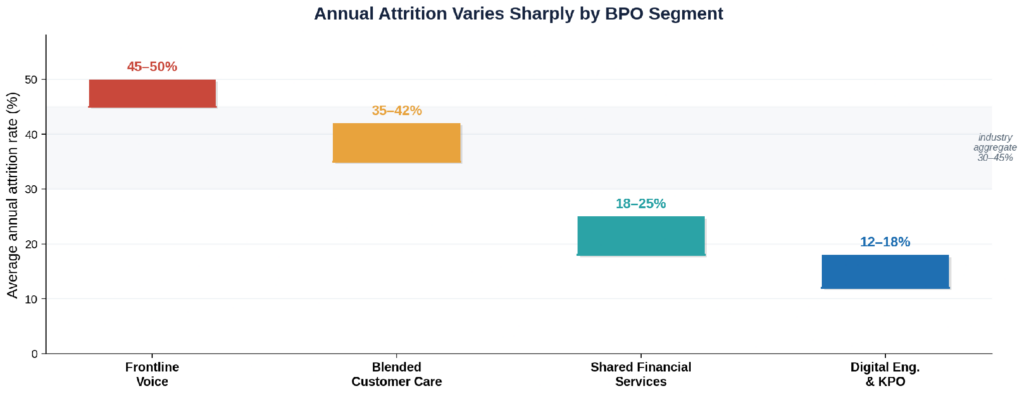
Figure 1. Annual attrition descends steadily from frontline voice to KPO, against a 30–45% industry aggregate.

Figure 2. Each segment’s attrition range, primary drivers, and resulting operational delivery risk.
The pattern matters for delivery risk: high-churn voice queues demand a continuous hiring pipeline, while predictable technical lines preserve institutional knowledge. The deeper question is where and why those exits concentrate.

Figure 3. About 65% of exits land in the first year—offset by geography, hybrid models, and career and health anchors.
What Are the Primary Structural Causes Behind Agent Turnover?
Turnover rarely reflects poor work ethic; it is driven by addressable systemic challenges. While competitive pay anchors an agent, the primary catalysts for voluntary resignation are workplace stress, weak middle-management coaching, and invisible career paths—which make agents easy to poach.
To insulate an offshore operation from costly disruption, enterprise buyers must look behind the raw percentages. Turnover in the Philippines is rarely a reflection of poor work ethic; rather, it is driven by systemic, addressable operational challenges.
A common executive error is assuming salary is the only lever for retaining top-tier Filipino talent. While competitive compensation anchors an agent, the primary catalysts for voluntary resignation are workplace stress, weak middle-management coaching, and invisible career paths. When an exceptional agent feels stuck in a dead-end loop, alternative providers will eagerly poach them by offering minor wage premiums and clearer professional progression.
— John Maczynski, CEO, PITON-Global
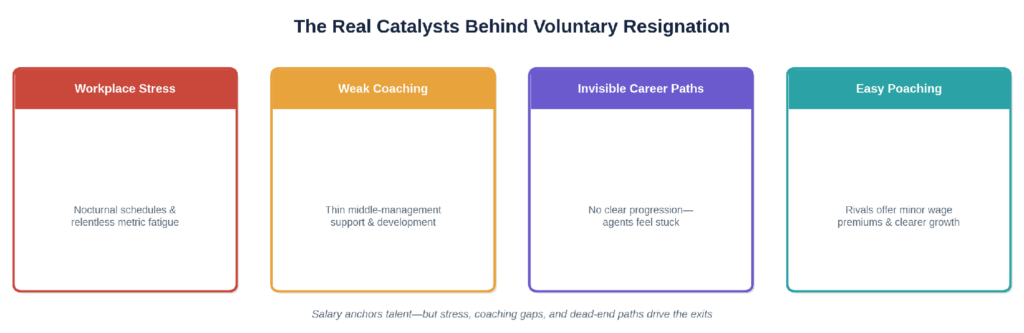
Figure 4. The real catalysts—stress, weak coaching, invisible paths, and easy poaching—drive most voluntary exits.
What Does Mitigating Churn in a Complex Program Look Like?
Mitigation matches a complex workflow to a specialized provider and rebuilds the labor model. One transportation provider with a 55% turnover logistics desk introduced day-one family HMO and tier-progression tracks, cutting turnover to 18%, improving response times 34%, and stabilizing performance within twelve months.
Client Challenge
A North American enterprise transportation provider faced severe delivery issues from a 55% turnover rate within its outsourced logistics support desk, which disrupted shipment-tracking pipelines and degraded account management.
Selection and Solution
PITON-Global mapped the client’s complex tech stack and workflow requirements against its audited network of 100+ operators, matching them with a specialized, employee-centric provider in Clark. The new provider restructured the labor model, introducing comprehensive family health benefits from day one and clear tier-progression career tracks tied to technical mastery.

Figure 5. Quantifiable outcomes within twelve months of matching the workflow to a specialized, low-attrition provider.
Outcomes and Lessons
Within twelve months, operational turnover dropped from 55% to 18%, average response times decreased 34%, and team performance metrics stabilized. The lesson: matching a complex workflow to a specialized provider with deliberate training and career structures converts a churn problem into durable delivery stability.
Why Use PITON-Global to Minimize Outsourcing Delivery Risk?
PITON-Global is an elite, advisory-led consultancy, not a transaction broker. Across a vetted network of 100+ premier providers, its data-first approach aligns scale, software, and budget with operators that have verified, vertical-specific competencies—mitigating scaling risk and driving performance from day one.
Who Is PITON-Global?
PITON-Global operates as an elite, advisory-led consulting firm rather than a traditional transaction broker. Maintaining a thoroughly vetted network of more than 100 premier Philippine call center and back-office providers, it removes the guesswork from vendor selection in a market where generic online proposals introduce massive operational vulnerability.
How Does PITON-Global Differ from Traditional Outsourcing Brokers?
PITON-Global’s strategic value lies in a data-first approach. Rather than forwarding leads, it aligns corporate scale requirements, software ecosystems, and budgetary parameters with boutique or enterprise providers that possess verified, vertical-specific competencies—mitigating the structural risks of international scaling.
How Does PITON-Global’s Network of 100+ Vetted Providers Benefit Organizations?
The vetted network of more than 100 premier providers lets organizations bypass a risky open-market search. Because each is assessed for vertical competency and real stability, buyers reach a partner genuinely able to keep attrition low in the segment that matters to them.
How Does PITON-Global’s Selection Framework Screen for Stability?
PITON-Global runs a four-stage framework: workflow mapping of stack, scale, and budget; stability screening of true historical attrition logs; capability vetting for vertical fit and leadership stability; and a best-fit match to a specialized, low-attrition provider—so scaling risk is mitigated before launch.

Figure 6. PITON-Global’s four-stage framework embeds stability checkpoints before any provider match is made.
Why Do Organizations Use PITON-Global?
Organizations use PITON-Global to mitigate scaling risk and secure seamless performance from day one. By screening real attrition data before matching, the firm helps enterprises avoid high-churn vendors and partner with providers that deliver durable stability in their specific segment.
What Are the Most Common Questions About Philippine Call Center Attrition?
Common questions concern whether regional operations lower attrition, how AI affects benchmarks, the standard probationary period, the role of healthcare benefits, realistic monthly targets for voice accounts, and how to verify a vendor’s actual attrition. Each is answered below.
Do Regional Operations Outside Metro Manila Exhibit Lower Attrition?
Yes. Secondary hubs like Cebu City, Davao City, and Clark show attrition 10% to 15% lower than Metro Manila, benefiting from reduced local competition and shorter daily commutes.
How Does the Integration of Artificial Intelligence Impact These Benchmarks?
AI tools minimize turnover by automating repetitive tier-1 queries, shifting human workloads toward complex problem-solving—which lowers agent burnout and increases job satisfaction.
What Is the Standard Probationary Period for a Call Center Agent in the Philippines?
The standard probationary period is six months. Under Philippine labor law, this window lets providers thoroughly assess an agent’s performance and alignment before confirming permanent employment.
How Does the Inclusion of Healthcare Benefits Influence Team Retention?
Private medical insurance—especially when extended to immediate family dependents—is one of the strongest retention anchors in the Philippine job market, drastically reducing casual job-hopping.
What Is a Realistic Monthly Attrition Target for an Enterprise-Grade Voice Account?
An enterprise voice account should target monthly attrition between 2.5% and 3.5%. Anything consistently exceeding 4.0% monthly warrants a structural review of management practices and compensation alignment.
How Can Buyers Verify a Prospective Vendor’s Actual Attrition Rates?
Organizations should mandate disclosure of audited historical workforce-retention logs, average manager-to-agent tenure ratios, and internal promotion percentages during the initial RFP stage.
Achieve sustainable growth with world-class BPO solutions!
PITON-Global connects you with industry-leading outsourcing providers to enhance customer experience, lower costs, and drive business success.
Get Your Top 1% Vendor List
Author
Ralf Ellspermann is a multi-awarded outsourcing executive with 25+ years of call center and BPO leadership in the Philippines, helping 500+ high-growth and mid-market companies scale call center and customer experience operations across financial services, fintech, insurance, healthcare, technology, travel, utilities, and social media.
A globally recognized industry authority - and a contributor to The Times of India, CustomerThink, and The AI Journal - he advises organizations on building compliant, high-performance offshore contact center operations that deliver measurable cost savings and sustained competitive advantage.
Known for his execution-first approach, Ralf bridges strategy and operations to turn call center and business process outsourcing into a true growth engine. His work consistently drives faster market entry, lower risk, and long-term operational resilience for global brands.
EXECUTIVE GOVERNANCE & ACCURACY STANDARDS
Authored by:

Ralf Ellspermann
Founder & CSO of PITON-Global,
25-Year Philippine BPO Veteran,
Multi-awarded Executive
Specializing in strategic sourcing and excellence in Manila
View Full Bio
Verified by:

John Maczynski
CEO of PITON-Global, and former Global EVP of the World’s largest BPO provider | 40 Years Experience
Ensuring global compliance and enterprise-grade service standards
View Full Bio
Last Peer Review: July 1, 2026
This service framework is audited quarterly to meet shifting global outsourcing regulations and COPC standards.