On this page
- Key Takeaways
- How Do Fully Loaded Costs Compare Between Onshore and Offshore Teams?
- What Strategic Factors Beyond Direct Labor Drive Total ROI in Philippine Outsourcing?
- What Hidden Costs and Tradeoffs Can Erode Philippine BPO Savings?
- How Quickly Do the Savings Materialize?
- What Does a Successful Cost-Reduction Program Look Like?
- How Does PITON-Global Help Enterprises Capture Philippine Outsourcing Savings Safely?
- Frequently Asked Questions
Mid-to-large enterprises realistically achieve deep, double-digit cost savings by outsourcing business processes to the Philippines versus in-house operations in North America, Western Europe, or Australia. Fully loaded BPO rates replace onshore costs at a fraction of the price — the unbundled price of an offshore seat shows exactly how — and mature partnerships add a further layer of savings through process standardization and AI-assisted workflows.
Key Takeaways
- Direct cost reduction: Fully loaded Philippine rates for voice customer experience and back-office roles come in at a fraction of Western domestic market costs.
- CapEx-to-OpEx shift: All-inclusive billing bundles facilities, technology, IT support, management, and compliance into one rate, eliminating upfront capital expenditure.
- Efficiency gains: Standardized workflows and AI-augmented agents drive a further double-digit improvement in total workforce productivity.
- Risk avoidance: Right-sized, specialized providers prevent the hidden costs of high attrition and under-resourced delivery teams that erode headline savings.
How Do Fully Loaded Costs Compare Between Onshore and Offshore Teams?
Fully loaded onshore costs for customer experience, back-office, finance, and technical support roles run several times the all-inclusive offshore rate for the same function, producing net savings of roughly two-thirds or more by function. Offshore billing bundles facilities, technology, management, and compliance, so the comparison is like-for-like rather than wage-to-wage.
Evaluating true financial impact requires looking past base-wage comparisons to fully loaded cost structures. Onshore personnel expenses include salary, statutory employment taxes, health insurance, retirement contributions, real estate, workstation hardware, software licensing, and continuous talent-acquisition overhead—benefits alone typically add a substantial premium to base pay before facilities and technology are counted. Philippine BPO rates are all-inclusive: facilities, technology stack, IT support, management oversight, regulatory compliance, and local statutory benefits (SSS, PhilHealth, Pag-IBIG, and 13th-month pay) are bundled into a single hourly or per-FTE rate. As the benchmarks below show, the gap holds across every major function.
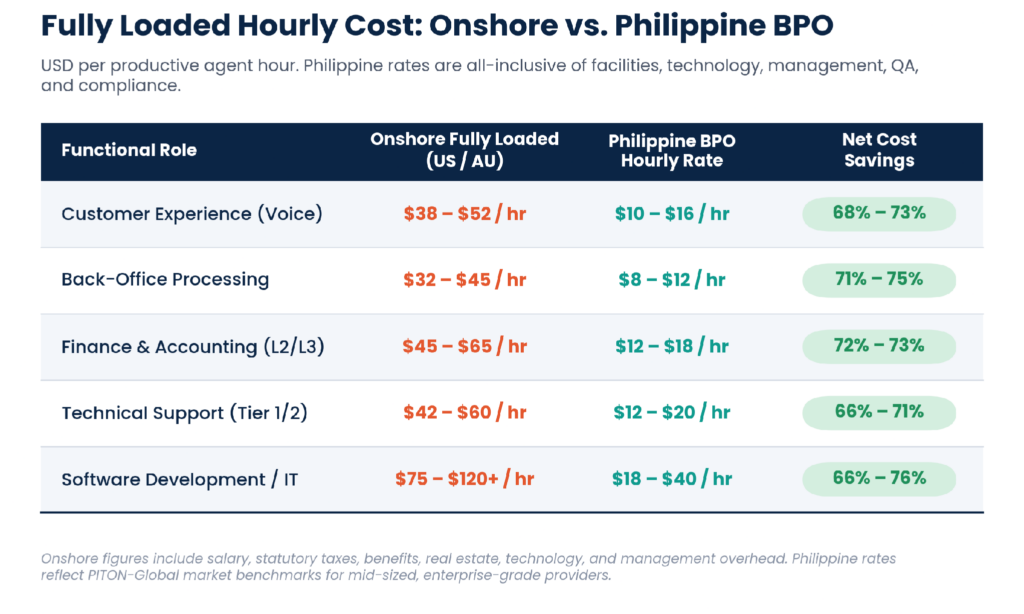
Figure 1. Fully loaded hourly cost by function: onshore versus Philippine BPO, in USD per productive hour.
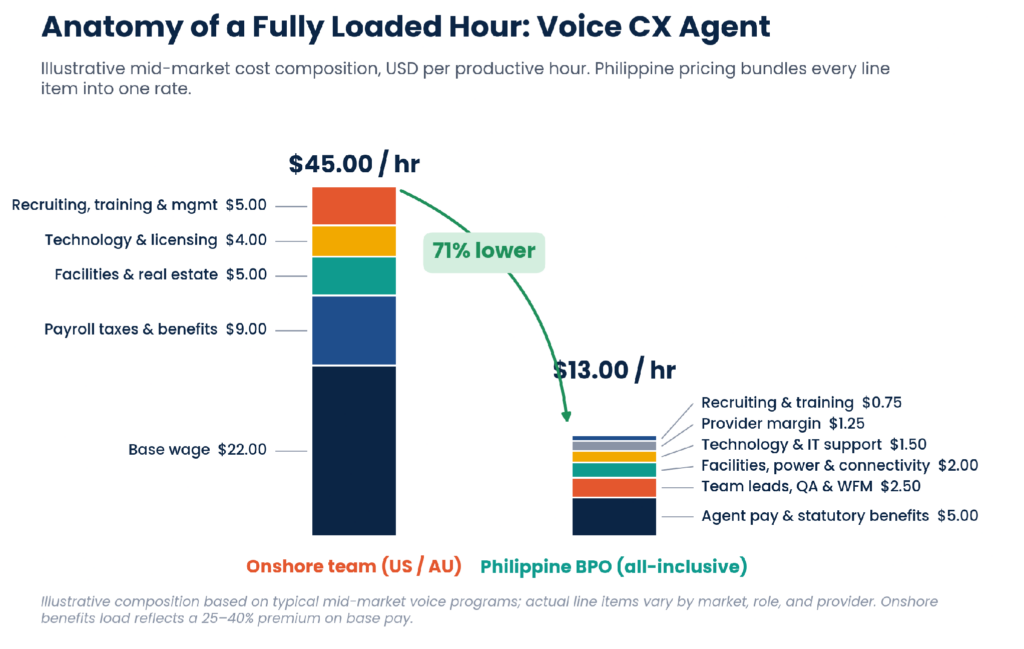
Figure 2. Anatomy of a fully loaded hour: an illustrative onshore voice seat versus an all-inclusive offshore rate.
On a monthly basis, a voice CX agent at $10–$16 per hour equates to roughly $1,700–$2,700 per FTE on a 168-hour schedule, versus $6,400–$8,700 onshore; for a 50-seat program, that gap is worth roughly $2–3 million a year before any efficiency gains. Three structural factors explain it: labor arbitrage on a university-educated, English-proficient workforce (the Philippine IT-BPM sector generated about $40 billion in revenue and employed 1.9 million people in 2025, according to IBPAP); infrastructure offloading, with PEZA-accredited facilities, redundant power and fiber, and data-security compliance bundled into the rate; and scalability flex, which lets enterprises add or release headcount with seasonal demand without domestic severance or recruiting friction.
What Strategic Factors Beyond Direct Labor Drive Total ROI in Philippine Outsourcing?
Total ROI depends on three levers beyond hourly rates: process standardization that cuts errors and rework, AI-human hybrid delivery that raises agent productivity materially, and attrition mitigation that eliminates recurring retraining costs. Together they add a meaningful efficiency layer on top of the direct labor savings.
Focusing exclusively on rate differentials overlooks the operational levers that determine long-term value. Top-tier Philippine providers run on documented standard operating procedures, automated ticket routing, and continuous quality assurance frameworks that systematically reduce error rates and rework—discipline that is often worth a double-digit efficiency gain on its own for clients migrating from an organically grown onshore team. Two further levers compound those gains.
AI-Human Synergy
Progressive facilities integrate agentic AI tools and real-time guidance systems, so agents (“AI Pilots”) resolve complex tickets faster and with greater data accuracy while routine contacts are automated end to end. AI does not eliminate the case for Philippine outsourcing; it changes the mix, as our 2026 strategic outsourcing guide details. IBPAP’s revised 2028 roadmap now emphasizes revenue per worker over headcount, and buyers should structure pricing so that productivity gains are shared rather than retained entirely by the provider.
Attrition Mitigation
Onshore contact centers regularly suffer very high annual attrition, and industry estimates put the cost of replacing a single agent at a five-figure sum once lost productivity is included. Premier Manila and Cebu facilities maintain significantly lower turnover through structured career pathing and corporate engagement, and they absorb recruiting and training within their rate—protecting clients from re-training expenditure that never appears in an hourly-rate comparison.
What Hidden Costs and Tradeoffs Can Erode Philippine BPO Savings?
Poorly planned transitions can consume a significant share of headline savings. The usual culprits are transition and knowledge-transfer costs, retained governance, unbudgeted telecom and shift-differential charges, scope creep, and elevated attrition when mid-sized programs receive “B-team” resources at mega-vendors. Disciplined vendor selection and outcome-based contracts prevent most of them.
While the economic rationale is compelling, missteps during vendor selection or transition quickly erode anticipated margins. Hidden costs typically stem from scope creep, unaligned contract terms, unexpected systems-integration hurdles, and poor culture matching — the offshore line items CFOs most often miss. Philippine labor law, for example, mandates a night-shift differential for work between 10 p.m. and 6 a.m.—the window that covers US and UK daytime hours—so a quoted rate that excludes it understates cost. Retained governance (typically a small but real share of contract value) is a legitimate expense, but it is often left out of the business case. The chart below shows how the same headline saving lands very differently depending on transition discipline.
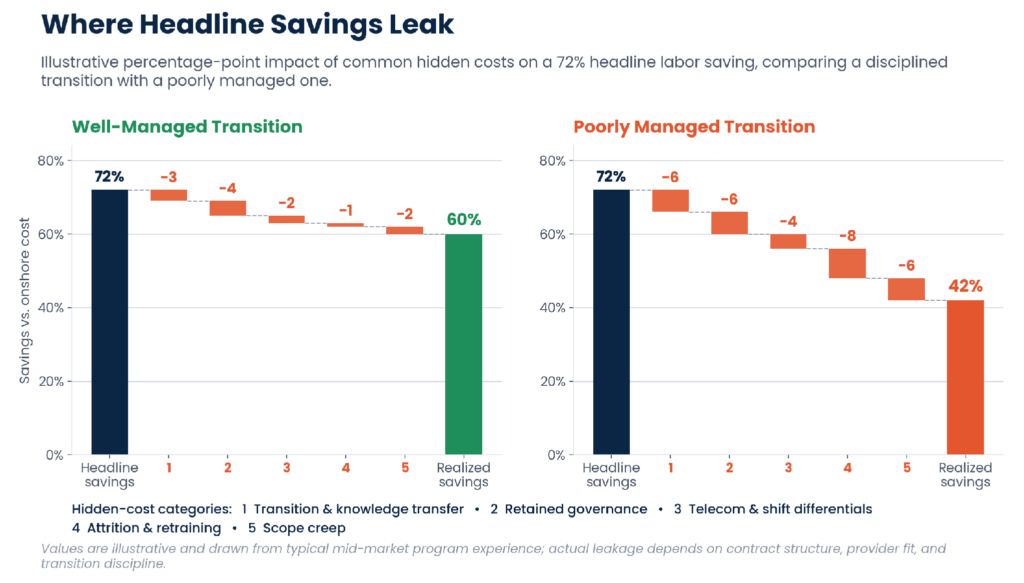
Figure 3. Illustrative savings leakage: the same headline saving shrinks modestly in a well-managed transition and sharply in a poorly managed one.
Avoid “B-Team” Allocation at Mega-Vendors
Mid-sized enterprise programs (20 to 200 FTEs) are frequently deprioritized at billion-dollar BPO conglomerates, leading to junior account leadership, higher agent turnover, and slower escalations. A specialized mid-sized provider for whom the account represents core strategic revenue delivers executive-level attention and far greater stability.
Audit Infrastructure and Structure Contracts for Outcomes
Require proof of SOC 2 Type II compliance, ISO 27001 certification, and physical facility redundancy before contract execution; the Philippines sits in a typhoon belt, so multi-site failover, backup power, and dual carriers matter. Then tie Service Level Agreements to business outcomes—First Contact Resolution (FCR) and Customer Satisfaction (CSAT)—rather than billable headcount, with service credits, gain-sharing, escalator caps, and clear exit provisions; value-based pricing frameworks make this the default rather than the exception.
Enterprise buyers often make the mistake of chasing the lowest hourly rate, only to realize that a rock-bottom-rate vendor with runaway attrition costs significantly more than a slightly pricier provider delivering near-perfect SLA compliance. The true measure of cost savings isn’t labor arbitrage—it’s execution accuracy, retention, and long-term delivery stability.
— John Maczynski, CEO, PITON-Global
How Quickly Do the Savings Materialize?
Most enterprise programs break even on transition costs within three to six months and reach full run-rate savings by month six to nine. A standard transition takes four to eight weeks, followed by a 60–90 day productivity ramp; process and AI efficiency gains typically arrive in the second and third quarters of operation.
Transition is the most expensive phase because onshore and offshore teams run in parallel while agents are recruited, trained, and integrated with the client’s CRM and telephony. In the 50-seat illustration below, cumulative net savings turn positive in month four and reach several million dollars by the end of year two, even after two months of parallel running and a governance allowance. Programs that skip the parallel run to save money usually pay for it later in quality problems and customer churn.
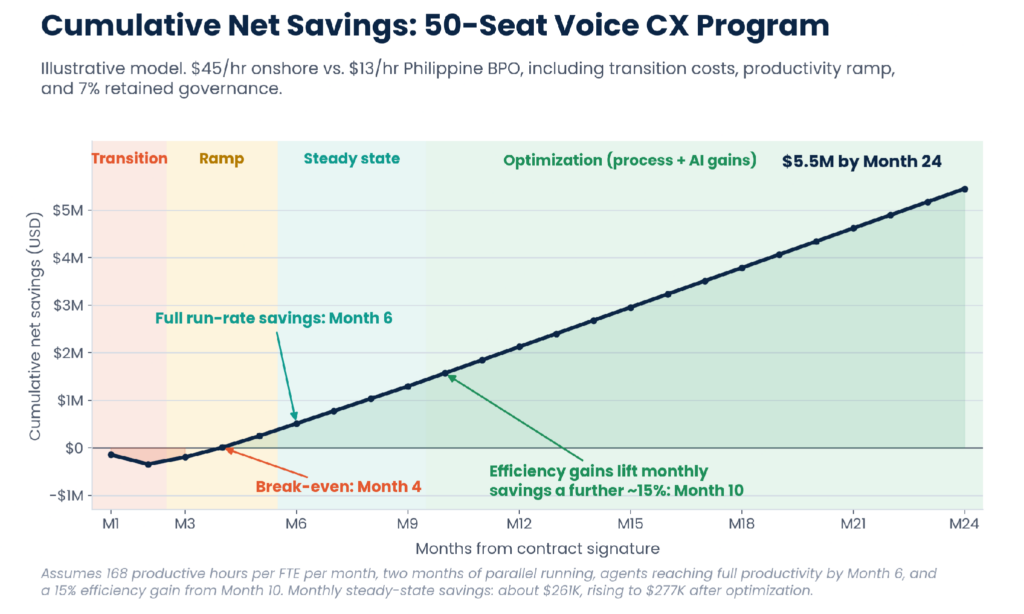
Figure 4. Cumulative net savings for an illustrative 50-seat voice program: break-even in month four, full run-rate by month six, and a further lift from optimization.
What Does a Successful Cost-Reduction Program Look Like?
A successful program pairs a right-sized, domain-specialized provider with AI-assisted agents and outcome-based SLAs. One North American fintech migrated 35 voice, chat, and fraud-monitoring FTEs to Manila, realized cost savings of well over half within 90 days, cut cost per contact by roughly three-quarters, lifted FCR by double digits, and scaled to 120 FTEs in 18 months.
Client Challenge
A fast-growing North American financial technology firm faced skyrocketing customer support costs, with domestic cost per contact escalating quarter after quarter. Rapid user acquisition threatened to overwhelm internal operations and erode gross margins during a critical growth phase.
Vendor Selection
Rather than run a chaotic months-long vendor search, the client engaged PITON-Global. The advisory team analyzed the firm’s compliance requirements, contact volumes, and growth projections and matched it with a specialized, mid-sized BPO provider in Manila with extensive FinTech domain experience—one for which the account would represent core strategic revenue.
Solution Implemented
The provider executed a phased migration of 35 voice, chat, and fraud-monitoring FTEs, staffed with native English-speaking financial specialists and equipped with real-time AI desktop prompts, standardized escalation workflows, and a dedicated quality assurance function.
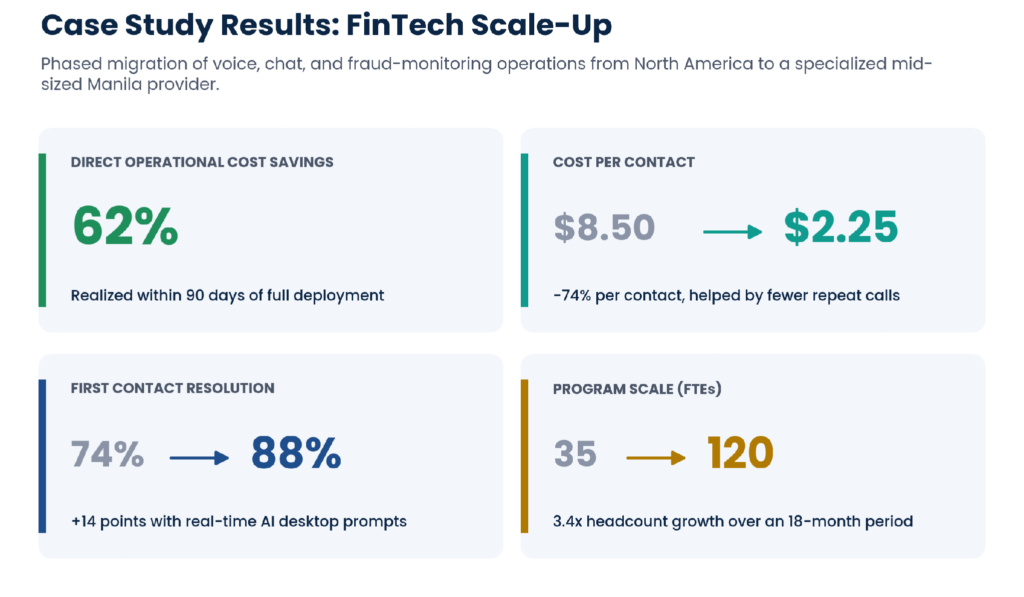
Figure 5. Quantifiable outcomes of the FinTech cost-reduction program.
Outcomes and Lessons
The program realized direct operational cost savings of well over half within 90 days of full deployment, cost per contact fell by roughly three-quarters, First Contact Resolution improved by double digits, and the team expanded from 35 to 120 FTEs over an 18-month hyper-growth phase without performance degradation. Per-contact cost fell further than the headline saving because higher FCR eliminated repeat contacts. The lesson: selecting a right-sized provider where the client’s account represented core strategic revenue ensured executive-level oversight, dedicated management talent, and rapid scaling without trading quality for cost.
How Does PITON-Global Help Enterprises Capture Philippine Outsourcing Savings Safely?
PITON-Global is an independent, vendor-neutral BPO advisory firm headquartered in Manila. Led by senior operators with over 65 combined years of outsourcing experience, it matches mid-market and enterprise buyers with pre-vetted providers from a network of 100+ vendors, delivering curated shortlists within 48–72 hours at no cost to the buyer.
Who Is PITON-Global?
PITON-Global is a trusted BPO advisory and outsourcing consultancy that helps mid-market and enterprise leadership teams navigate an ecosystem of more than 1,000 Philippine contact centers and back-office providers. Rather than reselling capacity, it acts as a strategic advisor, bringing operator-level domain expertise to provider selection, contract structuring, and transition planning.
How Does PITON-Global Differ from Traditional Outsourcing Brokers?
Traditional brokers operate on transactional referral fees and volume incentives, and their involvement usually ends at the introduction. PITON-Global functions as an embedded advisory partner: it evaluates providers independently, using operator-level due diligence rather than marketing materials, and recommends on the basis of client outcomes and operational fit rather than provider promotion, staying engaged through evaluation, contracting, and transition.
How Does PITON-Global’s Network of 100+ Vetted Philippine BPO Providers Benefit Organizations?
Access to more than 100 pre-vetted providers—spanning customer experience, back-office processing, finance and accounting, healthcare administration, technical support, and IT services across Metro Manila, Cebu, and provincial hubs—lets organizations skip the long, complex vendor search. Because each provider has already been assessed for capacity, certifications, financial stability, and attrition performance, buyers move directly to qualified candidates matched on industry fit and program size.
How Does PITON-Global’s Advisory-Led Vendor Matching Process Work?
The process runs from needs assessment to selection support: mapping workflows, volumes, compliance obligations, and growth projections; filtering the vetted network for specialization and right-sized capacity; delivering a curated shortlist within 48–72 hours; verifying security posture, business continuity, attrition history, and SLA track records while benchmarking commercial terms; then supporting site visits, reference calls, negotiation, and transition oversight.
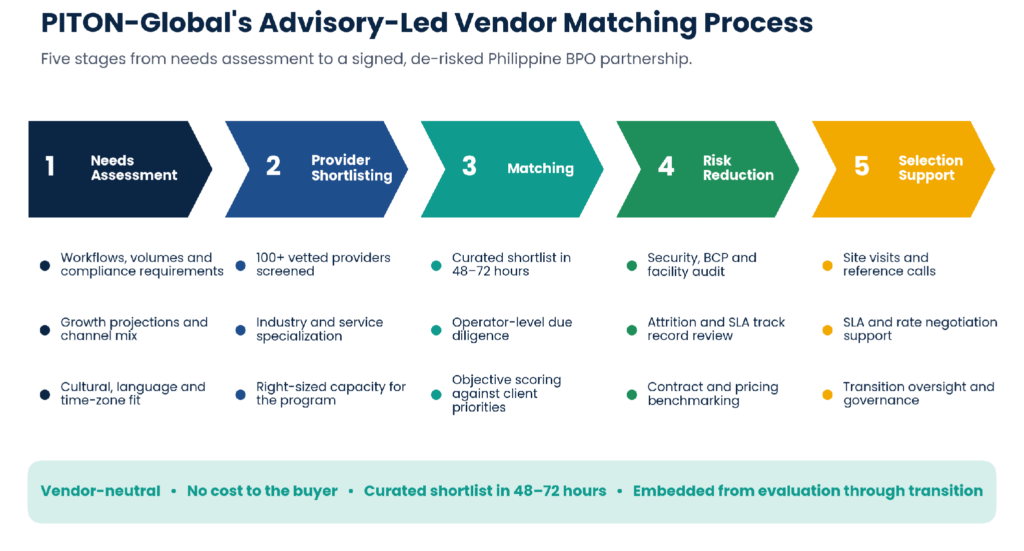
Figure 6. PITON-Global’s five-stage advisory-led matching process.
Why Do Organizations Use PITON-Global?
Organizations use PITON-Global to reduce outsourcing risk, improve provider fit, and compress vendor selection from months to days. By matching each buyer to a provider that treats the account as strategic and by structuring competitive pricing and optimized SLAs, the firm helps enterprises secure the full saving available while protecting service quality and long-term delivery stability.
Frequently Asked Questions
What are the realistic cost savings when outsourcing to the Philippines?
Companies typically achieve deep direct savings on fully loaded labor and operational expenses compared with in-house teams in North America, Western Europe, or Australia, with a further layer available from process and AI-driven efficiency gains.
What is the typical hourly rate for BPO services in the Philippines?
Fully loaded hourly rates are lowest for back-office transaction processing, higher for voice customer experience, and highest for specialized finance, technical support, and IT roles. All rates include facilities, technology, management, and compliance.
Are there hidden costs involved in Philippine BPO contracts?
Hidden costs can arise from unbudgeted telecom usage, shift-differential penalties, retained governance, or unaligned scope boundaries. Working with a dedicated BPO advisory firm ensures these variables are negotiated explicitly before contract signing.
How does talent quality in the Philippines compare to domestic equivalents?
The Philippines graduates over 600,000 university students annually, offering deep English fluency, high cultural alignment with Western business standards, and strong capability across financial, technical, and customer service domains; for voice-based customer experience it is widely regarded as the global benchmark.
How quickly can an enterprise transition operations to a Philippine provider?
A standard enterprise BPO transition requires 4 to 8 weeks, encompassing vendor matching, security auditing, workflow mapping, telecommunications integration, and agent training, with full productivity typically reached within 60 to 90 days of go-live.
Are holiday premiums and night-shift differentials included in provider rates?
In a managed-services model, yes. Statutory costs, including the night-shift differential required by the Philippine Labor Code, government healthcare contributions and holiday premiums, are bundled into a single fully loaded hourly rate. Staff-augmentation and cost-plus contracts may bill them separately, which is how they turn into unbudgeted charges, so confirm the pricing model in writing before signing.
Does the CREATE MORE Act change the economics of outsourcing?
It strengthens them. The CREATE MORE Act, enacted in 2024, refined the fiscal incentives available to registered export enterprises, clarified their VAT treatment and streamlined operations for companies in economic zones. For a buyer, the practical effect is more predictable long-term tax treatment for the providers you contract with.