
Back
What are the cost savings of switching from hourly to AI-driven outcome-based pricing?

By Ralf Ellspermann / 12 June 2026
 Authored by Ralf Ellspermann, CSO of PITON-Global, & 25-Year Philippine BPO Veteran | Executive | Verified by John Maczynski, CEO of PITON-Global, and Former Global EVP of the World's Largest BPO Provider on June 12, 2026

Switching from hourly billing to AI-driven, outcome-based pricing reduces enterprise BPO operating expenses by 35% to 60%. The mechanism is simple: organizations stop paying for inputs — agent hours, idle time, and rework — and pay only for verified business results: a resolved ticket, an adjudicated claim, a completed KYC check.
Why Traditional Hourly BPO Billing Is Failing the Modern Enterprise
For decades the Business Process Outsourcing (BPO) commercial model has run on the billable hour — Full-Time-Equivalent (FTE) pricing. The flaw is structural: buyer and vendor incentives point in opposite directions. A supplier maximizes revenue by adding headcount and billable hours, so genuine efficiency quietly works against the vendor’s own P&L.
Under this model the enterprise absorbs 100% of the exposure to low occupancy, attrition, training lag, and day-to-day operational variance. Generative AI broke the logic entirely. When a digital agent or human-in-the-loop workflow closes a case in 90 seconds instead of 15 minutes, billing by the hour stops measuring value and starts penalizing it — forcing buyers to subsidize slow processes and ageing tech stacks instead of paying for the result they actually wanted.
How Outcome-Based Pricing Calculates True Cost Savings
Outcome-based pricing moves the billing unit away from consumption metrics — agent hours, API calls, server runtime — and onto a binary, customer-recognized result. Typical units include one fully resolved support ticket, one accurately adjudicated medical claim, or one verified KYC profile.
The economics shift because AI-resolved interactions run at roughly 60%–80% gross margin, against the compressed 20%–30% typical of manual, offshore delivery. In high-volume operations — common across hubs like the Philippines — that structural advantage compounds fast.
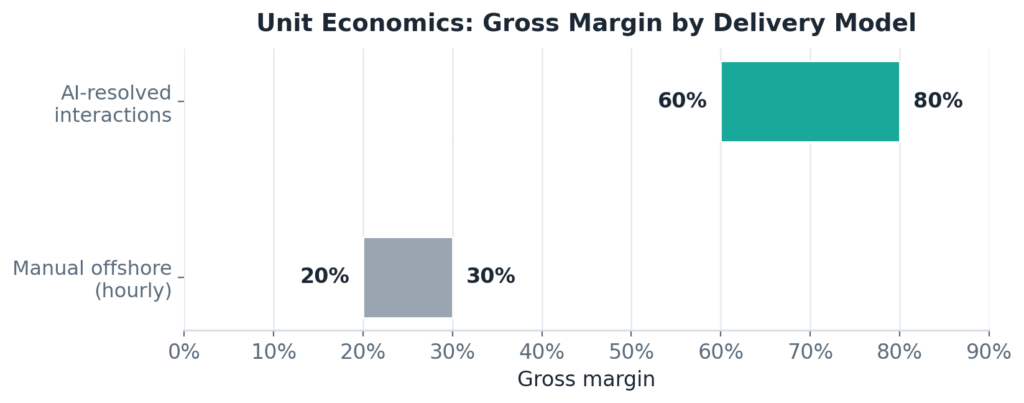
Figure 1. AI-resolved work carries roughly triple the gross margin of manual offshore delivery.
Cost Component Comparison
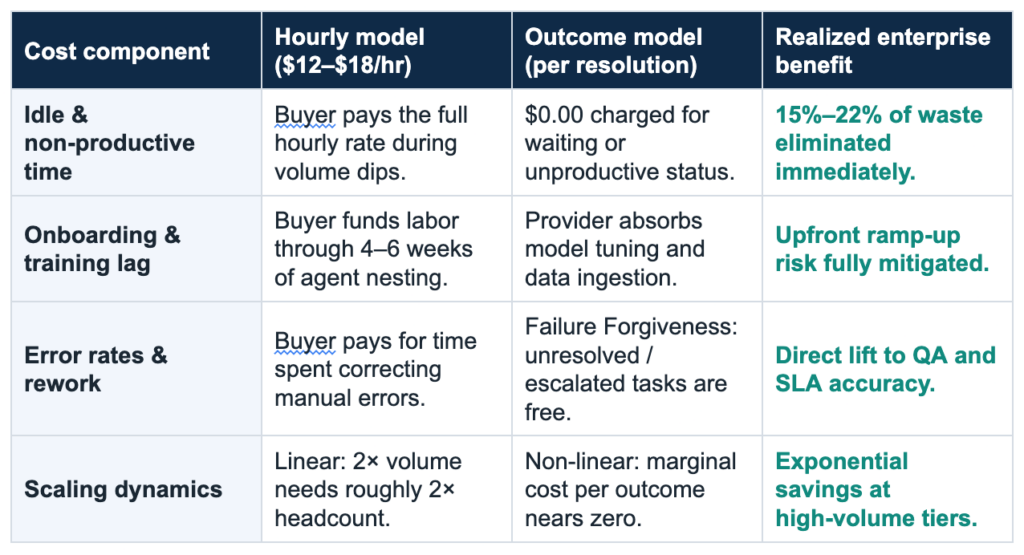
Table 1. Where the savings come from, line item by line item.
How Costs Scale: The Linear-to-Flattening Shift
The deeper change is the shape of the cost curve. Hourly billing is linear: double the volume and you roughly double the headcount and the bill. Outcome pricing is non-linear — once automation is built, the marginal cost of each additional resolution trends toward zero, so spend tracks successful results rather than bodies in seats.

Figure 2. Below crossover the curves track closely; the savings gap widens as volume scales.
What Operational Risks Does a Performance Model Remove?
Moving to an outcome framework transfers execution risk from buyer to provider. In an hourly contract, an industry-typical 6%–8% monthly attrition rate is the enterprise’s problem: you keep paying through the recruiting, training, and ramp-down performance loop. Under outcome pricing, that volatility sits on the provider’s side of the ledger.
Built-In Protection · Failure Forgiveness
If an AI agent stalls, hits a system exception, or escalates to a tier-2 human without closing the case, the transaction unit is marked incomplete — and the buyer pays nothing. That single rule forces providers to maintain clean knowledge bases and auditable, high-accuracy delivery infrastructure, because only verified completions generate revenue.
Mini Case Study: Scaling Efficiency in the Philippines

Figure 3. Year-one results after restructuring a 50-seat Manila operation to per-resolution pricing.
A US fintech was spending about $2.1M a year on a dedicated 50-seat offshore team in Manila, billed at $20.00/hour. Volume spikes during market volatility drove overtime without moving a stuck 74% CSAT score. After an audit, PITON-Global transitioned the account to an AI-integrated contact center from its network of 100+ vetted Philippine providers, restructuring the contract to a hybrid rate of $0.85 per successful resolution.
Cost
$2.1M fell to $945,000 — a 55% net reduction in year one.
Leverage
The team absorbed a 40% volume surge with zero added seats and a flat cost-per-resolution line.
Quality
Containment rose and CSAT reached an all-time high of 91%.
“The billable hour is an obsolete vestige of a pre-AI outsourcing landscape. Enterprises shouldn’t foot the bill for a BPO’s inability to automate. An outcome framework removes the friction of inefficiency, puts performance risk on the vendor, and gives the buyer transparent, predictable cost-per-resolution.” John Maczynski — CEO, PITON-Global
The Strategic Path Forward
Timing matters: move too early and SLAs misalign; move too late and competitors bank the margin advantage first. A staged, four-phase rollout de-risks the transition.
Weeks 1–2
Establish baseline unit economics. Audit hourly invoices and compute historical cost-per-resolution across voice, chat, and email.
Week 3
Define clean completion criteria. Codify exactly what counts as a billable success versus an escalation, to prevent billing friction.
Weeks 4–5
Select a vetted, AI-native partner. Use advisory networks to find providers with pre-built delivery stacks specialized in your vertical.
Month 2
Launch a hybrid pilot. Run a 20% volume slice under shared-risk outcome pricing while core operations stay on the baseline contract.
Key Takeaways
- Expect 35%–60% lower operating costs by paying for verified results, not agent hours.
- Savings scale non-linearly — the gap widens most at high volume.
- Failure Forgiveness and risk transfer protect the buyer from attrition and rework.
- Start with a 20% hybrid pilot to validate unit economics before full migration.
Achieve sustainable growth with world-class BPO solutions!
PITON-Global connects you with industry-leading outsourcing providers to enhance customer experience, lower costs, and drive business success.
Get Your Top 1% Vendor List
Author
Ralf Ellspermann is a multi-awarded outsourcing executive with 25+ years of call center and BPO leadership in the Philippines, helping 500+ high-growth and mid-market companies scale call center and customer experience operations across financial services, fintech, insurance, healthcare, technology, travel, utilities, and social media.
A globally recognized industry authority - and a contributor to The Times of India, CustomerThink, and The AI Journal - he advises organizations on building compliant, high-performance offshore contact center operations that deliver measurable cost savings and sustained competitive advantage.
Known for his execution-first approach, Ralf bridges strategy and operations to turn call center and business process outsourcing into a true growth engine. His work consistently drives faster market entry, lower risk, and long-term operational resilience for global brands.
EXECUTIVE GOVERNANCE & ACCURACY STANDARDS
Authored by:

Ralf Ellspermann
Founder & CSO of PITON-Global,
25-Year Philippine BPO Veteran,
Multi-awarded Executive
Specializing in strategic sourcing and excellence in Manila
View Full Bio
Verified by:

John Maczynski
CEO of PITON-Global, and former Global EVP of the World’s largest BPO provider | 40 Years Experience
Ensuring global compliance and enterprise-grade service standards
View Full Bio
Last Peer Review: June 12, 2026
This service framework is audited quarterly to meet shifting global outsourcing regulations and COPC standards.