
Back
Speech Recognition Training Outsourcing Philippines: Giving Voice AI the Gift of Comprehension

By Ralf Ellspermann / 14 March 2026
 Authored by Ralf Ellspermann, CSO of PITON-Global, & 25-Year Philippine BPO Veteran | Executive | Verified by John Maczynski, CEO of PITON-Global, and Former Global EVP of the World's Largest BPO Provider on March 14, 2026

Speech recognition training outsourcing in the Philippines provides the high-fidelity acoustic and linguistic data necessary for Voice AI to transition from simple transcription to deep comprehension. By utilizing a workforce skilled in phonetics, speaker diarization, and intent labeling, enterprises can train models to navigate diverse accents, noisy environments, and emotional nuances, ensuring seamless and intuitive human-computer interaction.
Executive Briefing
- Beyond Transcription: Move past “speech-to-text” into “speech-to-intent,” allowing AI to understand the meaning and emotion behind the spoken word.
- Linguistic Versatility: Leverage Filipino expertise to train models on a vast array of global accents, dialects, and prosodic speech patterns.
- Acoustic Precision: Access specialized teams capable of annotating complex audio in challenging, real-world conditions (e.g., background noise, multi-speaker crosstalk).
- Strategic ROI: Focus on “Intelligence Arbitrage” by utilizing cognitive specialists who deconstruct dialogue rather than just typing words.
- Safety & Ethics: Implement “Agentic Governance” with human-in-the-loop monitoring to identify bias and ensure conversational AI remains helpful and harmless.
From Transcription to Comprehension: The New Frontier of Voice AI
The first era of speech recognition was a technical triumph of dictation—converting audio waves into text strings. While revolutionary at the time, this foundational transcription was merely the beginning. Today, the ambition for Voice AI has shifted toward comprehension. It is no longer enough for an AI to recognize the words “I’m fine”; it must understand from the speaker’s tone, pitch, and pauses whether they are truly content or deeply frustrated.
This leap from translation to true understanding requires a new breed of training data. High-performing voice systems—whether in-car assistants, medical dictation tools, or empathetic customer bots—depend on datasets meticulously refined by human experts. These annotators identify the “invisible” cues in speech, such as sarcasm, hesitation, and emotional shifts, providing the raw material for machine learning models to master the art of human conversation.
The Philippine Advantage: A Hub of Linguistic Excellence
The Philippines has transitioned from being a traditional call center hub to a global center for high-value AI services. The nation’s workforce possesses a unique “linguistic intuition,” a byproduct of high English literacy and a deep cultural resonance with Western communication styles. This makes Filipino specialists the ideal architects for the complex datasets required in voice AI.
This advantage is rooted in a mature educational system that prioritizes critical thinking and communication. Unlike automated transcription tools that struggle with “code-switching” or heavy accents, Filipino annotators can accurately diarize multiple speakers and label complex intent. This combination of innate talent and a sophisticated BPO infrastructure makes the Philippines the strategic partner of choice for developers seeking breakthrough performance in voice applications.
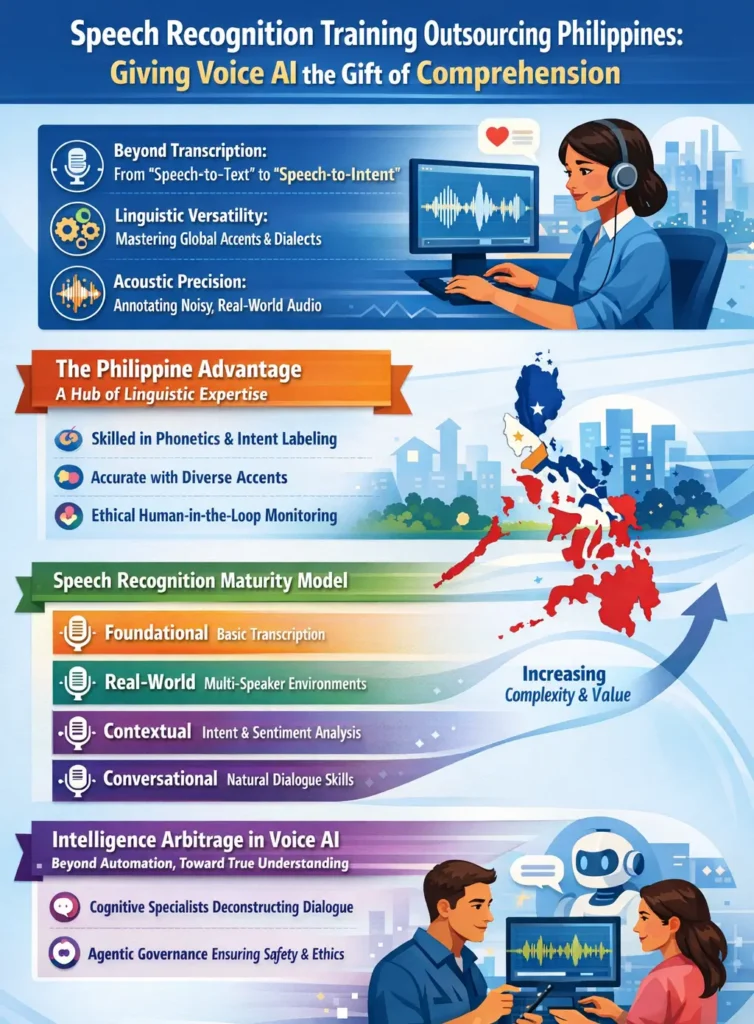
Speech Recognition Training Maturity Model
To effectively scale voice AI, organizations must understand where they sit on the maturity curve. As complexity increases, so does the strategic value of the output.
| Maturity Level | Core Task | Key Metric | Business Value |
| Level 1: Foundational | Clear, single-speaker transcription. | Word Error Rate (WER). | Simple dictation and voice commands. |
| Level 2: Real-World | Multi-speaker audio with diverse accents. | Speaker Diarization Accuracy. | Robust performance in noisy environments. |
| Level 3: Contextual | Labeling intent, sentiment, and entities. | Intent Recognition Rate. | Natural, context-aware user interfaces. |
| Level 4: Conversational | Training on turn-taking and prosody. | Conversational Success Rate. | Human-like, fluid AI dialogue. |
Intelligence Arbitrage in Voice AI
In the 2026 AI landscape, the value proposition has shifted from “Labor Arbitrage” to Intelligence Arbitrage. This concept focuses on accessing specialized cognitive abilities that are unavailable through automation alone.
“We are witnessing a paradigm shift in how machines learn to listen. It’s no longer about feeding the AI endless hours of raw audio; it’s about providing a curated education in human interaction. Our clients need linguistic specialists who can deconstruct dialogue and identify the subtle emotional cues that define communication. This human element transforms a voice interface into a true conversational partner.” — John Maczynski, CEO, PITON-Global
For instance, a Filipino specialist can distinguish between a customer who is shouting due to a poor connection and one shouting due to anger. They can identify cultural nuances that change the meaning of a phrase, ensuring the AI remains both accurate and culturally sensitive—a level of “Intelligence Gain” that is central to the Philippine advantage.
Service Tiers for Speech Recognition Training
PITON-Global assists companies in navigating the diverse requirements of voice AI development through a structured tiering system.
| Service Tier | Description | Ideal Use Case |
| Tier 1: Core | High-accuracy transcription of clean audio. | Dictation software, archival notes. |
| Tier 2: Advanced | Handling background noise and heavy accents. | In-car assistants, call center analytics. |
| Tier 3: Enriched | Adding layers of sentiment and intent. | Empathetic virtual assistants. |
| Tier 4: Expert | Mapping full conversational structures. | Social robots, advanced customer AI. |
Agentic Governance: The Human Touch in an Automated World
As Voice AI becomes “agentic”—taking actions like booking appointments or managing finances—robust governance becomes a non-negotiable requirement. Agentic Governance utilizes Filipino specialists as “guardians” of the AI. They monitor live or recorded interactions to identify potential biases, ensure ethical compliance, and provide the corrective feedback needed to keep the AI on track. This human oversight ensures that voice-activated systems remain helpful, safe, and aligned with human values, further cementing the strategic importance of the Philippines in the global AI ecosystem.
Expert FAQs
Why is human annotation still necessary when AI is getting so good?
While AI can transcribe words, it cannot yet reliably interpret the “unspoken” parts of speech—sarcasm, subtle emotion, or intent based on cultural context. Human experts are required to create the “ground truth” data that teaches the AI these nuances, and to correct the systemic errors that automated tools consistently repeat.
How does the Philippines handle “Speaker Diarization” for complex audio?
Speaker diarization (identifying “who spoke when”) is notoriously difficult for machines in noisy settings. Filipino specialists use specialized software to manually verify speaker transitions, ensuring that training datasets for multi-person environments—like boardrooms or busy hospitals—are 100% accurate.
What role does “Prosody” play in training?
Prosody refers to the rhythm, stress, and intonation of speech. By labeling prosodic cues, Filipino specialists help AI understand when a user is asking a question versus making a statement, or when they are using emphasis to convey urgency.
How does PITON-Global vet its Philippine partners for speech projects?
We evaluate partners based on their linguistic expertise, technical infrastructure (noise-canceling tech and secure data rooms), and their history with complex “Human-in-the-loop” AI projects. This ensures our clients are matched with teams that can deliver high-fidelity data at scale.
Achieve sustainable growth with world-class BPO solutions!
PITON-Global connects you with industry-leading outsourcing providers to enhance customer experience, lower costs, and drive business success.
Get Your Top 1% Vendor List
Author
Ralf Ellspermann is a multi-awarded outsourcing executive with 25+ years of call center and BPO leadership in the Philippines, helping 500+ high-growth and mid-market companies scale call center and customer experience operations across financial services, fintech, insurance, healthcare, technology, travel, utilities, and social media.
A globally recognized industry authority—and a contributor to The Times of India and CustomerThink —he advises organizations on building compliant, high-performance offshore contact center operations that deliver measurable cost savings and sustained competitive advantage.
Known for his execution-first approach, Ralf bridges strategy and operations to turn call center and business process outsourcing into a true growth engine. His work consistently drives faster market entry, lower risk, and long-term operational resilience for global brands.
EXECUTIVE GOVERNANCE & ACCURACY STANDARDS
Authored by:

Ralf Ellspermann
Founder & CSO of PITON-Global,
25-Year Philippine BPO Veteran,
Multi-awarded Executive
Specializing in strategic sourcing and excellence in Manila
View Full Bio
Verified by:

John Maczynski
CEO of PITON-Global, and former Global EVP of the World’s largest BPO provider | 40 Years Experience
Ensuring global compliance and enterprise-grade service standards
View Full Bio
Last Peer Review: March 14, 2026
This service framework is audited quarterly to meet shifting global outsourcing regulations and COPC standards.