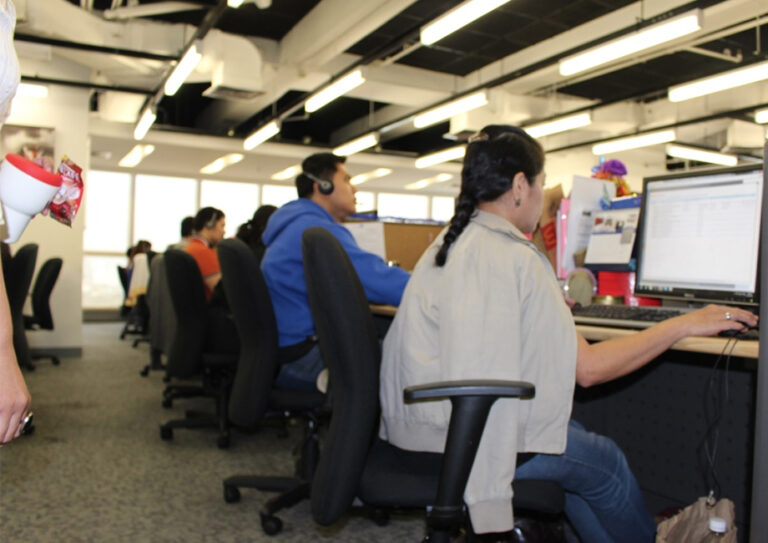

Next-gen call centers are defined by a division of labor, not by a gadget: software resolves the routine contacts, people handle the complex and emotionally charged ones, and data decides which is which before the customer has finished typing. That is already the operating model on an offshore service desk scoped for North American buyers in Manila or Cebu. For a VP of CX or COO planning the next contract, the practical questions are what the model looks like in operation, why the Philippine industry is positioned to run it well, and what to ask a provider about its roadmap. This post answers those in turn.
What a next-generation desk actually is
A next-generation desk is one where six capabilities work together as a system rather than sitting in separate pilots. Buyers will recognize most of them from vendor decks; what has changed is that they are now table stakes on a well-run Philippine program rather than aspirations.
- Conversational AI and self-service that resolve routine contacts, such as order status, balance checks and password resets, around the clock without an agent.
- Automation of the repetitive work around a contact, from data entry and case notes to appointment scheduling and follow-up messages, so agent time goes to the customer.
- Personalization drawn from the customer’s history, so the agent or the bot opens with context instead of asking the customer to repeat it.
- Predictive analytics that forecast volume, flag at-risk customers and route each contact to the person or system best placed to resolve it.
- Real-time agent assist that surfaces the right knowledge article, suggests next steps and drafts the case summary while the conversation is still live.
- Continuous compliance and security monitoring across every interaction, replacing the sampled QA audit with full coverage.
None of those is exotic. The distinction between a next-generation desk and an ordinary one is whether they are wired together, governed by one set of metrics and run by a provider that treats them as its operating model rather than as add-ons sold by the seat.
The new division of labor between software and agents
Automation takes the contacts that have one right answer; agents take the contacts that require judgment, and the boundary between them moves every quarter. That is the single most important thing for a buyer to understand about where support is going, because it changes what the human team is for. Five years ago a Filipino agent’s day was mostly routine volume with occasional hard cases. On a next-generation desk the routine has been absorbed by self-service, and what reaches the agent is the billing dispute with three exceptions, the traveler stranded at midnight, the patient who does not understand the letter they received.
Two consequences follow for the buyer. First, the human team becomes smaller as a share of contacts but more valuable per contact, so hiring and training standards should rise rather than relax as automation grows. Second, the metrics that mattered for a routine desk, chiefly handle time, become actively misleading for a judgment desk; first-contact resolution, CSAT and retained revenue are the measures that fit the work. Providers who have made the transition will say this unprompted. Providers who have not will still be selling handle time.
Data as the operating system of customer support
The desk of the next decade is run on prediction rather than reaction: it forecasts who will contact it, about what, and how much it will take to resolve them, then staffs and routes accordingly. The sibling post on how predictive analytics is reshaping the customer experience covers the models in detail. In operational terms the shift shows up in three places: workforce management that forecasts by half-hour interval and adjusts intraday; routing that sends a contact to the agent most likely to resolve it rather than the next one free; and proactive outreach that reaches a customer about a delayed shipment or a failed payment before they reach the desk.
Quality assurance changes shape too. Instead of a supervisor listening to five sampled calls per agent per week, speech and text analytics score every interaction for compliance phrases, sentiment and resolution, and the human QA team spends its time on calibration and coaching. For a buyer this is the difference between knowing what happened on a small sample and knowing what is happening on the whole queue, in near real time.
Why the Philippine industry is positioned to run this model
The country is positioned to lead the next phase of support because the model rewards exactly what its workforce already does well: judgment, empathy and fluent communication on the contacts that automation cannot close. The sibling analysis of why the Philippines is set to win the next decade of CX makes the strategic case at length; three facts carry most of it.
Scale first. According to IBPAP figures reported by the Philippine Star in January 2026, the IT-BPM sector passed $40 billion in revenue in 2025 and employed 1.9 million people, up from 1.82 million in 2024, with a 2026 baseline target of $42 billion and 1.97 million jobs. An industry that size is investing in AI tooling, analytics teams and reskilling at a pace no single buyer could fund alone, and the leading providers are already running agent-assist and analytics platforms as standard.
Language second. The 2025 EF English Proficiency Index places the country at a score of 569 and a global rank of 28, in the high-proficiency band, and fluency is precisely what the judgment-heavy contact demands. Policy third: the CREATE MORE Act signed in November 2024, as the Daily Tribune reported, lets registered firms keep up to half their workforce on work-from-home arrangements without losing incentives, which widens the hiring pool for specialist roles and hardens business continuity, both of which a next-generation desk depends on.
What it looks like in one demanding sector
Food delivery is a useful test because it combines high volume, real-time urgency and thin margins, and the sibling piece on how food-delivery platforms are redrawing their service map with Filipino teams shows the model working end to end. Order-status and refund-for-missing-item contacts are resolved by self-service tied to the platform’s own data. Predictive routing spots a driver running late and offers the customer a credit before they complain. What reaches an agent is the genuinely tangled case, a wrong order at a hospital ward or a payment that failed twice, and the agent arrives with the full context on screen. The same pattern transfers to retail, travel, fintech and telehealth with the nouns changed.
What to ask a provider about its roadmap
The buyer’s job is to distinguish providers who run the next-generation model from those who describe it, and a handful of questions does most of the work. Ask for the share of contacts currently resolved without an agent on a comparable program, and how that share has moved over the last two years. Ask which agent-assist tools are live today, on which platform, and what the measured effect on first-contact resolution has been. Ask how QA coverage is achieved, sampled or full, and who owns the analytics. Ask what happens to the human team as automation grows: a credible answer describes upskilling into tier-two and retention work, not headcount cuts.
Then look at the contract. A provider genuinely running this model will accept outcome metrics as the basis of the scorecard and will have a view on agent-assist delivery from the Philippines that is specific about tools, training and data controls. A provider still selling seats by the hour and reporting on handle time may be a fine operator of the old model, but it is not the future, and the contract should not be written as though it were.
Frequently asked questions
Will next-generation support mean fewer agents in my program?
Fewer agents per thousand contacts, yes, because self-service absorbs the routine. Fewer agents in absolute terms depends on how fast your contact volume grows. What changes for certain is the mix: a higher share of skilled tier-two and retention agents, and higher training standards to match.
Do I need to bring my own AI tools, or does the provider supply them?
Either works, and hybrids are common. Providers typically run their own agent-assist, analytics and QA platforms and integrate with the buyer’s CRM and ticketing systems. What matters is that data ownership, model training on your data and access controls are written down before go-live.
How do security and compliance change on a next-generation desk?
They get stronger if the tooling is used well. Full-coverage interaction analytics flag compliance breaches and unusual patterns across every contact rather than a sample, and the leading providers operate under SOC 2 Type II, PCI DSS and GDPR controls as a baseline. Confirm that the AI tools themselves sit inside the same control boundary.
Is the model only for large programs?
No. Because the provider carries the platforms, a program of fifteen dedicated agents can run on the same agent-assist, analytics and QA stack as a program of five hundred. Smaller buyers gain access to tooling they could never justify building in-house, which is one of the quieter arguments for the offshore model.