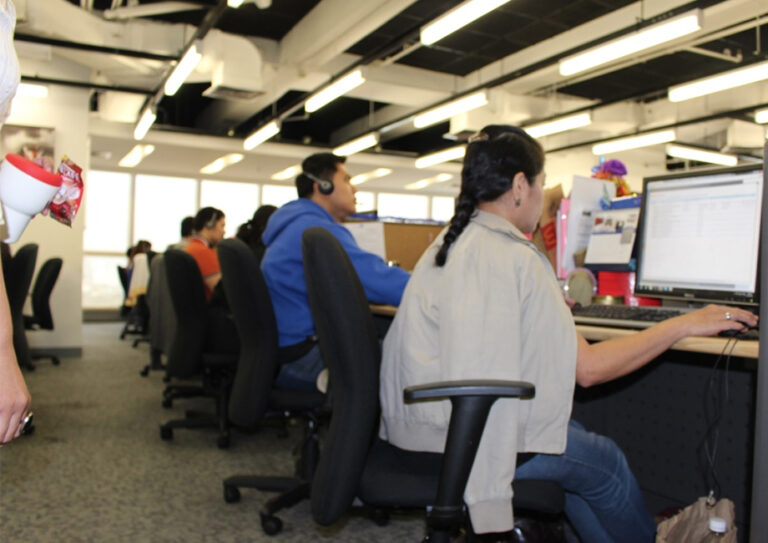

A caller who dials in Spanish, Mandarin or Korean and meets an English-only menu is already halfway to a competitor. Multilingual support in call centers in the Philippines answers that caller in their own language from a single, governed location, which is why a growing number of North American brands now route those queues to multilingual support staffed from Manila instead of building a separate desk for every market. This guide covers what that looks like in practice: which languages are staffed well, how agents are tested, what the routing layer does, what it costs and where the model has limits.
What breaking the language barrier means for a North American program
It means a customer is served end to end in the language they chose, with no transfer to a bilingual supervisor and no hand-off to a translation line. That sounds basic, yet many support operations still treat non-English contacts as an exception: a small overflow queue, a callback promise, or a third-party interpreter patched into the call. Each of those adds handle time, lowers first-contact resolution and tells the customer that their business is second tier.
The size of the audience is the reason it matters. In a June 2025 release of detailed language tables, the U.S. Census Bureau reported that about 22% of U.S. residents aged five and older speak a language other than English at home, and that 61% of them speak Spanish (American Community Survey data for 2017–2021). For a retailer, insurer or utility, that is not a niche segment; it is a fifth of the customer base, and many of those customers prefer to settle a billing dispute or a claim in the language they think in.
Breaking the barrier therefore has three practical parts: staffing agents who are genuinely fluent, routing each contact to the right queue on the first attempt, and measuring quality in every language to the same standard as English.
Which languages Filipino agents cover well
English is the foundation, and Spanish and the major Asian languages are the most common additions. The English base is well documented: the country scored 569 and ranked 28th in the 2025 EF English Proficiency Index, placing it in the “High” proficiency band. That fluency is what lets a provider run blended teams in which a bilingual agent switches cleanly between English and a second language on the same shift.
Spanish for the U.S. Hispanic market
Spanish is the highest-volume second language for most U.S. programs. Philippine providers in Manila and Cebu staff it with a mix of Filipino agents who have studied the language to a tested level and native speakers recruited to live and work in the country. Buyers should ask which mix a vendor proposes, because it affects accent, idiom and the depth of the bench when attrition hits.
Mandarin, Cantonese, Japanese and Korean
Asian-language queues serve two kinds of North American buyer: brands with large Chinese-, Japanese- or Korean-speaking customer segments at home, and companies selling into those markets directly. The Philippine time zone is an advantage here, because the local day shift overlaps with Asian business hours and with North American evenings, while the local night shift covers the North American business day.
European languages, including Canadian French
French, German, Italian and Portuguese are staffed in smaller pools. Canadian French deserves its own conversation: Quebec customers notice a European or textbook accent quickly, so a buyer with a large French-Canadian base should test the proposed agents with real call scenarios before committing volume. A wider view of how the language list has grown is in our piece on how multilingual capabilities have expanded the reach of Philippine teams.
How a multilingual queue is recruited, tested and coached
A good vendor tests fluency before hire, calibrates quality with native speakers and coaches culture as deliberately as product knowledge. Rigorous training has always been part of the sales pitch; what has changed is that buyers can now ask for evidence at each step.
- Screening uses a spoken and written test in the target language, scored by a native speaker, not a self-declared proficiency level on a résumé.
- Recognized certificates such as DELE for Spanish, JLPT for Japanese, HSK for Mandarin or TOPIK for Korean are useful signals, but a live role-play on your own call types is the real gate.
- Training covers product, process and cultural expectations for each market: how directly to deliver bad news, how formal the greeting should be, and when a caller expects an apology versus a fix.
- Quality monitoring is done in the language of the call, by evaluators who speak it natively, against the same scorecard as the English queue.
That last point is where weaker operations fall down. If calls in Korean are scored by an English-speaking analyst reading a translated transcript, tone and politeness errors disappear from the report. Ask to see a sample of scored calls in each language before you sign.
Routing and technology that match each customer to the right agent
Language routing should happen before the first ring reaches an agent. Most programs identify language from the dialed number, the IVR choice, the customer record or the language setting in the app, then route to a skill-based queue. Agents who speak two languages carry both skills, so the platform can use them on whichever queue is busier.
The same logic extends to chat and email, where language detection is easier and the pool of agents who write well in a second language is often deeper than the pool who speak it on the phone. Machine translation and real-time agent assist now help with knowledge-base articles and after-call notes, but they supplement fluent agents rather than replace them. Our overview of the tools a multilingual floor runs on goes deeper on routing, translation support and quality analytics.
For reporting, insist on service level, handle time, first-contact resolution and customer satisfaction broken out by language. A blended average can hide a Spanish queue that abandons twice as often as English.
What it costs and where the savings come from
The saving comes from consolidation as much as from the hourly rate. Running Spanish, Mandarin and English from one site in the Philippines means one vendor contract, one security audit, one workforce management team and one set of reports, instead of several small desks that each need their own supervisors.
On rate, PITON-Global’s indicative 2026 figures for Philippine voice programs run $10–16 per hour, fully loaded, for English-language inbound, outbound, blended and retention agents, roughly 60–70% below an onshore center. Bilingual seats price above that band, and the premium depends on how scarce the language is locally; Spanish usually sits closer to the English rate than Japanese or Korean does. Final rates are set per engagement through a competitive RFP.
Scale also keeps the premium in check. IBPAP reported that the country’s IT-BPM industry employed about 1.9 million workers in 2025 and passed $40 billion in revenue, according to The Philippine Star in January 2026. A labor market that deep makes it realistic to recruit a second class of Spanish or Mandarin agents without a months-long search.
Where multilingual support in Philippine call centers fits, and where it does not
It fits best when English carries most of the volume and a handful of other languages need consistent, measured coverage. The model is strongest for Spanish and the major Asian languages, for 24/7 programs where the local night shift covers the North American business day and the day shift covers its evenings, and for brands that want one vendor accountable for every queue.
It is a harder fit for a language with very little local supply, for work that needs regional legal knowledge in the customer’s country, or for a Quebec-heavy program that requires native Canadian French at high volume. In those cases the honest answer is a pilot with a clear exit clause, or keeping that one queue onshore while the rest moves. For the broader shift away from English-only service, see how Filipino teams moved beyond English-only support.
Frequently asked questions
Are the Spanish-speaking agents native speakers?
Some are and some are not. Most providers combine Filipino agents who have learned Spanish to a tested level with native speakers who have relocated to the Philippines. Ask the vendor for the proposed ratio and for recorded calls from each group.
Can one agent handle two languages?
Yes, and that is one of the main efficiencies. A bilingual agent carries two routing skills, so the platform can place them on the English or the second-language queue depending on demand, which smooths staffing across the day.
How is quality measured in a language my team does not speak?
Through native-speaker evaluators who score calls against your scorecard, plus regular calibration sessions in which your own team reviews translated samples alongside the scores. Customer satisfaction surveys should also be sent in the language of the interaction.
How long does it take to add a new language?
It depends on local supply. A common language such as Spanish can usually be added within a normal recruiting cycle, while a scarce language may take longer and is worth piloting with a small team before committing volume.