

On this page
- Key Takeaways
- What Determines the Baseline Scaling Velocity of a Philippine BPO?
- What Are the Real-World Benchmarks for Capacity Scaling Timelines?
- What Risks and Tradeoffs Impact Rapid Capacity Scaling?
- What Does a Successful Rapid Scale-Up Look Like?
- How Does PITON-Global Help Enterprises Scale Capacity Safely?
- What Are the Most Common Questions About Scaling BPO Capacity in the Philippines?
Philippine BPO companies can typically add capacity in 2–4 weeks for small-to-mid programs (15–30 seats) using pre-provisioned infrastructure and “warm-bench” talent—the elasticity that makes a managed provider running inbound and outbound queues so attractive. Mid-market expansions (30–100 seats) take 4–6 weeks, and enterprise deployments above 100 seats take 6–12 weeks, reflecting custom hiring, wave training, and secure facility setup.
Key Takeaways
- Mid-market scale advantage: Mid-sized Philippine BPOs expand functional capacity markedly faster than multinational tier-one providers by removing complex procurement and legal layers.
- Geographic deployment velocities: Sub-21-day technical deployments favor mature hubs like Metro Manila and Cebu; provincial university hubs take 6–8 weeks but yield lower long-term wage inflation.
- Warm capacity thresholds: Elite providers keep a reserve of workstations pre-wired and unassigned, plus a continuous pipeline of pre-vetted, background-checked applicants.
- The onboarding bottleneck: The critical path is rarely hardware or real estate—it is client-side CRM credentialing, API access, and product-specific knowledge transfer.
What Determines the Baseline Scaling Velocity of a Philippine BPO?
Scaling velocity is governed by three variables: human-capital pipeline density, technical infrastructure readiness, and client-side system onboarding speed. Top vendors run continuous pre-assessed candidate pipelines that cut hiring from 45 days to under 14 for standard customer care and technical support roles.
Enterprise capacity scaling in business services is governed by three primary variables: human-capital pipeline density, technical infrastructure readiness, and client-side onboarding speed. When decision-makers move to scale front- or back-office operations quickly, understanding the constraints of each variable is what prevents costly bottlenecks. As the framework below shows, the three tracks run in parallel—so the binding constraint is usually client-side onboarding, not hardware.
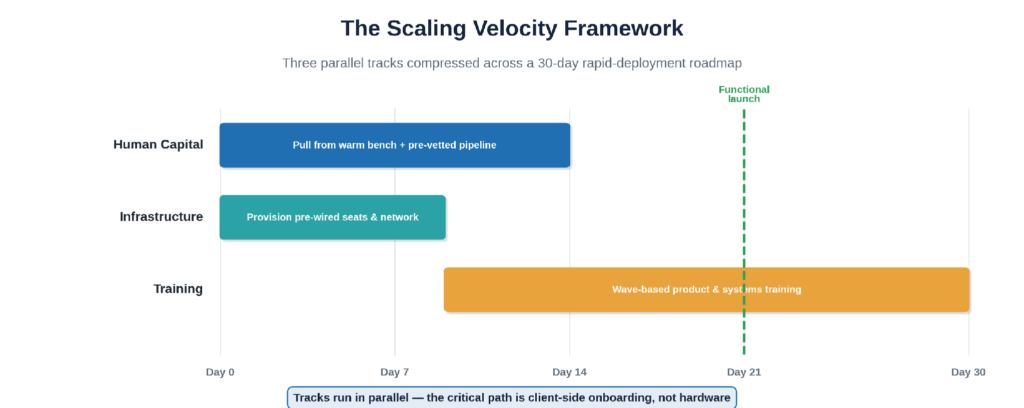
Figure 1. Human capital, infrastructure, and training tracks run in parallel across a 30-day roadmap.
For programs requiring native English fluency and deep analytical skills, top-tier vendors draw on a deep regional talent pool. In major university cities, providers maintain continuous pipelines of pre-assessed candidates—reducing the standard hiring cycle from roughly 45 days to under 14 days for standard customer care and technical support roles, which is central to how offshore teams help businesses scale customer operations faster.
What Are the Real-World Benchmarks for Capacity Scaling Timelines?
Real-world timelines run 2–4 weeks for boutique teams (10–30 seats), 4–6 weeks for mid-market programs (30–100 seats), and 6–12 weeks for enterprise operations (100+ seats). Plug-and-play multi-tenant setups are fastest; custom floor build-outs take longest.
To build an effective multi-year roadmap, procurement teams and COOs must look past marketing promises to real operational benchmarks—the discipline behind a Fortune 500-style supplier sourcing process. Timelines vary heavily by team complexity, headcount, and regional deployment strategy. The chart and table below set out the standard durations and the infrastructure realities behind each tier.
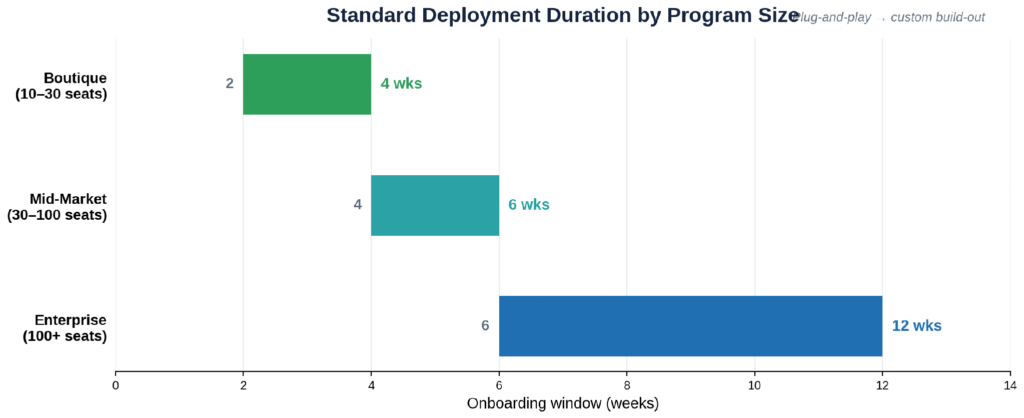
Figure 2. Standard deployment windows widen with headcount and the move from plug-and-play to custom build-out.
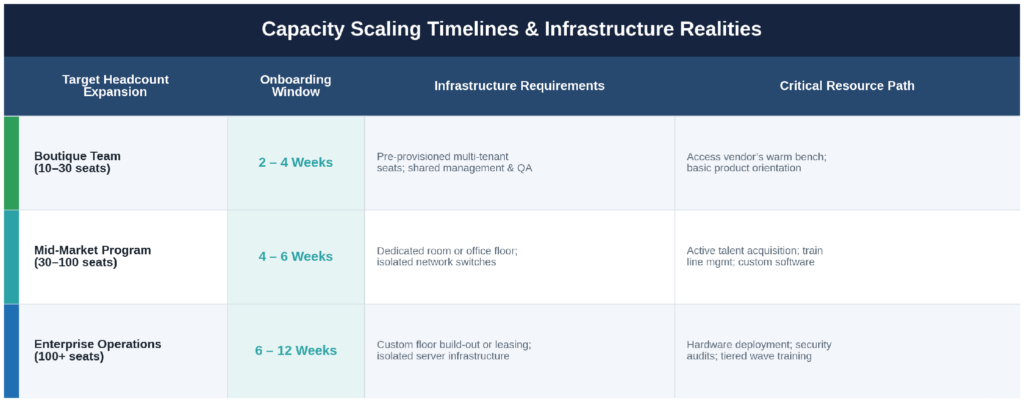
Figure 3. Onboarding windows, infrastructure requirements, and the critical resource path by program size.
The pattern is consistent: speed scales inversely with dedicated infrastructure. Boutique teams launch fastest because they ride pre-provisioned multi-tenant seats and a warm bench, whereas enterprise operations need custom floor build-outs, isolated servers, and tiered wave training—which is why their windows extend to 6–12 weeks.
What Risks and Tradeoffs Impact Rapid Capacity Scaling?
Accelerating timelines without guardrails risks compromised talent quality and substandard facilities. Rushed screening lowers first-contact resolution and raises attrition, while overflow space can mean weaker backup power and physical security. A phased approach seeded by existing talent mitigates both.
Accelerating expansion without proper guardrails introduces structural risks that can destabilize service quality, lower customer satisfaction, and raise attrition. Two tradeoffs deserve particular attention.
The Compromise of Talent Quality
When a provider compresses a hiring timeline to meet aggressive client demands, the most common casualty is candidate screening quality. Rushing recruitment tends to lower first-contact-resolution capability, increase agent errors, and create team instability—precisely the outcomes that erode the customer experience a scale-up is meant to protect.
Facility Constraints and Substandard Real Estate
Rapid growth can force a provider to place new teams in secondary, poorly configured facilities. That often means less stable backup-power infrastructure, such as weaker redundant generator configurations, and weaker physical security—creating operational vulnerabilities during peak service windows.
Many enterprise buyers push for unrealistic launch dates, assuming that capacity in the Philippines is purely a plug-and-play commodity. Speed should never come at the expense of proper agent vetting and secure infrastructure. The most successful expansions use a phased approach, where the vendor’s existing talent pool forms the core of the new team, while new hires are gradually integrated across structured training waves.
— John Maczynski, CEO, PITON-Global
What Does a Successful Rapid Scale-Up Look Like?
A successful rapid scale-up seeds a new team with the vendor’s senior agents on pre-wired floor space. One enterprise fintech facing a sudden user surge launched 50 seats in 21 days, cut hold times from 22 minutes to 45 seconds, scaled to 120 seats by week six, and cut overhead substantially.
Client Challenge
A prominent North American fintech firm hit an unexpected surge in user acquisition over 60 days. The spike overloaded internal support, causing response delays up to 48 hours and threatening user retention during a key growth phase.
Vendor Selection
The company engaged PITON-Global to launch a fully compliant care operation within a strict 30-day window. PITON-Global evaluated its network of 100+ vetted mid-market BPOs, bypassing multi-month RFPs to identify three vendors with open, secure floor space and immediate talent access.
Solution Implemented
The chosen provider deployed an initial 50-seat team in 21 days using a dedicated, pre-wired office floor and moving senior agents from its existing talent pool to serve as trainers and team leaders.
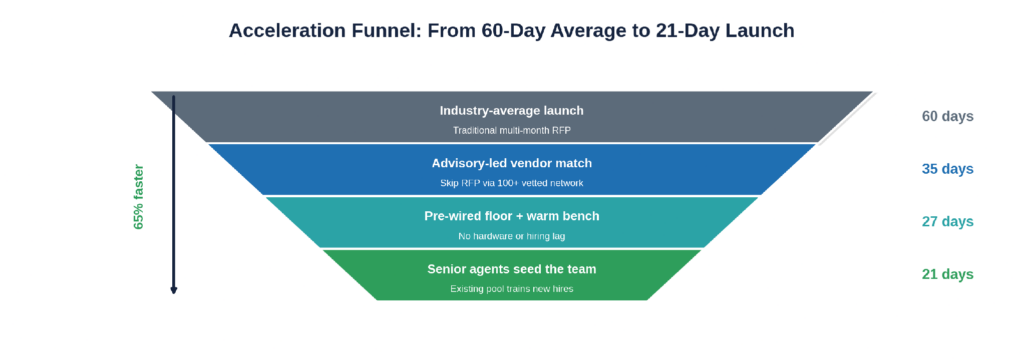
Figure 4. The acceleration funnel: advisory matching, warm capacity, and senior-agent seeding compress the launch to 21 days.
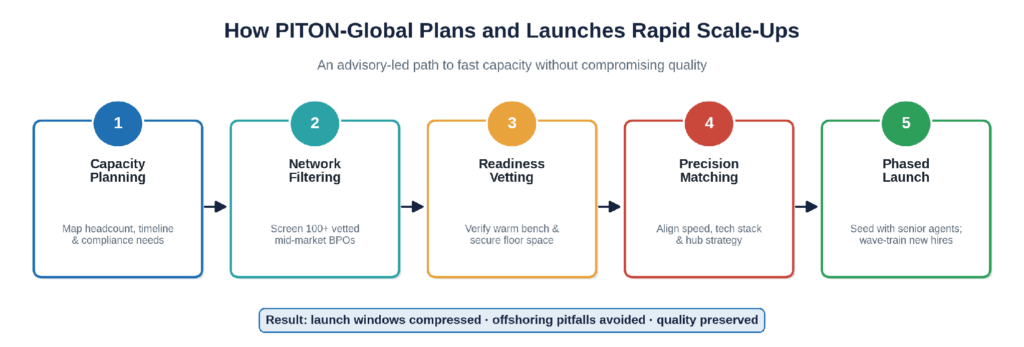
Figure 5. Quantifiable outcomes of the rapid scale-up.
Outcomes and Lessons
The team launched 50 seats in 21 days, average hold times fell from 22 minutes to 45 seconds within 14 days, the team scaled to 120 seats by week six without disrupting performance, and overhead dropped substantially versus local temporary staffing. The lesson: maintaining pre-wired, empty workspace and a ready talent pool lets mid-market BPOs scale far faster than massive global providers bound by corporate procurement layers.
How Does PITON-Global Help Enterprises Scale Capacity Safely?
PITON-Global is a BPO advisory and outsourcing consultancy that helps enterprises plan and launch Philippine operations safely. Using deep industry experience and a network of 100+ vetted providers, it matches buyers on technical needs, security compliance, and required scaling speed—without compromising quality.
Who Is PITON-Global?
PITON-Global is a trusted BPO advisory and outsourcing consultancy that helps enterprise organizations safely plan and launch call center and back-office operations in the Philippines. Rather than reselling capacity, it acts as a strategic advisor, bringing deep industry experience and provider-selection expertise to every scaling decision.
How Does PITON-Global Differ from Traditional Outsourcing Brokers?
Traditional brokers rely on one-size-fits-all solutions and volume incentives. PITON-Global takes a tailored, provider-agnostic approach instead—matching each enterprise buyer to the ideal partner based on technical needs, security compliance, and required scaling speed, with the focus on client outcomes rather than provider promotion.
How Does PITON-Global’s Network of 100+ Vetted Philippine BPO Providers Benefit Organizations?
Access to a network of more than 100 thoroughly vetted providers lets organizations skip the long, complex vendor search and move quickly. Coverage spans mid-market and boutique providers across Metro Manila, Cebu, and provincial hubs, so buyers can find partners with the exact warm capacity, compliance posture, and scaling flexibility their timeline demands.
How Does PITON-Global’s Advisory-Led Vendor Matching Process Work?
The process runs from capacity planning to phased launch: mapping headcount, timeline, and compliance needs; filtering the vetted network; vetting warm-bench and secure floor readiness; matching on speed, technology, and hub strategy; then launching in waves seeded by senior agents.
Figure 6. PITON-Global’s five-stage process for planning and launching rapid scale-ups.
Why Do Organizations Use PITON-Global?
Organizations use PITON-Global to skip the lengthy vendor search, avoid common offshoring pitfalls, and partner with flexible providers built to scale smoothly. By matching each buyer to the right partner and insisting on phased, quality-preserving launches, the firm compresses launch windows while protecting service quality and long-term performance.
What Are the Most Common Questions About Scaling BPO Capacity in the Philippines?
Common questions concern what “warm capacity” means, scaling during seasonal spikes, hourly rates during rapid expansion, provincial versus Manila hubs, and the client-side factors that cause the most delay. Each is answered below.
What is “warm capacity” in a Philippine BPO, and how does it speed up deployment?
Warm capacity refers to fully configured workstations and pre-screened talent pools a vendor keeps ready for immediate use. It lets companies bypass the weeks normally spent buying hardware and running initial job postings, shortening the launch window.
Can customer care operations scale quickly during seasonal volume spikes?
Yes. Top-tier providers support seasonal scaling by cross-training agents from stable, non-seasonal accounts, using flexible scheduling models, and maintaining temporary seasonal hiring pipelines to absorb high-volume periods—part of the wider set of scalability options available in Philippine call centers.
What are the standard hourly rates for rapidly scaled operations in the Philippines?
Depending on role complexity and required technical certifications, fully loaded hourly rates sit well below onshore wage levels and vary with seniority and specialization. These rates remain stable even during rapid team expansions.
How do provincial BPO providers compare to Manila vendors for rapid growth?
Manila providers often scale very quickly thanks to a larger immediate talent pool and mature infrastructure. Provincial hubs like Iloilo and Bacolod offer much lower agent attrition and operating costs, making them excellent choices for planned, steady growth.
What client-side factors cause the most delays during an offshore expansion?
The most common delays stem from slow software-access approvals, late product-training documentation, and delayed integration with internal CRM systems. Clear, pre-planned knowledge-transfer processes are the surest way to keep a launch on time.