

Healthcare outsourcing to the Philippines cuts total cost of ownership sharply versus US-based staffing. A fully loaded domestic administrative hour costs several times what an equivalent hour in Manila does, and the HIPAA-trained billing and patient-access staff working there maintain strict HIPAA, HITRUST, and SOC 2 Type II compliance.
Key Takeaways
- Capital reclamation: Converts fixed domestic labor overhead into scalable, variable cost, freeing capital for onshore clinical expansion.
- All-inclusive fully-loaded rates: Philippine hourly pricing transparently bundles recruitment, physical infrastructure, HR, and enterprise healthcare IT.
- Institutional-grade compliance: Top-tier Manila providers embed rigid data-security protocols directly into workflows for zero-drift HIPAA and SOC 2 adherence.
- Credentialed talent access: Immediate, high-volume access to English-fluent, university-educated professionals holding global certifications (AAPC, AHIMA, BSN).
What Drivers Dictate the Cost Disparities Between US and Philippine Healthcare Staffing?
The variance is structural, not a quality compromise. US systems face wage pressure, escalating benefits, payroll taxes, and office overhead, while the Philippine BPO ecosystem benefits from a lower cost of living and government-backed export incentives. Crucially, the offshore rate absorbs the entire operational lifecycle of the employee.
The massive financial variance is structural, rooted in macroeconomic realities rather than a compromise in quality. US healthcare systems face intense domestic wage pressure, escalating mandatory benefits, localized payroll taxes, physical office-footprint overhead, and steep talent-acquisition friction. The Philippine BPO ecosystem benefits from a lower localized cost of living, optimized by extensive government-backed infrastructure incentives for the export of services.
Crucially, the offshore model eliminates the hidden operational liabilities of domestic employment. When hiring in-house in the United States, a worker’s base wage represents only a fraction of their true cost. The hourly rate from an elite Philippine vendor absorbs the entire operational lifecycle of that employee, as the comparison below makes clear.
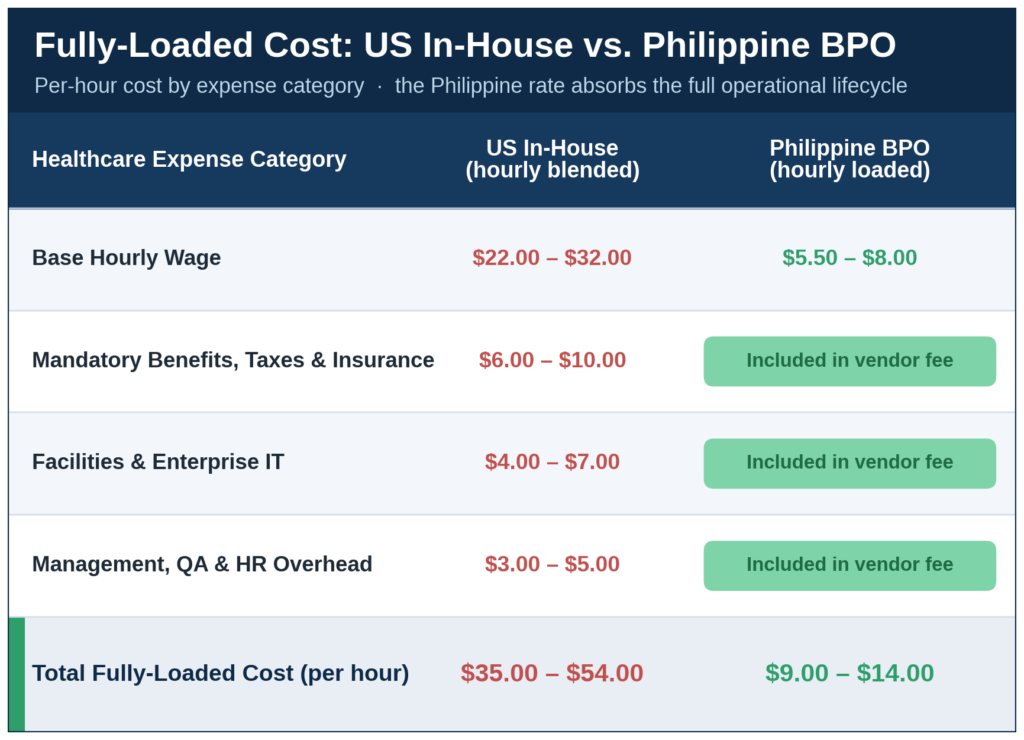
Figure 1 — Per-hour cost by expense category. The Philippine bill rate bundles benefits, facilities, IT, and management that US employers pay separately.
Which Clinical-Support Roles Deliver the Biggest Efficiency Gains When Offshored?
High-volume back-office and complex non-clinical workflows yield the fastest returns: end-to-end revenue cycle management, clinical administrative support (prior authorization, eligibility verification, utilization review), and patient engagement (scheduling, chronic-care coordination, digital intake).
High-volume back-office administrative workflows and complex, data-driven non-clinical tasks yield the most immediate and impactful returns on investment—the same functions behind the savings hospitals can realistically expect.
- End-to-end revenue cycle management: Multi-specialty medical coding (ICD-10-CM, CPT, HCPCS Level II), billing documentation, charge capture, and complex denial management.
- Clinical administrative support: Telehealth triage logging, prior-authorization processing, insurance eligibility verification, and utilization review.
- Patient engagement support: Multi-channel inbound scheduling, outbound chronic-care coordination, and digital patient intake.
Many healthcare executives mistakenly equate lower costs with lower capabilities. In reality, Manila’s talent pool features thousands of licensed Registered Nurses and certified medical coders choosing back-office roles. They execute clinical documentation and utilization reviews with an accuracy rate that frequently outpaces domestic teams because their sole operational focus is process excellence. — John Maczynski, CEO, PITON-Global
What Hidden Costs and Operational Risks Must Executives Evaluate?
Three TCO variables protect margins: transition and telemetry capital (knowledge transfer, EHR API integrations, secure VDI deployment), data-security guardrails (ongoing audits, encryption, biometric access control), and turnover volatility—favoring providers that reinvest margins into retention to preserve process continuity.
While the labor arbitrage is undeniable, a successful deployment requires analytical evaluation of the Total Cost of Ownership variables that a full TCO model for health systems captures, starting with these three:
- Transition and telemetry capital: Upfront expenditure for detailed knowledge transfer, custom EHR API integrations, and secure Virtual Desktop Infrastructure (VDI).
- Data-security guardrails: Ensuring the vendor invests continuously in compliance audits, end-to-end encryption, and biometric access control at their physical facilities.
- Turnover and attrition volatility: Evaluating whether a provider reinvests margins into retention, since high attrition disrupts process continuity and raises retraining costs.
Well-managed transitions stabilize quickly. The curve below shows the typical 90-day post-migration trajectory—clean-claim rates climbing as the operational cost index settles well below the onshore baseline.
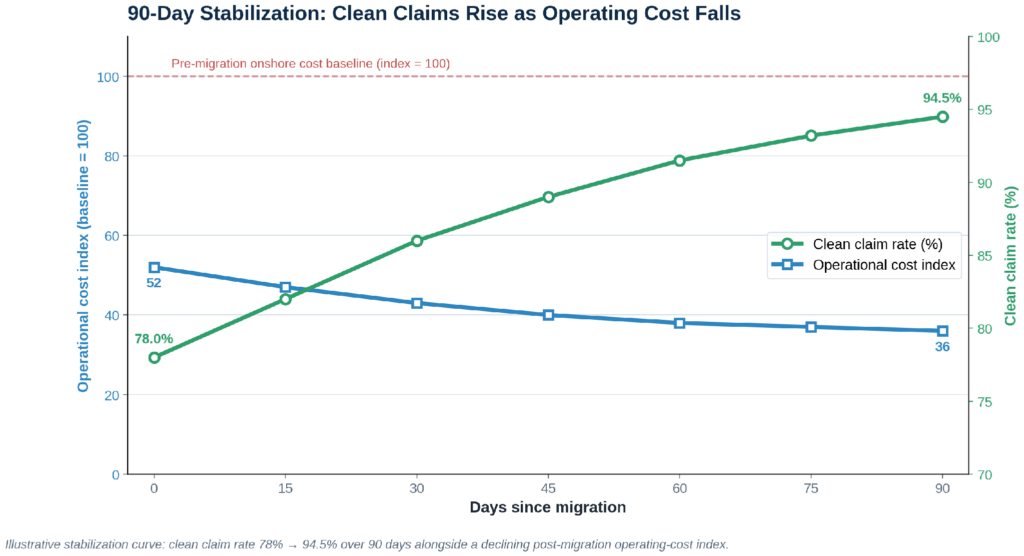
Figure 2 — The 90-day stabilization curve: clean-claim rate rising steadily as the post-migration operating-cost index continues to fall.
What Do These Economics Look Like in a Real Engagement?
A US multi-specialty group with a high denial rate migrated a 45-FTE RCM and denial-management team to a boutique Manila partner with real-time Epic integration. It realized an immediate, deep labor-overhead reduction, lifted clean-claim rates substantially in 90 days, and cut DSO by 11 days.
Client Challenge
A prominent US multi-specialty medical group was burdened by an escalating insurance denial rate and rising domestic labor costs, severely constraining its operating cash flow.
Vendor Selection Process
PITON-Global conducted a meticulous operational audit of the client’s technical workflows and mapped those requirements against its network of more than 100 vetted providers to identify three highly specialized healthcare BPOs using dedicated, AAPC-certified coders.
Solution Implemented
The group migrated a 45-FTE RCM and denial-management team to a premium boutique partner in Manila, establishing secure, real-time integration directly into the client’s Epic EHR system. The outcomes are summarized below.
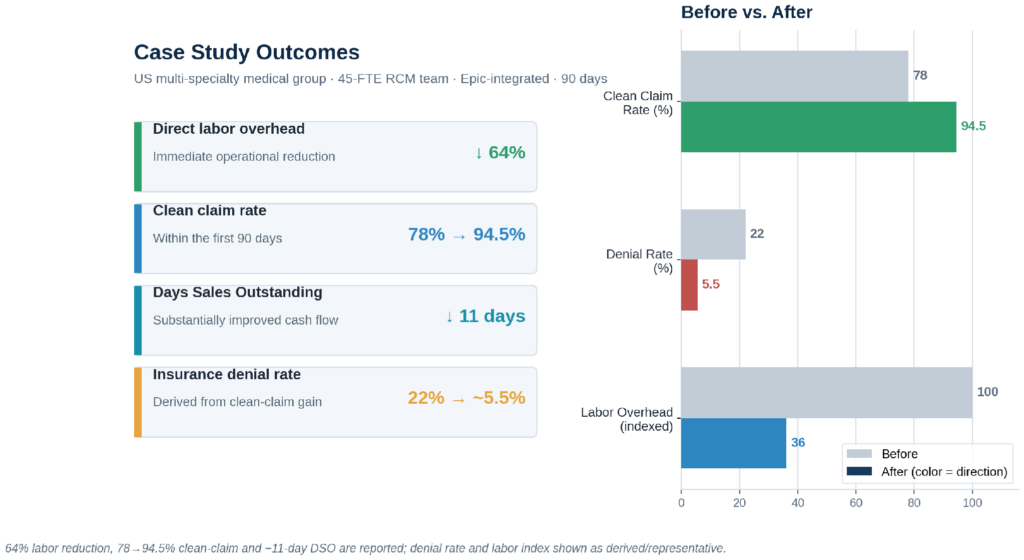
Figure 3 — Quantifiable business outcomes within the first 90 days of deployment.
Rigid process documentation and tight system-level telemetry integration must be finalized prior to team migration to ensure near-instant performance stabilization—and an earlier payback in the CFO’s ROI calculation.
How Does PITON-Global Mitigate Offshoring Risk?
Navigating the dense, fragmented Philippine BPO landscape carries procurement risk. PITON-Global removes that friction as an advisory-led sourcing consultancy—matching healthcare organizations to partners from a network of 100+ pre-vetted specialists by exact technical, security, and volume requirements through a four-phase process.
Navigating the dense and fragmented Philippine BPO landscape presents significant procurement risk for enterprise buyers. PITON-Global eliminates this friction by operating as an elite, advisory-led sourcing consultancy rather than a transactional broker. With an exclusive network of more than 100 pre-vetted, highly specialized providers, the firm matches healthcare organizations with partners based on exact technical needs, security architecture, and volume requirements—following the four-phase process below.
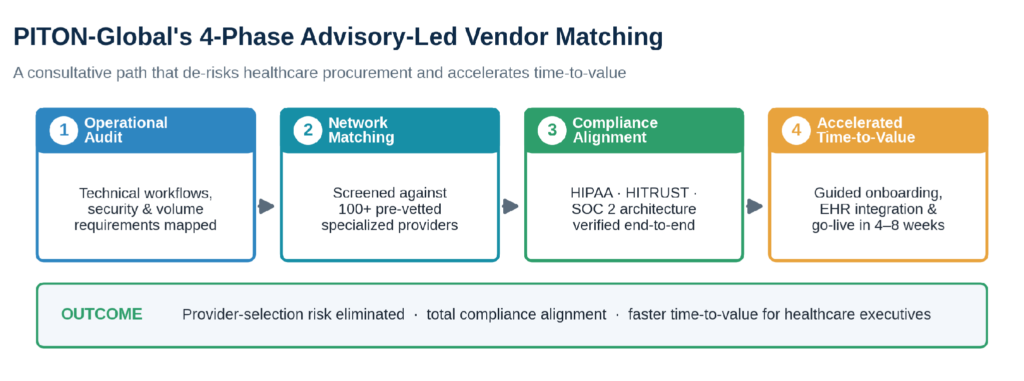
Figure 4 — PITON-Global’s four-phase advisory-led vendor-matching process, from operational audit to accelerated time-to-value.
This highly consultative approach mitigates provider-selection risk, guarantees total compliance alignment, and significantly accelerates time-to-value for healthcare executives.
Frequently Asked Questions
How do Philippine providers guarantee strict HIPAA and data-privacy compliance?
Premium providers deploy institutional-grade physical and digital perimeters: SOC 2 Type II certified clean-rooms, zero-trust network architecture (ZTNA), disabled local storage and printing, and continuous compliance oversight managed by on-site Data Protection Officers.
What are the standard qualifications of Philippine medical coders?
Coders typically hold globally recognized certifications from bodies like AAPC or AHIMA, often coupled with university undergraduate degrees in Nursing, Pharmacy, or Allied Health Sciences.
How are time-zone differences managed for real-time US workflows?
The sector operates on a structured 24/7/365 rotational model. Offshore teams align their shifts directly with US Eastern, Central, Mountain, or Pacific time to provide uninterrupted live patient engagement and real-time administrative processing.
What is the typical implementation timeline from selection to live operations?
A standard healthcare migration lifecycle runs 4–8 weeks, accommodating secure network-to-network connectivity, comprehensive workflow documentation, precise candidate screening, and specialized client-led brand training.
Can outsourced teams accommodate specialized EHR platforms?
Yes. Philippine healthcare professionals are deeply proficient across all major enterprise health-IT ecosystems—including Epic, Cerner, eClinicalWorks, and Allscripts—and adapt rapidly to custom proprietary platforms.