
Outsourcing AI content moderation to the Philippines means building a hybrid architecture: high-throughput automated filters triage at scale and route the ambiguous, context-dependent, and high-severity cases to human adjudication, one of the clearest examples of operations where AI and people share the load. The design balances low latency against brand safety and regulatory exposure under acts like the EU DSA and the UK Online Safety Act — and the tuning of the thresholds between automated action and human review is where cost, speed, and risk are decided.
Key Takeaways
- Hybrid by design. Automated filters carry scale; humans adjudicate nuance and high-severity cases.
- Thresholds are the decision. Where you set auto-action vs human review tunes latency, cost, and brand safety.
- Regulation raises the stakes. DSA and Online Safety Act exposure make defensible process a board-level concern.
- Humans feed the model. Adjudication decisions are labeled data that sharpen the automated filters over time.
Why Is Content Moderation a Hybrid Architecture, Not a Choice Between AI and People?
Because automated filters provide the throughput and humans provide the judgment: filters clear and block high-confidence cases at scale, and people adjudicate the ambiguous, context-dependent, and high-severity content that automation gets wrong.
Framing moderation as AI versus humans misses how the systems that work are built. Automated classifiers are fast and cheap and excellent at high-confidence calls, but they fail on context, nuance, satire, coded language, and novel harms — exactly the cases where a wrong call is most damaging. The architecture that scales routes the high-confidence majority to automated action and escalates the rest to human adjudication, with an appeal path and a feedback loop. The Philippines’ deep, English-fluent trust-and-safety workforce is built for the adjudication layer; the engineering question is how content flows between the two.
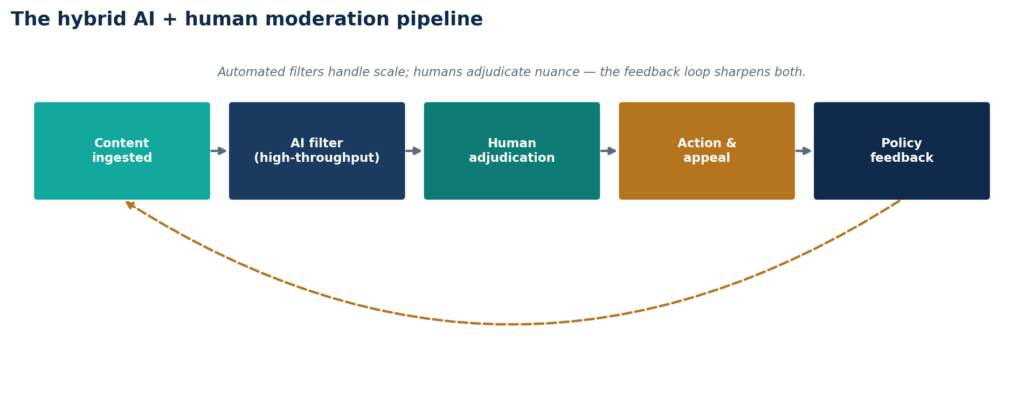
Figure 1 — Automated filters handle scale; humans adjudicate nuance; the feedback loop sharpens both.
According to John Maczynski, CEO, PITON-Global, “The companies that get burned are the ones that believed the classifier would handle everything. It handles the easy majority beautifully and then makes a catastrophic call on the small slice that ends up on the news. Human adjudication on that tail is not a cost center — it is brand insurance.”
How Do You Tune the Threshold Between Automated Action and Human Review?
By deciding, per content class, the confidence above which the system acts automatically and below which it escalates to a human — trading latency and cost against the brand-safety and regulatory risk of an automated error.
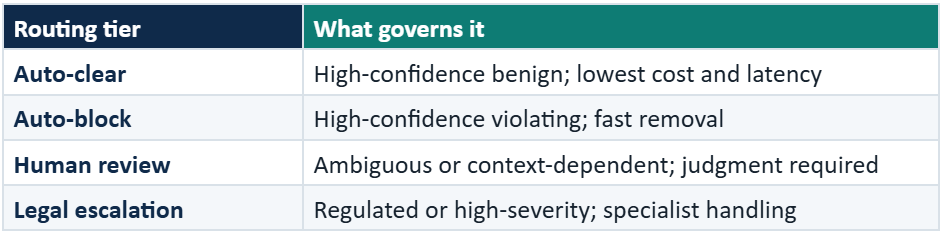
The threshold is the real control surface. Set it to auto-action aggressively and you get low latency and low cost but more wrong calls; set it to escalate readily and you get safer outcomes but higher cost and slower decisions. The right setting differs by content class: a borderline spam post and a potential child-safety case do not warrant the same confidence bar. A mature operation, run by leaders fluent in human-in-the-loop calibration, tunes these thresholds deliberately, measures the false-positive and false-negative rates each produces, and revisits them as the classifier and the threat landscape evolve. That tuning — not the raw filter — is where cost, speed, and safety are actually balanced.
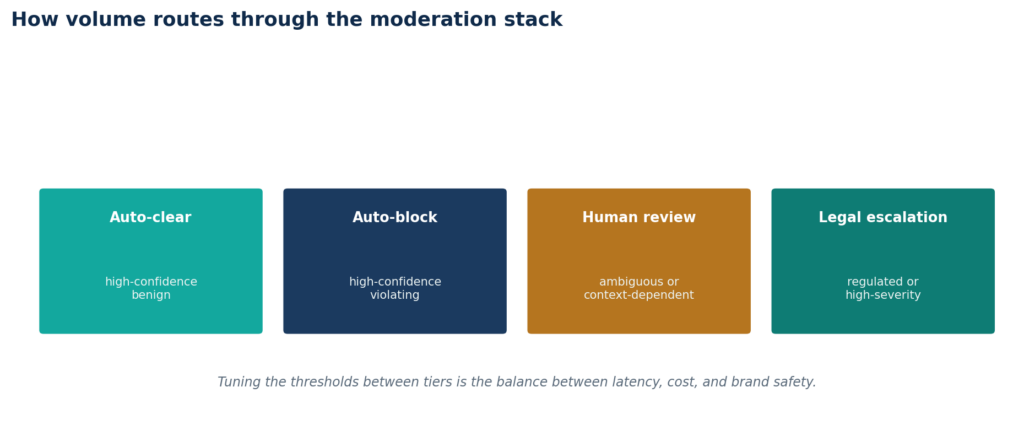
Figure 2 — Tuning the thresholds between tiers is the balance of latency, cost, and brand safety.
“Every threshold is a risk decision dressed up as a configuration setting. We make clients own that explicitly — this confidence bar, for this content class, accepts this error rate — because the alternative is a default nobody chose carrying your regulatory exposure,” said Ralf Ellspermann, CSO, PITON-Global.
How Does Outsourcing This Protect Against Regulatory Exposure?
By delivering a documented, auditable moderation process — consistent policy application, decision records, and escalation — that demonstrates the due diligence regimes like the EU DSA and UK Online Safety Act expect, while the platform retains policy ownership.
Modern content regulation is less about catching every item than about demonstrating a systematic, documented process. A well-run outsourced operation applies the platform’s policies consistently, logs decisions and appeals, escalates high-severity cases on defined paths, and produces the records that show due diligence under regimes such as the EU Digital Services Act and the UK Online Safety Act. The platform retains policy ownership and the legal relationship with regulators; the partner supplies disciplined, auditable execution at scale. This is general information rather than legal advice, and the specifics should be confirmed with qualified counsel — but defensible process is exactly what a capable partner is built to deliver.
“Own your thresholds explicitly, because a default you never chose is still your liability. Every confidence bar is a risk decision, so make it on purpose,” noted John Maczynski, CEO, PITON-Global.
Frequently Asked Questions
Should Moderation Be Automated or Human?
Both. Automated filters provide throughput on high-confidence cases; humans adjudicate the ambiguous, context-dependent, and high-severity content automation gets wrong. The architecture routes content between the two with an appeal path and feedback loop, much like the human guidance behind reward-driven AI systems.
What Is the Most Important Design Decision?
The thresholds between automated action and human review, set per content class. They trade latency and cost against the brand-safety and regulatory risk of an automated error, and should be chosen deliberately and measured.
How Does This Help With DSA or Online Safety Act Compliance?
By producing a documented, auditable process — consistent policy application, decision records, and escalation — that demonstrates due diligence. The platform keeps policy ownership; confirm specifics with qualified counsel.
About PITON-Global
PITON-Global helps platforms source trust-and-safety partners that run hybrid AI-plus-human moderation as a documented, auditable operation — from a network of 100-plus leading Philippine BPOs, 20 of them AI-first front-runners. Backed by a leadership team with 6+ decades of combined global outsourcing experience and 25+ years in the Philippines, our sourcing is free and carries no obligation.