

Locating AI and autonomy outsourcing in the Philippines is rarely a single-city decision. Manila offers the deepest talent pool and largest scale; Cebu adds strong talent with often lower attrition; Clark and the northern hubs add cost efficiency and geographic resilience. For mission-critical AV and AI operations the right answer is usually a primary hub plus a geo-diverse second site — a BPO footprint designed for business continuity, not just the lowest rate in one location. The same logic runs through the full scope of AI-company outsourcing work, from annotation to evaluation.
Key Takeaways
- Not one city. Mission-critical operations want a primary hub plus a geo-diverse second site.
- Manila for depth. The largest talent pool and deepest specialized skills sit in Metro Manila.
- Cebu for stability. Strong talent with often lower attrition and competitive cost.
- Clark for resilience. Cost efficiency and geographic diversity for business continuity.
How Do Manila, Cebu, and Clark Differ for AI and Autonomy Work?
Manila leads on talent depth and scale, including specialized AI and trust-and-safety skills; Cebu offers strong talent with often lower attrition and competitive cost; Clark and the north add cost efficiency and geographic diversity for resilience.
The three hubs play different roles. Metro Manila is the deepest market — the largest pool of experienced talent and the widest availability of specialized AI, engineering-adjacent, and trust-and-safety skills — which makes it the natural home for the most demanding or hardest-to-staff work, such as benchmarking models before real-world deployment. Cebu is a mature, strong-talent market that often shows lower attrition and slightly lower cost, attractive for operations where stability matters. Clark and the northern hubs bring cost efficiency and, importantly, geographic separation from Manila. For specialized AI and autonomy roles the depth difference is real, so the talent requirement often drives the primary-site choice.

Figure 1 — The right answer is usually a primary hub plus a geo-diverse second site, not a single location.
According to John Maczynski, CEO, PITON-Global, “Clients fixate on which city has the lowest rate and miss the real question, which is resilience. If your autonomy operation runs around the clock, a single site is a single point of failure. The smart footprint is a deep primary hub and a geographically separate backup — cost is the third consideration, not the first.”
Why Is a Multi-Site Footprint Usually the Right Answer?
Because mission-critical AI and autonomy operations cannot tolerate a single point of failure; a primary hub for depth plus a geo-diverse second site protects against weather, power, and local disruption while preserving the talent access the work requires.
For an operation that monitors live fleets or runs always-on trust-and-safety queues, continuity is not optional, and a single city — however deep its talent — concentrates risk from weather, power, and local disruption. The resilient pattern is a primary hub chosen for talent depth and a second site chosen for geographic separation, with the operation designed to fail over between them. This is a footprint decision, not a rate decision: you are buying business continuity and talent access together. Cost efficiency from a hub like Clark is a welcome third benefit, but it follows the resilience and talent logic rather than leading it. If the choice between an internal team and a vendor is still open, settle the build-versus-outsource question for AI support first.
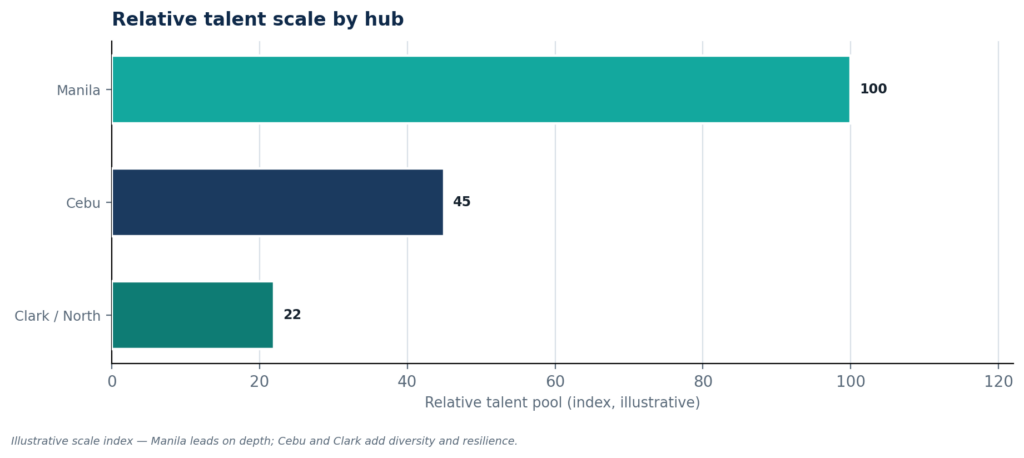
Figure 2 — Illustrative scale index; Manila leads on depth, Cebu and Clark add diversity and resilience.

“We map the talent requirement first — some specialized AI roles are realistically Manila-deep — then design the geographic redundancy around it. The location plan should fall out of the work and the continuity need, never out of a rate-card comparison alone,” said Ralf Ellspermann, CSO, PITON-Global.
How Should You Choose the Primary Site?
Start from the talent the work requires — specialized AI and autonomy roles are often Manila-deep — then layer in attrition, cost, and continuity, choosing a primary hub for capability and a second site for geographic diversity rather than optimizing any single factor.
The sequence matters. Begin with the talent the role actually demands: if the work needs specialized AI skills such as human judgment for generative AI evaluation, engineering-adjacent, or experienced trust-and-safety skills at depth, Manila is often the realistic primary. Then weigh attrition and stability, where Cebu can be attractive, and cost and resilience, where Clark and the north contribute. Finally, design the multi-site footprint so the primary hub supplies capability and the second site supplies geographic separation. Choosing this way — capability first, resilience second, rate third — produces a footprint that holds up operationally. Because labor markets shift, validate current talent and cost conditions before finalizing.
“Design for the day the lights go out in one city, not just the day everything works. A second site in a different region is inexpensive insurance against a very expensive outage,” noted John Maczynski, CEO, PITON-Global.
Frequently Asked Questions
Which Hub Is Best for AI and Autonomy Work?
It depends on the role, but specialized AI and trust-and-safety skills are deepest in Manila. Cebu offers stability and Clark offers cost and resilience — which is why a multi-site footprint usually beats a single city.
Why Use More Than One Site?
Mission-critical, always-on operations cannot tolerate a single point of failure. A primary hub for talent depth plus a geo-diverse second site protects against weather, power, and local disruption while preserving talent access.
How Should the Primary Site Be Chosen?
Capability first, resilience second, rate third: start from the talent the work requires (often Manila-deep for specialized roles), then weigh attrition, cost, and continuity, and design geographic redundancy around the primary hub.
About PITON-Global
PITON-Global designs Philippine location and multi-site footprint strategy for AI and autonomy operations — matching the talent requirement to the right hub and building geographic resilience — across a network of 100-plus leading Philippine BPOs, 20 of them AI-first front-runners. Our leadership carries 6+ decades of combined global outsourcing experience and 25+ years on the ground in the Philippines; advisory is free and carries no obligation.