

Modeling the unit economics of autonomous vehicle (AV) delivery support outsourcing to the Philippines starts with TCO per autonomous mile, where remote operations, monitoring, field recovery, and data/QA are the support stack. Outsourcing converts these from fixed payroll into variable cost, and the lever that drives profitability is the operator-to-vehicle ratio: as intervention rates fall, one operator supervises more vehicles, so support cost per mile declines instead of scaling linearly. The same per-mile lens applies across all outsourced fleet support for autonomous vehicles.
Key Takeaways
- Model per mile. TCO per autonomous mile, not headcount, is the unit a board can underwrite.
- Support is the marginal cost. Once hardware is deployed, people behind the fleet dominate cost per mile.
- The ratio is the lever. Vehicles-per-operator rising as interventions fall is the path to profitability.
- Fixed becomes variable. An offshore ROC flexes with fleet size and runs follow-the-sun without night premiums.
- Measure cost per delivery. The right denominator is per mile or per delivery, never the operator seat rate.
What Belongs in TCO per Autonomous Mile?
The support stack: remote operations, monitoring and the robot operations center, field recovery and rebalancing, and data and QA — each a variable cost per mile once the vehicle is deployed.
Hardware and capital dominate the build phase, but once a fleet is on the road the marginal cost of a delivery is overwhelmingly the people behind it. A defensible model decomposes support cost per mile into remote operations (assistance and exception handling), monitoring and the ROC, field recovery and rebalancing, and data and QA. Each is a line a CFO can track and each is separately sourceable, from the remote desks behind robotic last-mile delivery fleets to the corridor coverage that driverless long-haul trucking requires. Modeling them per mile rather than as a headcount budget is what lets you compare scenarios, set targets, and underwrite a path to profitability.
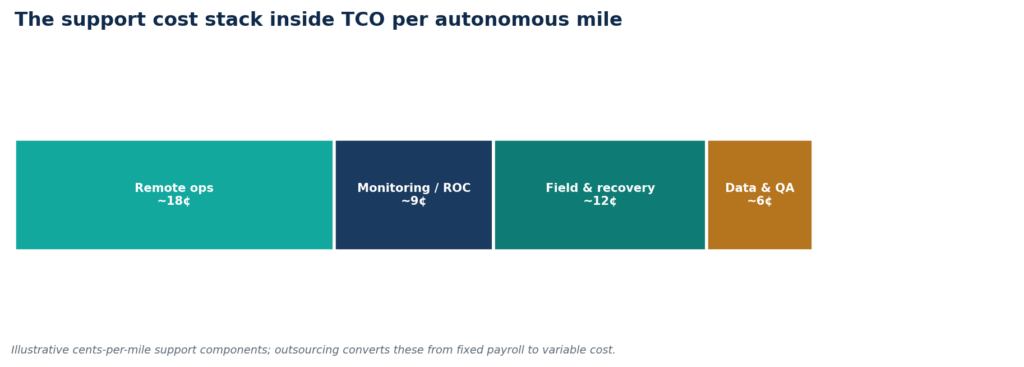
Figure 1 — Illustrative support components per mile; outsourcing converts these from fixed payroll to variable cost.
According to John Maczynski, CEO, PITON-Global, “Investors don’t underwrite headcount; they underwrite cost per mile and the curve it sits on. The moment you can show support cost per mile falling as the fleet scales, the conversation changes from burn rate to unit economics — and that curve is built in the operations model, not the pitch deck.”
Why Is the Operator-to-Vehicle Ratio the Lever That Drives Profitability?
Because support cost is set by how many operators you must staff; as autonomy matures and intervention rates fall, one operator safely supervises more vehicles, so cost per mile declines rather than scaling linearly with the fleet.
Early in a deployment, with high intervention rates, the operator-to-vehicle ratio is near one-to-one and support is expensive per mile. As the autonomy stack matures and the work shifts toward monitoring and assistance, one operator can safely supervise many vehicles. Engineering that ratio upward — through better tooling, edge-case playbooks, triage, and training — is what turns support from a linear cost into a declining cost per mile, and it is exactly what a capable outsourcing partner should be measured on. The ratio, not the wage, is the profitability lever.
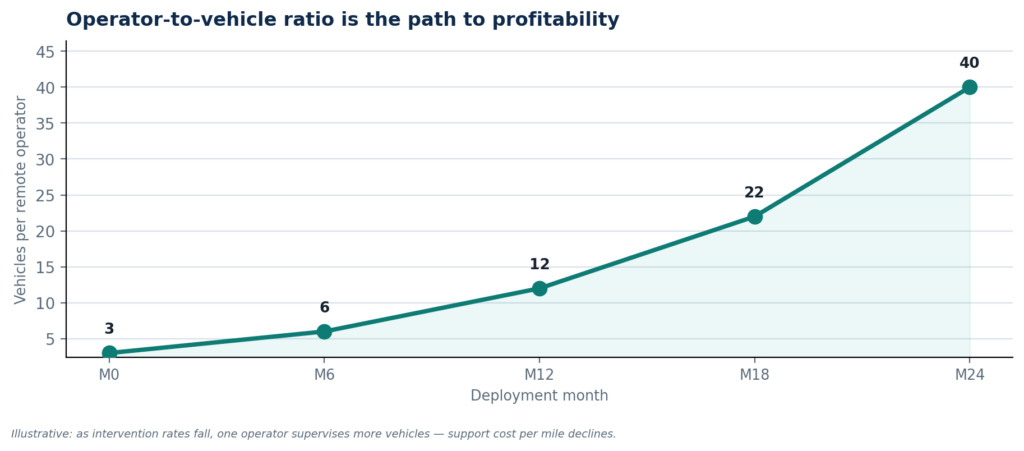
Figure 2 — Illustrative: as intervention rates fall, one operator supervises more vehicles; support cost per mile declines.
“The partners worth having are the ones who put the operator-to-vehicle ratio in the contract and commit to raising it safely over time. That single number, trended over twenty-four months, is the difference between a support line that scales linearly and one that bends toward profit,” said Ralf Ellspermann, CSO, PITON-Global.
How Does Outsourcing to the Philippines Change the Model?
It converts fixed domestic payroll into variable cost at a fraction of domestic labor cost, delivers follow-the-sun coverage from one center without night-shift premiums, and supplies the trained operators to raise the ratio — lowering cost per mile at every stage.
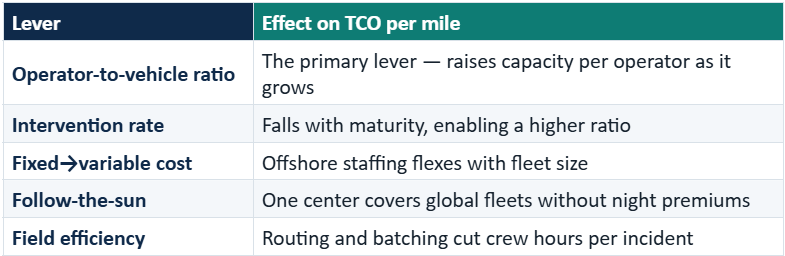
Plugging the Philippines into the model pulls several levers at once. Labor runs well below comparable onshore cost, and an offshore ROC turns support into a variable cost that flexes with the fleet rather than a fixed payroll with night-shift premiums. A single around-the-clock center covers U.S., EU, and APAC fleets follow-the-sun. And a mature operations workforce supplies the trained operators needed to push the operator-to-vehicle ratio upward safely, inside a clearly governed remote-intervention hand-off. Each lever lowers TCO per mile; together they are what make the unit economics of an outsourced support model close.
“The board does not fund vans, it funds a credible path to cost per mile. Build the support model around the operator-to-vehicle ratio and you are telling a unit-economics story, not a burn story,” noted John Maczynski, CEO, PITON-Global.
Frequently Asked Questions
What Is the Right Unit to Model AV Delivery Support On?
TCO per autonomous mile (or per delivery), decomposed into remote operations, monitoring/ROC, field recovery, and data/QA. Modeling per mile rather than per headcount is what lets you underwrite a path to profitability.
Why Does the Operator-to-Vehicle Ratio Matter So Much?
Because support cost is driven by how many operators you must staff. As intervention rates fall with maturity, one operator supervises more vehicles, so cost per mile declines instead of scaling linearly with the fleet.
How Does the Philippines Lower Cost per Mile?
By converting fixed payroll to variable cost at a fraction of onshore labor cost, covering global fleets follow-the-sun from one center without night premiums, and supplying trained operators to raise the operator-to-vehicle ratio safely.
About PITON-Global
PITON-Global helps autonomous-delivery operators model and source the support stack that makes unit economics close — from a network of 100-plus leading Philippine BPOs, 20 of them AI-first front-runners, shortlisted on their ability to raise the operator-to-vehicle ratio safely. Backed by a leadership team with 6+ decades of combined global outsourcing experience and 25+ years in the Philippines, our sourcing is free and carries no obligation.