
By industrializing surveillance. Insider-trading scandals, a 2026 Congressional probe, and a DOJ indictment have made market integrity prediction markets’ top operational priority — Kalshi alone opened 200+ investigations in 2025 and surpassed that in Q1 2026. Detecting manipulation, insider activity, and disputed resolutions requires a human-judgment layer at scale, which is why platforms turn to the Philippines’ trust-and-safety workforce.
Key takeaways
- Integrity is now the No. 1 priority. Kalshi’s head of enforcement has called insider-trading monitoring the platform’s top focus; it opened 200+ investigations in 2025 and exceeded that in Q1 2026 alone.
- The pressure is regulatory and public. A May 2026 House Oversight probe, a DOJ indictment over a classified-information trade, and candidate suspensions have made this an existential issue.
- Four threat classes dominate. Insider activity, market manipulation, resolution disputes, and account/access abuse — each needs different detection and review.
- Detection is a data-fusion problem. Signals are scattered across order books, wallets, KYC, news timestamps, and oracle data; the hard part is making them interoperable, then applying human judgment.
- The Philippines supplies the judgment layer. Its trust-and-safety bench provides scalable, 24/7 human review around the platform’s own tooling and final decisions.
Why has market integrity become prediction markets’ biggest operational risk?
Direct answer: Because high-profile insider-trading cases triggered federal scrutiny that now threatens the sector’s license to operate.
The reputational and regulatory stakes escalated sharply through early 2026. A New York Times investigation reported that more than 80 Polymarket users placed suspiciously timed trades — including wagers made hours before undisclosed military operations. In April 2026, a federal indictment alleged a U.S. Army soldier used classified intelligence to place a $33,000 Polymarket bet and cashed out roughly $400,000. Around the same time, Kalshi fined and suspended three federal candidates who bet on their own races. Then, in May 2026, the House Oversight Committee opened an investigation into Kalshi and Polymarket, demanding records on how they verify identities, enforce geographic restrictions, and flag anomalous trading.
The scale of the response tells the story. Kalshi launched more than 200 integrity investigations in 2025 and, by its enforcement head’s account, surpassed that figure in the first quarter of 2026 alone — with insider-trading monitoring now described as the platform’s top priority.
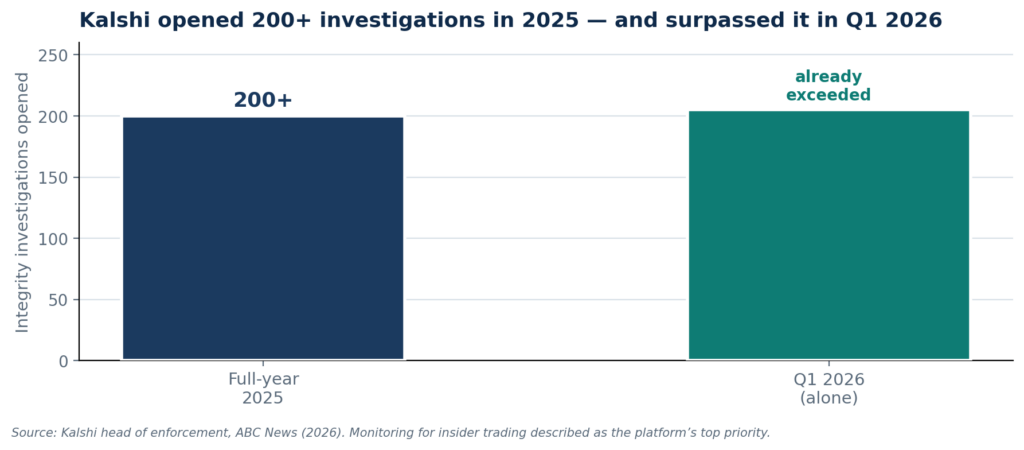
Figure 1 — Integrity caseloads are climbing fast. Source: Kalshi head of enforcement, ABC News (2026).
“Integrity is no longer a back-office function for these platforms — it is survival. When a congressional committee and the DOJ are both at your door, the question stops being cost per seat and becomes whether you can investigate every suspicious trade, defensibly, at the speed the market moves. That is a judgment-critical workflow, and it is exactly what automation alone cannot close.” John Maczynski — CEO, PITON-Global; former Global EVP of the world’s largest BPO provider
What integrity threats do prediction markets actually have to catch?
Direct answer: Four classes: insider activity, market manipulation, resolution disputes, and account or access abuse.
Each threat class behaves differently and demands a distinct detection-and-review motion. Insider activity involves trading on non-public information — the hardest to detect because it looks like a well-timed bet. Manipulation includes wash and spoof trading or coordinated rings that distort prices. Resolution disputes arise when an outcome is ambiguous or a data source conflicts. Account and access abuse covers geographic circumvention, multi-accounting, and bot or Sybil rings.
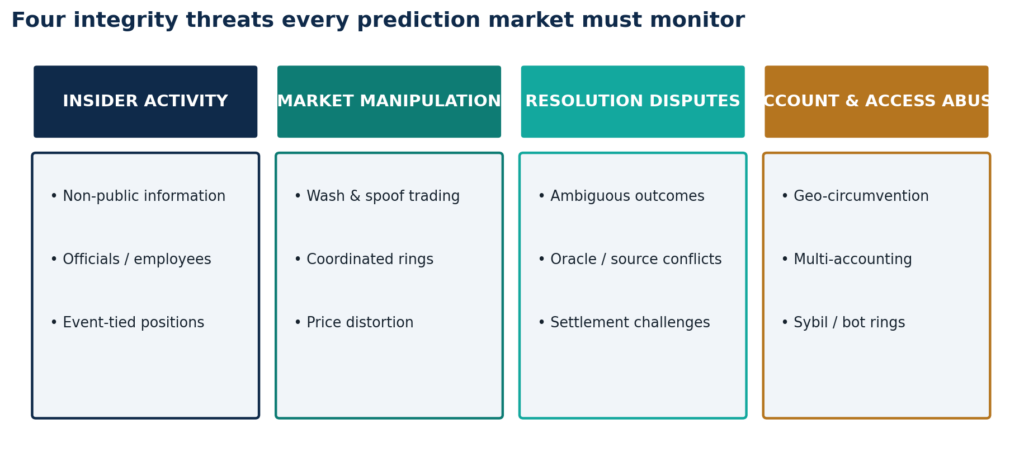
Figure 2 — The integrity workload is not one queue but four distinct threat classes.
In response, both leading platforms formalized market-integrity rules in March 2026 — barring politicians from trading on their own campaigns, athletes from their own leagues, and employees from contracts tied to their employers — and Kalshi adopted a sports-integrity screening overlay and an in-interface suspicious-activity report button. Rules, though, are only as good as the monitoring and review behind them.
Why can’t software alone solve prediction-market integrity?
Direct answer: Because the decisive signals are fragmented across systems, and judging intent requires human context machines lack.
Industry surveillance specialists describe the core difficulty bluntly: to identify manipulation or insider activity, teams must aggregate data from disparate sources — trading and order books, funding and wallet activity, KYC and onboarding systems, and third-party feeds such as league rosters, news timestamps, and oracle results — much of it scattered across different systems and ownership boundaries. The challenge is not only collecting the data but making it interoperable, then having a skilled reviewer decide whether a pattern is innocent or illicit.
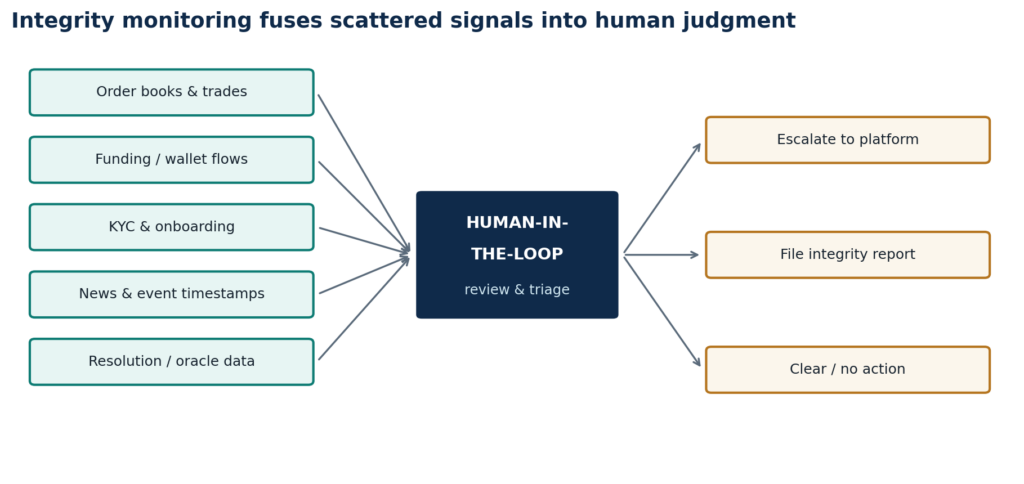
Figure 3 — Automated signals converge on a human-in-the-loop layer that triages, escalates, or clears.
That is fundamentally a human-in-the-loop problem at scale. Automated systems can surface anomalies, but distinguishing a lucky, well-timed trade from an insider one — or a legitimate hedging cluster from a coordinated ring — turns on context, affiliations, and timing that require trained judgment. As caseloads climb into the hundreds per quarter, that judgment has to be staffed elastically and around the clock.
Why are prediction markets outsourcing integrity work to the Philippines?
Direct answer: Because it is the world’s leading hub for scalable, high-judgment trust-and-safety work in English, aligned to U.S. hours and norms.
The Philippines built its reputation precisely on the kind of work integrity monitoring requires: content moderation, trust and safety, and complex investigative review that fuse cultural fluency with policy interpretation. The same human-judgment layer that platforms rely on to catch nuanced moderation threats maps directly onto reviewing suspicious trades, triaging disputes, and preparing escalation packages. Specialist teams integrate with a platform’s surveillance tooling, CRMs, and policies — typically within a 10–12 week framework — and operate 24/7 to match the event calendar.
| Integrity need | Why the Philippines fits |
| Suspicious-trade review | Deep investigative and trust-and-safety bench experienced in nuanced, high-stakes judgment. |
| Dispute triage | Mature case-handling and escalation workflows with clear audit trails. |
| 24/7 event coverage | Large contact-center base that surges into resolution windows and breaking news. |
| Policy interpretation | Cultural fluency and English proficiency aligned to U.S. and ANZ user bases. |
| Human-in-the-loop | Proven AI-plus-human models where agents supply the context automation misses. |
| Reviewer wellbeing | Established duty-of-care and wellness frameworks for high-intensity review work. |
Sources: PITON-Global and Philippine BPO sector reporting on trust & safety capabilities (2026). Confirm current scope with providers.
“Catching a suspicious trade is not so different from catching a coded threat in content moderation — it’s pattern, context, and judgment under time pressure. That is the discipline Philippine trust-and-safety teams have perfected. They give a prediction market an elastic review bench that surges when a market resolves, with the cultural fluency and care this work demands.” Ralf Ellspermann — CSO, PITON-Global; 25-year Philippine BPO veteran
Doesn’t outsourcing integrity create its own compliance risk?
Direct answer: Not when the boundary is respected: execution scales offshore, while final determinations and regulator-facing accountability stay with the platform.
Outsourcing integrity work does not mean outsourcing accountability. The defensible model keeps decision rights and regulatory responsibility with the platform and its officers, while the Philippine team supplies the scalable execution layer: monitoring queues, first-line review, dispute intake, evidence assembly, and escalation. When a congressional committee asks for internal records, the platform must be able to show a clean, auditable chain of who reviewed what and why — which a well-structured outsourced operation strengthens rather than dilutes. Done correctly, an elastic review bench improves coverage, consistency, and response time without surrendering control.
“The platforms that get this right do not hand over the keys — they extend their own integrity team. We help operators identify Philippine partners with genuine trust-and-safety depth and the audit discipline regulators now expect, matched to their products and jurisdictions. We do it free of charge and with no obligation, because we earn through our partner network, not the platform.” John Maczynski — CEO, PITON-Global; former Global EVP of the world’s largest BPO provider
Frequently asked questions
What is market integrity in prediction markets?
It is the set of controls that keep trading fair — detecting and acting on insider trading, market manipulation, disputed resolutions, and account or access abuse — so prices reflect genuine information rather than exploitation.
Why is integrity suddenly such a focus in 2026?
A New York Times investigation into suspiciously timed trades, an April 2026 DOJ indictment over a classified-information bet, candidate suspensions, and a May 2026 House Oversight probe have made integrity an existential, regulator-driven priority.
Can integrity monitoring be fully automated?
No. Automated tools surface anomalies, but distinguishing illicit activity from coincidence requires human judgment about context, timing, and affiliations — a human-in-the-loop layer that must scale 24/7.
What stays with the platform when integrity work is outsourced?
Final determinations, enforcement decisions, regulatory filings, policy ownership, and regulator-facing accountability. The outsourced team handles monitoring, first-line review, dispute intake, and escalation around that core.
About PITON-Global
PITON-Global is a vendor-neutral outsourcing advisory with 25+ years in the Philippine market, connecting high-growth and regulated platforms with industry-leading BPO providers across trust & safety, fintech, and complex CX. We help prediction-market operators source and vet the right Philippine integrity and support partner — free of charge and with no obligation.
Editorial note: regulatory and enforcement details are current as of mid-2026 and drawn from the sources above; verify against primary sources before acting. Attributed quotes should be confirmed by the named executives prior to publication.