

Outsourcing administrative and non-clinical work to the Philippines lets health systems decouple fixed overhead from patient volume. By integrating a scalable offshore “shadow workforce” of HIPAA-trained revenue-cycle pods for US hospitals, departments can dynamically adjust staffing for revenue cycle management, coding, and data processing — keeping in-house clinicians focused on patients while offshore pods absorb the administrative surge.
Key Takeaways
- Elastic capacity: Move from fixed-cost internal staffing to a variable, “pod-based” model that scales in lockstep with admissions and billing cycles.
- Decoupled overhead: Shift non-clinical burdens — insurance verification, prior authorizations — to offshore specialists, cutting domestic labor cost substantially.
- Clinician focus: Remove repetitive data-entry and clerical work from nurses’ and physicians’ scope of practice to reduce burnout.
- AI-augmented accuracy: Use offshore “human-in-the-loop” teams to audit AI-generated coding and documentation, catching errors before claims reach a payer.
Why Do Traditional In-House Staffing Models Create Operational Rigidity?
Because hospitals treat administrative labor as a fixed cost while patient volume is inherently volatile. When volume spikes, departments must either pull clinicians into clerical roles — inefficient and burnout-inducing — or wait out 3–6-month local recruitment cycles, leaving them paying peak-time wages for baseline tasks.
This “fixed-capacity trap” is structurally unable to respond to sudden shifts in patient acuity or regulatory billing requirements without sacrificing quality or profitability. The hospital absorbs the full cost of peak staffing year-round, even when demand falls well below it — and the same rigidity is why chronic hospital workforce shortages hit administrative departments first.
How Do Philippine Outsourcing Models Provide Structural Flexibility?
They use a “pod” model that operates as an extension of existing hospital staff, enabling near-instant scalability domestic temp agencies cannot match — thanks to the country’s vast pool of healthcare-trained professionals. The result is variable cost that tracks volume instead of a fixed plateau.

Figure 1. Decoupling administrative capacity from patient volume.
The economics are the clearest illustration. An in-house team is a fixed-cost plateau — you pay peak-time wages year-round — while an outsourced pod is an elastic curve that rises and falls with patient volume. The shaded gap is spend avoided on idle capacity.
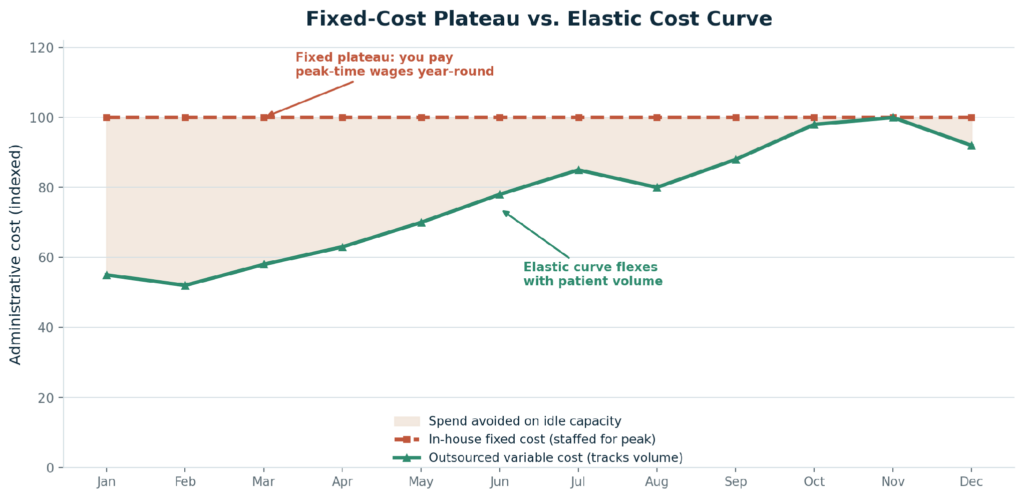
Figure 2. The fixed-cost plateau of in-house teams versus the elastic cost curve of outsourced pods.
Across the levers that matter most — agility, cost structure, coverage, and expertise — the two models diverge sharply.

Figure 3. In-house model versus an outsourced Philippine pod across four operational levers.
What Are the Operational Risks of Outsourcing Without Domain Expertise?
The biggest risk is engaging a “generalist” BPO. In healthcare, documentation and coding demand deep context — payer-specific denial rules, ICD-10 nuances, and HIPAA compliance — so the right model uses Philippine pods as a quality-assurance layer where human experts validate AI-driven coding before claims reach a payer.
This is the line between a simple cost-cutting move and a true revenue-cycle transformation: specialized pods drive denial rates down and net-collection rates up, while generalist or manual approaches leave revenue leaking. The shift is what separates the high-risk quadrant from the transformation quadrant.
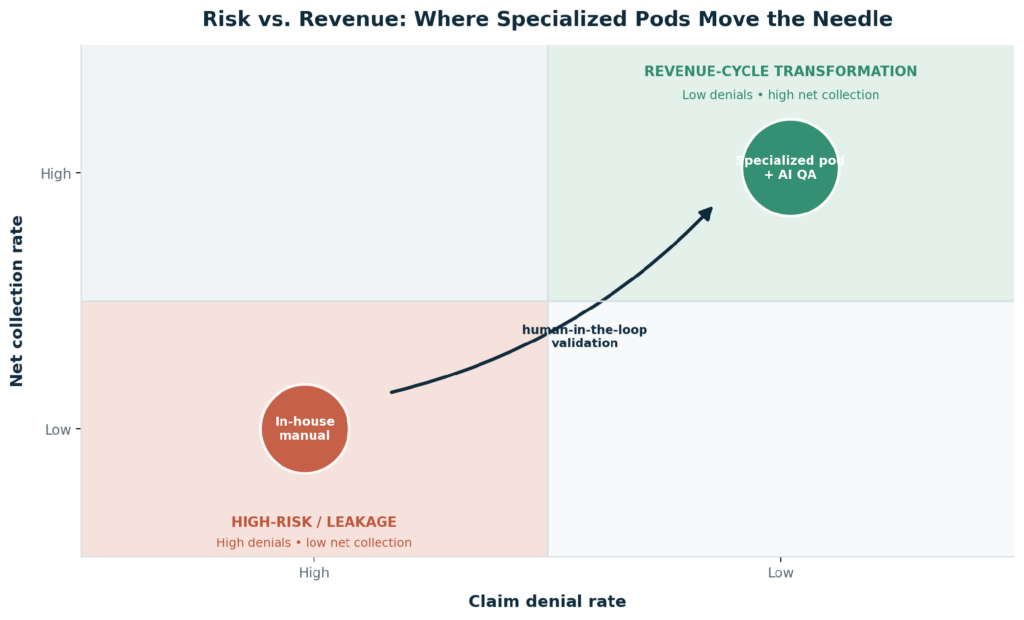
Figure 4. Risk versus revenue: where specialized pods with human-in-the-loop QA move the needle.
“Efficiency without accuracy is a liability in healthcare. You aren’t just offloading tasks; you’re offloading risk. The most effective systems use Philippine pods as a quality-assurance layer, where human experts validate the work of AI-driven coding engines, catching errors that would otherwise trigger claims denials. This is the difference between a simple cost-saving initiative and a true revenue-cycle transformation.”
— John Maczynski, CEO, PITON-Global
How Can Your Health System Transition to an Outsourced Support Model?
Successful integration replaces “throwing work over the wall” with a tiered strategy: a focused pilot, secure system synchronization, and outcome-based performance auditing. Crucially, the pod should work inside your EMR/EHR environment — not a separate silo — with a human-in-the-loop workflow that pairs AI speed with clinical judgment.
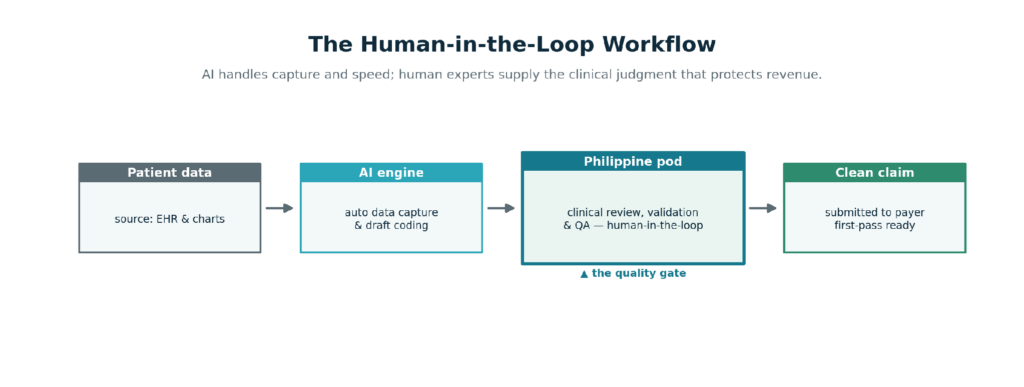
Figure 5. The human-in-the-loop workflow: AI captures and drafts; the offshore pod validates before submission.
The transition itself follows three steps. A pilot integration takes one high-friction, non-clinical task — patient eligibility verification, say, or payroll and HR processing for clinical staff — through a 90-day proof. System synchronization securely integrates the pod into your EMR/EHR. And performance auditing sets KPIs focused on first-pass clean-claims rate rather than labor cost alone, before scaling across departments.
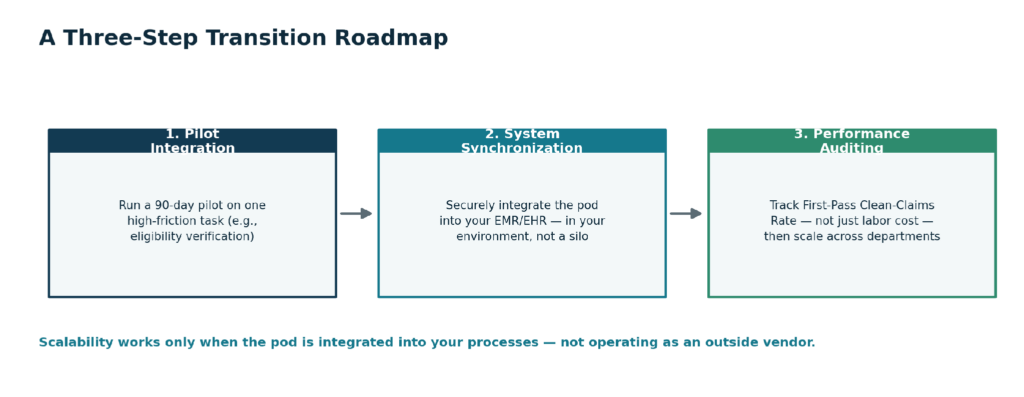
Figure 6. A three-step transition roadmap from pilot to department-wide scale.
What Does a Flexible RCM Pod Achieve in Practice?
It absorbs the administrative surge and reclaims leaking revenue. The representative composite below shows a multi-state health system reverse a denial crisis by integrating a 30-person RCM pod directly into its revenue workflow.
Consider a mid-sized hospital network with a stubbornly high claim denial rate, driven by manual data-entry errors and a severe insurance-verification backlog. Working through an advisory partner, it matched with a provider experienced in its specific EMR environment and integrated a 30-person RCM pod that audited claims in real time before submission.
Within six months, denial rates fell sharply, reclaiming significant annual revenue while easing the administrative load on internal nursing staff. The figures are an illustrative composite rather than a single named client, but the lesson is consistent: scalability works only when the provider is integrated into the client’s processes, not operating as an external vendor.

Figure 7. Representative revenue-cycle optimization from an integrated RCM pod (illustrative composite).
What Role Does PITON-Global Play in the Philippine Outsourcing Ecosystem?
PITON-Global is an advisory-led consultancy that partners with enterprise healthcare providers to navigate Philippine outsourcing. It does not operate as a traditional broker; it acts as an extension of the procurement team, using a network of 100+ vetted, industry-specific providers to ensure an initiative reduces risk rather than creating new operational dependencies.
Who Is PITON-Global?
PITON-Global is a healthcare-focused outsourcing advisory firm for the Philippine BPO market. It functions as an extension of a hospital’s procurement team, matching clinical and administrative needs to the right specialized provider.
How Does PITON-Global Differ from Traditional Outsourcing Brokers?
Brokers refer vendors for commission; PITON-Global is advisory-led and vendor-neutral. It vets partners not just on price but on clinical domain expertise, cultural alignment, and technical compatibility — the factors that actually determine outsourcing success.
How Does PITON-Global’s Network of 100+ Vetted Philippine BPO Providers Benefit Organizations?
A vetted network of more than 100 industry-specific providers lets hospitals quickly find pods with the right EMR experience and RCM certification — avoiding the “vendor mismatch” that is the most common cause of outsourcing failure.
How Does PITON-Global’s Advisory-Led Vendor Matching Process Work?
It begins with a diagnostic audit of the client’s workflows and systems, matches the client to a provider with proven expertise in the client’s specific EMR environment, and supports a tiered rollout — pilot, synchronization, and performance auditing — with KPIs centered on first-pass clean-claims rate.
Why Do Organizations Use PITON-Global?
Organizations use PITON-Global because outsourcing failure usually stems from vendor mismatch. The advisory process ensures a partner is vetted for clinical domain expertise, cultural alignment, and technical compatibility — turning a flexibility initiative into a durable operational advantage rather than a new dependency.
Frequently Asked Questions
Common questions concern HIPAA compliance, cross-time-zone quality, the effect on local staff, scaling speed, and the value of an advisory firm. The concise answers below address each.
Is Philippine BPO compliant with HIPAA?
Yes. Top-tier Philippine healthcare providers are SOC 2 Type II compliant and maintain physical, technical, and administrative safeguards that meet or exceed U.S. domestic standards, typically under a signed BAA.
How do we maintain quality across time zones?
The “follow-the-sun” model turns the time gap into an advantage: the Philippine pod performs overnight processing, so internal staff begin each day with processed claims and updated charts.
Does this replace our local admin staff?
No — it evolves their role. Offloading repetitive, non-clinical tasks frees local staff to focus on high-touch patient experience and care, which directly improves patient-satisfaction (HCAHPS) scores.
How quickly can we scale a pod?
For established roles, vetted partners can typically deploy a team within 30 days, including process-specific training and EMR access.
Why use an advisory firm like PITON-Global?
Because outsourcing failure usually stems from vendor mismatch. An advisory process vets a partner for domain expertise, cultural alignment, and technical compatibility — not just price.