

⚡ 30-Second Executive Briefing
- The 2026 Crisis: Global chargeback volumes are projected to hit 337 million transactions this year, a 42% surge from previous levels, driven by automated “friendly fraud” bots.
- The Manila Advantage: The Philippines has evolved into a Risk Intelligence Hub, utilizing CAMS-trained analysts and Agentic AI to lift win rates substantially while cutting manual handling, one strand of outsourced financial services, from KYC to collections.
- Financial Impact: Merchants using the offshore hybrid model achieve chargeback win rates well above the domestic average and substantial operational savings.
- Rapid Response Mandate: In 2026, responding to alerts within 60 minutes is the “Gold Standard.” Manila teams integrate with Ethoca and Verifi webhooks to stop chargebacks before they hit the merchant account.
- Security Mastery: Compliance is maintained through Zero-Knowledge Enclaves, ensuring sensitive cardholder data is monitored but never exposed to offshore analysts.
Executive Summary: The 2026 “Dispute Gap”
In 2026, the global payments landscape is being crushed by the “Dispute Gap.” While digital commerce has accelerated, so has the sophistication of “friendly fraud.” According to the latest 2026 Chargeflow Global Statistics, the risk to eCommerce has reached a staggering $132 billion, with merchants now losing an average of $3.75 for every $1 disputed due to compounding fees and labor costs, which has turned chargebacks management into a board-level concern.
Merchants ready to put a team on the dispute gap can use our guide to chargeback management outsourcing in the Philippines, which explains how the work runs, what to measure and where an outsourced disputes desk does not fit.
The Philippines has emerged as the global “Alpha Hub” for dispute resolution because it offers a rare surplus of financial analysts who understand the “Legal Chain of Evidence” required by card networks. These teams are no longer “back-office clerks”; they are revenue recovery specialists. To see how disputes management integrates into a larger resilience strategy, review the comprehensive Financial Services Outsourcing Philippines 2026 strategic blueprint outlining the full operational transformation model.
Recovering $3.75 for Every $1 Disputed: The 2026 Philippine Chargeback Strategy
In 2026, e-commerce faces a crisis of 337M chargebacks and a +42% surge in “Friendly Fraud”. This strategy details the Manila Response, where specialized hubs provide a 60-Minute “Gold Standard” Response to close the dispute gap. By moving from a reactive 48-hour US model to an integrated Philippine strategy, merchants increase their Win Rate from 22% to 71%. This shift effectively recovers $3.75 for every $1 disputed while slashing agent costs by over 60%.
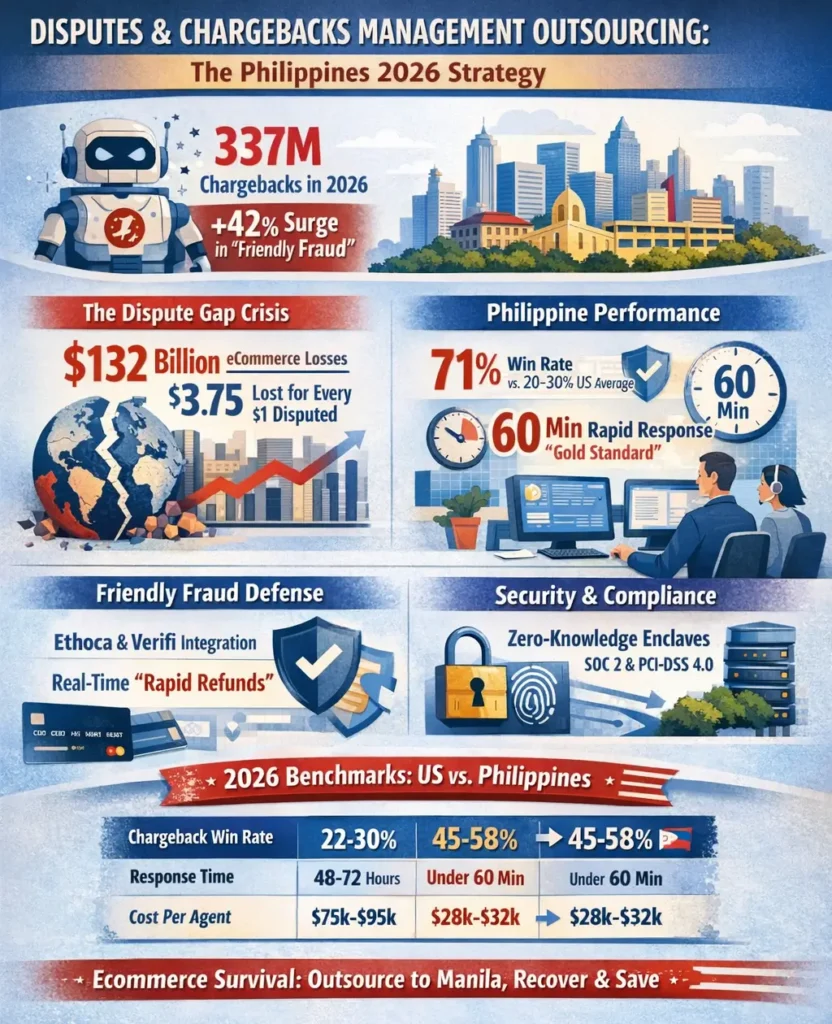
Reactive dispute models lose far more than the amount claimed once fees and labor are counted; this strategy turns “Friendly Fraud” into a recovery engine. Utilizing Ethoca & Verifi Integration, Manila-based hubs deliver “Rapid Refunds” and under 60-minute response times. This model secures consistently higher win rates and SOC 2 compliance through Zero-Knowledge Enclaves. It transforms chargeback management into a high-speed defense that protects merchant accounts and recovers billions in e-commerce losses.
The 24-Hour Accountability Era
In 2026, speed is no longer a luxury—it is a legal requirement. Card network rules now heavily favor merchants who provide “Rapid Alert Resolution.” John Maczynski, CEO of PITON-Global, emphasizes that a chargeback is no longer just an administrative task; it is a direct threat to a merchant’s processing relationship.
“The Philippines provides the only ecosystem where human intuition can keep pace with AI-driven friendly fraud,” Maczynski explains. “Our teams in Manila aren’t just filing paperwork; they are acting as Risk Pilots who use sub-second alerts to initiate refunds or push evidence in under 60 minutes, preventing formal chargebacks from ever occurring.”
Navigating the 2026 Margin Crisis
For many high-volume merchants, the “cost of doing business” has reached a breaking point. A 2026 Equifax Market Pulse report reveals that one in three industry leaders cites fraud and disputes as the primary threat directly impacting their business viability this year.
John Maczynski notes that for fintechs and retailers operating on thin margins, the math is devastating. By moving dispute operations offshore, firms aren’t just cutting labor costs; they are recovering millions in lost revenue that would otherwise be written off. Manila-based Dispute-Link Remediation teams resolve billing discrepancies on the spot, significantly accelerating the cash conversion cycle. This rapid resolution is the first step in a broader Accounts Receivable Outsourcing Philippines: 2026 Cash Flow Strategy, ensuring that once revenue is recovered, it is efficiently managed to maintain peak liquidity.
2026 Performance Benchmarks: US vs. Philippines
| Performance Metric | Legacy US In-House | 2026 Philippine AI-Hybrid | Economic Impact |
| Chargeback Win Rate | 22% – 30% | 45% – 58% | $4.1M+ Annual Recovery |
| Response Time (Alerts) | 48–72 Hours | < 60 Minutes | Protects Merchant Health Score |
| Representment Accuracy | 88% | 98.5% (ISO-Standard) | Prevents “Second Chargebacks” |
| Fraud Loss Reduction | 12% | 40% – 60% | Direct Margin Preservation |
| Fully Loaded FTE Cost | $75k – $95k | **$28k – $32k** | 65%–75% Operational Savings |
Industry-Specific Risk Mitigation
In 2026, Manila providers utilize customized evidence-matching logic based on industry-specific reason codes.
Dispute Landscape by Sector (2026 Forecast)
| Industry Sector | Primary Dispute Driver | Avg. Chargeback Value | Manila Recovery Strategy |
| SaaS & Subscriptions | “Forgotten Renewal” | $69 – $99 | Automated “Rapid Refund” via Alerts |
| Travel & Hospitality | Cancellations/Weather | $120 – $450 | Multi-document T&C verification |
| Digital Goods/Gaming | Unauthorized Agent/Child | $77 – $99 | IP-Matching & Usage Log Audit |
| Luxury Retail | “Not as Described” | $500+ | High-Touch Video/Photo Evidence |
Agentic AI: The “Risk Pilot” Model
The year 2026 is defined by Agentic Commerce—where autonomous AI agents frequently initiate purchases, the same shift reshaping card authorization and processing work. This has led to a surge in “Unauthorized Agent” disputes. Traditional systems cannot distinguish between a human error and a bot error.
Manila hubs now deploy Agentic Hybrid Workflows. In this model, AI Risk Pilots categorize disputes by win probability in milliseconds. For high-value disputes, Filipino specialists step in to craft personalized representment letters. This synergy allows AI to handle the volume of low-ticket tickets while humans maximize recovery on high-stakes cases.
Solving the “Friendly Fraud” Pandemic
Friendly fraud now accounts for nearly 75% of all disputes in 2026. By connecting directly to Ethoca and Verifi webhooks, Manila teams can intercept a dispute the moment it is logged. This allows merchants to resolve the issue with the customer immediately—often through a “Rapid Refund” that costs less than the eventual chargeback fee. Maczynski highlights that this proactive approach has successfully moved 2026 merchants out of “High-Risk” monitoring tiers within 90 days.
Security and Data Sovereignty: Zero-Trust Representment
In 2026, financial data security is a non-negotiable priority. Offshore A/R operations now utilize Zero-Trust Access models, ensuring analysts work in Read-Only Sandboxes where they can reconcile data without unilateral transfer rights. Every workstation is secured via Biometric Identity Confirmation, and providers maintain strict adherence to SOC 2 Type II and PCI-DSS 4.0 requirements.
Expert FAQ (2026 Dispute Briefing)
- Q: How do you handle the new “AI-Initiated” payment disputes?
- A: Our Manila teams are specifically trained in 2026 Liability Models that define accountability when an AI agent makes an unauthorized purchase.
- Q: Can a Philippine team improve our Visa/Mastercard monitoring status?
- A: Yes. By implementing Rapid Alert Resolution, we can often materially reduce formal chargeback volume within the first three months.
- Q: Is this only for high-volume merchants?
- A: No. Even for mid-market merchants, Manila analyst rates make professional dispute management a profit-positive move.