

⚡ 30-Second Executive Briefing
- The 2026 Problem: Autonomous AI agents now drive 14% of global transactions, creating a $117B “Dispute Gap” fueled by “Bot-to-Bot” errors and automated friendly fraud.
- The Manila Solution: The Philippines has transitioned into a Strategic Intelligence Hub, integrating Agentic AI with human “Risk Pilots” to verify intent where automated filters fail, within financial operations priced on risk-adjusted yield.
- Financial Impact: Merchants leveraging this hybrid model achieve sharply lower fraud losses, markedly higher chargeback win rates, and substantial operational savings.
- Compliance Mastery: Continuous PCI-DSS 4.0 “Live State” and SEC Cyber Resilience (36–72 hour reporting) are maintained through Zero-Knowledge Enclaves.
- Revenue Lift: By reducing false declines through Precision Authorization, merchants recapture top-line revenue that over-cautious filters used to turn away.
Executive Summary: The 2026 “Agentic Commerce” Collision
In 2026, the global payments landscape is defined by Agentic Commerce—a paradigm where autonomous AI agents now authorize an estimated 14% of global C2B transactions. While this automation has accelerated commerce, it has also birthed a new crisis. According to the latest data from the Nilson Report, global card fraud losses have hit $33.41B, but the real threat lies in the “Dispute Gap.” Merchants are losing billions not to simple theft, but to “Bot-to-Bot” transaction errors and automated friendly fraud, the new workload for every credit card processing team.
Credit card processing outsourcing to the Philippines has consequently shifted from a back-office utility to a frontline Strategic Intelligence Hub. By merging the Philippines’ cultural affinity for Western finance with Agentic AI-Human Hybrids, Manila-based operations are delivering the only scalable defense against this hyper-automated landscape. For a deeper look at how payment operations and fraud governance converge within a unified offshore strategy, read the complete Financial Services Outsourcing Philippines (2026): A Strategic Blueprint.
Bridging the $117B “Dispute Gap”: The 2026 Philippine Strategy for Payment Mastery
In 2026, 14% of global transactions are driven by AI agents, leading to a massive surge in bot-to-bot errors. This strategy details the Manila Solution, where Agentic AI and Filipino “Risk Pilots” verify intent to prevent fraud before it hits the ledger. By transitioning to a Philippine-based processing hub, merchants achieve transaction speeds of <6 seconds (down from the U.S. average of 45) and a 71% chargeback win rate. This operational pivot delivers 65–75% cost savings while ensuring PCI-DSS 4.0 compliance and 36-72 hour SEC-resilient reporting.
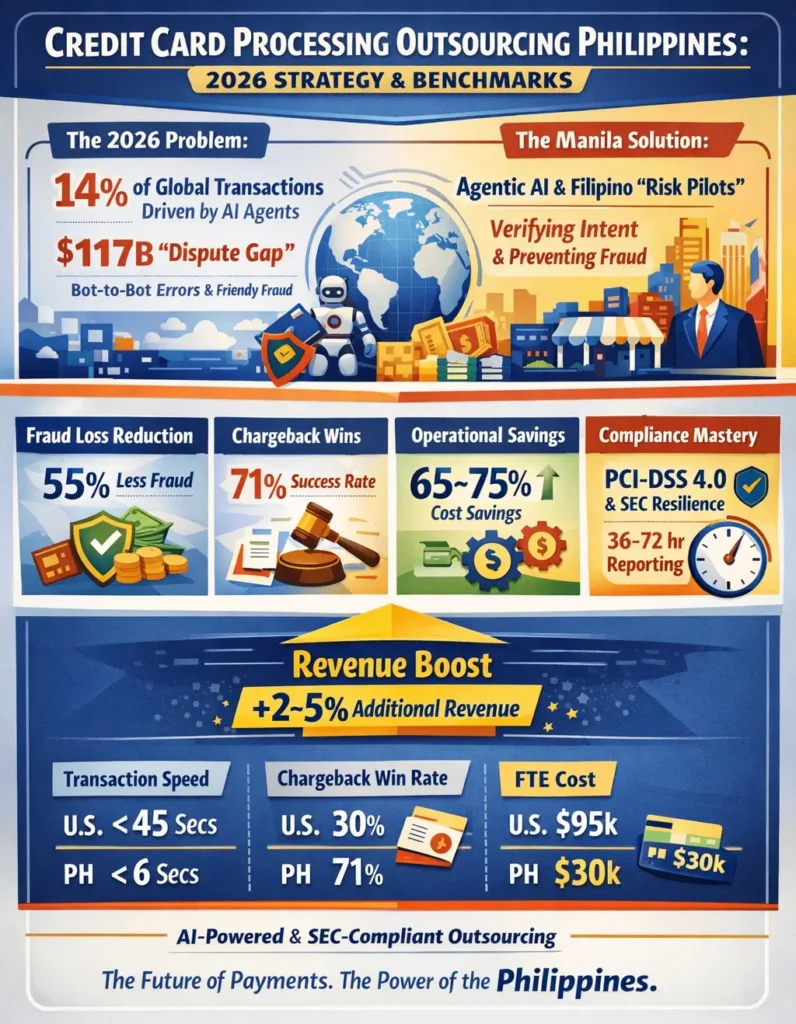
Old-school processing is plagued by a widening “Dispute Gap”; this strategy uses Intelligence Arbitrage to reclaim lost margins. By deploying Risk Pilots to verify human intent, Manila hubs cut fraud sharply and lift revenue. With transaction speeds under 6 seconds, this model ensures SEC-Compliant resilience, turning payment processing into a high-speed engine of Global Revenue Growth.
The Compliance Catalyst: Continuous PCI-DSS 4.0 “Live State”
By February 2026, PCI-DSS 4.0 is no longer a periodic checklist; it is a continuous “Live State.” Compliance now requires a Targeted Risk Analysis (TRA) for every control frequency. Traditional domestic firms are buckling under the weight of the 2026 SEC Cyber Resilience Framework, which mandates material incident disclosure within 36 to 72 hours.
Elite Manila providers have responded by deploying “Compliance-as-Code” infrastructures. These centers operate as Zero-Knowledge Enclaves, ensuring that sensitive Cardholder Data (CHD) is monitored by AI 24/7. In this environment, Filipino “Risk Pilots” manage high-stakes exceptions that automated systems are prone to miss, ensuring that the SEC’s stringent reporting windows are consistently met without disrupting the transaction flow.
Solving the “Bot-to-Bot” Dispute Crisis
The year 2026 is defined by “Agentic Friction.” When a consumer’s AI agent mistakenly triggers a high-value purchase or a sophisticated fraud bot mimics a user’s biometric signature, standard rules-based filters inevitably fail. Some might argue that 2026 is the year where standard rules-based filters simply cease to be effective.
In this landscape, offshore teams use Agentic AI to analyze sub-second anomalies, acting as a “Trust Layer” that verifies intent rather than just processing swipes. By moving operations to Manila, merchants are seeing a 55% reduction in fraud losses. This success stems from the ability to identify “intent drift”—where an AI agent acts outside its owner’s historical preferences—and intervening before the transaction settles. This transition allows merchants to maintain the fluid, “frictionless” experience that 2026 consumers demand while simultaneously hardening their defenses against bot-driven disputes.
Reclaiming EBITDA through Chargeback Recovery
The financial stakes in 2026 are binary: a merchant either recovers their revenue or suffers a permanent erosion of their margin. Global chargeback costs are projected to exceed $117 billion this year, making recovery a critical component of corporate survival. John Maczynski, CEO of PITON-Global, notes that in this “Accountability Era,” a chargeback is no longer a back-office administrative task; it is a direct threat to a merchant’s processing relationship and overall valuation.
To combat this, Manila hubs have been reimagined as “Dispute Command Centers.” These centers utilize specialized AI to retrieve merchant evidence in milliseconds, coupled with CAMS-trained (Certified Anti-Money Laundering Specialist) analysts who win high-probability representations. This synergy has lifted client win rates well above the domestic average. Maczynski argues that the Philippines provides the only ecosystem where human intuition can keep pace with AI-driven friendly fraud, moving beyond “fighting” disputes to using Agentic Hybrid Teams to predict and intercept them before they ever hit the ledger.
2026 Comparative Performance Benchmarks: US vs. Philippines
| Performance Metric | Legacy US In-House | 2026 Philippine AI-Hybrid | Economic Impact |
| Transaction Decisioning | < 45 Seconds | < 6 Seconds | Prevents $1.4M+ Cart Abandonment |
| Chargeback Win Rate | 28% – 32% | 68% – 75% | **$4.1M+ Direct Annual Recovery** |
| False Decline Rate | 4.8% | < 1.1% | 3.2% Direct Top-Line Revenue Lift |
| Compliance Status | Periodic Scramble | Continuous (Zero-Drift) | Total Regulatory De-risking |
| Dispute Resolution Time | 18 – 30 Days | 7 – 12 Days | 60% Faster Cash Flow Re-entry |
| Fully Loaded FTE Cost | $85k – $115k | **$28k – $34k** | 65%–75% Operational Savings |
Diving Deeper: The Rise of “Precision Authorization”
One of the most damaging realities for merchants in 2026 is the $20B False Positive Problem. Over-aggressive AI filters are currently declining more legitimate customers than actual fraudsters because they lack the nuance to distinguish between a “risky” transaction and a “novel” one. The Philippines has solved this through a model known as Precision Authorization.
The Three-Tiered Precision Model:
- Tier-1 Agentic Filtering: AI agents process millions of routine pings in milliseconds, handling the large majority of traffic autonomously.
- Tier-2 Human Context: Manila-based analysts (Risk Pilots) intervene on high-value “gray area” transactions—such as a large crypto purchase or luxury cross-border travel—that domestic AI would simply block as “atypical.”
- The Revenue Result: This hybrid model allows merchants to approve more of the transactions that were previously lost to “safe-bet” domestic declines. In a trillion-dollar economy, that lift is the difference between market leadership and obsolescence.
Technical Architecture: Agentic AI Meets Human Intuition
The success of the Manila model in 2026 is rooted in its technical architecture. Unlike previous “bots” that followed rigid scripts, Agentic AI in Manila hubs uses Retrieval-Augmented Generation (RAG) to pull from massive card-network datasets in real-time. This allows the AI to “reason” through a dispute by comparing the current transaction against 200+ variables, including the user’s “Digital Twin” behavior.
When the AI reaches a confidence threshold below 90%, it triggers a seamless handoff to a Filipino agent. These agents are trained not just in customer service, but in Forensic Payment Analysis. They look for the “human markers” of a transaction—the emotional context of a purchase or the subtle patterns of social engineering—that even the most advanced 2026 AI cannot yet replicate.
Security and Data Sovereignty: The “Zero-Knowledge” Perimeter
In 2026, data sovereignty is non-negotiable. With the EU AI Act and CCPA reaching full enforcement, offshore centers have had to evolve. Philippine centers now utilize Biometric Desktop Monitoring and Hardware-Level Encryption at the agent workstation level.
No raw PAN (Primary Account Number) data ever touches an offshore server. Instead, Filipino agents interact with “tokens” through a Zero-Knowledge Architecture. This satisfies not only the technical requirements of PCI-DSS 4.0 but also the ethical and legal requirements of global data privacy laws. This “Perimeter-less” security model ensures that while the intelligence is offshore, the data remains within the merchant’s sovereign control.
Securing Your Share of the Digital Economy
Payment processing in 2026 is no longer a back-office function; it is a battle of intelligence. By leveraging credit card processing outsourcing in the Philippines, merchants gain an AI-powered, SEC-compliant infrastructure that transforms their “cost center” into a “profit engine.” However, as transaction volumes scale across diverse rails, this front-end efficiency must be supported by a robust Payment Operations Outsourcing Philippines: 2026 Strategic Blueprint to manage real-time settlement and global liquidity.
As the digital economy keeps expanding, the ability to authorize precisely, recover aggressively, and comply continuously—the same disciplines behind agentic loan processing and underwriting support—will define the winners of the next decade. At PITON-Global, we provide the strategic bridge to ensure your payment vision thrives in this high-stakes environment.
Expert FAQ (2026 Executive Brief)
- Q: How does the Philippines handle the “GENIUS Act” requirements for payment stablecoins?
- A: Elite Manila hubs have established Stablecoin Ops units. These teams manage bank-grade AML audits and ensure reserve transparency, reconciling on-chain ledgers with traditional bank systems in real-time to prevent “De-pegging” fraud.
- Q: Can offshore teams manage PCI-DSS Level 1 service provider requirements?
- A: Yes. The leading providers in Manila undergo quarterly on-site PCI assessments by QSA firms, providing a full Attestation of Compliance (AOC) to satisfy acquiring banks and global regulators.
- Q: What is the impact of Agentic AI on staff tenure in the Philippines?
- A: Tenure has increased to an industry-leading 34 months. AI handles the repetitive tasks, allowing agents to focus on high-level fraud investigations, which offers a more fulfilling and lucrative career path.