
Back
Autonomous Vehicle Edge-Case Labeling Outsourcing Philippines: Teaching Machines the Unpredictable

By Ralf Ellspermann / 16 March 2026
 Authored by Ralf Ellspermann, CSO of PITON-Global, & 25-Year Philippine BPO Veteran | Executive | Verified by John Maczynski, CEO of PITON-Global, and Former Global EVP of the World's Largest BPO Provider on March 16, 2026

TL;DR: The Key Takeaway
The future of autonomous vehicle safety hinges on mastering “edge cases”—the rare and unpredictable events that defy algorithmic prediction. The solution lies in a new paradigm of autonomous vehicle edge-case labeling outsourcing to the Philippines, which moves beyond simple data annotation to sophisticated logic verification. This strategic approach leverages the nation’s elite AI talent to provide the nuanced, human-centric reasoning required to train and validate advanced driver-assistance systems (ADAS) and autonomous driving models. PITON-Global architects these critical partnerships, connecting leading AV developers with the specialized expertise in the archipelago needed to conquer the last mile of AI safety.
Autonomous vehicle (AV) edge-case labeling in the Philippines is the high-value process of annotating rare, “long-tail” driving scenarios—such as erratic pedestrian behavior or complex sensor artifacts—that defy standard algorithms. In 2026, the Philippines has transitioned from basic tagging to Logic Verification, where “AI Tutors” use Reinforcement Learning from Human Feedback (RLHF) to correct model reasoning. This strategic intervention reduces “phantom braking” and disengagement rates, providing the “Model Alignment” necessary for Level 4 robotaxis to navigate the unpredictable real world safely.
Executive Briefing
- The Scarcity of “The Weird”: The bottleneck for L4/L5 autonomy isn’t data volume, but the quality of data for rare, high-impact edge cases (e.g., a pedestrian in a costume, a flock of birds taking flight).
- From Tagger to AI Tutor: Filipino specialists have evolved into analytical experts who don’t just label objects but explain why an AI’s decision was flawed, grounding the model in human-logic.
- Time-to-Solve (TTS) Metric: Success is now measured by how quickly a model masters a new edge case after human-led logic verification, shifting ROI from “cost-per-label” to “safety-velocity.”
- The Sovereign AI Stack: Utilizing the Philippines’ Pilipinas AI (the nation’s first sovereign AI stack launched in 2026) to ensure that sensitive AV training data remains securely hosted and governed.
- Incentivized Intelligence: Leverages the CREATE MORE Act to claim 100% deductions on power and AI-training costs, making the Philippines the most cost-efficient hub for compute-heavy edge-case analysis.
The Edge-Case Conundrum: Beyond Brute Force
In 2026, AV developers have realized that a petabyte of highway data cannot teach a car how to handle a couch falling off a truck. These “Black Swan” events are too rare for traditional machine learning to “see” enough times to learn.
The Philippine solution is Logic Verification. Rather than just drawing a box around the fallen couch, Filipino AI Tutors analyze the model’s intent. If the AI planned to swerve into a blind spot, the Tutor corrects the logic, teaching the AI the physics of the obstacle and the social cues of surrounding drivers.
“We are no longer labeling the obvious; we are validating the improbable. AV labs come to Manila for cognitive horsepower to de-risk the unknown.” — John Maczynski, CEO, PITON-Global
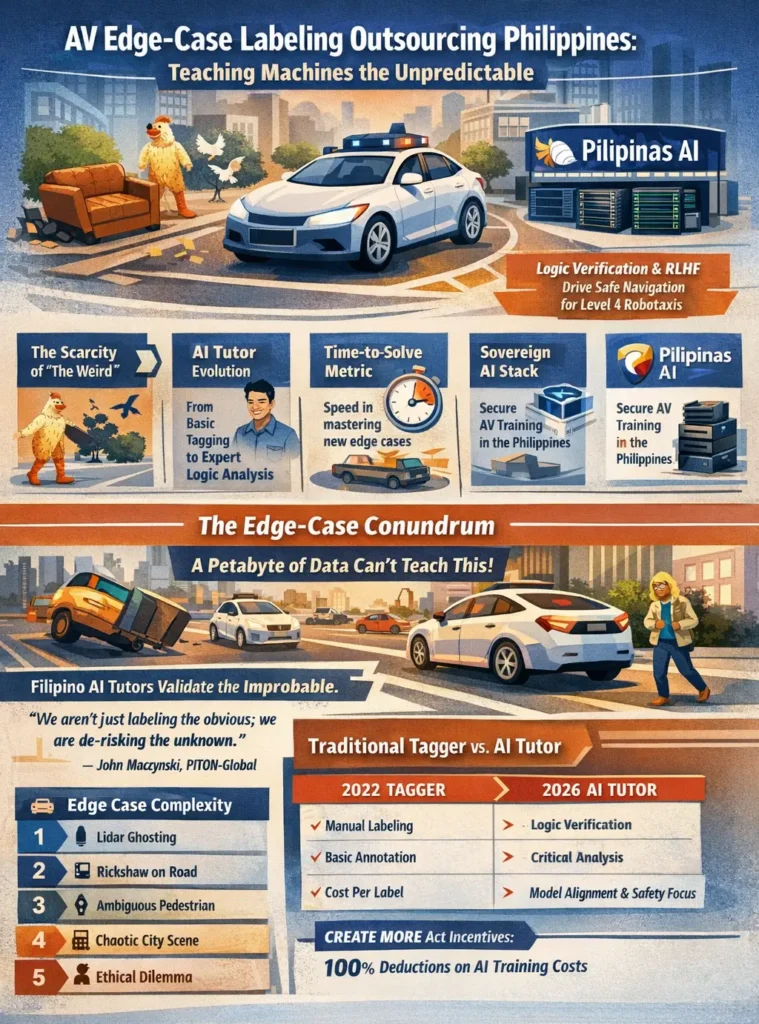
Edge Case Complexity & Human Intervention
The level of expertise required in the Manila hub scales with the complexity of the “unpredictable” scenario:
The “AI Tutor” Paradigm Shift
The role of the annotator in the Philippines has undergone a profound transformation to meet 2026 standards.
| Feature | Traditional Tagger (2022) | AI Tutor (2026) |
| Primary Task | Manual object classification. | Logic Verification & RLHF. |
| Core Skill | Speed & Repetitive Accuracy. | Critical Thinking & Scenario Deconstruction. |
| Value Metric | Cost per Labeled Asset. | Model Performance Lift & TTS. |
| Impact | Foundational Training. | Model Alignment & Safety Trust. |
Expert FAQs
How does the “Time-to-Solve” (TTS) metric work?
In 2026, we don’t look at how many boxes were drawn. We measure the time between identifying a new edge case (e.g., a new type of construction barrier) and the model successfully passing a validation test for that scenario. High-quality feedback from Filipino Tutors drastically reduces this window.
Why is the Philippines considered a “Data-Sovereign Corridor”?
With the 2026 hosting of the ASEAN AI Summit, the Philippines has codified “Agentic Governance” into law. Combined with ePLDT’s VITRO Sta. Rosa (the nation’s first AI-hyperscale data center), AV firms can keep their training data within a high-security, sovereign environment that meets global safety standards.
Can simulation replace human edge-case labeling?
No. Simulation is great for volume, but it lacks the “semantic truth” of the real world. Human-validated real-world data is the “ground truth” used to anchor simulations. Without the Filipino “AI Tutor” to verify the logic, simulations can perpetuate the same “hallucinations” or errors found in the original model.
How does the 2026 CREATE MORE Act lower costs for AV firms?
Edge-case analysis often requires running the AI model in the background (compute-heavy). The Act allows BPOs to claim 100% deductions on power and training, effectively subsidizing the massive energy and upskilling costs required for high-level AV logic verification.
Achieve sustainable growth with world-class BPO solutions!
PITON-Global connects you with industry-leading outsourcing providers to enhance customer experience, lower costs, and drive business success.
Get Your Top 1% Vendor List
Author
Ralf Ellspermann is a multi-awarded outsourcing executive with 25+ years of call center and BPO leadership in the Philippines, helping 500+ high-growth and mid-market companies scale call center and customer experience operations across financial services, fintech, insurance, healthcare, technology, travel, utilities, and social media.
A globally recognized industry authority - and a contributor to The Times of India, CustomerThink, and The AI Journal - he advises organizations on building compliant, high-performance offshore contact center operations that deliver measurable cost savings and sustained competitive advantage.
Known for his execution-first approach, Ralf bridges strategy and operations to turn call center and business process outsourcing into a true growth engine. His work consistently drives faster market entry, lower risk, and long-term operational resilience for global brands.
EXECUTIVE GOVERNANCE & ACCURACY STANDARDS
Authored by:

Ralf Ellspermann
Founder & CSO of PITON-Global,
25-Year Philippine BPO Veteran,
Multi-awarded Executive
Specializing in strategic sourcing and excellence in Manila
View Full Bio
Verified by:

John Maczynski
CEO of PITON-Global, and former Global EVP of the World’s largest BPO provider | 40 Years Experience
Ensuring global compliance and enterprise-grade service standards
View Full Bio
Last Peer Review: March 16, 2026
This service framework is audited quarterly to meet shifting global outsourcing regulations and COPC standards.