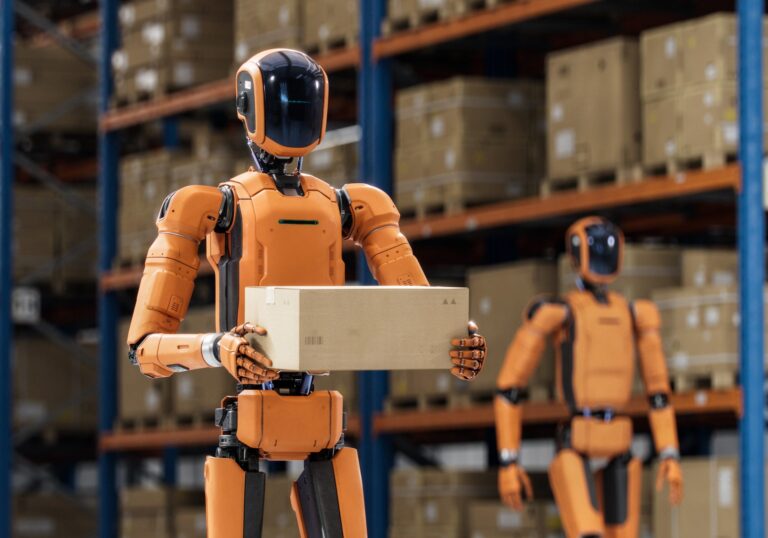

TL;DR: The Key Takeaway
The global robotics industry is shifting its operational oversight to the Philippines, creating a new domain of excellence in robotics teleoperation support services. This strategic move is not about cost reduction but about accessing a highly specialized talent pool of ‘Remote Robot Wranglers’ who provide critical governance, real-time intervention and the exception handling and remote oversight for robots that autonomous fleets depend on. The outsourcing of these services to the Southeast Asian powerhouse ensures that complex robotic systems in logistics, manufacturing, and security operate with maximum efficiency, safety, and logical consistency, establishing a new benchmark for AI-driven operations in 2026.
Robotics teleoperation support in the Philippines is the high-fidelity remote oversight and intervention of autonomous robotic fleets (AMRs, humanoids, and drones). In 2026, the Philippines has emerged as the global command center for “Remote Robot Wranglers”—specialists who provide real-time Agentic Governance for fleets in Western warehouses and factories. This service moves the human role from manual task execution to high-level logic verification, ensuring operational continuity in the face of “edge cases” that stymie even the most advanced Physical AI.
Executive Briefing
- Human-in-the-Loop 2.0: Shifting from 1-to-1 direct control to a 1-to-200+ fleet management ratio, where humans only intervene when AI confidence scores drop.
- The “Remote Wrangler” Skillset: A hybrid of spatial reasoning, low-latency piloting, and “Cognitive Triage”—diagnosing robotic failures half a world away in seconds.
- Agentic Governance: Acting as the “Human Firewall” to ensure autonomous agents (like delivery robots or security drones) adhere to safety protocols and brand logic.
- Economic Velocity: Leveraging the CREATE MORE Act (RA 12066) to claim enhanced deductions on power and training, vital for the high-bandwidth, high-compute nature of teleoperation.
- Infrastructure for 2026: Operating from fiber-connected hubs with redundant links to keep latency low for global operations, while national connectivity keeps expanding; the DICT, for example, has used Starlink satellite internet to connect schools and communities in geographically isolated and disadvantaged areas (GIDAs).
The Great Unseen: Why Robots Still Need a Human Touch
By 2026, “Physical AI” has reached a tipping point, but it remains brittle in the face of “Black Swan” events—a fallen pallet, an unmapped spill, or a confusing intersection for an autonomous truck. Fully autonomous systems still require a safety net.
Offshore teams have filled this gap by providing Teleoperation Centers of Excellence. When a robot in a US-based fulfillment center encounters an anomaly, it flags a “Remote Robot Wrangler” in Manila. Within seconds, the operator takes control, clears the obstacle, and releases the robot back into autonomous mode—preventing costly facility-wide downtime. The intervention lifecycle, latency budget and staffing model behind that loop are laid out in how to outsource robotics teleoperation support.
“The new frontier is ensuring the continuous, intelligent operation of billion-dollar robotic fleets at scale. The Philippines provides the human oversight that underwrites that safety.” — John Maczynski, CEO, PITON-Global
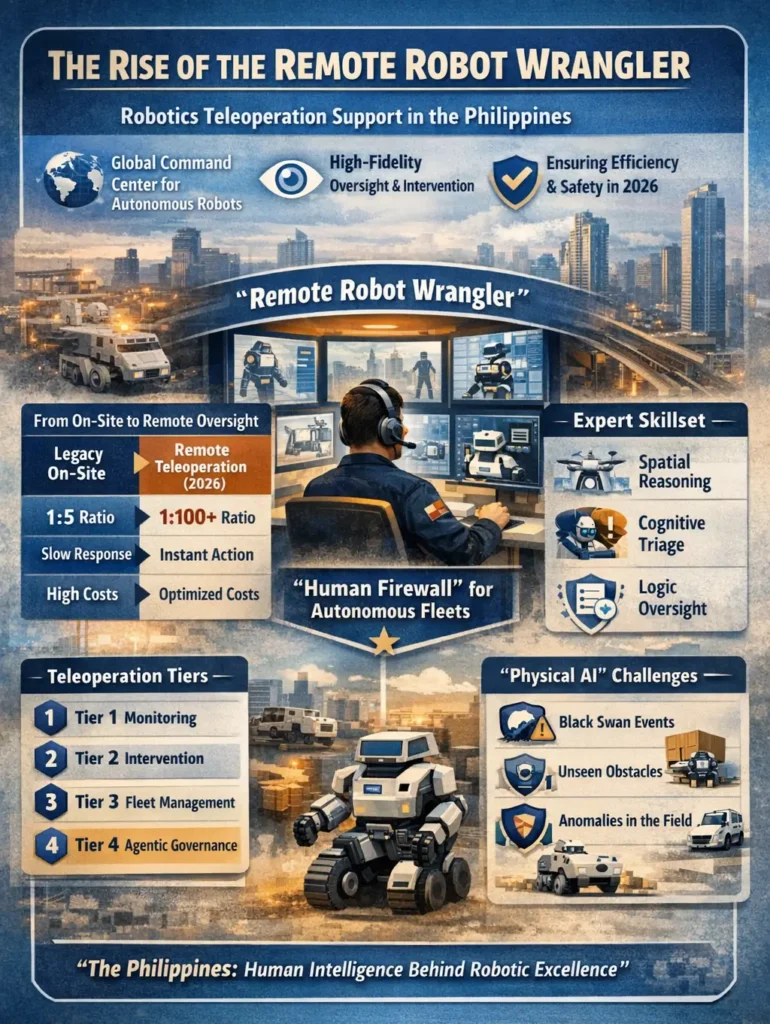
On-Site Management vs. Remote Wrangling (2026 Model)
The shift from on-site technicians to centralized remote oversight has revolutionized the ROI of robotics.
| Feature | On-Site Management (Legacy) | Remote Teleoperation (2026 Model) |
| Operator-to-Robot Ratio | 1:5 – 1:10 | 1:50 – 1:200+ |
| Response Time | Minutes to Hours (physical travel) | Seconds (Instant Remote Access) |
| Cost Structure | High (Salaries, travel, insurance) | Optimized (Shared Central Expertise) |
| Strategic Metric | Mechanical Uptime | Logic Integrity & Fleet Safety |
The ‘Remote Robot Wrangler’: A New Profession
In 2026, “Wrangling” is an elite professional track. These specialists are trained in high-fidelity simulation environments that mirror the exact physics of the remote assets they manage—from NEO humanoids to 1X logistics bots.
Core Competencies of a Remote Wrangler:
- Spatial Reasoning: Navigating 3D environments via 2D/VR feeds with zero collision errors.
- Logic Verification: Identifying if a robot’s failure is sensor-based (hardware) or decision-based (AI logic).
- Red Teaming: Proactively testing robot behavior in virtual twins to identify vulnerabilities before they manifest on the factory floor, then feeding the findings back into robot perception training.
Teleoperation Complexity & Service Tiers
PITON-Global categorizes teleoperation projects based on the level of “Agentic Autonomy” involved:
| Tier | Role | Required Expertise | Value Proposition |
| Tier 1 | Basic Monitoring | Passive dashboard observation. | Escalation & Status Reporting. |
| Tier 2 | Simple Intervention | Remote “stuck” recovery (reboot/move). | Minimizing minor downtime. |
| Tier 3 | Fleet Exception Handling | Managing 100+ units in real-time. | Scalable Global Ops. |
| Tier 4 | Agentic Governance | Logic auditing & AI coaching. | Sovereign Safety & Trust. |
Expert FAQs
How do you handle latency (lag) between the Philippines and the US?
In 2026, we utilize Predictive Teleoperation. The operator’s interface uses a “Digital Twin” to project the robot’s movement 200ms into the future, compensating for trans-Pacific latency. Combined with the country’s Konektadong Pinoy infrastructure, real-time control is now safer and more responsive than ever.
Is this just a “bridge” to full autonomy?
No. As AI becomes more agentic, the complexity of its failures increases. While robots may require fewer interventions in 2026 than in 2023, the criticality of those interventions is higher. The “Human-on-the-Loop” remains the final legal and ethical arbiter for high-value assets.
What are the tax benefits for Robotics BPOs under CREATE MORE?
The CREATE MORE Act specifically targets high-tech exports. Robotics hubs in Manila or Cebu registered under the Act enjoy a reduced Corporate Income Tax rate and enhanced deductions on power and training. This is crucial, as teleoperation centers consume significant energy for GPU-intensive remote rendering.
How is the Philippine government supporting this?
Through new training facilities such as the Robotics and CNC Manufacturing Facilities that TESDA opened at its Cordillera State Institute of Technical Education in Baguio City in January 2026, and the DTI’s National AI Strategy Roadmap 2.0 (July 2024), which calls for workforce upskilling and reskilling, the government is building a supply of workers who understand both the mechanical and algorithmic sides of robotics.