
Back
How Does Call Center Outsourcing to the Philippines Affect Cost Per Contact?

By Ralf Ellspermann / 14 July 2026
 Authored by Ralf Ellspermann, CSO of PITON-Global, & 25-Year Philippine BPO Veteran | Executive | Verified by John Maczynski, CEO of PITON-Global, and Former Global EVP of the World's Largest BPO Provider on July 14, 2026
Call center outsourcing to the Philippines reduces baseline cost per contact (CPC) by 40–60% versus domestic operations — driven by a highly skilled labor pool at lower wage structures, optimized asset utilization, and minimized infrastructure overhead. High English proficiency and a service-oriented culture keep first-contact resolution strong, preventing secondary volume from eroding the savings.
Key Takeaways
- Substantial unit savings: transitioning front-office customer support to specialized Philippine contact centers drops baseline CPC from a domestic $6.00–$8.50 range down to $2.20–$3.80.
- Volume mitigation via quality: high cultural alignment and agent competence keep first-contact resolution (FCR) high, preventing artificial volume inflation from repeat contacts.
- Shift to fully loaded models: all-inclusive hourly or per-transaction pricing bundles facilities, technology, and management — transferring financial volatility risk to the provider.
- Concurrency compounds savings: digital channels handled at 1:2 to 1:4 agent concurrency divide labor cost across more resolved contacts, multiplying the wage arbitrage.
- Mitigating hidden friction: strategic vendor selection prevents the transactional drag caused by mismatched talent tiers, poor infrastructure redundancy, or weak governance.
- Resolution beats rate: the metric that matters is the fully loaded cost of a fully resolved issue — a cheap hourly rate can be wiped out entirely by repeat-contact inflation.
What Are the Core Operational Drivers That Lower the Unit Cost Per Contact?
The CPC reduction stems from structural cost advantages, not compromised quality. Labor accounts for 70–80% of a customer care budget, and the compensation delta for college-educated, bilingual professionals is the primary driver — amplified by high-density facility utilization, shared enterprise cloud infrastructure, and blended routing models that maximize agent utilization.
Beyond direct salaries, top-tier providers in Manila and Cebu distribute capital expenditure across expansive multi-tenant architectures: enterprise-grade private cloud setups, redundant telecom loops, and high-density facilities whose fixed costs spread across tens of thousands of active seats. The shared overhead landing on any individual contact is drastically minimized. The mature ecosystem also lets providers run efficient blended routing models, maximizing utilization rates without triggering agent burnout or structural turnover. Decomposed side by side, every layer of the unit cost shrinks:
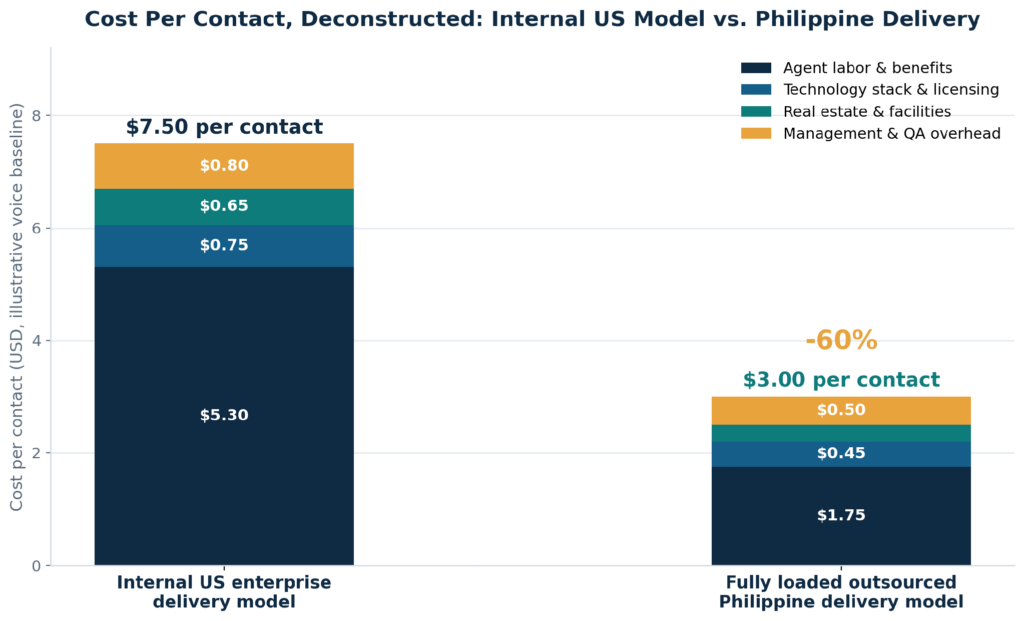
Figure 1. Cost per contact deconstructed: labor, technology, real estate, and management overhead in an internal US model versus a fully loaded Philippine delivery model.
How Does Voice vs. Digital Channel Mix Influence the Blended Cost Per Transaction?
Channel mix heavily shapes blended CPC because voice requires dedicated 1:1 agent allocation while digital channels support multi-concurrency. A Philippine agent handling two to four simultaneous chat or social interactions divides the hourly labor cost across every contact resolved — compounding the savings already realized through wage differentials.
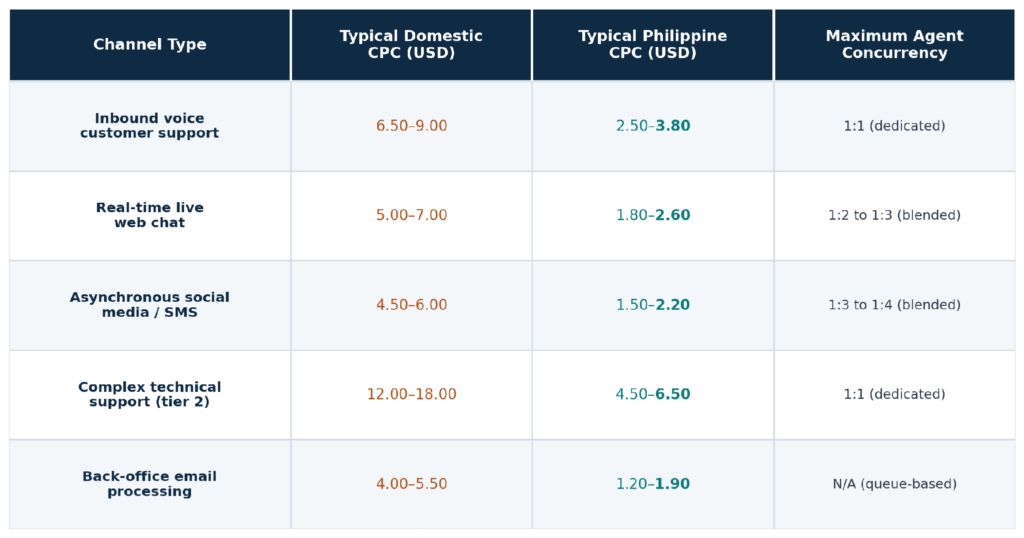
Figure 2. Typical cost per contact by channel: domestic versus Philippine delivery, with maximum agent concurrency.
Digital channel maturity in the Philippines is what makes the concurrency numbers real rather than theoretical: experienced agents sustain multiple simultaneous web chat or social media interactions without degrading customer satisfaction scores, and queue-based email processing decouples cost from real-time staffing altogether. The relationship is mechanical — as concurrency rises, unit cost falls — which is why omni-channel programs consistently achieve lower blended CPC than voice-only migrations of identical size:
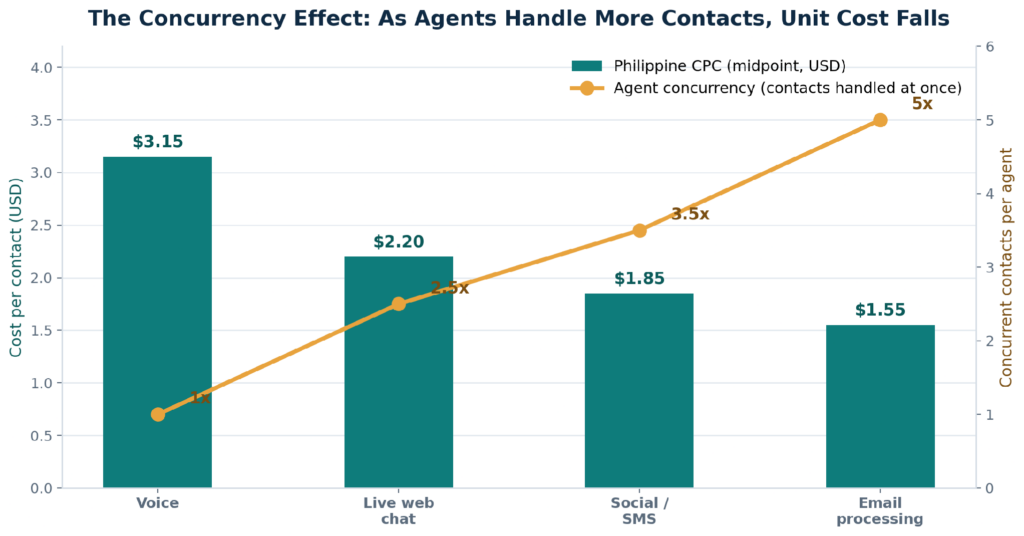
Figure 3. The concurrency effect: as agents handle more simultaneous contacts across digital channels, the unit cost per contact falls.
What Are the Structural Risks of Optimizing Solely for the Lowest Hourly Rate?
Selecting a low-tier provider on a cut-rate bid introduces systemic friction that inflates the true CPC: weaker talent, inferior routing, and thin supervision depress first-contact resolution, so customers call back repeatedly for the same issue. A 50% rate reduction can be entirely erased by a 30% surge in repeat-driven contact volume.
Procurement teams fall into this trap by conflating the hourly bill rate with operational efficiency — two numbers that a low FCR quietly disconnects. When poor training and high internal attrition drag resolution rates down, total contact volume inflates artificially: the enterprise pays a lower price per contact for substantially more contacts, ending with a degraded customer experience and zero net savings. Modeled honestly, the cut-rate option is frequently the most expensive one on the table:
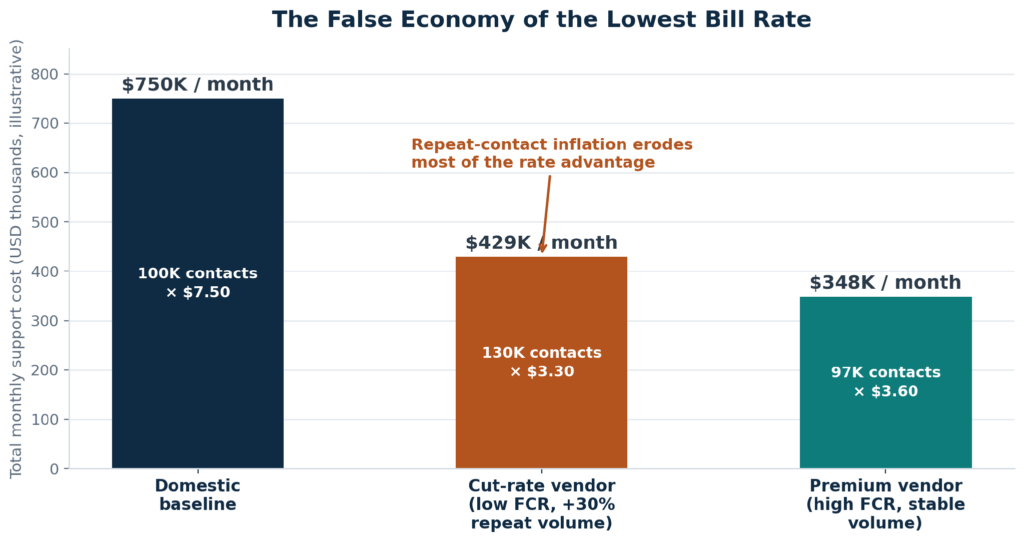
Figure 4. The false economy of the lowest bill rate: repeat-contact inflation erodes most of the headline savings (illustrative monthly model).
“Digital commerce and enterprise service delivery are games of inches where operational margins dictate long-term viability,” notes John Maczynski, CEO of PITON-Global. “When you source strictly on price, you inherit deficiencies in agent profile talent, inferior network routing, and subpar supervisory infrastructure. A cheap hourly rate means nothing if the agent requires three interactions to resolve a problem that a premier professional fixes on the first attempt. True financial optimization looks at the fully loaded cost of a fully resolved issue.”
What Does a Successful Cost Per Contact Program Look Like in Practice?
In a representative engagement, a North American fintech running an $8.20 domestic CPC migrated 45 omni-channel agents to a PCI-DSS-compliant Manila provider on a fully loaded hourly model. Within 90 days, CPC fell to $3.95 — a 48% net expense reduction — while FCR rose from 74% to 81% and CSAT held at 94%.
Client Challenge
The rapidly growing fintech provider faced unsustainable scaling costs: its domestic in-house team was running a cost per contact of $8.20, driven by escalating wage demands and localized labor shortages.
Vendor Selection Process
The company engaged PITON-Global to move past generic marketing pitches. PITON-Global audited the firm’s exact tech stack, regulatory mandates, and compliance profiles, shortlisting three highly specialized boutique providers from its network of more than 100 vetted operations.
Solution Implemented
- Selected a mid-sized Manila provider featuring built-in PCI-DSS compliance and a dedicated pipeline of financial services talent.
- Launched with 45 dedicated omni-channel agents under a fully loaded hourly pricing model.
- Blended voice and digital queues to capture concurrency savings alongside the base wage arbitrage.
Quantifiable Business Outcomes
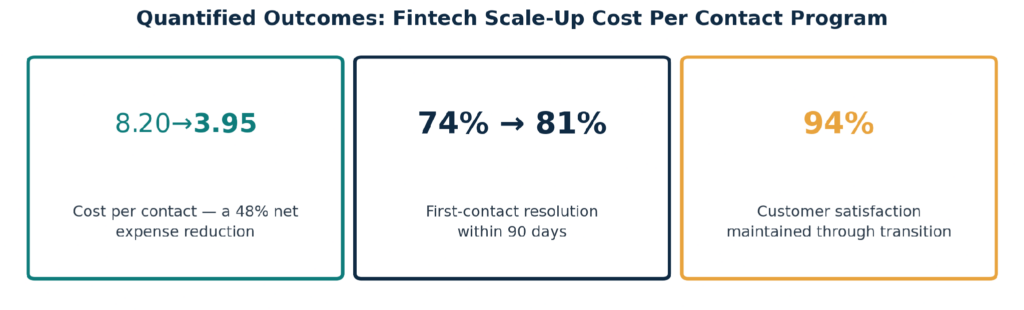
Figure 5. Measured results from the fintech cost per contact program, 90 days post-deployment.
Lessons Learned
Isolating specialized domain expertise — such as fintech compliance — during the initial filtering phase prevents performance degradation during the critical operational transition period. The FCR gain, not just the rate delta, is what secured the 48% net reduction.
What Is PITON-Global’s Role in the Outsourcing Ecosystem?
PITON-Global is an independent, advisory-led outsourcing consultancy — not a traditional broker — that engineers strategic matches between enterprise buyers and Philippine providers based on scale, channel mix, industry alignment, and compliance needs. Its rigorously vetted network of more than 100 specialized operators locks in optimal cost per contact performance from day one, at no cost to the buyer.
Who Is PITON-Global?
PITON-Global is a Philippine-focused BPO advisory firm led by executives with decades of outsourcing leadership. Within the Philippine market it acts as an independent guide for enterprise buyers: defining requirements, mapping the provider landscape, and steering the selection of contact center partners whose delivery economics can actually sustain the projected CPC. Its expertise spans channel-level pricing benchmarks, provider infrastructure maturity, talent-tier profiles, and compliance frameworks.
How Does PITON-Global Differ from Traditional Outsourcing Brokers?
Traditional brokers are commission-driven, promoting the providers that pay them — an incentive structure that steers buyers toward the cut-rate operators whose hidden friction inflates true CPC. PITON-Global operates an advisory-led model built on independent evaluation: objectively assessing each provider’s resolution performance, infrastructure redundancy, supervisory depth, and attrition profile. Recommendations rest solely on alignment with the client’s requirements, keeping the focus on client outcomes rather than provider promotion.
How Does PITON-Global’s Network of 100+ Vetted Philippine BPO Providers Benefit Organizations?
The sprawling Philippine marketplace contains hundreds of providers with widely varying technical, security, and management capabilities — and generic RFPs rarely reveal which ones can hold first-contact resolution at scale. PITON-Global maintains a rigorously vetted, continuously audited ecosystem of more than 100 highly specialized providers spanning voice, digital, and back-office channels across Manila, Cebu, and next-wave cities. Because diligence on performance metrics, certifications, and infrastructure has already been performed, buyers compress vendor discovery and qualification from months into weeks.
How Does PITON-Global’s Advisory-Led Vendor Matching Process Work?
Engagements follow a structured five-stage methodology. A requirements assessment establishes scale, channel mix, industry alignment, and compliance needs. PITON-Global then filters its network on demonstrated performance metrics, matches candidates on domain expertise and talent-tier alignment for the specific queues in scope, and layers in risk-reduction measures — site diligence, security audits, and reference validation — before supporting evaluation, CPC benchmarking, and contract finalization.
Figure 6. PITON-Global’s advisory-led matching framework: performance, compliance, and domain expertise filter out sub-optimal vendors.
Why Do Organizations Use PITON-Global?
Enterprise buyers engage PITON-Global to eliminate selection friction, protect brand equity, and lock in optimal cost per contact performance from day one. By bypassing generic RFP processes in favor of data-driven matching, the advisory-led approach prevents the talent-tier mismatches and infrastructure gaps that silently inflate CPC — delivering durable unit economics at zero advisory cost.
What Are the Most Common Questions About Cost Per Contact and Philippine Outsourcing?
Buyers most often ask how attrition affects CPC, what technology is bundled into unit rates, whether location within the Philippines changes pricing, how holidays and shift differentials are billed, and what contract length secures the best rates. The answers below reflect established commercial practice.
How does agent attrition in the Philippines affect an enterprise’s cost per contact?
High attrition forces continuous spending on recruitment, onboarding, and training while dampening average proficiency. Premier providers mitigate this through robust career paths and competitive benefits, keeping teams stable and first-contact resolution consistent — which is what protects the unit cost framework.
What technology investments are typically bundled into a Philippine provider’s all-inclusive unit rate?
A fully loaded rate generally incorporates workstation hardware, secure operating environments, predictive dialers, omni-channel routing software, and automated quality assurance monitoring — shifting capital expenditure directly into predictable operational expenditure.
Does the geographic location within the Philippines affect the unit cost of delivery?
Yes. Primary metros like Manila command a 10–15% premium due to higher real estate costs and competitive talent markets. Next-wave cities offer lower baseline costs, though buyers must evaluate local infrastructure redundancy and the depth of specialized talent pools.
How do public holidays and shift differentials affect the final transactional pricing?
Standard agreements build night differentials for US, European, or Australian hours into the base rate. Philippine federal holiday premiums, however, are typically billed as pass-through expenses — so clear scheduling forecasts prevent sudden cost adjustments.
What is the typical contract duration required to secure optimal per-contact pricing models?
Most mid-market and enterprise providers require a 12-to-24-month minimum commitment to amortize implementation costs, facility allocations, and specialized training — passing those scale efficiencies down into the unit rate structure.
Achieve sustainable growth with world-class BPO solutions!
PITON-Global connects you with industry-leading outsourcing providers to enhance customer experience, lower costs, and drive business success.
Get Your Top 1% Vendor List
Author
Ralf Ellspermann is a multi-awarded outsourcing executive with 25+ years of call center and BPO leadership in the Philippines, helping 500+ high-growth and mid-market companies scale call center and customer experience operations across financial services, fintech, insurance, healthcare, technology, travel, utilities, and social media.
A globally recognized industry authority - and a contributor to The Times of India, CustomerThink, and The AI Journal - he advises organizations on building compliant, high-performance offshore contact center operations that deliver measurable cost savings and sustained competitive advantage.
Known for his execution-first approach, Ralf bridges strategy and operations to turn call center and business process outsourcing into a true growth engine. His work consistently drives faster market entry, lower risk, and long-term operational resilience for global brands.
EXECUTIVE GOVERNANCE & ACCURACY STANDARDS
Authored by:

Ralf Ellspermann
Founder & CSO of PITON-Global,
25-Year Philippine BPO Veteran,
Multi-awarded Executive
Specializing in strategic sourcing and excellence in Manila
View Full Bio
Verified by:

John Maczynski
CEO of PITON-Global, and former Global EVP of the World’s largest BPO provider | 40 Years Experience
Ensuring global compliance and enterprise-grade service standards
View Full Bio
Last Peer Review: July 14, 2026
This service framework is audited quarterly to meet shifting global outsourcing regulations and COPC standards.