

On this page
- Key Takeaways
- Which Customer Care Segments Produce the Most Drastic Capital Relief?
- Why Do Specialized Retention Queues Protect More Top-Line Capital Than Simple Call Routing?
- How Can Operations Managers Systematically Audit and Capture High-Yield Support Metrics?
- Why Is “Intelligence Arbitrage” Supplanting Low-Cost Headcount Models?
- What Do These High-Yield Functions Look Like in a Real Engagement?
- What Is PITON-Global’s Role in the Outsourcing Ecosystem?
- What Are the Most Common Questions About High-Return Support Outsourcing?
High-stakes tier-2/tier-3 escalations, technical support, and premium omnichannel retention generate the highest financial returns from an outsourced omnichannel CX desk in the Philippines. These judgment-critical functions pair a deep labor-overhead reduction with a measurable increase in customer lifetime value through rapid first-contact resolution.
Key Takeaways
- Intelligence arbitrage yields: moving beyond basic transactional data entry to complex, empathetic tier-2 support maximizes fiscal yield.
- The empathy moat: high-stakes issue resolution mitigates customer attrition and protects top-line enterprise revenue — a return no hourly-rate comparison captures.
- Cost structure improvements: shifting localized workflows into an all-inclusive Philippine hourly bracket cuts domestic operational overhead by roughly two-thirds.
- Value multipliers: embedding AI-assisted response diagnostics allows teams to convert roughly a third of typical return requests into exchanges.
- Automation reshuffled the map: tier-1 inquiries are increasingly absorbed by conversational software; the human-delivered ROI now concentrates in the complex interactions that remain.
- Specialization decides the multiple: advisory-led matching, such as PITON-Global’s, pairs high-stakes queues with providers whose talent and tooling can actually run them.
Which Customer Care Segments Produce the Most Drastic Capital Relief?
The most drastic capital relief comes from high-stakes escalations, tier-2/3 technical and SaaS support, and revenue cycle support — all delivered at an all-inclusive Philippine hourly rate that sits at a fraction of the fully loaded domestic burden. Lower-tier inquiries have largely been automated; the human-delivered returns now concentrate in what remains.
Building an accurate offshore financial model starts with categorizing support workflows by complexity and business impact. Basic order tracking and password resets have been progressively absorbed by conversational software, which means the offshore business case is no longer about relocating the simplest work — it is about applying premium cost compression to the specialized, judgment-heavy interactions automation filters out. Those are precisely the queues where domestic labor is most expensive, so the arbitrage is deepest exactly where the work matters most:
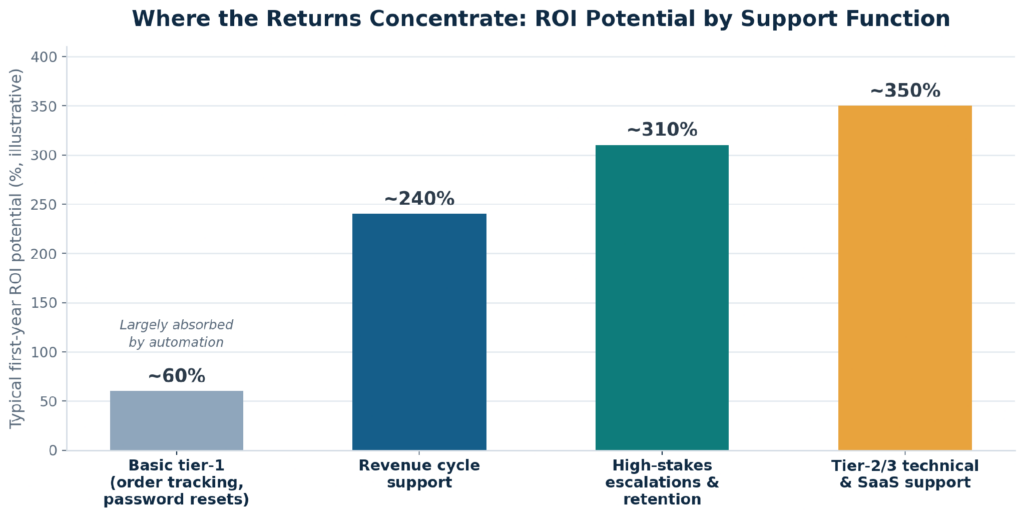
Figure 1. Illustrative first-year ROI potential by support function: returns concentrate in judgment-critical tiers, not automated basics.
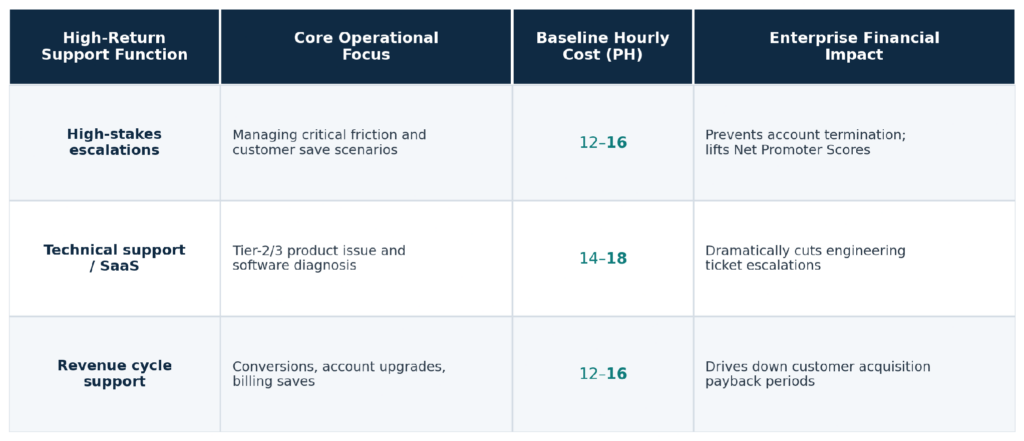
Figure 2. The three highest-return support functions, with Philippine baseline pricing and the enterprise financial impact each drives.
Why Do Specialized Retention Queues Protect More Top-Line Capital Than Simple Call Routing?
When a customer hits complex friction — a disputed charge, an accounting error, a failed checkout — that single interaction decides whether the account survives. A sentiment-driven handoff to an empathetic Philippine specialist converts the high-stress moment into rebuilt trust; cold scripted routing converts it into a churn event.
Evaluating a care program solely on raw headcount cost misses this entirely, because the financial return is measured not just in hours saved but in customer lifetime value protected. The cultural strengths of the Philippine workforce — deep empathy and a natural service orientation — are precisely suited to save scenarios, and experienced teams across Manila and Cebu pair that human skill with modern desktop systems that run integrated back-office processes, resolving complex issues on the first interaction and eliminating down-funnel operational waste.
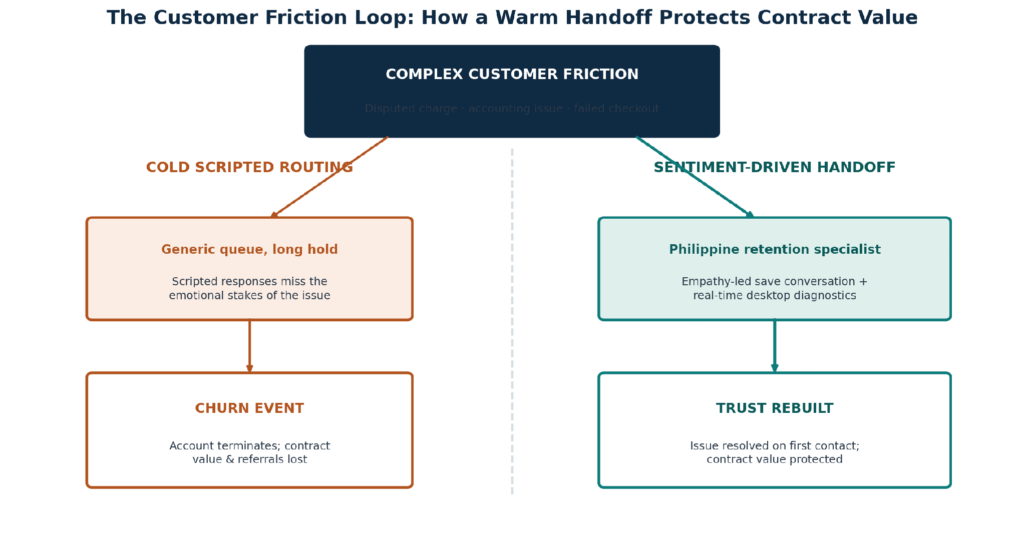
Figure 3. The customer friction loop: a warm, sentiment-driven handoff protects account contract value where scripted routing loses it.
How Can Operations Managers Systematically Audit and Capture High-Yield Support Metrics?
The audit runs in four phases: isolate the high-friction tier-2 queues generating repeat contacts, map fully loaded domestic overhead, audit the vendor’s integration capabilities for copilots and data firewalls, and execute a tiered performance launch that tracks first-contact resolution against financial goals.
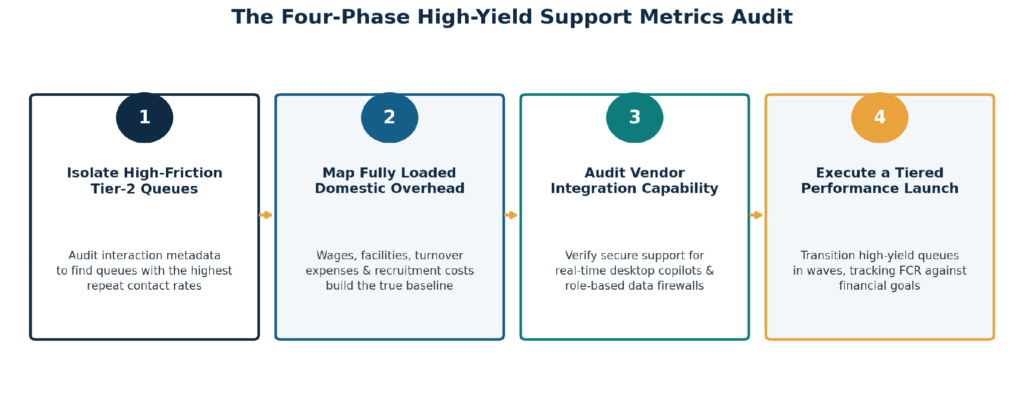
Figure 4. The four-phase high-yield support metrics audit executed before shifting workflows or transitioning software infrastructure.
Phase one audits current inbound interaction metadata to identify the specific product, billing, or technical queues that generate the highest repeat contact rates — the friction concentrations where offshore specialization pays most. Phase two calculates all true onshore costs, including basic wages, facilities, employee turnover expenses, and recruitment overhead, to build an accurate baseline. Phase three verifies that the prospective partner’s technical architecture can securely support real-time desktop copilots and role-based data firewalls. Phase four transitions the high-yield queues in structured waves, tracking first-contact resolution changes closely to confirm the program is hitting its financial targets before each subsequent wave launches. The sequence mirrors the assessment stage of the complete guide to outsourcing customer service.
Why Is “Intelligence Arbitrage” Supplanting Low-Cost Headcount Models?
Per-seat pricing creates an inherent conflict of interest: a provider charging for raw human hours has no incentive to make conversations shorter or more effective. The intelligence-driven model measures value in judgment-critical outcomes — total cost per resolution, saves per queue, revenue protected — and rewards providers for the automation that headcount models punish.
The shift redefines what a high-return function even is. Under pure labor arbitrage, the best queue to offshore was the one with the most hours; under intelligence arbitrage, it is the one where skilled specialists armed with real-time data change business outcomes — retention saves, exchange conversions, engineering escalations avoided. That is why the returns in Figure 1 climb with complexity rather than volume.
“In today’s operational landscape, a BPO partner’s value is no longer measured by how many physical seats they can fill,” observes John Maczynski, CEO of PITON-Global. “The real return comes from managing complex, judgment-critical workflows that automation alone cannot solve. The highest-performing programs deploy highly skilled Philippine specialists who use real-time data to drive down total cost-per-resolution while protecting brand reputation.”
What Do These High-Yield Functions Look Like in a Real Engagement?
In a representative engagement, a rapidly expanding e-commerce brand drowning in checkout errors and return claims — with 45-minute waits and sagging CSAT — migrated to a specialized Manila partner. The program reached positive ROI within 90 days, cut processing costs by roughly two-thirds, and converted nearly a third of return requests into active exchanges.
Client Challenge
The digital commerce brand faced a severe spike in complex checkout errors and product return claims, pushing customer support wait times past 45 minutes and driving customer satisfaction sharply lower — with each unresolved return representing lost revenue on top of the support cost.
Vendor Selection Process
The organization collaborated with PITON-Global to move away from unverified, low-cost options and identify specialized providers with proven experience in e-commerce workflows and secure data environments.
Solution Implemented
- PITON-Global filtered its network of more than 100 audited operators to select a premium partner in Manila.
- Combined specialized support specialists with real-time desktop automation tools for instant diagnostics and alternatives.
- Prioritized the return-claims queue, equipping agents to offer real-time exchange alternatives during the save conversation.
Quantifiable Business Outcomes
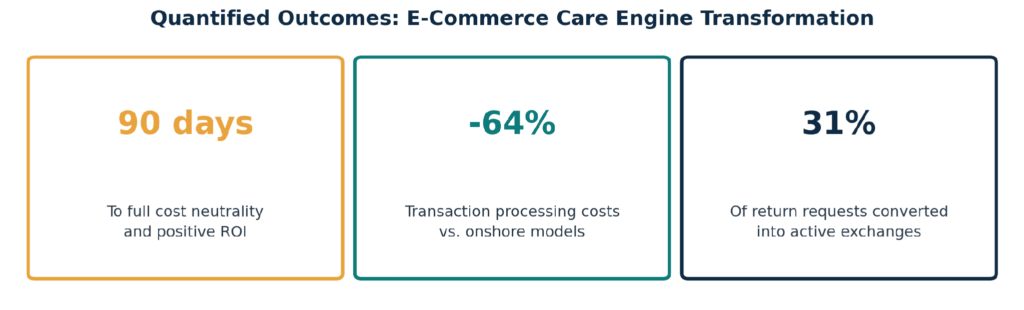
Figure 5. Measured results from the e-commerce care engine transformation.
Lessons Learned
Outsourcing returns the highest value when you partner with a provider that treats customer support as a retention and revenue protector rather than a simple cost center — the long-term value case for strategic support partnerships. The return-to-exchange conversion — revenue recovered, not merely cost saved — was worth more than the headline labor savings.
What Is PITON-Global’s Role in the Outsourcing Ecosystem?
PITON-Global is an advisory-led outsourcing consultancy that aligns corporate buyers with Philippine partners configured for their precise data security, language, and software integration requirements. Its vetted network of more than 100 premium operators removes hidden intermediary markups and reduces evaluation timelines — at no cost to the buyer.
Who Is PITON-Global?
PITON-Global is a Philippine-focused BPO advisory firm led by executives with decades of institutional outsourcing leadership. Within the Philippine market it acts as an independent guide for enterprise buyers: defining requirements, mapping the provider landscape, and steering the selection of partners for high-stakes escalation, technical support, and retention programs. Its expertise spans provider talent benches, automation tooling, pricing benchmarks, and compliance frameworks.
How Does PITON-Global Differ from Traditional Outsourcing Brokers?
Traditional brokers are commission-driven, promoting the operators that pay them and embedding hidden intermediary markup fees into the pricing chain. PITON-Global operates an advisory-led model built on objective verification — independently assessing each provider’s technical maturity, empathy-driven talent quality, security posture, and management depth. Recommendations rest solely on alignment with the client’s requirements, keeping the focus on client outcomes rather than provider promotion.
How Does PITON-Global’s Network of 100+ Vetted Philippine BPO Providers Benefit Organizations?
The diverse Philippine landscape features hundreds of active providers across widely varying levels of technical maturity — and the specialized operators capable of running judgment-critical tier-2 queues rarely surface through generic directories. PITON-Global maintains a continuously audited ecosystem of more than 100 premium operators spanning e-commerce, SaaS, fintech, and healthcare support verticals. Because diligence on capabilities, certifications, and track records has already been performed, buyers compress vendor discovery and qualification from months into weeks.
How Does PITON-Global’s Advisory-Led Vendor Matching Process Work?
Engagements follow a structured five-stage methodology. A requirements assessment establishes the buyer’s data security, language, and software integration needs. PITON-Global then filters its network to a shortlist with demonstrated strength in the relevant support vertical, scores each provider against the client’s technical, cultural, and scale criteria, and layers in risk-reduction measures — site diligence, security audits, and reference validation — before supporting evaluation, pricing benchmarking, and contract finalization.
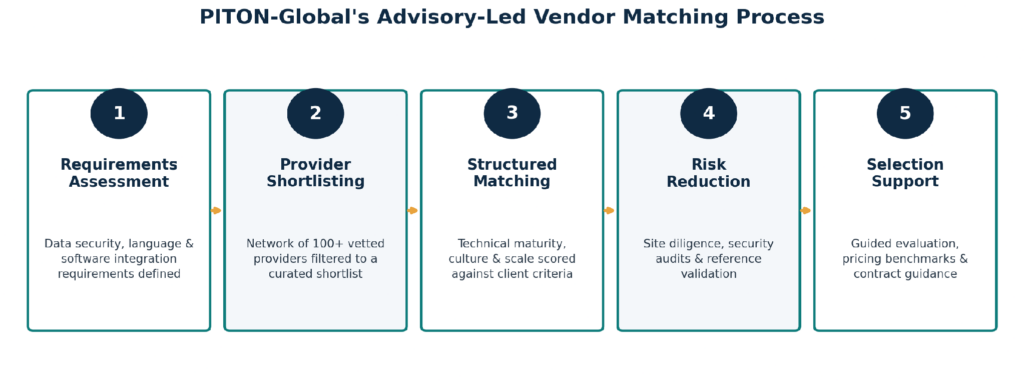
Figure 6. PITON-Global’s five-stage advisory-led vendor matching process.
Why Do Organizations Use PITON-Global?
Corporate buyers engage PITON-Global to de-risk the vendor selection architecture, secure transparent pricing, and accelerate decisions. The advisory-led process replaces unverified options with objective evaluation, removes hidden markup fees, and provides strategic guidance from initial assessment through contract signature — ensuring high-stakes queues land with partners who can actually deliver the upper-bound returns, at zero advisory cost.
What Are the Most Common Questions About High-Return Support Outsourcing?
Buyers most often ask which metrics improve fastest, how regulated data stays protected, why tier-2 queues outperform tier-1 lines, what transition costs to expect, and how seasonal spikes are handled. The answers below reflect established practice among premium Philippine providers.
Which specific customer metrics show the fastest improvement after a Philippine migration?
First contact resolution (FCR) and Net Promoter Scores (NPS) typically see the fastest gains, driven by the strong communication skills and natural empathy of local teams.
How do data privacy standards in the Philippines protect regulated corporate workflows?
Premium providers operate in secure, audit-ready facilities that maintain strict compliance with global data privacy regulations, including SOC 2 Type II and PCI-DSS standards.
Why do complex tier-2 technical queues generate a higher return than basic tier-1 lines?
Tier-2 queues carry higher domestic labor costs, so moving these specialized roles to the Philippines drives deeper structural savings — while simultaneously freeing onshore engineers from ticket escalations.
What initial transition costs should enterprise procurement teams expect?
Budgets should account for initial telecommunications setups, core workflow documentation, and a brief period of running parallel teams during training handoffs — outlays typically recovered within the first quarter.
How do modern Philippine providers handle sudden, seasonal spikes in volume?
Top-tier partners offer flexible staffing models and shared-services routing—and some buyers add a second vendor to diversify risk—to scale agent capacity up or down easily, without disrupting performance on the high-stakes queues.