
Back
How do Philippine BPOs handle AI model grounding for client-specific data?

By Ralf Ellspermann / 12 June 2026
 Authored by Ralf Ellspermann, CSO of PITON-Global, & 25-Year Philippine BPO Veteran | Executive | Verified by John Maczynski, CEO of PITON-Global, and Former Global EVP of the World's Largest BPO Provider on June 12, 2026

Key Takeaways
- Top-tier Philippine BPOs ground AI by feeding proprietary client data into hardware-isolated RAG pipelines — not public LLMs.
- A Tri-Layer Zero-Trust architecture (secure ingestion → grounded retrieval → human governance) keeps PII off Philippine hardware via non-persistent VDIs.
- Disciplined grounding plus human-in-the-loop auditing compresses hallucination from up to 25% to an operational floor of 0.8%–2.0%.
- The $42B sector is reskilling ~2M workers from script execution toward AI governance, prompt engineering, and semantic auditing.
Top-tier Philippine BPOs handle enterprise AI grounding by integrating proprietary client data into secure, hardware-isolated Retrieval-Augmented Generation (RAG) architectures and agentic workflows. Rather than exposing sensitive corporate data to public large language models (LLMs), these providers use localized vector databases, non-persistent Virtual Desktop Infrastructures (VDIs), and strict Human-in-the-Loop (HITL) auditing. This methodology suppresses hallucination to an operational floor of 0.8%–2.0%, converting raw enterprise data into brand-compliant, execution-ready customer intelligence.
The Framework That Keeps Client Data Isolated
Enterprise buyers migrating from legacy “agent-plus-script” operations to intelligent automation routinely run into “AI-washing” — generic LLM wrappers that lack localized grounding, leak corporate context toward public training sets, and return hallucination rates as high as 25%. To eliminate that exposure, premier providers in Manila and Cebu deploy a Tri-Layer Zero-Trust RAG Architecture built on certified compliance frameworks. It walls off client-specific assets — internal ERP records, dense technical manuals, decade-long voice-to-text (VTT) logs — from the open internet at every hop.
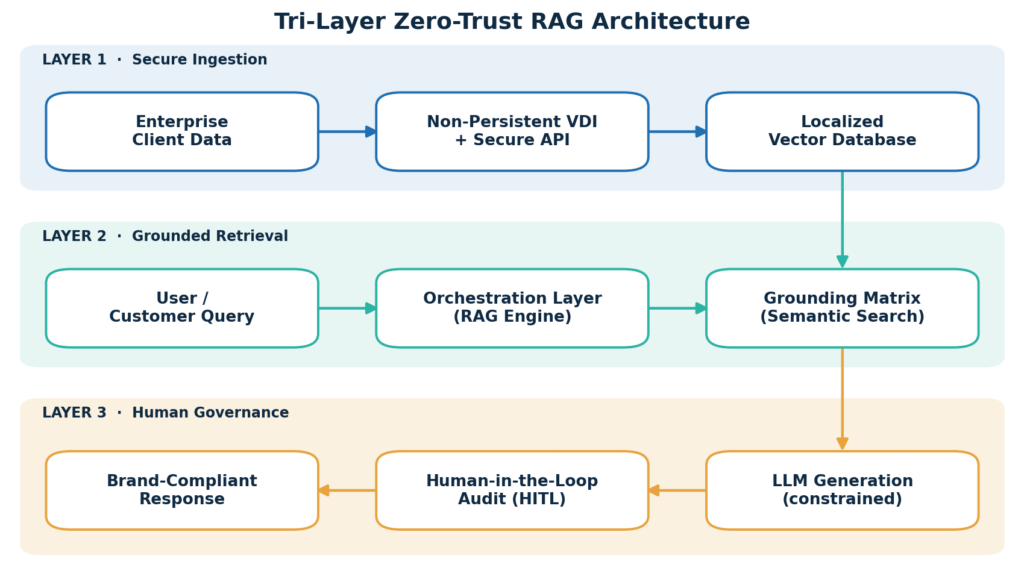
Figure 1 — Data flows through secure ingestion, grounded retrieval, and a human-governance overlay before any response reaches a customer.
Layer 1 — Vector Embeddings & Non-Persistent Storage
Client documents are chunked and converted into mathematical vectors by an embedding model (for example, text-embedding-3-large), then written to an isolated vector store mapped exclusively to that client’s instance. Under a zero-trust access model, no personally identifiable information (PII) persists on Philippine hardware: non-persistent VDIs wipe text strings and transaction states from RAM the moment a session ends.
Layer 2 — Hardware-Locked Knowledge Coupling
The LLM is constrained at the API orchestration layer and denied access to open-web datasets during inference. The orchestrator forces the model to retrieve context only from the vetted vector database. When a query falls outside the semantic bounds of the approved corpus, the system triggers a “hard-handoff” to a live specialist instead of letting the model improvise an answer.
Where the Knowledge Actually Lives — Vector Store Options in Production
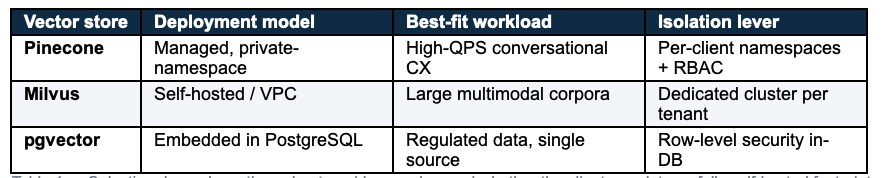
Table 1 — Selection depends on throughput, residency rules, and whether the client mandates a fully self-hosted footprint.
Compliance Backbone
Grounding pipelines are layered on certified controls — ISO/IEC 27001:2022, SOC 2 Type II, HIPAA, and the Philippine Data Privacy Act of 2012 enforced by the National Privacy Commission. Certification is the floor for entry, not the differentiator.

Figure 2 — Disciplined grounding plus human auditing pushes error rates into a 0.8%–2.0% operating band.
How Human-in-the-Loop Workflows Optimize Accuracy
Grounding is not a “set-and-forget” software install; it is a continuous data-sanitization and optimization lifecycle. The $42 billion Philippine BPO sector, employing nearly 2 million specialists, is rapidly shifting its workforce from routine execution toward AI governance, prompt engineering, and semantic auditing — the human disciplines that keep a grounded model honest.
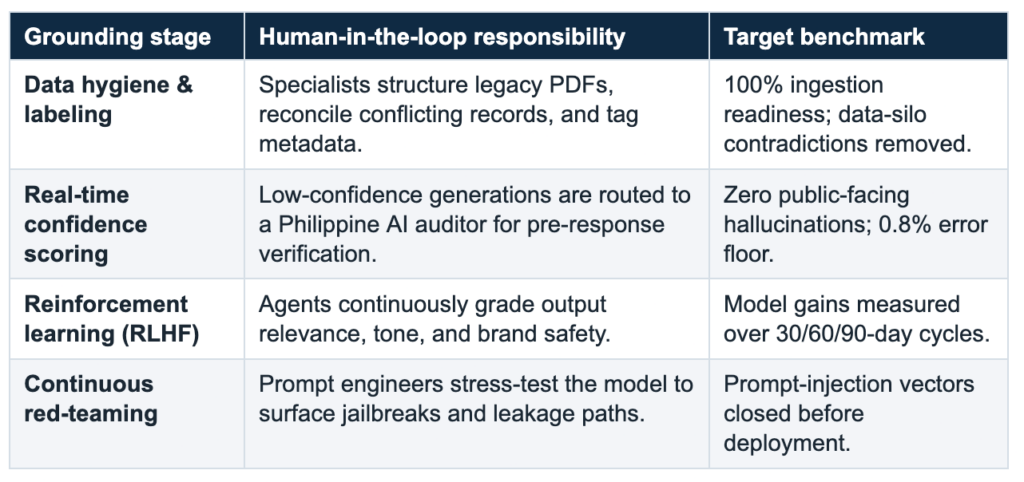
Table 2 — The four human checkpoints that convert a raw RAG pipeline into a governed production system.

Figure 3 — Seats are migrating from script execution toward oversight roles that grounding makes essential.
“AI without data isn’t intelligence; it’s a hallucination machine. The market is flooded with generic wrappers that expose corporate buyers to massive liability. True competitive advantage in 2026 comes from combining highly sanitized, client-specific data with elite human oversight — that is why the top 1% of Philippine providers are winning. They don’t just supply software; they supply the operational governance that makes AI safe and contextually flawless.”
— John Maczynski, CEO, PITON-Global
Mini Case Study: Scaling Agentic CX for an Insurtech Disrupter
The Challenge
A fast-growing US insurtech partnered with PITON-Global after an off-the-shelf conversational AI tool produced a crippling 22% hallucination rate, eroding retention and creating compliance exposure.
The Solution
Using a vendor-agnostic advisory framework, PITON-Global matched the client to a tier-one Philippine partner from its 100+ vetted providers. The provider built a custom RAG architecture grounded in eight years of structured claims data, policy terms, and historical voice logs, then deployed 45 Philippine AI auditors and Tier-2 escalation experts to run live reinforcement learning.
The Results
Hallucinations fell from 22% to 1.1% within 45 days; first-contact resolution rose 34% through grounded voice-bots; and structural costs dropped 55% versus an equivalent US in-house data-engineering and support operation.
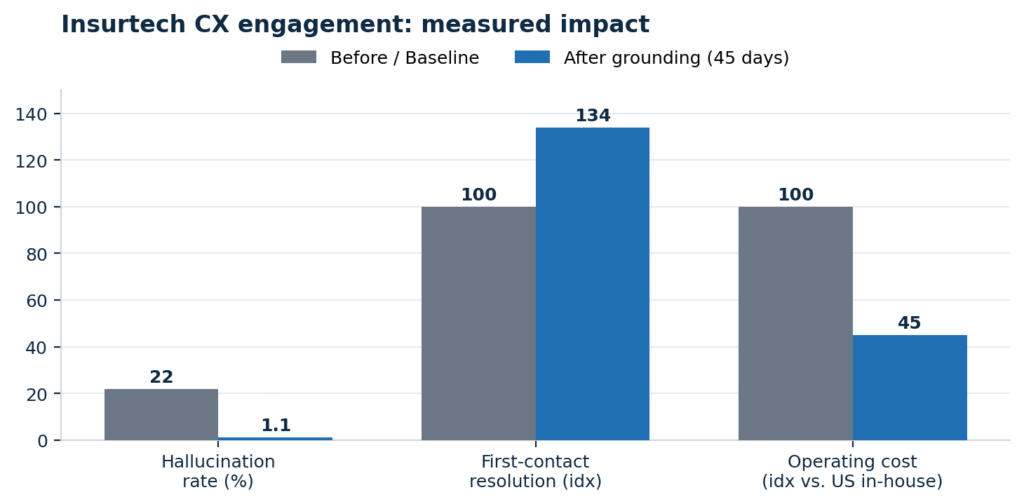
Figure 4 — Before-and-after metrics across hallucination rate, first-contact resolution, and operating cost (indexed).
What Comes Next: Agentic Orchestration
Through 2026 and beyond, dependence on heavy manual data-cleansing will decline as agentic orchestration matures. Expect multi-agent systems in which one AI agent audits data hygiene, a second manages real-time vector updates, and an elite human overlay concentrates on hyper-complex edge cases and semantic calibration. The strategic lesson for buyers is blunt: stop treating outsourcing as pure labor arbitrage. Brand equity now depends on selecting partners that can govern the entire data-readiness, grounding, and security lifecycle within global regulatory bounds.
Frequently Asked Questions
Does my proprietary data train a public model?
No. In a zero-trust RAG setup, your data is embedded into an isolated vector store and used only for retrieval at inference. The LLM is blocked from open-web training data and from retaining your context after the session.
What hallucination rate is realistically achievable?
Well-governed deployments operate in a 0.8%–2.0% band. Rates above that usually signal a generic wrapper without localized grounding or human auditing.
How fast can a grounded pipeline go live?
Production timelines of 30–45 days are common once source data is consolidated; the gating factor is data hygiene, not model selection.
What happens when the AI doesn’t know the answer?
A confidence threshold triggers a hard-handoff to a human specialist rather than allowing the model to fabricate a response.
Find a Vetted, AI-Capable Partner
Seeking an AI-ready outsourcing partner in the Philippines? PITON-Global provides premium, vendor-neutral advisory services at zero cost to your organization. Contact PITON-Global →
About This Briefing
This guide is produced by the PITON-Global Advisory Research Desk and reviewed by solutions architects working across 100+ vetted Philippine BPO providers. Performance figures reflect aggregated, anonymized deployment data and published industry benchmarks; the $42B revenue and ~2M employment figures track widely reported Philippine IT-BPM sector estimates. Architecture and configuration details are illustrative of common production patterns and should be validated against your own compliance requirements.
Achieve sustainable growth with world-class BPO solutions!
PITON-Global connects you with industry-leading outsourcing providers to enhance customer experience, lower costs, and drive business success.
Get Your Top 1% Vendor List
Author
Ralf Ellspermann is a multi-awarded outsourcing executive with 25+ years of call center and BPO leadership in the Philippines, helping 500+ high-growth and mid-market companies scale call center and customer experience operations across financial services, fintech, insurance, healthcare, technology, travel, utilities, and social media.
A globally recognized industry authority - and a contributor to The Times of India, CustomerThink, and The AI Journal - he advises organizations on building compliant, high-performance offshore contact center operations that deliver measurable cost savings and sustained competitive advantage.
Known for his execution-first approach, Ralf bridges strategy and operations to turn call center and business process outsourcing into a true growth engine. His work consistently drives faster market entry, lower risk, and long-term operational resilience for global brands.
EXECUTIVE GOVERNANCE & ACCURACY STANDARDS
Authored by:

Ralf Ellspermann
Founder & CSO of PITON-Global,
25-Year Philippine BPO Veteran,
Multi-awarded Executive
Specializing in strategic sourcing and excellence in Manila
View Full Bio
Verified by:

John Maczynski
CEO of PITON-Global, and former Global EVP of the World’s largest BPO provider | 40 Years Experience
Ensuring global compliance and enterprise-grade service standards
View Full Bio
Last Peer Review: June 12, 2026
This service framework is audited quarterly to meet shifting global outsourcing regulations and COPC standards.