
Back
What Is the Role of an “Experience Architect” in a Philippine BPO?

By Ralf Ellspermann / 10 June 2026
 Authored by Ralf Ellspermann, CSO of PITON-Global, & 25-Year Philippine BPO Veteran | Executive | Verified by John Maczynski, CEO of PITON-Global, and Former Global EVP of the World's Largest BPO Provider on June 10, 2026

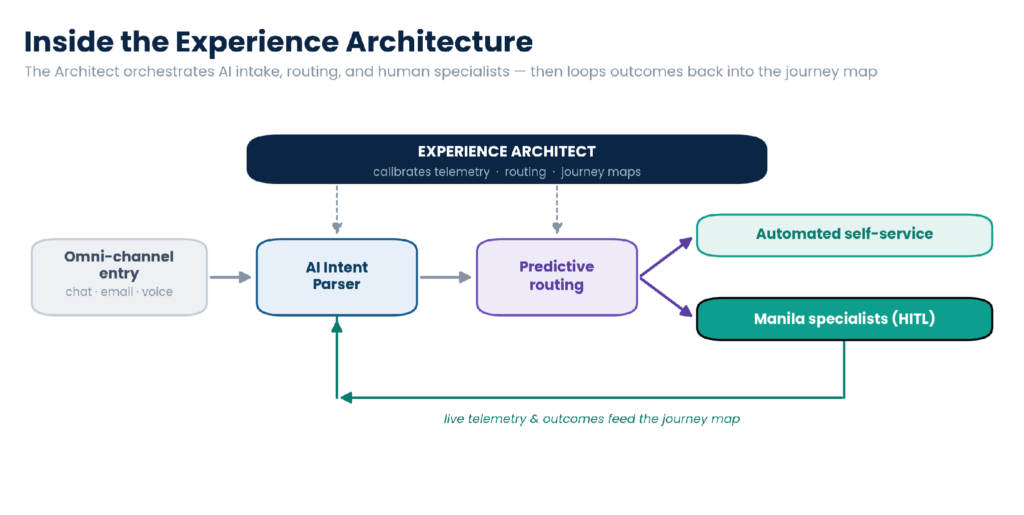
A senior transformation strategist who designs, maps, and orchestrates end-to-end customer lifecycles by combining intelligent AI automation with human empathy. Working across data layers and behavioral design, they re-engineer contact environments to maximize customer lifetime value, remove transactional friction, and keep the experience consistent across every channel.
For decades, offshore delivery was sold as labor-cost arbitrage. The Experience Architect represents a different proposition entirely: engineering precision. Rather than staffing seats against a script, this senior strategist treats the customer journey as a system to be designed — wiring together AI intake, predictive routing, human specialists, and feedback loops so the experience improves continuously rather than being graded after the fact. In a Philippine market crowded with capable vendors, this role is becoming the clearest signal of a provider that competes on capability rather than price — and the reason a growing number of enterprise contracts now name an Experience Architect as a delivery requirement. It reframes the buying decision from cost per seat to value per journey.
Why Are Global Brands Shifting From QA Managers to Experience Architects?
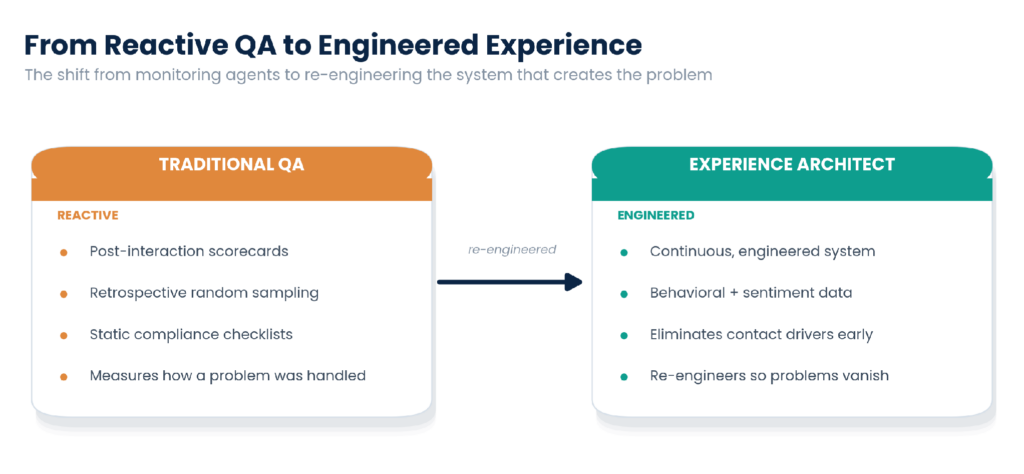
Because traditional QA is reactive. It relies on post-interaction scorecards, random sampling, and static checklists that catch isolated events but miss cross-channel friction. An Experience Architect treats CX as an engineered, continuous system — analyzing behavioral and sentiment data to eliminate contact drivers before they occur.
Legacy QA managers operate after the fact: they score completed interactions, sample at random, and check adherence to rigid scripts. That isolates symptoms but structurally fails to diagnose friction patterns that span channels. The Architect inverts the model — instead of measuring how an agent handled a problem, they reconstruct the operational framework so the problem is programmatically resolved, or never surfaces at all. For a global brand, the practical difference is where value is created: QA polices the symptom at the edge of the operation, while the Architect redesigns the core so fewer symptoms ever appear. That is a structurally cheaper place to solve problems, because a prevented contact costs nothing to handle.
What Operational Benchmarks Does Journey Architecture Drive?
Substantial, measurable gains. Against a traditional QA framework, the Experience Architect model lifts First Contact Resolution from roughly 62–68% to 84–91%, compresses Average Handle Time from 420 to 290 seconds, minimizes Customer Effort, and raises annual agent retention from 55–65% to 82–88%.
Experience Architects treat every journey map as a rigorous deployment plan, breaking down silos between engineering, analytics, and floor operations. The result is not localized efficiency tweaks but macro-level relationship improvements that translate directly into fiscal returns — lower telecom overhead, higher agent capacity, expanded lifetime value, and dramatically reduced recruitment outlays. Read down the table, the pattern is consistent: unified context, not harder script compliance, is what moves every metric in the right direction at once.
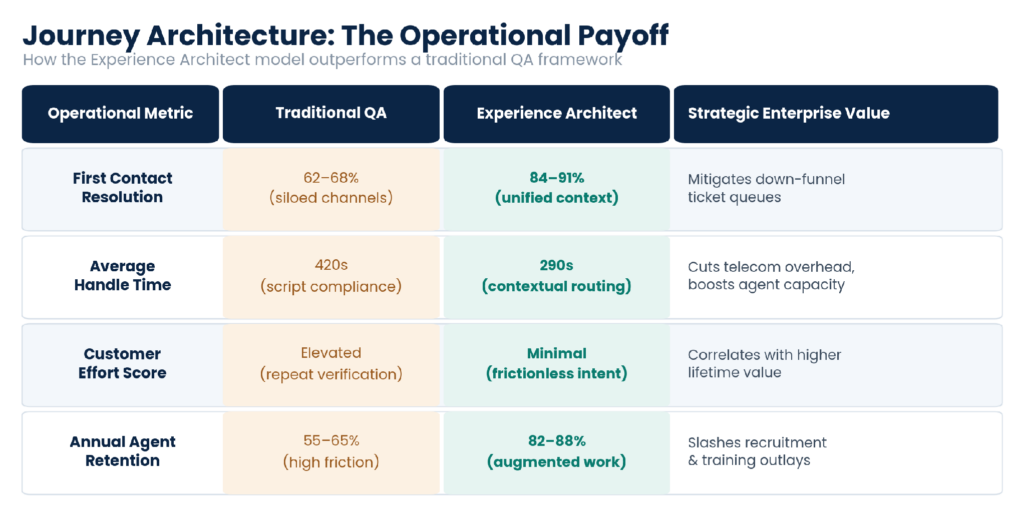
How the Experience Architect model outperforms a traditional QA framework across core metrics.
How Does an Experience Architect Balance AI and Human Capital?
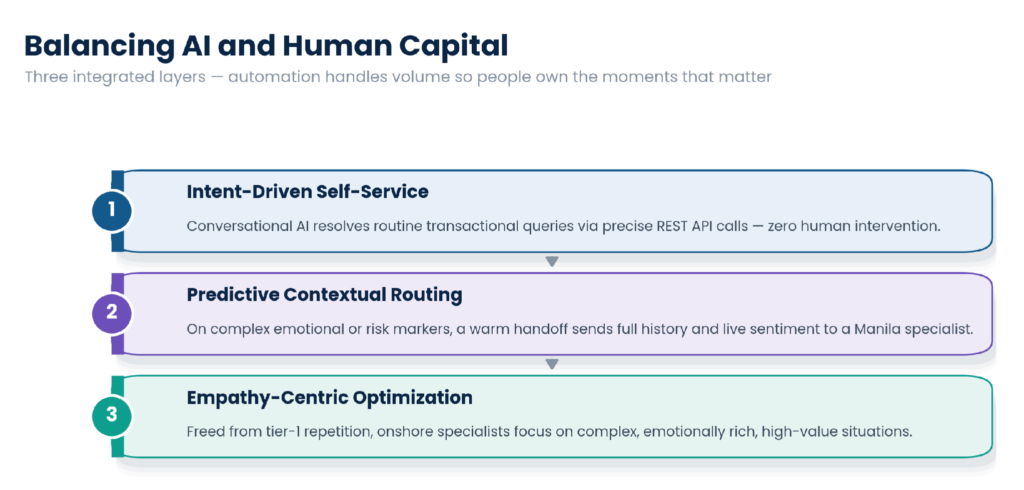
By layering them. Conversational AI resolves routine queries through direct API calls with no human touch; predictive routing triggers a warm, context-rich handoff when an interaction shows emotional or risk markers; and automating tier-1 work frees onshore specialists to focus entirely on complex, emotionally demanding situations.
The Architect is the operational link between automated self-service and complex human interaction, building an ecosystem where each layer supports the other. Routine transactions resolve autonomously; emotionally complex or high-risk cases route seamlessly to a Manila specialist with the full conversation history and live sentiment already on screen; and the onshore workforce is reserved for the high-value judgment that only people provide. The layering is deliberate: each tier absorbs only what it is best suited to handle, so neither the model nor the human is ever asked to do the other’s job. For the customer, the seams between automated and human service simply disappear.
“The emergence of the Experience Architect signifies a permanent structural shift in offshore delivery. Global outsourcing is no longer merely an exercise in geographic labor-cost arbitrage; it is an exercise in engineering precision. The providers in the Philippines who dominate are those who deploy deep architectural systems while safeguarding the natural cultural empathy that makes Filipino professionals uniquely valuable.”
— John Maczynski, CEO of PITON-Global
How Did PITON-Global Engineer a 42% Retention Surge?
A North American consumer fintech was bleeding customers through fractured app-chat, email, and voice channels. PITON-Global paired it with a boutique digital-transformation provider staffed with Experience Architects who unified the channels via real-time data pipelines. Within 120 days, First Contact Resolution rose from 64% to 88% and customer retention climbed 42%.
The client’s siloed support channels were alienating users and inflating customer-acquisition costs — acquisition spend was climbing precisely because the support experience was undoing the marketing that brought customers in. Rather than a traditional multi-seat call center, PITON-Global matched the company — from its vetted network of more than 100 specialized Philippine providers — with a premium boutique transformation partner. The architects audited the infrastructure and integrated an omni-channel system wired directly into the client’s central database via real-time pipelines.
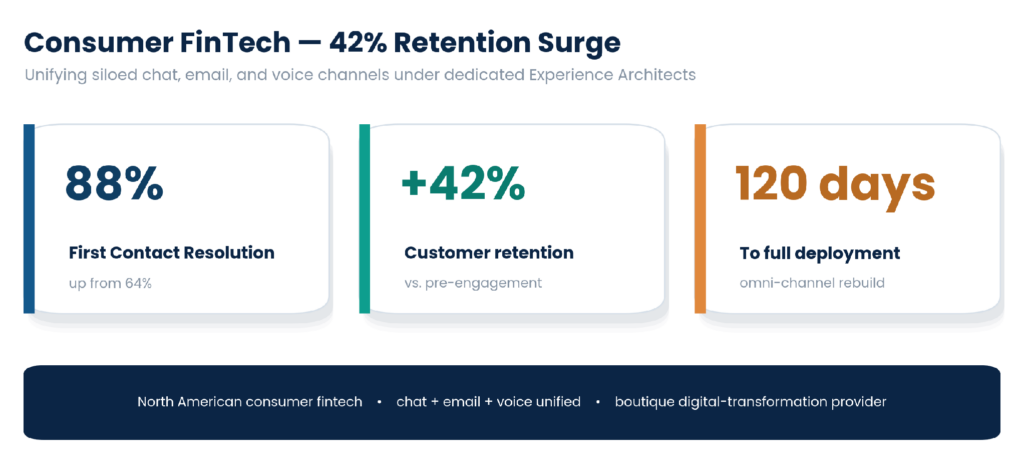
That single structural change eliminated repetitive identity verification, automated routine balance inquiries, and used predictive routing to send complex account issues to specialized teams. Within 120 days First Contact Resolution climbed from 64% to 88%, friction dropped sharply, and retention rose 42% — a powerful return that a reactive QA model could never have engineered. The lesson is that retention is an architecture problem before it is a service problem; fix the structure, and the satisfaction and loyalty numbers tend to follow on their own.
Achieve sustainable growth with world-class BPO solutions!
PITON-Global connects you with industry-leading outsourcing providers to enhance customer experience, lower costs, and drive business success.
Get Your Top 1% Vendor List
Author
Ralf Ellspermann is a multi-awarded outsourcing executive with 25+ years of call center and BPO leadership in the Philippines, helping 500+ high-growth and mid-market companies scale call center and customer experience operations across financial services, fintech, insurance, healthcare, technology, travel, utilities, and social media.
A globally recognized industry authority - and a contributor to The Times of India, CustomerThink, and The AI Journal - he advises organizations on building compliant, high-performance offshore contact center operations that deliver measurable cost savings and sustained competitive advantage.
Known for his execution-first approach, Ralf bridges strategy and operations to turn call center and business process outsourcing into a true growth engine. His work consistently drives faster market entry, lower risk, and long-term operational resilience for global brands.
EXECUTIVE GOVERNANCE & ACCURACY STANDARDS
Authored by:

Ralf Ellspermann
Founder & CSO of PITON-Global,
25-Year Philippine BPO Veteran,
Multi-awarded Executive
Specializing in strategic sourcing and excellence in Manila
View Full Bio
Verified by:

John Maczynski
CEO of PITON-Global, and former Global EVP of the World’s largest BPO provider | 40 Years Experience
Ensuring global compliance and enterprise-grade service standards
View Full Bio
Last Peer Review: June 10, 2026
This service framework is audited quarterly to meet shifting global outsourcing regulations and COPC standards.